-
Title
-
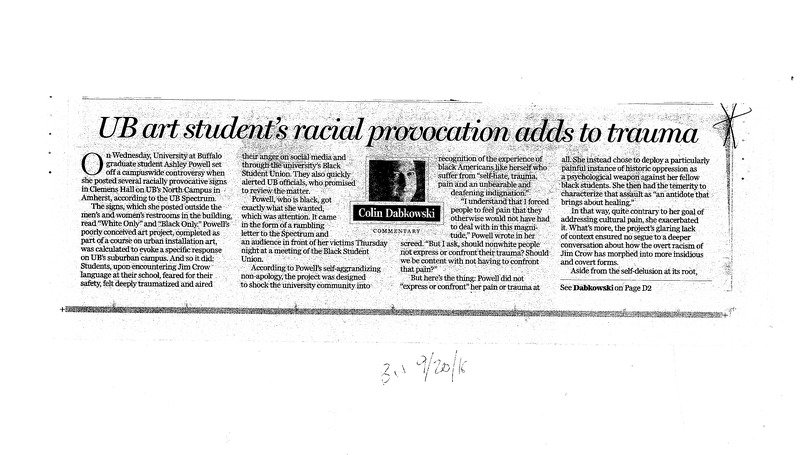
UB art student's racial provocation adds to trauma, September 20, 2016
-
Description
-
Photocopied newspaper pages of The Buffalo News article "UB art student's racial provocation adds to trauma" by Colin Dabkowski, September 20, 2016.
-
Subject
-
Black Student Union (State University of New York at Buffalo)
-
Date
-
2016-09-20
-
Date Created
-
2023-11-03
-
Type
-
Text
-
Format
-
application/pdf
-
Identifier
-
VF_I18G_015
-
Is Part Of
-
Black Student Union collection (LIB-UA005)
-
Publisher
-
State University of New York at Buffalo. University Libraries
-
Language
-
en-US
-
Source
-
Black Student Union Vertical File (I18)
-
Extent
-
22x28cm
-
Creator
-
Buffalo news
-
Contributor
-
State University of New York at Buffalo. University Archives
-
Transcription
-
UB art student's racial provocation adds to traumaColin DabkowskiCommentaryOn Wednesday, University at Buffalograduate student Ashley Powell setoff a campuswide controversy whenshe posted several racially provocative signsin Clemens Hall on UB's North Campus inAmherst, according to the UB Spectrum.The signs, which she posted outside themen's and women's restrooms in the building,read "White Only" and "Black Only." Powell'spoorly conceived art project, completed aspart of a course on urban installation art,was calculated to evoke a specific responseon UB's suburban campus. And so it did.Students, upon encountering Jim Crowlanguage at their school, feared for theirsafety, felt deeply traumatized and airedtheir anger on social media andthrough the university'a BlackStudent Union. They also quicklyalerted UB officials, who promisedto review the matter.Powell, who is black, gotexactly what she wanted,which was attention. It camein the form of a ramblingletter to the Spectrum andan audience in front of her victimes Thursdaynight at a meeting of the Black StudentUnion.According to Powell's self-aggrandizingnon-apology, the project was designedto shock the university community intorecognition of the experience ofblack Americans like herself whosuffer from "self-hate, trauma,pain and an unbearable anddeafening indignation.""I understand that I forcedpeople to feel pain that theyotherwise would not have hadto deal with in this magnitude,"Powell wrote in herscreed. "But I ask, should nonwhite peoplenot express or confront their trauma? Shouldwe be content with not having to confrontthat pain?"But here's the thing: Powell did not"express or confront" her pain or trauma atall. She instead chose to deploy a particularlypaintful instance of historic oppression asa psychological weapon against her fellowblack students. She then had the temerity tocharacterize that assault as "an antidote thatbrings about healing."In that way, quite contrary to her goal ofaddressing cultural pain, she exacerbatedit. What's more, the project's glaring lackof context ensured no segue to a deeperconversation about how the overt racism ofJim Crow has morphed into more insidiousand covert forms.Aside from the self-delusion at its root,See Dabkowski on Page D2BN 9/20/16UB art student's racial provocation adds to traumaColin DabkowskiCommentaryOn Wednesday, University at Buffalograduate student Ashley Powell setoff a campuswide controversy whenshe posted several racially provocative signsin Clemens Hall on UB's North Campus inAmherst, according to the UB Spectrum.The signs, which she posted outside themen's and women's restrooms in the building,read "White Only" and "Black Only." Powell'spoorly conceived art project, completed aspart of a course on urban installation art,was calculated to evoke a specific responseon UB's suburban campus. And so it did.Students, upon encountering Jim Crowlanguage at their school, feared for theirsafety, felt deeply traumatized and airedtheir anger on social media andthrough the university'a BlackStudent Union. They also quicklyalerted UB officials, who promisedto review the matter.Powell, who is black, gotexactly what she wanted,which was attention. It camein the form of a ramblingletter to the Spectrum andan audience in front of her victimes Thursdaynight at a meeting of the Black StudentUnion.According to Powell's self-aggrandizingnon-apology, the project was designedto shock the university community intorecognition of the experience ofblack Americans like herself whosuffer from "self-hate, trauma,pain and an unbearable anddeafening indignation.""I understand that I forcedpeople to feel pain that theyotherwise would not have hadto deal with in this magnitude,"Powell wrote in herscreed. "But I ask, should nonwhite peoplenot express or confront their trauma? Shouldwe be content with not having to confrontthat pain?"But here's the thing: Powell did not"express or confront" her pain or trauma atall. She instead chose to deploy a particularlypainful instance of historic oppression asa psychological weapon against her fellowblack students. She then had the temerity tocharacterize that assault as "an antidote thatbrings about healing."In that way, quite contrary to her goal ofaddressing cultural pain, she exacerbatedit. What's more, the project's glaring lackof context ensured no segue to a deeperconversation about how the overt racism ofJim Crow has morphed into more insidiousand covert forms.Aside from the self-delusion at its root,See Dabkowski on Page D2BN 9/20/16There are useful waysto funnel one's rageDABKOWSKI - from D1Powell's astounding attempt to justifyher project contains a clear falsedichotomy: That somehow the onlyway to face up to the violent realities ofrace in America or to "vent" about thedaily terror of mere existence for blackAmericans is to physically bring pasttraumas back to life.Though it fits the broad definitionof art, Powell's project boils down toa cruel and counterproductive act ofpsychological violence against thevery group of people she purports torepresent.None of this is to say that therearen't useful ways to funnel one's rageabout the unfathomable injusticesperpetrated upon black America orthe numb horror of daily existencefor this historically marginalizedcommunity into something resem-bling thoughtful commentary. Therecertainly are, including plenty ofexamples right here in Buffalo, wherethere continues to be a disturbingpaucity of practicing minority artists.Take Dana McKnight's recentfilm, "Which Consumption Mac andCheese," a short piece about the whitecommodification of black musicalculture, in which a young white mansimply eats dish after dish of macaroniand cheese to the sounds of StevieWonder, Michael Jackson and otherartists. Or take Stacey Robinson'sperformance as part of his studies atUB, during which he stood in a cornerof the Albright-Knox Art Gallery in2014 and asked methodically andpassionately about the lack of blackartists included in the collection.(These two projects happen to bepolite, but politeness need not be afeature of such art.)If your practice involves intentionallyretraumatizing a populationthat is already deeply scarred fromcenturies of systematic abuse andviolent oppression hardly salved bythe accomplishments of the civilrights movement, you are not makingthoughtful art or launching a smartconversation; you are throwing anadolescent tantrum and, in this case,desperately scrambling to dressup your ugly, subsophomoric gutinstincts in the see-through clothing ofacademic art-speak."I understand my art project hasexhumed our shared pain," Powellwrote. "However, our society cannotheal or change until nonwhite peopleare able to confront and gain agencythrough our burdens, and whitepeople are able to confront andbecome accountable for their privilege.It is a delusion to believe that we canchange society without first changingourselves."Powell's jargon-filled display ofintellectual acrobatics may impresssome, but to me it smacks of a baseand uncritical desire to light a fire anddamn who it burns.What's more, the idea that thisproject has accomplished its functionas some kind of progressiveconversation starter is laughable. Theconversation that's been started inthe wake of the stunt is largely aboutthe narcissism of its progenitor andthe emotional well-being of the stunt'sblack victims. While those victimsrecover the deep rots of systemicoppression and institutional racismremain very much unshaken.You also could start a "conversation"by yelling "fire!" in a crowded building,or throwing a tantrum in Wegmans.The trouble is that the conversationwill rarely be about the topic youpurport to be "interrogating" with yourgenius avant-garde strategy, but aboutthe severe limits of your critique.As a white, male critic, I understandI am writing from a position ofprivilege. I am in no way pleading forblack artists to make their work morepalatable in order to satisfy mainstreamtastes. I'm arguing againstinflicting another round of psychologicaltrauma on a community that canhardly bear any more.email: cdabkowski@buffnews.com
-
Rights
-
COPYRIGHT NOT EVALUATED. The copyright and related rights status of this Item has not been evaluated. Please refer to the organization that has made the Item available for more information. You are free to use this Item in any way that is permitted by the copyright and related rights legislation that applies to your use. https://rightsstatements.org/page/CNE/1.0/
-
This digital collection is made available for research and educational purposes. Researchers are responsible for determining copyright status, and securing permissions for use and publication of any material. Copyright for items in this collection may be held by the creators, their heirs, or assigns. Researchers are required to obtain written permission from copyright holders and the University Archives prior to reproducing or publishing materials, including images and quotations. For inquiries about reproduction requests and permissions, please contact the University Archives at: http://library.buffalo.edu/archives/.

 VF_I18G_015.pdf