
http://digital.lib.buffalo.edu/upimage/LIB-HSL008_v06n01-1972-Spring.pdf
Media
Part of Buffalo physician, Spring 1972
- Text
-
fhc Buffalo Physician
SCHOOL OF MEDICINE
STATE UNIVERSITY OF NEW YORK AT BUFFALO
Dr. Carl 5. Benson, M'22
Dr. I. Frederick Painton, M'27
Nine Class
Reunions
April 7, 8
Pictures were not available lor Drs.
William C. Baker, William M. Bukowski, Richard /. Kenline, cochairman, class ol 7 947, and Dr.
R. Ronald Tofiolo, class of 7957.
Dr. Elmer Friedland, M'32
Dr. John Ambrusko, M'37
Nine Classes will have reunions during Spring Clinical Days April
7 and 8. Approximately 400 physicians and their wives are expected
to attend the reunion dinners. Mr. David Michael, director of med
ical alumni affairs, is organizing the reunion dinners with the help
of reunion chairmen pictured here.
Dr. Carl S. Benson of 109 Murray Avenue, Binghamton, New
York is chairman of the 50 year class reunion (1922). O t h e r living
members of this class:
Doctors Franklin T. Clark, 4825 Lewiston Road, Niagara Falls,
N e w Y o r k ; F t a r r y L. C l a r k , 9 3 0 O c e a n A v e n u e , B r o o k l y n , N e w Y o r k ;
Thomas P. Moylan, 53 Ardmore Road, West Hartford, Connecticut;
Lynn Rumbold, 33 Indian Spring Lane, Rochester, New York; Daniel
R. Tronolone, 139 North Ogden Street, Buffalo; and Perry G. Vayo,
1400 East Avenue, Rochester, New York.D
Spring 1972
Volume 6, Number 1
THE BUFFALO PHYSICIAN
Published by the School of Medicine, State University of New York at Buffalo
IN THIS ISSUE
Class Reunions
EDITORIAL BOARD
(inside front cover)
Editor
ROBERT S. McGRANAHAN
Managing Editor
MARION MARIONOWSKY
2
Dr. Eccles
7
Maternal, Child Medical Center
by Jean A. Cortner, M.D.
Photography
HUGO H. UNGER
EDWARD NOWAK
9
Continuing Education Courses
10
Fetal Care Unit
MELFORD J. DIEDRICK
12
Dr. Miller Retires
Graphic Artists
13
Cummings Foundation Grant/ Indonesian Researcli
Medical Illustrator
RICHARD MACAKANJA
DONALD E. WATKINS
14
VA Hospital
Secretary
16
Dr. Cudkowicz
FLORENCE MEYER
CONSULTANTS
President, Medical Alumni Association
DR. LOUIS C. CLOUTIER
President, Alumni Participating Fund for
Medical Education
DR. MARVIN BLOOM
Vice President, Faculty of Health Sciences
17
Immunodermatology Conference
18
Hypertension
20
Immunology Convocation
21
RMP Goals/Dr. Cammer
22
Screening Drugs
23
$1,073,849 Grant
26
Student Convocation
27
Ear Grant/Brains
DR. CLYDE L. RANDALL
28
Spring Clinical Days
Vice President, University Foundation
30
Ecology
JOHN C. CARTER
31
Immunology Center/ Dr. Edgar C. Beck
Director of Public Information
32
Mental Health Center
JAMES DeSANTIS
33
Dr. George W. Thorn
DAVID K. MICHAEL
34
Health Care Challenge
Director of University Publications
40
Family Practice Center
Director of Medical Alumni Affairs
THEODORE V. PALERMO
Vice President for University Relations
DR. A. WESTLEY ROWLAND
The Buffalo Physician
44
Scuba Class
46
Canadian Medicare
47
Dr. Samuel Feinstein
48
The Classes
53
People
56
Alumni Tour/In Memoriam
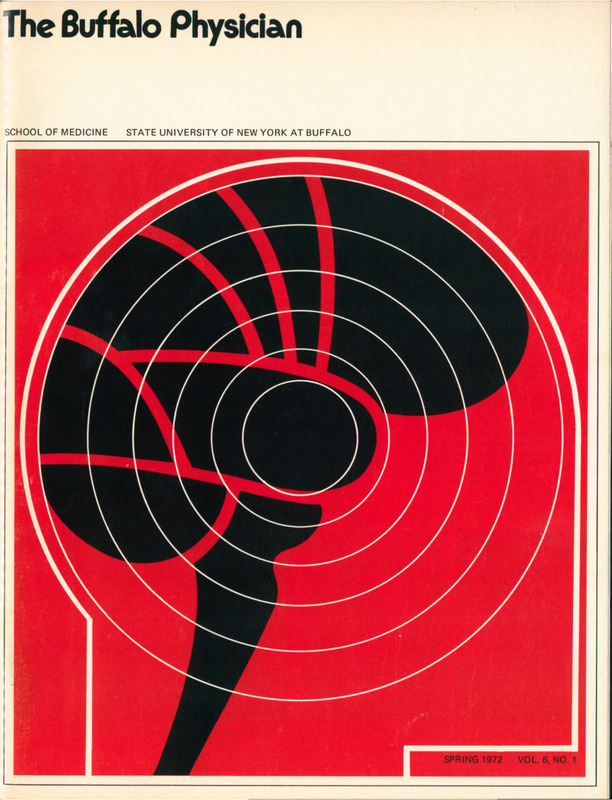
The cover design by Richard Macakanja focuses upon Dr. John Eccles'
study of the cerebrum (pages 2-6).
THE BUFFALO PHYSICIAN, Spring 1972 — Volume 6, Number 1, published quarterly
Spring, Summer, Fall, Winter — by the School of Medicine, State University of New
York at Buffalo, 3435 Main Street, Buffalo, New York 14214. Second class postage
paid at Buffalo, New York. Please notify us of change of address. Copyright 1972
by The Buffalo Physician.
Dr. Eccles
Dr. Eccles Takes
a Philosophic Look
at the Cerebrum
\ L n studies the brain because all that matters in his life is a
result of its functioning. Not only does it account for his immediate
perception — his vision, hearing, memory, emotion, thoughts, ideals,
imagination, technical skills —but his creative achievements — his
art, philosophy, science — as well.
I n v e s t i g a t i o n s , b e g u n a f t e r W o r l d W a r II b y a n A u s t r a l i a n n e u r o physiologist led to his knighthood in 1958 and to a Nobel prize in
1963. Sir John Eccles —"Dr. Eccles" as he prefers to be called in
this country — heads the Center for the Study of Neurobiology. He
came to Buffalo in July 1968 from the Australian National University
in Canberra where he had been professor of physiology for 17 years.
As a Rhodes Scholar from Australia he went to Oxford to work
under Sir Charles Sherrington, distinguished physiologist and Nobel
Laureate. There he was introduced to the scientific examination of
the nervous system and later derived a philosophical approach to the
problems of the nervous system from Dr. Sherrington. Sherrington's
philosophy, published in Man on his Nature, has guided Dr. Eccles
in his efforts to understand the way in which the brain is related to
mind.
From analytical studies of individual nerve cells, Dr. Eccles
has developed theories of how they function, the means by which
impulses are passed from one cell to another, and the manner of
their interconnection. New insights into both reflex actions and the
formation of thought within the brain by the eminent scientist —
he is a philosopher as well — provide a firm base for future progress.
Before man can experience even the simplest sensation, Dr.
Eccles explained, millions of cerebral nerve cells must be activated
in just a matter of milliseconds. They must then be woven into pat
terns by both space and time. And the limitless possibilities of con
nectivity between them provide an infinite variety of patterned
operations.
Ten billion cerebral nerve cells — each a living entity — endow
man with potentialities adequate for any achievement. He explained
that what exemplifies man's essential uniqueness is his attempt to
understand his work through accumulated experiences over a life
time. In his self consciousness, Dr. Eccles pointed to man's transcendance over animals. "Man has imagination, a sense of values,
and systemization of knowledge stored and transmitted in the
coded form of written language, thus permitting progressive de
velopment. Man has the power to understand nature and to con
trol it."
But, for this amazingly young 68-year old scientist, there
remains a fundamental mystery of man's existence that transcends
any biological account of the development of his body including
his brain with its genetic inheritance and its evolutionary origin.
While he accepts the explanation of his own origin — animal an
cestry — as well as a well-established biological mechanism of
evolution through mutation and natural selection, they provide
but a partial explanation.
2
THE BUFFALO PHYSICIAN
For the slim, relaxed man with gray eyes and thinning gray hair,
"in some way completely beyond my understanding, my thinking
changes the operative patterns of neuronal activities in my brain.
Thinking thus comes eventually to control discharges of impulses
from pyramidal cells of my motor cortex, eventually contracts my
muscles, and so gives the behavioral patterns that stem therefrom."
There is general agreement, said the holder of the Royal
Society's 1962 Royal Medal, that for every conscious experience
there is a counterpart in man's neuronal mechanisms. "We may be
on the threshold of understanding the basic principles responsible
for memory traces, patterned engrams as they are termed." These
engrams, he continued, are available for recall in memory when
there is an appropriate input into its circuitry.
The Nobel Laureate — Dr. Eccles won the prize at age 60 —
further explained that a neuronal pathway, activated by a particular
sensory input will, on repeated activation, achieve a kind of stabi
lization through enhanced synaptic functions of its neuronal link
ages. While neuronal mechanisms involved in perception are
known, there is much less understanding of the neuronal mech
anisms underlying conscious experience.
Science, said the distinguished professor of physiology and
biophysics, is loaded with "values." It represents the sum total of
each scientist's personal performance to explain some aspect of
nature. This explanation is then offered for critical judgment and
experimental testing by others to eliminate error. Scientists therefore
can only develop hypotheses approaching progressively nearer to
the truth.
"If only mankind understood that science is a very human en
deavor to understand nature, to present in all humility the best of
our feeble efforts to do so," the former president of the Australian
Academy of Science said, "perhaps it could then be appreciated as
a great and noble human achievement rather than as a destructive
force, as some great monster to be either feared or worshipped."
Drs. Peter Scheid, Ingmar Rosen, lohn
and Helena Eccles record impulses
from nucleus of brain stem in cerebel
lum (has control of movement) in a
decerebrated cat.
SPRING, 1972
This material has been ex
trapolated from
Dr. Eccles
book, "FACING REALITY: Philo
sophical Adventures by a Brain
Scientist" published by SpringerVerlag, New York in 1970. In
this book Dr. Eccles expresses
his efforts to understand a hu
man individual, namely himself,
as an experiencing being with
an
evolutionary
origin.
The
book was published in the hope
that it may help man to dis
cover a way out of his aliena
tion and face up to the ter
rifying and wonderful reality of
his existence with
faith, and hope.n
courage,
For Dr. Eccles, chances that life exists elsewhere in the cosmos
are infinitely small. But he points to the immense projects that are
planned for Mars to search for forms of life. Says the Melbourne
medical graduate (1925) who received his doctorate from Oxford
four years later, "we must realize the full negative impact of new
knowledge derived from the study of the Moon, Venus, Mars, and
the problems of space travel. As physiologists, he explained,
"we can predict with complete assurance that man is forever earthbound. We share this earth as brothers and there will never be
anywhere else to live."
Although its mode of operation cannot yet be explained sci
entifically, Dr. Eccles feels certain that there is freedom of will. For,
he said, "we experience, do things, have conscious control of move
ment." While he feels that scientific activity is an affair of man's
rational, conceptual thought with exercise of will, movement, and
sensory perception, he cautioned that creative illumination can only
come to minds prepared by assimilation and critical evaluation of
knowledge in a particular field.
In the subconscious mind, he pointed to evidence for creativeness — enormous development of complex, highly specialized engrams in the neuronal network with its stored memories and critical
evaluations, its permanency resulting from increased function in
synaptic use. These "plastic" patterns, he said, point to the "knowhow" of the brain.
Drs. Cary I. Allen, Cian B. Azzena,
Tadao Ono record impulse from motor
cortex, relay nuclei to the cerebellum.
For creative imagination to exist, Dr. Eccles pointed to the need
for an adequate number of neurones, and a wealth of synaptic con
nection between them to build up limitless engrams of highly
specific character. If there is potency for unresting activity in engrams so that spatio/temporal patterns continually weave into
complex/interacting forms, then the stage is set for creative imag
ination.
Continuing, he explained that continuous intensive interplay
of these patterns of neuronal activation are necessary for the sub
conscious operation of the mind. New emergent patterns can then
be expected and if these patterns have organization to combine and
transcend existent ones, "some new idea born of creative imagina
tion will emerge."
But he cautioned that if creative imagination is to be fruitful
"there must be a process of conscious criticism, evaluation to dis
cover flaws in a new idea, a consistency with existing knowledge,
the design and carrying out of experimentation to test predictions
from this new idea. And," he added, "finally there must be new
hypotheses."
Science, says Dr. Eccles, is an art and must therefore be learned
in a strange way. What he feels is needed is creative imagination,
experimentation, and a good idea of what to expect from past ex
perience. He cautioned that while expectations may be fulfilled it is
the "something else coming in that you take no notice of . . . the
something that keeps reappearing, that is nature's way of trying
to tell me something" that is essentially the way he has made dis
coveries.
4
THE BUFFALO PHYSICIAN
CAT CEREBELLUM
The structure of the neuronal network? More complex than a
vast telephone exchange says Dr. Eccles.
Its 1 0 billion densely
packed nerve cells — within the folded surface sheet of the cerebral
cortex — communicate with each other by specified regions of close
contact called
synapses. While each
nerve cell
receives
many
thousands of these synaptic contacts via branches or axons that
stem from other nerve cells, each in turn influences hundreds or
thousands of others when triggered to discharge an impulse along
its own efferent pathway (axon) with its numerous branches.
Each nerve cell receives information from hundreds of others
by convergence and in turn gives to hundreds by divergence. While
excitatory synapses stimulate, inhibitory ones counteract or silence
what otherwise might turn into a convulsion of millions of activated
nerve cells.
SPRING, 1972
5
Dr. Eccles recognizes the existence of three worlds. The first
is that of matter and energy (World I), the second is conscious ex
perience (World II), and the third is civilization and culture (World
III), that is dependent for its continuity on coded information in
books and other artefacts. While the subjective world (World II)
is dependent on the neuronal mechanisms of the brain — ready for
recall — the world of objective knowledge (World III) is where prob
lems, theories, and arguments are coded in some appropriate form
to ensure their objectivity and continuing independence.
But knowledge of all three worlds he believes to be a result of
human intellectual activity. Science, for example, gives us our
knowledge and understanding of World I and also is concerned
with World II.
He asks! Does not the mystery and wonder of our origin and
nature surpass myths whereby man in the past attempted to explain
his origin and destiny? And cannot life be lived as a challenging and
wonderful adventure that has meaning to be discovered?
And he responds! "We must appreciate man's greatness, we
must regain faith and hope in man and his destiny. Else all is lost."D
Drs. Takeloshi Ono, Saburo Kawaguchi, Tadao Ono prepare some electrodes for stimulation of
various structures in the brain.
THE BUFFALO PHYSICIAN
During the first half of this century, many children's hospitals were
built in the United States, most of which were "free-standing," that
is, separate from other major medical facilities in the community.
This was understandable and even desirable at the time because
oediatricians were fighting an uphill battle for independence from
he domination of internal medicine. The results were excellent in
that pediatricians, surgeons, nurses and other professional and paraprofessional personnel congregated into specifically and efficiently
designed units for the care of children. Laboratory and X-ray pro
cedures more appropriate to the child were developed, and a social
a n d p s y c h o l o g i c a l s e t a i m e d a t u n d e r s t a n d i n g a n d h e l p i n g t h e ill
child occurred.
Dr. Cortner
Some of the children's hospitals were built in university com
plexes and many others moved into university or medical com
plexes in the course of time, but in most cases merely constructing
buildings next to each other failed to supply the magic necessary
to produce continuous excellent care for the child from conception
through adolescence.
The majority of newborns arrive into this world unannounced
to the pediatrician and with little or no pertinent past or family
history immediately available to him. Perhaps the very fact that
we use birth date instead of conception date to mark the beginning
of life testifies that w e d o not recognize that a live child is under
going his most important period of growth and development in
utero.
Within the last decade, we have learned how to communicate
better with the child in utero and, although still severely limited,
w e c a n d e t e r m i n e i n t h e f i r s t t r i m e s t e r o f p r e g n a n c y if h e h a s c e r t a i n
genetic disorders, such as mongolism or other chromosomal
anomalies, or certain biochemical defects, such as Tay Sachs and
Lesch-Nyhan disease, thereby giving the parents the option of pre
vention by abortion.
Maternal and
Child Medical
Center Concept
by Dr. Jean A. Cortner
In the third trimester of pregnancy, we have been able to in
stitute diagnosis and therapy of the child severely affected with
erythroblastosis. Also, we can determine fetal age much more
accurately and therefore prevent some hyaline membrane disease,
about which w e have been able to d o so little o n c e it occurs. All
of this, plus the many neonatal complications that relate directly
to maternal health and disease, argues forcefully for better integra
tion of obstetrical and pediatric services.
Dr. William Silverman and other neonatologists have long argued
that the mother is the best neonatal transport unit despite man's
r e c e n t e f f o r t s a t r e d e s i g n i n g t r u c k s . If w e a r e g o i n g t o m a k e u s e o f
this fact and attempt to bridge the abrupt transition of care at birth,
high-risk pregnancies must be delivered where both the mother and
infant can receive optimal care.
At the other end of the pediatric spectrum, we have the same
problem with adolescents. The healthy teenager goes through
another of the most important periods of growth and development
without an orderly transition of his care from the pediatrician to
the internist. The adolescent with a chronic condition has an even
worse time, as demonstrated by the diabetic who gets caught beSPRING, 1972
7
Dr. Cortner is professor and chair
man of
the department of
pedi
atrics and physician-in-chief at
Children's Hospital. He presented
this paper at the Pediatric Section
of the AMA convention in Atlantic
City, lune 27, 7977.
tween two disagreeing physicians, undermining his confidence in
both.
A few model adolescent units have already demonstrated that
internists and pediatricians can work together and present a united
front to the patient, even though they may disagree privately. Under
these conditions, the adolescent is properly introduced to the in
ternist who will ultimately take over his complete care, and he
receives continuous care in the process.
Dr. Schoenfeld
A physician, columnist, author will
give the annual Harrington Lecture
March 17 at 8:30 p.m. in G-22,
Capen.
He is Dr. Eugene Schoen
feld, who
is
on
the
Student
Health Service Staff at the Univer
sity of California at Berkeley.
He
received his M.D. degree from the
University of
Miami in
7967.
In
1964 he received an M.P.H. degree
from Yale University's School of
Public Health.
Dr. Schoenfeld is
famous for his book, "Dear Doctor
HIPpocrates — Advice Your Family
Doctor Never Gave You."
He is
also noted for his medical column
related to sex, drugs and dieting.
In the 1960's Dr. Schoenfeld work
ed
with
Dr.
Schweitzer
at
Schweitzer Hospital in Africa.•
the
Of course, all of this can theoretically be provided in a large
general hospital, assuming that a critical mass of obstetrical and
pediatric patients is attained, and that the various disciplines work
together rather than independently within the same walls. Perhaps,
however, it can be done even better in a "maternal and child medi
cal center," which attempts to provide a continuum of care from
conception into young adulthood.
What then are the major ingredients necessary to convert a
free-standing children's hospital into a maternal and child medical
center? First of all, a large obstetrical service is required. Ideally,
this service should deliver 4000 or 5000 newborns per year in order
to attain the critical mass necessary for all of the supporting services,
such as obstetrical anesthesia. This obstetrical service should cater
to the high-risk mother and infant and, in addition to having its own
obstetrical clinic at the medical center, should have outreach
clinics in high-risk areas. It has already been shown that these
clinics can be run in major part by well trained paraprofessionals
with the backup of a single attending obstetrician per clinic. The
pediatrician should work with the obstetrician in these clinics, also
using paraprofessionals if necessary or desirable, to give well and
sick child care.
Gynecologists/obstetricians have already recognized that there
are at least three major subdivisions of their specialty: perinatology,
endocrinology and fertility, and gynecologic oncology. The maternal
and child medical center should be the ideal place for the perina
tologist to care for the mother and child. Endocrine and fertility
specialists and internists should be available to care for the medical
problems associated with the high-risk mother, such as diabetes,
hypertension, renal disease, etc. Laboratory services must be ex
panded to provide the tests pertinent to the care of the mother
and the developing fetus, including the techniques for prenatal
detection of genetic disorders and fetal monitoring during labor and
delivery. A division of perinatal medicine should be administered
jointly by the departments of obstetrics and pediatrics and should
contain obstetricians, pediatricians, basic scientists and even in
ternists concerned with the intrauterine and immediate postpartum
health of the child. At the other end of the spectrum, a division of
adolescent medicine should be jointly run by the departments of
internal medicine and pediatrics, and at least one full or part-time
internist should be a member of each pediatric specialty team, such
as hematology, endocrinology, renology, etc., in order to assure
continuous care for children with chronic diseases as they emerge
into the adult world. The center must also supply rehabilitation for
all of those afflicted with a chronic disease, a portion of which
8
THE BUFFALO PHYSICIAN
should be supplied by a department of family psychiatry concerned
with the individual in his family and social setting.
Pediatricians have long known that " a n o u n c e of prevention is
worth a pound of cure." Such a medical center dramatically illus
trates this axiom and provides the ideal substrate for medical re
search aimed at prevention as well as cure or improved quality of
life.
American College of Physicians
Cocktail Party
Hosted By:
SUNV at Buffalo
Medical Alumni Association
Open to:
could legitimately be called "old wine in new bottles" unless, in
All Alumni and Friends
Wednesday, April 19, 1972
Atlantic City
addition to the changes noted above, the traditional intradisciplinary
attitudes of obstetricians, pediatricians and internists yield to patient-
Check Convention newspaper
for hotel and room.
The problems in health care recognized here are not new and
oriented concern for interdisciplinary continuous care.
O n e children's hospital in this country is attempting t o estab
lish the type of maternal and child medical center described, and
in so doing accepts the responsibility for evaluating the care given
in order ultimately to present hard data rather than opinion and
anecdote. The Children's Hospital of Buffalo has the good fortune
of already having an obstetrical service which currently delivers
approximately 2,600 children per year. This is being expanded and
oriented toward the delivery of the high-risk mother and infant.
Outreach clinics are being established in several so-called high-risk
areas in the community. Departments of Internal Medicine and
Family Psychiatry and Divisions of Perinatology and Adolescent
Medicine are in the planning stages.
Perhaps most importantly,
frequent discussions of the problems that we conceptualize solving
are being held in order to develop the appropriate attitudes among
the various professional disciplines. The responsibility for evalua
tion will be assigned to competent epidemiologists who have no
personal ax to grind.
This is the third trimester of the 20th century.
We must re
e v a l u a t e o u r p o t e n t i a l s a n d p r i o r i t i e s if w e a r e t o p r e v e n t a r e
tarded 21st century.•
Eight continuing education courses will be offered by the Medical
School during the next four months. All are open to practicing
physicians and medical students.
March 9 — Kidney Disease, Diagnosis and Treatment: The Role
of Kidney Biopsy, Hotel Statler Hilton (with the Kidney Foundation
of Western New York).
March 24 — Child Development: On the Importance of In
fancy, Statler Hilton Hotel.
April 7 and 8 — Thirty-fifth Annual U/B Alumni Spring Clinical
Days, Goodyear Hall, University campus.
April 13 and 14 — Highlights of Current Problems of Clinical
Anesthesia a n d Intensive Care, Treadway Inn, Niagara Falls, N. Y.
May 4 and 5 — Surgical Aspects of Gastroenterology, Parkway
Inn, Niagara Falls, N. Y.
May 17 —Pediatric Cardiology, Children's Hospital.
M a y 1 9 — C o m m u n i t y Psychiatry in t h e G e n e r a l H o s p i t a l , E. J.
Meyer Memorial Hospital.
June 5-9 — Refresher Seminar in Pediatrics, site to be an
n o u n c e d .•
SPRING, 1972
9
Continuing
Medical Education
Courses
Dr. Ray discusses fetal monitoring ol patient with Dr. Dan McMahon as
Nurse Syers and husband ol patient look on.
Delivering a better baby who is at high risk is the major goal of
]^0YV p 0 t c l l
p „ „ p IT n i f
a nGW ^6la' Care Un't
^ a S ' 3 e e n °P e n e d by the department of
obstetrics and gynecology at the Children's Hospital.
Explained its director, Dr. Michael Ray, "it is done through a
two-phase approach in evaluating fetal well being. By continuous
monitoring of the fetal heart rate from the capillaries of the scalp
and automatic recording onto strip charts of the stress of uterine
contractions (the physiological phase) the physician can tell at any
time during delivery how well the baby is doing.
"But if an abnormality is indicated," said the 32-year old
Buffalo born (Children's Hospital) and educated (Canisius High
School 1957, SUNYAB medical graduate 1965, internship in mixed
medicine 1966, and residency in gyn/ob 1970) "we are equipped to
go to the next step to determine the biochemical half or the acid
base balance of the unborn child through a sample of its blood
from capillaries of the scalp."
While well over 95 percent of pregnancies are normal ones,
pointed out the assistant professor of obstetrics and gynecology
who divides his time equally between the Children's and E. j. Meyer
Memorial Hospitals where a monitoring program is also underway,
"we are primarily interested in that small percentage of patients
with special problems. They may range from severe toxemia
(metabolic disturbances) to diabetes, heart or kidney disease, an rh
incompatibility or a postmature baby in need of special care."
There are at least 250,000 babies or about three percent of
births a year in this country displaying neurological damage which
may be due to a genetic condition such as Mongolism or from a
virus infection such as Rubella. But when it is due to either birth
asphyxia or perinatal hypoxia — a lack of oxygen at some stage of
birth — then Dr. Ray believes that something can be done.
10
THE BUFFALO PHYSICIAN
More than 120 babies at high risk, or a little over ten percent
of all hospital deliveries at the Children's were monitored during
the unit's first half year of operation. Eliminated has been the guess
work on how well a baby is doing during its journey through the
birth canal, the most hazardous that any of us will ever undertake.
For it is during these 24 hours surrounding delivery w h e n t h e d e a t h
rate is higher than a t any other period during a lifetime.
Finding a better way to evaluate how well a baby is doing dur
ing labor and delivery became a quest for Dr. Ray. For the two
parameters used during delivery while he was a
resident were
listening to a baby's heart beat — valuable only in the most ominous
conditions — and looking for meconium staining of the amniotic
fluid — a signal of potential problems. Together they lacked reliable
predictive value and could not point to the degree of danger that
the baby was undergoing.
With encouragement and support through a Buswell Fellowship
by the department of obstetrics and gynecology, and funds from the
United
Health
Foundation
of
Western
New
York,
the
young
physician over the next year (1970-71) studied continuous fetal heart
rate monitoring — stressed in the literature at that time — at the
University of Southern California.
As a postresident fellow at Los Angeles County Hospital under
Dr. Edward H. Hon, the pioneer in electronic fetal monitoring, Dr.
Ray cared for patients in the perinatal intensive care delivery room
or more simply the research center where various maternal and
fetal parameters were studied with respect to certain methods of
anesthesia (such as paracervical blood and its effect on the baby
in utero and after birth).
He also worked on a uterine relaxant, for there are times when
a physician would prefer to stop labor until the baby recovers in
utero and then proceed with the delivery. Explained Dr. Ray, there
is nothing better than a uterus as incubator or a normal placenta
as an organ of biochemical and blood gas exchange.
Drs. Jim Brennan and John Antkowiak chock remote monitor while Mesdame^
Fuhrmann and Rellinger chart the findings.
SPRING, 1972
Returning to Buffalo in 1971, Dr. Ray developed and set up the
new fetal care unit at the Children's Hospital where training is also
an important feature. Resident physicians and medical students
rotate through the unit, and a summer elective is offered to under
graduates.
"We are doing normal things with normal patients in a new
way," said Dr. Ray who is happy to be back in Buffalo. "We are
utilizing electronics in fetal monitoring. Monitoring has been used
in adults," he continued, "but never before in the intrauterine
patient."
As an undergraduate, he completed two summers as a Fellow
with Dr. David Dean in a cardiopulmonary laboratory working on
cardiac problems in adults. A subsequent elective was spent in
pediatric cardiology with Drs. Edward Lambert and Arno Hone.
But he has taken one step in time backward, to the intrauterine
patient.
With funding, Dr. Ray hopes at some future date to start a
research delivery room where he again can study multiple maternal/
fetal cardioparameters. For it is only through the triad of research,
service, and teaching that optimal care for the intra or exo-uterine
patient can be assured.•
Dr. Miller
Retires
Dr. Miller
Dr. David K. Miller, who has served both the School of Medicine
and the E. J. Meyer Memorial Hospital for more than 34 years, re
tired last fall. The outstanding teacher, scholar and clinician was
professor of medicine and associate director of medicine at the
county hospital at the time of his retirement.
Dr. Miller received a bachelor's degree from Illinois Wesleyan
College in Bloomington in 1925 followed by a medical degree from
Harvard University in 1929. After completing an internship at Boston
City Hospital he studied in both Germany and Austria. From 1931
to 1937 he was assistant in medicine and assistant resident physician
at the Rockefeller Institute for Medical Research before coming to
Buffalo as instructor in medicine.
Two years later he became director of medicine and head of
the department of medicine at E. J. Meyer Memorial Hospital (19391967) as well as professor of medicine at the University. From 1937
to 1948 he directed the laboratories at Meyer Hospital. In July,
1967 Dr. Miller asked that he be relieved of his hospital duties.
A Fellow in the American College of Physicians, a member of
county, state, and national medical societies as well as the Buffalo
Academy of Medicine, American Society of Clinical Investigation,
Society of Experimental Biology and Medicine, and the Harvey
Society, he has also written numerous articles on anemia, blood and
bone marrow. The 67-year-old physician was the recipient of a spe
cial plaque at the annual 1969 Stockton Kimball Luncheon for "his
contributions as outstanding teacher, scholar and clinician."•
12
THE BUFFALO PHYSICIAN
$39,000 Cummings Foundation
Grant to Dr. Barnard
A $39,000 grant from the Cummings Foundation of
Buffalo has
been awarded to Dr. Eric A. Barnard, professor and chairman of the
biochemistry department to set up a protein-sequencing laboratory.
The equipment purchased under the grant will be used in research
of muscular dystrophy and other genetic diseases, as well as on the
evolution of protein molecules.
According to Dr. Barnard, the new equipment will
reduce
from years to weeks the time needed to determine the sequential
arrangement of amino acids, the building blocks of protein mole
cules. Changes in these sequences have been linked to genetic
diseases.
Dr. Barnard said, "This equipment exists so far in only a few
laboratories in the world. Its acquisition puts the University ahead
in this field." He added, "It will lead in time to an acceleration of
our studies of the differences between protein molecules found in
the muscles of animals and children with muscular dystrophy and
those found in normal muscles." This research is largely supported
by the Muscular Dystrophy Associations of America. Currently four
faculty members of the U/B Biochemistry Department are involved
in bio-medical research projects on proteins, in which this equip
ment will be a great aid.D
Indonesian Research
A young couple will be working on
Indonesia during the next six months.
two different projects
in
Dr. Zebulon C. Taintor, an
assistant professor of psychiatry, will be working with psychiatric
hospitals in the computerization of patients' histories. They will be
based in Djakarta. His wife, Mavis, will d o research for her doctoral
thesis in political science.
Her topic: "The Communist Party in
Indonesia from 1951 to 1965." This is her second visit to Indonesia.
She was there in 1968 to begin her research while her husband was
a volunteer physician in Vietnam.
Dr. Taintor said, "there is an effort to get a world-wide report
ing system among psychiatric hospitals by having patients' histories
computerized. This will enable us to determine the influence of
local conditions, culture and other factors on mental illness."
His Indonesian studies are sponsored by the International Com
mittee Against Mental Illness and by the World Health Organization.
Dr. Taintor has been head of the Medical School's graduate and
resident psychiatry p r o g r a m s c e n t e r e d a t t h e E. J. M e y e r M e m o r i a l
Hospital. He has also helped in establishing the drug emergency
program at Meyer Hospital.•
SPRING, 1972
13
Dr. Barnard with the new time saving equip
ment.
Medical School Research at Veterans Hospital
1.
A team that is investigating transport processes
across biological membranes under Dr. john W.
Boylan, professor of medicine and physiology,
move into new quarters at Veteran's Hospital.
2.
Dr. Stephen Wittenberg, assistant professor of
medicine, joined three team members for coffee.
Left to right: Dr. Wittenberg; Dr. Judith Van
Liew, research assistant professor of medicine;
Dr. Daphne Hare, assistant professor of medicine
and biophysical sciences; Dr. Theodore Herman,
research assistant professor of medicine.
3.
Pretty much "at home" in their new laboratories
are several of the 15-member immunology unit
team.
Under Dr. Morris Reichlin, professor of
medicine, studies on immunity in health as well
as in disease are underway with particular em
phasis on the antigenic structure. They are also
studying abnormal antibodies in certain connec
tive tissue disease and muscle proteins in certain
muscle diseases. Left to right: Mrs. Patricia Dix,
graduate student; Miss Bonnie Reid, secretary;
Dr. Morris Reichlin; Dr. Martha Mattioli, research
assistant instructor in medicine; Miss Nancy Ball
ing, technician.
4.
In the hematology unit, under Dr. Robert W.
Noble, Jr., assistant professor of medicine and
biochemistry, studies on immunology, specifical
ly the chemistry of reaction of hemoglobin with
oxygen, are underway. Graduate student Miss
Sandy
5.
McDonald
performing
fast
kinetics
of
hemoglobin reactions.
In the endocrine unit, studies on the control of
carbohydrate incubate tissue and lipid metabol
ism are underway, particularly the effects of ex
perimental obesity in rats.
Under Dr. Jack K.
Goldman, assistant professor of medicine, resi
dents rotate through the service while medical
students perform their research under his super
vision.
Discussing some aspects of her project
with Dr. Goldman is o n e of two laboratory tech
nicians, Mrs. Elizabeth Gabel, while Mrs. Marjorie
Kodis works at centrifuge.
6.
In the rheumatology unit, Dr. Floyd A. Greene,
associate professor of medicine, works with red
cell membranes, rh factor, and lipid protein in
teractions. Also performed by the unit is s o m e
clinical work in immunoglobulins.
the lab is technician Mrs. Doreen
7.
At work in
Milbrandt.
A bit of research on tests related to Hodgkins
Disease is
under
underway
hematology
in
the hematology
consultant
Dr.
Ben
unit
Fisher
along with some work on cell culture to measure
phosphatase.
Bordenave.
At work is technician Mrs. Anna
DR. G U S T A V O C U D K O W I C Z , a n internationally r e n o w n e d p r o
fessor of pathology and microbiology at the Medical School and a
member of the advisory board of its Center for Immunology, has
been invited to participate in a joint United States/Australian re
search thrust on cancer as well as American/French cooperation on
human transplantation.
At an international cancer conference to be held in Sydney,
Australia March 13-17, world experts in leukemia, melanoma and
skin cancer will report on new information in the hope of improving
the understanding of its causes and mechanisms. Dr. Cudkowicz will
participate in the sessions on leukemia and report results from his
own investigations relevant to immunologic rejection of leukemic
cells.
From there he will join an American/Australian symposium
on current cancer research to be held in Melbourne the following
week as one of 12 U. S. representatives on cancer research efforts.
He has also been invited to present seminars on immunology and
transplantation a t Melbourne's famed Walter and Eliza Hall Institute
of Medical Research.
In response to an invitation from the French Public Health
Service (INSERM), Dr. Cudkowicz will also journey to Paris for two
weeks as a visiting scholar. He will visit several medical institutions
and lecture on the above subjects at the Pasteur Institute, the Col
Dr. G u s t a v o Cudkowicz
lege de France, and the Institute de Cancerlogie et d' Immunogenetique.
To better predict the outcome of a bone marrow graft by
"typing," Dr. Cudkowicz will also formulate plans for future re
search with Dr. Jean Dausset, one of the pioneers in identifying
human transplantation antigens at the Institut de Recherches sur
Conferences in
les Maladies du Sang in Paris. These experiments will be carried
out under a Franco/American Agreement for Transplantation. The
Australia, France
contemplated studies on about a dozen families who have already
for Dr. Cudkowicz
ing additional antigens that are tissue specific. These may be ex
been typed for major transplantation antigens are aimed at identify
clusively expressed on hemopoietic cells which are responsible for
blood formation. This will be the first attempt at "typing" humans
for tissue-specific transplantation antigens of bone marrow cells. To
date, explained Dr. Cudkowicz, studies on hemopoietic cell antigens
have only been carried on in Buffalo. They have been confined to
the laboratory mouse, a good transplantation model for man.
In
vestigations have revealed that these particular antigens determine
whether bone marrow grafts will either "take" or be promptly
rejected.
Why is bone marrow transplantation so important? "In a num
ber of inborn immune deficiency diseases and blood disorders (such
as agammaglobulinemia and sickle cell anemia) and in acquired
diseases (such as bone marrow aplasia due to an overdose of drugs),"
said Dr. Cudkowicz, "marrow grafts act as replacement therapy.
For not only do such grafts replace the blood-forming system but
the immune system as well. Thus, once a foreign marrow graft is
accepted, the recipient will also accept other organs from the same
donor."
16
THE BUFFALO PHYSICIAN
Details of the test systems for the joint collaborative effort with
Dr. Dausset and for the shift from laboratory to hospital are present
ly being worked out in Buffalo's department of pathology. A team
has been working with Dr. Cudkowicz over the past few years on
identifying, defining, and elucidating the kinds of cells that partici
pate in humoral and cell-mediated immune reactions.
In
their
experiments in the mouse, the current team (Eva Lotzova, Ph.D.,
instructor of pathology; Domenico Trizio, MD, and Toshiya Kino,
MD, both Buswell Fellows and research assistant professors of path
ology) has found that hemopoietic specific antigens are controlled
by independent genes. The major one, the team discovered, is close
ly linked to the chromosomal region that is responsible for the usual
transplantation antigens.
Said Dr. Cudkowicz, "there is a strong
possibility that the same holds true in man."
Considerable progress by the team has permitted an insight
into cellular events leading to immune response and marrow graft
rejection in mice, a natural prelude to work on man.
Explained the
Italian-educated physician/researcher, "what we are basically after
is a better understanding of h o w the many facets of the immune
system are regulated.
Armed with this knowledge, we could then
intervene more effectively by therapeutic treatment of the patient."
In their unique approach the team has sought the key to the
immunobiology of hemopoietic grafts and genetic regulation of
immune reactivity. "This last variable," said Dr. Cudkowicz, "is of
great importance for the morbidity of the patient and may represent
the key to what is known as 'predisposition' for certain diseases.
Our research is aimed toward finding a useful tool by which w e can
select donors for bone marrow grafts on one hand, and for identify
ing by a simple laboratory test the 'predisposed' on the other."D
Immunodermatology
Conference, June 28, 29
The department of microbiology at the Medical School will sponsor
a "Immunodermatology Work Shop Conference" on June 28 and
29. Dr. Ernst H. Beutner, professor of microbiology, will direct the
two day conference. He will be assisted by three of his associates
in the department. Dr. Tadeusz Chorzelski of the Academy of
Medicine in Warsaw, Poland, and Dr. Robert Jordon of the Mayo
Clinic, will be among the distinguished experts participating. The
workshop will
include
reviews and
demonstrations of
current
methods for immunopathologic studies of skin diseases.•
SPRING, 1972
17
Checking data (left to right) are Drs. Cudkowicz,
Toshiya Kino, Domenico Trizio and Eva Lotzova.
For the one out of every ten in this country who has a hypertensive
condition, a multidisciplinary attack by a unique team at the Univer
sity may have profound effects.
In over eight years of research the team of investigators—bio
chemists, pathologists—has pinned down the pathogenesis of some
forms of experimental hypertension in the rat. Team studies, con
firmed by those of others, point to oversecretion of a hormone —
11-deoxycorticosterone or DOC as it is referred to — as the causative
agent.
Chief research assistant Luther Joseph and Dr.
Brownie compare loss oi muscle, iat, etc. on
tumor-bearing rat with one that is normal.
But the studies in experimental hypertension began back in
1962 when a large grant in pathology research, prepared by path
ology chairman Floyd Skelton, was funded. Fie was joined a year
later by a young Scottish-born and educated biochemist, Dr. Alex
ander Brownie, who continued his research into the steroid bio
chemical aspects of hypertension.
Upon the untimely death of Dr. Skelton in 1967, Dr. Brownie
assumed responsibility for the $1,000,000 research and training
grants in the relatively new field of experimental pathology. They
were among the largest recorded in Medical School annals. A threeyear renewal recently awarded to the 40-year old research associate
professor of pathology and professor of biochemistry assures con
tinuation of the team attack into the problem of hypertension.
Experimental
Hypertension
Headquartered in four thousand square feet of well-planned,
well-equipped space in the Old Bell Plant, a satellite of the Uni
versity, the experimental hypertension team interest centers on its
three important aspects — pathology, steroid biochemistry, and
electronmicroscopy. "So well do we as investigators cooperate,"
Dr. Brownie said, "that the same six animal models of experimental
hypertension are used for all three purposes."
In the steroid biochemistry effort, Drs. Brownie and Samuel
Gallant, a Ph.D. graduate of the training program in experimental
pathology, are looking for the mechanism that will explain how
hypertension — that is more prone in the male than the female —
works. To determine the abnormalities that exist in function, models
related to abnormalities in hormone production are being used.
Ultra-structural investigations are the responsibility of Drs.
Peter A. Nickerson and Iwao Nakayama. Now in his fifth year of
research with the team, Dr. Nickerson — he is a Clark biology
alumnus — feels that what will ultimately lead to our complete un
derstanding of the pathogenesis of hypertension and especially the
role of the adrenal gland will be knowledge derived from ultra
structural studies correlated with the steroid biochemical work of
Dr. Brownie.
Dr. Nakayama, who was the first to identify the ACTH-secreting
cells in the pituitary by using models of hypertension, joined the
team following a two-year absence. He continues studies on the
fine structure of hormone-secreting cells of the anterior pituitary.
But these electronmicroscopists are interested in looking at
hypertension from other angles as well and have turned their atten
tion to tumors in the pituitary that secrete very large amounts of
pituitary hormones. They are now able to develop hypertension in
18
THE BUFFALO PHYSICIAN
animals bearing ACTH, growth hormone, and prolactin secreting
tumors.
Because of success with animal, models, attention has been
turned to the human, and to development of micromethods to
measure hormones in the blood. Pathology efforts, headed by Dr.
Agostino Molteni, center on the effect of hypertensive disease on
various organs of the body, but specifically the kidney. Techniques
gained in experimental models have been translated by the Milanese
physician (he joined Dr. Skelton in 1965, earned a doctorate in ex
perimental pathology in Buffalo two years ago) into a community
testing program for the diagnosis of renal vascular hypertension.
In a screening program with Buffalo General Hospital's Drs.
David Greene and Ivan Bunnell, DOC in both normal as well as
hypertensive individuals is being measured t o determine its role in
human hypertension.
In a study of hypertension in children with Dr. Joseph RahiII,
blood levels of renin by radioimmuno and bioassays have revealed
some very interesting connections between renin and hypertension.
At the burn treatment center at Emergency Hospital, there is an
i n v e s t i g a t i o n u n d e r w a y w i t h D r s . L o u i s C l o u t i e r a n d L. M o l t e n i o n
renin and steroid hormone levels in the high percentage of severely
burned patients that are hypertensive.
As the development of spontaneous hypertension in animals
correlates a bit closer to hypertension in the human, much of Dr.
Molteni's present efforts are directed toward the role of salt in this
experimental model.
Because of team findings with experimental models, an attempt
will be made to prevent hypertension. In its approach, an immuno
logical one, Dr. Gallant has achieved some success in preparing
a n t i b o d i e s a g a i n s t D O C i n t h e r a t . It i s h o p e d t h a t i n d u c t i o n o f
antibodies in animals against DOC will deter the effects of hyper
secretion of DOC. An antisera will also be prepared to be used in
the radioimmunoassay of these steroid hormones.
Teaching pathology and biochemistry to both medical and
dental students remains an important task for these investigators
Dr. Nakayama and graduate students Carl Porter
and Michael Tseng join Dr. Nickerson in a
demonstration of material by electronmicroscopy.
At planning session Dr. Brownie illustrates a
point to Dr. Nakayama as Drs. Nickerson, Gal
lant, and Molteni look on.
SPRING, 1972
19
while support, through a training grant, assures a future supply of
experimental pathology researchers. Over the past two years eight
doctorate degrees in this field have been awarded. And at any one
time there are about a half-dozen pre- and post-doctoral fellows
training under the team.
It is coordinated team effort that has led to its success. And
for its ebullient young principal investigator — who has returned
from an Edinburgh sabbatical committed to continue collaborative
efforts begun there, to lead in the ninth year of research efforts
into experimental hypertension, to co-chair the Medical School
curriculum committee, to pursue his own research interest in the
mechanism of action on ACTH, and whose medical school classes
in biochemistry are highly regarded — it is raising the question that
DOC may be involved in hypertension that is most satisfying. For
"it is something that has not been looked at very seriously in the
past."
a
problem
with
Dr.
In summing up the work of the group, Dr. Brownie feels that
"our work with experimental models, where DOC has been con
stantly involved, makes it absolutely necessary to evaluate its role
in human hypertension. While it may not be the causative agent in
the human, it must be eliminated. For if it is not DOC then it is
probably another adrenal cortical hormone."•
Immunology International Convocation
The third International Convocation on Immunology will be June
12-15 at the Statler Hilton Hotel. This is the third of a continuing
series of biennial convocations sponsored by The Center for Im
munology at the Medical School. The Center was established in
1967 to foster training and research in immunology.
The Ernest Witebsky Memorial Fecture will be given at the
opening session by Dr. Elvin A. Kabat, professor of microbiology,
at Columbia University. His topic: "General Features of Antibody
Molecules." A special feature of the four-day convocation is a
banquet in honor of Professor Pierre Crabar, Institut Pasteur,
Paris. He has made many important contributions to the study of
antigens and antibodies, and has done much to stimulate the de
velopment of immunology as a discipline in France and the world.
The purpose of the Convocation is to bring together scientists
from all over the world to present and discuss the current status
and future trends in various areas of immunologic research. This
program will be concerned with the properties of the specific sites
on immunoglobulin molecules responsible for their reaction with
antigens and with the specific receptors on cells whose interaction
with antigen triggers the immune response. The program will probe
the relation of the structural features of antigens, antibodies, and
cell receptors to the specificity of their interactions.O
20
THE BUFFALO PHYSICIAN
The Regional Medical Program of Western New York is changing its
priorities to meet the health needs of the people of this region.
The three new goals: (1) t o stimulate a n d p r o m o t e preventive serv
ices in health maintenance. (Prevention includes efforts to limit
the progression of disease at any stage, reduce the likelihood of its
recurrence and to maintain health). (2) To develop and improve
primary care services (augmenting availability and distribution of
first-stage medical care in under-served rural and inner city areas).
(3) To encourage the development, expansion and integration of
rehabilitation services into the continuum of medical services (effec
tive home care, social services, patient education and the extension
of physical and occupational therapy services out into the com
munity under the direction of the primary physician).•
New Goals
for RMP
Dr. Cammer's Career
For 25 years a 1939 Medical School graduate has had a reputation
as a distinguished medical practitioner, educator, author, consultant
and lecturer. Dr. Leonard Cammer has been a clinical associate
professor of psychiatry at the New York Medical College since 1948.
He was founder (1959) and first medical director of Cracie Square
Hospital, New York City.
In 1962, Dr. Cammer authored a textbook, "Outline in Psy
chiatry," that has been used in many medical schools throughout
the world. In 1969 h e authored " U p From Depression" that was
o r i g i n a l l y p u b l i s h e d b y S i m o n a n d S c h u s t e r . I n 1 9 7 1 it w a s p u b l i s h e d
by Pocketbooks, New York. Modern Medicine in commenting on
the book said, "it is a splendid book for the laity which should b e
very helpful to all those persons who have a close relative who has
become depressed."
Dr. Cammer has also authored or co-authored 25 original
papers, and has made several presentations at professional meetings
in this country and Mexico. Dr. Cammer is a Fellow in the American
Psychiatric Association, American College of Psychiatrists and Acad
emy of Psychosomatic Medicine. He holds membership in several
other state and national professional organizations. He also has
appointments to four New York City area hospitals and serves as
a consultant to several state and national agencies.
After graduating from the College of the City of New York in
1933, Dr. Cammer entered UB. In 1937 h e received his master's
degree in physiology. After graduating from medical school he
took a two-year rotating internship at City Hospital, Welfare Island,
New York City, 1939-41, and was a commander in the Naval
Medical Corps from 1941-1946. From 1944 to 1947 he was in psy
chiatric training as a Commonwealth Fund Fellow, Institute of Penn
sylvania Hospital; the Pennsylvania Hospital for Nervous and Men
tal Diseases; and the New York State Psychiatric Institute and
Hospital. Dr. Cammer appeared on over 50 local and national tele
vision and radio broadcasts during 1969-1971.•
SPRING, 1972
21
Dr. Cammer
Screening Program for Drugs
"Exceptional" was the summer fellowship committee's ranking of
an application submitted by Lynda M. Young to explain possible
effects of drugs on a mammalian fetus during development. It placed
the sophomore medical student in the category reserved for those
projects that "in some cases were planned as carefully as senior
research programs."
For Lynda the summer fellowship was her opportunity to get
back into embryology and to find out what research, that is so
closely allied to medicine, is all about. Her screening program for
drugs was a continuation of some of the pioneering work in teratol
ogy begun by Drs. Sumner Yaffe, Maimon Cohen, and Anil Muk
herjee.
Lynda M. Young
A search through the literature revealed little clinical investiga
tion into the effect of drugs on the fetus until the Thalidomide
disaster of a decade ago. Subsequent animal studies however show
teratogenic effects — its mechanism as yet unknown — of drugs to
be both dose- and time-related, with the fetus highly susceptible
during the first three months of gestation.
Alarmingly a women takes an average of four to five medica
tions during her pregnancy. And common drugs such as most vita
min preparations, aspirin, antacids, diuretics, cathartics, antihista
mines, barbiturates, she discovered, are taken without medical su
pervision or knowledge.
Dr. Anil Mukherjee and Lynda examine plate
through double microscope.
Drugs may affect maternal tissues by reducing oxygen-carrying
capacity of blood, altering level of blood glucose, reducing availabil
ity of either essential vitamins, hormones, aminoacids or trace ele
ments. Or they may have a direct effect on embryonic cells in
structure to cause deformity or may interfere with the passage of
oxygen, glucose or other vital substances across the placenta.
Because of inadequate enzyme systems the fetus is unable to
metabolize drugs in the same way as mature organisms. Therefore
drug administration during pregnancy should be minimal, with bene
fits to mother carefully weighed against possible harm to fetus. Said
Dr. Mukherjee, "one of the things that we are learning is that more
and more women are becoming aware that they must not take
medicine during pregnancy."
With so little data on drug effect available in the early stages
of development, Lynda felt drawn to this type of research. She
selected the drug sodium salicylate for use in her experimental
model for while it is a popular nonprescription medication taken
for a variety of ailments it also causes neonatal bleeding and
coagulation defects.
Concentrations of this drug paralleled doses used in treatment
schedules. In her attempt to develop an in vitro system to serve as
a model for screening drugs she hoped that her methods would
provide some insight into the problem.
22
THE BUFFALO PHYSICIAN
Lynda rapidly became adept in growing embryos over the
summer. She tested all cell stages up to the blastocyst stage.
The
embryos, grown in vitro, were exposed to different drug concentra
tions for varying lengths of time. Observations were made over a
24-hour period for gross morphological abnormalities or death of
the embryos. Dosage, she discovered, was a more important factor
than length of drug exposure in producing teratogenic effects.
Lynda, who is now a junior, will continue her screening pro
gram over the academic year. Together with Drs. Mukherjee,
Cohen, and Yaffe, she has submitted her work for publication in
the journal Teratology.•
Denise Bash discusses a point with
Lynda.
Dr. Farhi Receives $1,073,849 Grant
A $1,073,849 grant was awarded
to Dr.
Leon
Farhi,
professor
of physiology and project director of the Laboratory of Environ
mental Physiology. Funding, by the National Heart and Lung In
stitute over the next five years, will permit expansion of studies
into the cardiovascular effects of changes in environmental factors.
" W e a r e p r o u d t h a t a t t h i s t i m e o f f i n a n c i a l s q u e e z e yve a s a
department (physiology) have been found worthy of such an
award," Dr. Farhi said. Funding of this comprehensive proposal will
allow the department to support not only individual investigators
but also the electronic and mechanical facilities of its unique new
central laboratory — its human centrifuge, submergence basin, run
ning track and high pressure chamber rated at 170 atmospheres.
With other laboratories opening into its area, this new labora
tory provides a focal point for the team of investigators. There is
thus maximum efficiency in an enlarged team effort to study the
effects of air, water, artificial atmospheres such as pressure and
temperature, inspired gas composition, and gravity field on three
interrelated
physiology.
areas — cardiovascular,
respiration
and
circulatory
While fundamentally still interested in the basic processes that
affect man under environmental stresses (the Eskimo, etc.), the ex
pert in pulmonary physiology points o u t that " t h e r e is n o d o u b t
that we are looking very seriously at things that are important in the
everyday life of an urban population," Dr. Farhi said.
Ecological application of one, greater involvement into the
effects of carbon monoxide on the population, has already been
made. For in a pioneering work on the effects of carbon monoxide
in man to which Dr. Farhi has m a d e a major contribution, it was
found that there is n o level of this gas in o u r environment that is
without effect. It therefore becomes important to minimize man's
exposure to it.D
SPRING, 1972
23
""""
I 1A
mSI0U"
™»» «
*"»»»«
m
„
mcmrr
..
'""L
w i y A C H,
july I971
Either, and V
take this
RL
W^g9
will last
•mbers
iq„0
-d wiU tacinde
^om"^o%^iol°^TtWs
occaB^a
mnich*X^
)Otiies
;eit
dt to join
this dinner
ail in the
best wishes
Pahn
Wot\otaT"y
C°»™M5
It was a chance to see one another, to have a good time following
the 25th International Congress of Physiological Sciences held in
July in Munich. But to the former Fellows who were trained in their
earlier days in Buffalo's department of physiology under Dr. Her
mann Rahn, and to current faculty, the Buffalo Reunion was also an
opportunity to honor this leading physiologist. It was their way of
paying homage to the man who has had such an enormous impact
on world health through his teaching. For through the understand
ing of life processes—he imposed a rigorous discipline for careful
work, accumulation of good data, and its imaginative interpretation
—has come the foundation for good medicine.
In his presentation of an enormously broad overview of science
to the more than 70 foreign scholars from 21 countries who have
trained in Buffalo over the past dozen years, Dr. Rahn has covered
the whole spectrum, from the little one-celled animal to man
journeying into outer space. Many of these Fellows are now de
partment heads, leaders in the field in both Europe and South
America. They are training hundreds of others.
This international exchange program, initiated in 1957 by Dr.
Rahn when he joined the Buffalo faculty as its physiology chairman,
features not only a scholar/student/technician/lecture exchange, but
cooperative publications and field studies to far-flung corners of
the globe. Most of the foreign scholars in residence were originally
trained as doctors of medicine. In order to pursue some area of
physiology, they later went into basic research.
Not only was there Gemutlichkeit (comradeship) at the tradi
tional Brotfest (beer, bread, cheese, radishes) at the Augustiner
Garten that afternoon, but there were moments of solemnity as well.
To four eminent physiologists who, through their students,
have maintained a long association with Buffalo, were presented
Honorary Buffalo Awards by festivities chairman Dr. John Boylan.
The "Honorary Buffaloes" are Dr. Kurt Kramer (Munich), Dr. Klaus
Thurau (Munich), Dr. Rodolfo Margaria (Milan), and Dr. Pierre
Dejours (Strasbourg).
In his presentation of the Order of the Avian Egghead, Dr.
Charles Paganelli alluded to the similarities between the work of
its recipient, Dr. Rahn (doing physiology studies on the embryo of
an unhatched egg) to that of an outer space ship that must also
learn to live in its unusual environment. Dr. Rahn proudly wore
the medallion the remainder of the day.
What manner of teacher is Dr. Rahn? Said a former student,
"he taught me most of what I know. He has always been a great
believer in learning through doing. He would always challenge
students, not tell them what to do. As a guide rather than a trainer,
he would watch us do our own thing."•
SPRING, 1972
25
Dr. Rahn, Dr. Pierre Dejours, one ol Honorary
Buffalo's, Dr. Boylan
Ccorge Newman jr., Dr. Sumner Yaffe
21 Medical Students Honored
Twenty medical students shared 14 awards at the annual fall Medical
School Convocation in Butler Auditorium. A senior, George New
Dr. Peter Regan, Mary lane Massie
man, Jr., received three awards — Lange and Alumni Association,
both for outstanding achievement during the third year, and the
Children's Hospital prize for ability to understand childhood disease.
The other recipients and awards:
Merck and Company Award (for academic excellence during the
third year) Patricia K. Duffner and Richard A. Savage;
Mosby Award (for high performance during the previous year) Third
Year: Robert DiBianco, Frederick S. Hust; Second Year: Susan J.
Hakel, Steven J. Morris; First Year: Barry Kilbourne;
Lange Award (for high performance during the previous year) Third
Year: Marc J. Leitner; Second Year: Michael V. Murphy, Tim
othy T. Nostrant; First Year: Bernard S. Alpert, Susan P. Ham
mond ;
Farny R. Wurlitzer Award (for outstanding work in psychiatry) Mary
Jane Massie;
Physiology Award (for outstanding performance in physiology) Don
ald R. Greene;
Ernest Witebsky Memorial Award (for outstanding performance in
microbiology) Timothy T. Nostrant, Michael R. Savona;
Dr. Felix Milgrom, Michael R. Savona, Timothy
T. Nostrant
James A. Gibson and Wayne J. Atwell Anatomical Award (for high
est record of anatomy during first year) George M. Kleinman;
Kornel L. Terplan Award (for demonstration of best knowledge of
pathology during second year) Barry Sanders;
Roche Laboratories Award (for highest ranking student during first
and second years) Michael R. Savona;
Pfizer Award (for three years of academic excellence) Thomas J.
Lawley;
Dr. John Watson Award (for excellence in medicine) John W. Kraus;
Alpha Omega Alpha (honorary society) Robert DiBianco, Frederick
S. Hust, Thomas J. Lawley, Marc J. Leitner, Stephen M. Newman,
and Richard A. Savage.•
26
THE BUFFALO PHYSICIAN
Dr. Joel M. Bernstein, M'61, clinical associate in surgery (otolaryn
gology), at the University, received a $10,000 grant from The Deaf
ness Research Foundation of New York City.
The money will be
u s e d f o r r e s e a r c h t o d e t e r m i n e if a u t o i m m u n e d i s e a s e o f t h e i n n e r
ear can be produced experimentally.
"To the best of our knowledge, no American investigator has
studied the problem of autoimmune disease of the inner ear," Dr.
Ear
Research
Grant
Bernstein said. "Except for several articles in the German literature
and one by a Japanese investigator, there have been no fundamental
experiments on autoimmune disease of the cochlea."
Dr. Bernstein went on to say that he hopes this research will
shed some light on some inner ear diseases whose causes are un
known. Hopefully we may be able to provide some information on
Meniere's Disease, sudden deafness and sensorineural hearing loss,
following stapedectomy.
Dr. Bernstein is the principal investigator. He will be assisted
by Dr. Noel R. Rose, M'64, director of the Center for Immunology
at the University, w h o is the co-investigator. The Center for Im
munology laboratories at the University and the Temporal Bone
P a t h o l o g y L a b o r a t o r y a t t h e E. J. M e y e r M e m o r i a l H o s p i t a l , a l o n g
with the Animal Research Laboratory at the hospital will all be used
for the project. Dr. Daniel Fahey, M'48, directs the Temporal Bone
D r . Bernstein
Pathology Laboratory and is a clinical associate professor of surgery
(otolaryngology).
The Deafness Research Foundation carries the endorsement of
leading professional bodies in the fields of otology and otolaryn
gology, and it is the only national, voluntary health agency devoted
primarily to furthering research into the causes, treatment and pre
vention of hearing impairment and other ear disorders. Now in its
fourteenth year of operation, it is responsible for having directed
more than $3.7 million to otological research and other related ob
jectives since its establishment.•
Nobel prize winning Dr. John C. Eccles, Distinguished Professor of
physiology and biophysics at the Medical School participated in a
symposium on Human Rights, Retardation and Research in Wash
ington, D. C. recently. Professor Eccles participated in a panel dis
cussion of "Why Should People Care."
"What is o n e of the most serious problems confronting man
today?" h e asked. " I t is not war. It is n o t pollution. It is essentially
that man has lost faith in himself. The alienation of man is my deep
concern." Calling retarded persons those who "got a bad deal
genetically," Dr. Eccles said science still does not know " h o w re
tardation happens" and suggested the key to the mystery may lie
with current research into "how human
weekend session was sponsored
Foundation.•
SPRING, 1972
brains are built." The
by the Joseph
P.
Kennedy Jr.
27
Building Brains
35th Annual State University at Buf
Theme: "CURRENT SOCIAL & ETHICAL ISSUES IN MEDICINE"
April 7 and 8, 1972
V.
rocjram
MAIN CAMPUS -SUNYAB
Goodyear Hall, 10th Floor
FRIDAY, APRIL 7
9:00 a.m.
Registration
9:30 a.m.
Welcome:
LOUIS CLOUTIER, M.D.'54
President, UB Medical Alumni Association
9:45-10:45 a.m.
MODERN APPROACHES TO DRUG ADDICTION
(feature film: "What Did You Take?")
Moderator:
NATHANIEL WEBSTER, M.D.
Staff Physician, Masten Park Community Rehabilitation Center
Panelists:
GARY W. HEALEY, Ph.D.
Staff Psychologist, Masten Park Community Rehabilitation Center
OSCAR S. LOPEZ, M.D.
Masten Park Community Rehabilitation Center
10:45-11:15 a.m.
Intermission
11:15-12:15 p.m.
DELIVERING HEALTH SERVICES IN THE FORM OF PROFESSIONAL CORPORATIONS
Moderator:
CASPER FERRARO, D.D.S.
Consultant, Professional Services, Marine Midland Bank of Western New York
Panelists:
RAYMOND ROLL, JR., J.D.
Senior Partner, Lipsitz, Green, Fahringer, Roll, Shuller, & lames, Attorneys
JACK GELLER, J.D.
Attorney, Lipsitz, Green, Fahringer, Roll, Shuller, & lames
12:15-12:45 p.m.
Business Meeting,
12:45-1:45 p.m.
Luncheon
1:45-3:15 p.m.
ABORTION IN NEW YORK STATE ONE YEAR AFTER THE LAW
Moderator:
Election of Officers
JACK LIPPES, M.D.'47
Associate Professor of Gynecology-Obstetrics
Medical Director of Planned Parenthood, Buffalo
Panelists:
LISE FORTIER, M.D., F.R.C.S. (C)
Gynecologist, University of Montreal, School of Medicine,
Montreal, Quebec, Canada
EMMA HARROD, M.D.
Director of Maternal and Child Health, The Erie County Health Department
CHRISTOPHER TIETZE, M.D.
Director of the Bio-Medical Division, The Population Council, New York City
3:15-3:45 p.m.
Intermission
falo Medical Spring Clinical Days
3:45-4:45 p.m.
CANCER OF THE
Moderator:
FACE
JOHN QUINLIVAN, M.D.'45
Plastic and Reconstructive Surgeon, Buffalo Mercy Hospital
Clinical Instructor in Surgery
Panelists:
GORDON H. BURGESS, M.D.'63
Dermatologist, Roswell Park Memorial Institute
JOSEPH R. CONNELLY, M.D.
Plastic and Reconstructive Surgeon, Buffalo Mercy Hospital
JOHN T. PHELAN, M.D.
General Surgeon ot Oncology, Buffalo General, St. lerome (Batavia) Hospitals
Clinical Instructor in Surgery
6:30 p.m.
Fiftieth Class Reunion—Plaza Suite, Reception and Dinner
SATURDAY, APRIL 8
9:00 a.m.
9:30-10:30 a.m.
Registration
MEDICAL AND LEGAL RAMIFICATIONS O F
PATIENTS
SUBJECTED
TO
NEW
AND
EXPERIMENTAL DRUGS AND TREATMENT
Moderator:
RALPH HALPERN, J.D.
Partner, Raichle, Banning, Weiss and Halpern, Attorneys
Panelists:
WILLIAM A. CARNAHAN, J.D.
Partner, Carnahan, DiGiulio, LaFalce, Moriarty, and Hill, Attorneys
DANIEL T. ROACH, J.D.
Partner, Adams, Brown, Starrett, and Maloney, Attorneys
JOHN H. WEBSTER, M.D.
Chief Therapeutic Radiologist, Roswell Park Memorial Institute
JACK ZUSMAN, M.D.
Director of the Division of Community Psychiatry, School of Medicine, SUNYAB
10:30-11:00 a.m.
Intermission
11:00-12 noon
NEW DEVELOPMENTS IN
Moderator:
HEALTH CARE
DELIVERY
ERNEST HAYNES, M.D.
Director, Family Practice Center, Deaconess Hospital
Clinical Professor of Family Practice
Panelists:
HIRAM B. CURRY, M.D.
Professor and Chairman, Department of Family Practice,
The Medical College of South Carolina
KENNETH ECKHERT, SR., M.D.'35
Chairman, Comprehensive Health Planning Council of Western New York
Clinical Instructor in Legal, Social, Preventive Medicine
J. W A R R E N PERRY, P h . D .
Dean, School of Health Related Professions, SUNYAB
12:30 p.m.
Medical Alumni Annual Luncheon and Stockton Kimball Memorial Lecture, Main Dining
Room
G u e s t Lecturer: ROBERT J. GLASER, M.D.
Vice President
Commonwealth Fund, New York City
Dr. Harry L. Metcall, M'60,
(left) president of the Erie
County Chapter of the New
York State Academy of Fam
ily Physicians and Dr. Max
Cheplove, M'26, congratulate
Dr. John Schoff Millis, win
ner of the organization's 1971
Dr. Max Cheplove Award for
"significant advancement of
the cause of family medi
cine." Dr. Millis is chancellor
emeritus at Case Western Re
serve University, Cleveland.
Both Drs. Cheplove and Metcalf are on the clinical fac
ulty of the Medical School.C3
Buffalo Evening News
Ecology
of Health
Dr. Edward M. Cordasco, clinical assistant professor of medicine, is
one of the founders of the Niagara Frontier Environmental Edealth
Research Foundation. It will conduct a three-year pilot study of the
"ecology of health" in Erie and Niagara Counties, including the
environmental aspects of lung disease. The foundation was con
ceived about 15 months ago when Mrs. Florence Briggs of Niagara
Falls approached area physicians and the UB Research Institute with
financial backing for environmental health studies. The project
became a reality in early December with the election of a board of
directors and board of advisers, according to Dr. Cordasco.
Utilizing Niagara County health personnel, the foundation is
canvassing area residents to determine individual health histories
of respiratory processes as well as testing healthy persons and those
with a history of respiratory ailments. More than 20,000 persons
will be tested in the next three years to determine the related
factors leading to lung disease such as smoking, allergies, air pollu
tion and heredity. Erie County will also be included in studies and
the foundation's long range plans include a "multi-county" opera
tion. Other studies will deal with the effects of water and land
pollution on health. This is the first environmental health group in
New York State and one of the first in the nation, according to Dr.
Cordasco.•
30
THE BUFFALO PHYSICIAN
Immunology Center in Jeopardy
Buffalo, which is known all over the world as a mecca for immunol
ogy, is in clanger of losing that reputation. For, without an e n d o w
ment of its own, the Center for Immunology can no longer keep or
for that matter even attract the brightest young scientists who must
look to other institutions for security and a chance to build a solid
medical career.
The Center was established at the State University at Buffalo in
December 1967 as an integral part of the School of Medicine and the
Health Sciences Center where a wide scope of immunological re
search and teaching could continue to advance.
Would it not b e tragic to see the goals and dreams of o n e of
our most illustrious faculty, the late Dr. Ernest Witebsky, distin
guished professor and past chairman of the department of bac
teriology and immunology who served as The Center's first director,
also die?
For he envisioned Buffalo as the focus for immunology and
Dr. Forlier started practicing in
1957 and since 1960 has been a
very active protagonist of Family
Planning and went on to defend
abortion on demand even in a very
Catholic, French Quebec which is
already changing rapidly in its
position on the subject. In fact the
birth rate in Quebec which, many
years ago was the highest in Can
ada, is now the lowest. Dr. Fortier
will appear on the abortion panel
Friday afternoon at Spring Clinical
Days.[J
helped to build it into o n e of the few institutions in the world to
include the most important fields of immunology as it applied to
human health and disease.
It would b e here, at The Center, w h e r e
teaching and training of future bright young scientists would con
tinue to add lustre to Buffalo's reputation.
Will you help to keep' The Center open through a contribu
tion to the Ernest Witebsky Fund for Immunology — U.B. Founda
tion, 250 Winspear Avenue, Buffalo 14215?D
Dr. Beck Honored
Dr. Edgar C. Beck was honored at a retirement dinner in Novem
ber. Many of the guests were colleagues and patients.
The 1919
Medical School graduate was a specialist in the treatment of dia
betes. He was on the clinical faculty 45 years and retired in 1966 as
clinical professor of medicine.
In 1923 h e was o n e of
the first
Buffalo physicians to treat diabetic coma with insulin. In the 1950's
he promoted administering the simple painless diabetes detection
test on a mass scale in such places as department stores.
Dr. Beck recalled that many doctors treated patients in their
homes, day and night.
House calls led the doctor to an intimate
knowledge of his patient's family and financial, emotional and social
problems. "Often this had to serve in the diagnosis in lieu of a
battery of laboratory tests."
Dr. Beck said, " he was often able to relieve mental and physical
pain because of his experience, his sympathetic understanding and
his closeness to the family. This was known as the art of medicine
and I h o p e that it will not b e completely lost because it can greatly
supplement the scientific approach."
Dr. Beck believes his hopes will be fulfilled.
He bases his
optimism on the eagerness of today's medical students to serve the
underprivileged. In 1953 Dr. Beck won UB's Samuel P. Capen
Award for instituting the Annual Participating Fund for Medical
Education.•
SPRING, 1972
31
Dr. Beck
Mental Health Center Director
Dr. Stanley R. Platman, deputy director of the South Beach Psychi
atric Center in Brooklyn, N. Y., is the new executive director of The
Buffalo General Hospital Community Mental Health Center.
The
appointment was announced by Dr. Theodore T. Jacobs, director of
Buffalo General. At the same time, Dr. S. Mouchly Small, chairman
of the department of psychiatry in the School of Medicine an
nounced Dr. Platman's appointment as a clinical professor in the
department of psychiatry. The 37-year-old Dr. Platman is presently
an associate professor in the department of psychiatry at the Downstate Medical Center, SUNYAB, in Brooklyn.
Construction of Buffalo General's Community Mental Health
Center was completed late last year, but the opening of $4.8million facility has been delayed, largely because of the search for a
director. Dr. Jacobs said BGH was "very pleased to obtain a man of
Dr. Platman's stature to assume direction of our Community Mental
Health Center.
We have great confidence that he can bring this
fine facility to its fullest potential in providing a vitally needed
service to our community." Dr. Platman's appointment as director
of the center was confirmed by the Mental Health Department of
the Erie County Health Department and by the Community Board
of the Community Mental Health Center.
Dr. Platman will strive to
staff the BGH CMHC as quickly as possible and begin its psychiatric
services to one-sixth of Erie County. The BGH CMHC has 60 in
patient beds for adult patients and outpatient facilities for both
adults and children.
Dr. Platman was born in London, England.
He received his
bachelor of medicine and bachelor of surgery degrees from Queens
University in Belfast, Ireland, in 1959. He became a member of the
Royal College of Physicians in London in 1963, and completed his
Dr. Platman
American Boards in Psychiatry in 1970.
He served his internship as
a physician in Belfast City Hospital and, as a surgeon, at Whittington
Hospital in London.
Dr. Platman was a Medical Officer with the
British Medical Service in Swaziland from October, 1960, to Octo
ber, 1961. He was a resident in psychiatry and neurology at Tara
Hospital and the University of Witwatersrand in Johannesburg, South
Africa, from October, 1961, to May, 1963, before beginning general
practice in London.
Dr. Platman came to the United States in November of 1963 as
a research scientist at the Bureau of Research in Neurology and
Psychiatry, Princeton, N. J.
In June of 1964, he joined the Depart
ment of Medicine at Presbyterian Hospital, Columbia University,
New York City, where he did research in endocrinology. In June of
1966, he went to the New York State Psychiatric Institute, Columbia
University, as the head of a metabolic research unit.
Dr. Platman
then moved on to the South Beach Psychiatric Center and the
Downstate Medical Center in May, 1969. At the psychiatric center,
he began as chief of clinical service and advanced to his present
position as deputy director in November, 1969.
32
THE BUFFALO PHYSICIAN
Dr. Platman is the author of approximately 50 papers in psychi
atry. In 1969 he received the Aesculapius Award from Rome Univer
sity, Rome, Italy, "for work with the use of cations in psychiatry."
In addition to being a member of the Royal College of Physicians,
Dr. Platman is a member of the American Association for the Ad
vancement of Science, the American Medical Association, the Ameri
can Psychiatric Association, the Association for Research in Nervous
and Mental Disease, Inc., the Association of New York State Mental
Hygiene Physicians, the American Public Health Association, the
British Medical Association, the Canadian Psychiatric Association
and Sigma Xi.G
Dr. George Thorrt Honored
The annual report of the Peter Bent Brigham Hospital in Boston
has been dedicated by Dr. George W. Thorn, a 1929 graduate of
the Medical School. Dr. Thorn is physician-in-chief and the Hersey
Professor at the Harvard Medical School. He was cited for bring
ing a new era of biological chemistry to the hospital.
"The scope of his knowledge seemed almost limitless and to
each problem he added a new dimension or direction of investiga
tion. This intellectually facile and imaginative teacher knew no peer
in his generation. Equally distinguished are his scientific contribu
tions — too many to set forth at this time but which encompassed
original and fundamental contributions not only in endocrinology
but also in the wide field of medicine," said the annual report
author, Dr. Eugene C. Eppinger.
Dr. Thorn delved into the study of adrenal cortex diseases
when the function of this organ was almost obscure and its diseases
poorly understood and fatal. Effective treatment today is based on
the fundamental knowledge of structure and function provided by
George Thorn's work.
The doctor was praised for his virtues of loyalty to his as
sociates, for his teaching success which is personified by more than
200 former students
holding
professional
positions
in
medical
schools throughout the world, and for his " . . . Herculean efforts in
the 'dark days' of the hospital which were important and probably
crucial in maintaining the integrity of the hospital," said the dedi
cation.
"George Thorn should also be cited for his remarkable fore
sight in establishing fundamental sciences as an integral part of the
hospital. His efforts in this regard which are now so widely copied
were indeed pioneering two decades ago. Without doubt the im
pact of his contribution has served to bring the proceeds of the
biological science to medicine on a scale far exceeding that of the
Brigham itself."G
SPRING, 1972
33
Dr. Thorn
Educators Meet
Health Care
Challenge
T
he NATION'S MEDICAL EDUCATORS grappled with ways to
improve the system by which their physician graduates prescribe
medical care for Americans at the 82nd annual meeting of the
Association of American Medical Colleges in Washington, D. C.,
Oct. 28-Nov. 2. They hope to meet the challenge that has resulted
from pressures and criticisms that politicians, the public, commis
sions, students, faculty and physicians have leveled against medical
education.
The chairman of the Association of American Medical Colleges,
declaring an end to what he called "the days of ivory tower isola
tion" in academic medicine, prescribed a 12-point program "to
accomplish our task of bringing the nation's health system to an
optimal level by 1985." In his address to the 82nd AAMC annual
meeting, Dr. William G. Anlyan, vice president for health affairs at
Duke University proposed:
• Development of a time-availability health-care system in
which no one in the nation would be beyond one hour's time of a
doctor's care.
• Building into the system equal care for all under a non
voluntary insurance program, but with the options of pre-payment
or fee-for-service financing.
• Establishment of a peer review system for recertification of
physicians every five years and making continuing education manda
tory.
• Instilling a greater awareness among physicians that, in the
health-cost spiral, "the doctor's order in the hospital or office is
far costlier than any other trigger mechanism."
• Increasing medical school admissions to a level of 25,000
by 1985—double the current number of medical freshmen.
• Creation of a separate, cabinet-level rank of Secretary of
Health, and coordination of all health programs of the present
Department of Health, Education and Welfare, the Veterans Ad
ministration and the Department of Defense under a Federal Health
Council reporting directly to the President.
Dr. Anlyan also called for sustaining a "first-rate national effort
in bio-medical research," noting that "a thriving research and de
velopment program is a vital component of every industry, and the
health industry is no exception." He said that in addition to in
creasing the numbers of specialists in medicine, schools should
make a major effort to train primary care physicians based in general
internal medicine or general pediatrics, and that selected com
munity hospitals should serve as their educational laboratories.
Among his other points, Dr. Anlyan called for greater flexibility
within medical curriculums; educational programs for upgrading
the quality of management in academic health centers; restructur
ing their organizational charts to fit administrative responsibilities;
and acceptance by academic medical centers of "the total con
tinuum of medical education" and assumption of "new roles tailored
to the health-care needs of society."
34
THE BUFFALO PHYSICIAN
Congressman Paul G. Rogers also called for a Federal Depart
ment of Health headed by a cabinet officer. The Florida Democrat
w h o is Chairman of the House Subcommittee o n Public Health and
the Environment exploded several myths including the myth that
there is a coherent system of Federal health programs under govern
mental leadership; that the priority of health in HEW comes first
(not welfare).
And the greatest myth is the mythical 22.2 billion
dollar health figure (for the 12 months ending June 30, 1972)
created by the Office of Management and Budget.
The figure in
truth covers a wide range of services bearing little relationship to
health maintenance of the American people.
The 92nd Congress is already an activist in health legislation
and major decisions are being made.
"The production of men of
medicine by universities and colleges constitutes the production of
a national resource. Inventory has been taken of existing manpower
resources and comparison of needs examined and for the first time
a goal set. We are gearing legislation to meet that goal," Congress
man Rogers said.
The Congressman challenged the medical educators to extend
themselves beyond the confines of teaching. "We need your ex
pertise, your leadership to guide us to excellence in methods of
service past the walls of your institutions to the point that you be
come a
resource for your entire region.
Leadership must come
f r o m y o u a n d y o u r i n s t i t u t i o n s a n d n o t t h e s t a t e if t h e i n s t i t u t i o n i s
to maintain its integrity.
I know Congress will try to give health
the priority it deserves. W e can give it support and help build the
structure, but you must give it life and vitality. The genius of
medical knowledge and manpower is in the university teaching
college and hospital."
The president of the National Academy of Sciences said the
government will n o longer support research that is vague even
though this type of research has done much in the last two decades.
Dr. Philip Handler reminded the educators that today's medical
student comes to our medical school much better prepared.
"We must revise the content of our basic science courses. We
have overtrained physicians in science.
Our bio-medical courses
must be more clinically oriented.
"Scientific medicine has overtaken and bypassed most of us in
this room," Dr. Handler said.
Senator Warren G. Magnuson proposed that many experts in
a variety of medical specialties be sent abroad for brief periods to
study health-care systems of foreign countries.
He is chairman of
the Senate Commerce Committee and the HEW Subcommittee, and
one of the Senate's leaders on health affairs.
Mr. Magnuson's idea is aimed at exposing more American
medical professionals to the good and bad points of existing health
plans and at stimulating discussion among their peers and the
public when they return to their every-day jobs in research, teach
ing and practice. "Such a program could have considerable impact
on the problem of understanding the difficulties of providing better
health care for Americans."
SPRING, 1972
35
"The Federal health establishment
is entitled to have a lull-time Sec
retary ot Health who can be heard
in the White House over the guil
lotine of the Office of Manage
ment and Budget." — Congressman
Paul C. Rogers
Medical school deans and faculty
members are encouraged to come
to Washington—to write letters and
visit with their congressmen often
so they can have some input into
federal health bills that are in the
planning stage.
Faculty members
must also talk to lay groups in their
respective communities. The pub
lic wants to meet, see and hear
from the scientist, the physician—
so they can have a better under
standing of medicine.D
Such trips, for about three months each, would be for the
purpose of studying the foreign systems, not for research or treating
exotic diseases, the Washington Democrat said. "I would like to get
100 or so biomedical representatives—medical professors, research
ers, private practitioners, nurses and other allied health workers—
to learn first hand about other systems."
"Through NIH we have brought foreign nationals, outstanding
in some phase of health, to the United States. We must make that
a two-way street. This will help us understand our own health-care
system and differences in others," Senator Magnuson said.
"Today American doctors have reached the point where they
are technologically the best trained physicians in the world.
But we are not providing optimal medical care. We must seek to
solve today's problems in ways that do not create bigger new
problems for tomorrow.
"I have often thought that we need new and different types of
trained health manpower—different than you and I have even
thought about. We need people who can do new things in health
care. I am an optimist. With your help and leadership we can affect
change. We must narrow the gap in health between what is and
what should be," Senator Magnuson concluded.
HEW Secretary Elliot L. Richardson told the educators that "we
all want a healthier nation. A nation where the right to health care
is protected but freedom of choice is preserved. Where our doctors
stand on the frontiers of research but are also present in the inner
city and rural America. Where we train the finest specialists in the
world but provide every American with access to primary care.
Where we build a profession on scientific excellence but insure
that all peoples in our pluralistic society are participants. The letter
of the law may soon be on the books, but the spirit depends upon
your perceptions of the need and your commitment to fulfilling it.
"The burden falls primarily on you. For it is in the medical
schools that the attitudes and aspirations of your profession are
formulated. The potential of a new Federal role in health man
power is not that it provides greater financial security for the pres
ervation of the status quo, but rather that it challenges you to
prevent as well as cure, to replace the arrogance of knowledge
with the humility of service and to open up the ivory towers of
medical research and reach out to the people in need," Secretary
Richardson said.
'We reach for the stars and our
expectations outrun our achievenents. There is a limit somewhere
o the productivity of a society and
onsequently on how much can be
lone, by
how
many
in
all
the
ealms for which we hold limitless
imbilions, including health."
—Chancellor Alexander Heard
The Alan Gregg Memorial lecturer reminded his audience of
the "limitless scope of health concerns today." The Chancellor of
Vanderbilt University, Alexander Heard, pointed out that health is
affected by poverty, diet, as well as air and water pollution. "The
scope of health concerns is all-embracing. All health is now public
health. Neither public nor private hospitals, nor medical schools,
nor their universities, nor combinations of institutions, can address
the intricate problems they face except through and with the aid
36
THE BUFFALO PHYSICIAN
of government (local, state, regional, national). Government, after
all, is the vehicle for comprehensive common action in our country,"
the Alan Gregg Memorial lecturer said.
"All health professionals will find that what they do and want
to do are matters of public policy. The relationships with the rest
of society of those concerned with health care will increase in in
tricacy, frequency, and importance. The full health education of
physicians and other types of health personnel will not be complete
in the future without attention to the social and political context
within which they must function. They are participants in the
political process, whether they desire to be or not. Their effective
participation will be greatly influenced by their breadth of view
point, their understanding of the full society within which they
function, and of the processes of decision-making that will ul
timately determine what they and their institutions are asked to do,
permitted to do, forced to do."
Mr. Heard outlined four conspicuous needs: (1) Increased
labor and financial efficiency is a necessity because health ex
penditures have been growing faster than the gross national product.
(2) The role of the physician as the uniquely central, dominant
figure in health care is changing and will change more. (3) There
is no cost-free benefit. We can improve our environment if we
increase productivity. But we can do it then only if we use the pro
ceeds that flow from increased productivity to restore the environ
ment, rather than to purchase additional amenities of life. That is
the type of choice to be made. (4) The goals we expect from a
health system require searching, ethically oriented scrutiny. The
society and its health professionals need more closely defined and
limited objectives in the competition for social priorities and the
resources to reach them.
Senator Edward M. Kennedy outlined his views on the issue of
Federal health policy. He expanded upon three areas — health
manpower, conquest of cancer, and health maintenance organiza
tions. He is Chairman of the Senate Health Subcommittee.
"If the American people are going to underwrite a substantial
and growing proportion of the costs of educating this nation's
health manpower, then they have a right to know what those costs
are. I believe Congress will provide significantly greater resources
for health manpower than it ever has in the past. And I believe it
will do so because of the growing recognition that adequate
numbers of the appropriate types of health manpower is one of the
keys that can unlock the health crisis which confrohts this nation.
"The basic philosophy of the Senate Health Manpower bill was
to encourage the medical schools to accelerate their efforts to pro
duce more of the right kinds of health manpower. And to do it as
rapidly as possible. It is painfully obvious that the research grant is
a woefully inadequate mechanism for assuring the stability of high
quality educational programs addressed to national health care
needs.
SPRING, 1972
37
"The future of hospitals, of med
ical
schools,
medical
of
university-based
centers, of
health
care
generally, very directly depends on
the quality of the governments of
our country, in all their forms and
operations."—Chancellor Alexander
Heard
The
Chancellor
reminded
medical educators of
Health Organization's
the
the World
7946 defini
tion which has become famous:
"Health
is
a
state
of
complete
physical, mental and social wellbeing and not merely the absence
of disease and infirmity."
"Biomedical research is the only
aspect of America's health care in
dustry that can fairly be evaluated
as excellent."
"We must
delivery
refashion our health
system.
And
we
must
harness the enormous leverage of
the public financing of health care.
For, properly harnessed, that lever
age can turn the rhetoric of reform
into reality." — Senator Kennedy.
"We must develop a new kind of
'multi-hospital teaching institu
tion'." — Dean Rogers
(Dr.
Rogers
assumed
the
presi
dency of the Robert Wood Johnson
Foundation on January 15, 1972).
"For too long the financing tail has wagged the health care dog.
The time has come to change that sorry situation. For, if we do not,
we will only compound the very serious policy mistakes we have al
ready made. Comprehensive HMO legislation can and should be
come the cutting edge of reform of the health delivery system. To
view it otherwise is to diminish the opportunity that now exists.
"If comprehensive HMO legislation is the cutting edge of re
form, national health insurance is its essential companion. If we
really mean business when we talk of a delivery system which
renders quality services on an equitable basis, then we must face
the fact that no program of project grants or loans guarantees can
suffice. HMO's can only prime the pump. Continuity of care, quality
care, economical care, and equity of access to that care demands
equitable national health insurance. That, ladies and gentlemen,
is what national health insurance is all about.
"The debate on national health insurance is far from over and
I firmly believe the public's interest is best served by the most
searching, critical, and strenuous debate possible. I favor the Health
Security Act because it is the best answer I see to this crisis,"
Senator Kennedy said.
Dean David E. Rogers of the Johns Hopkins School of Medicine
stressed the importance of making our medical schools more adapt
able and more responsive to the needs of our students and society.
"Unless we do it immediately, medical educators will be sup
planted by others who might do it even worse."
Dean Rogers continued, "Although I don't see much evidence
in our teaching medical centers for a change, we must assume a
leadership role. We must join with others in society to create a real
unit of health. Unless we do we will find ourselves an unimportant
force in the health care picture. We must be excited by and be will
ing to experiment with new methods and new objectives. But time
is running out, and we must get about it.
"We should continue to be deeply involved in the advance
ment of biomedical science. Society will be sold short if we are not.
On the other hand, it is time that we owned up to the fact that our
compelling interests in science do not necessarily educate physicians
properly for their roles in society and the delivery of medical care.
"Our programs for teaching health professionals are in need
of dramatic overhaul. We should design programs which would
recognize the commonality of certain kinds of learning for doctors,
nurses, physician assistants, psychologists, and other health pro
fessionals so that they would get acquainted earlier with one an
other and their individual professional aspirations. If the physician
is indeed to be the captain of a health care team, would it not be
reasonable to train him as a member of the crew as well as the
captain so that he understands and appreciates the areas of re
sponsibility which will fall to his other health colleagues? Training
the physician in splendid isolation does not make sense to me if we
are designing for the future. How can one be an effective captain
of a team that one has never played on?
38
THE BUFFALO PHYSICIAN
" W e should redesignate what is meant by a 'university' hospital
" W e in universities cannot pro-
or teaching service . . . University teaching centers should accept
mole any unity in the health sys
full responsibility for the differentiation period of education of the
tem if a
physician now labelled the 'residency' program. Let's place all post
'white hats'
graduate
specialty hospital, while the 'other
residency
training
programs
directly
under
university
a u s p i c e s . If w e t r u l y b e l i e v e w e h a v e r e s p o n s i b i l i t i e s f o r e d u c a t i n g
physicians — not untried young men and women labelled M.D.'s —
let's take it o n .
"Acceptance of full responsibility for all of the postgraduate
residencies would bring more realism into our medical teaching
centers without disabling them, would encourage the development
of university based multi-track programs for physicians which were
responsive to the actual health of our country, and might do much
to eliminate the disunity between those who 'practice' and those
who 'teach' in our profession," Dean Rogers said.
An intern at the Duke University Medical Center, Dr. Douglas
S. Lloyd, said "house staff members are a new force in medicine
and they intend to make the 1970's a decade of transition to new
health care delivery and an educational system. They are seeking new
approaches to medical education, and then want a chance to help
design them. Specifically house officers want to serve on policy
committees at departmental and institutional levels. They want a
voice in matters which involve patient care and allocation of re
sources. Often they are closer to the problems of patient care than
the senior staff, and so they want the opportunity to effect change
in the management of these problems."
The dean of the UCLA School of Medicine, Dr. Sherman
Melinkoff, urged his colleagues to keep an open mind to new ideas,
but cautioned not to stampede. "If one school decides to try an
experimental approach to family medicine, well and good. Let's see
h o w it turns out. But let us not encourage legislators to make the
funding of all medical schools dependent upon the creation of De
p a r t m e n t s o f F a m i l y P r a c t i c e . If o n e s c h o o l d e c i d e s t o t r y c l a s s e x
perimental techniques, again let us keep an open mind. But let
us not at once hail this trial as the revealed advent of a better era
and promptly legislate fiscal penalties for not toeing the line."D
SPRING, 1972
39
full time faculty are the
who run the super-
guys' run primary care, community
hospitals or ambulatory programs."
—Dean Rogers
To C R E A T E
FAMILY PHYSICIANS by intent —not by default."
Deaconess
That is the motto at the Family Practice Center of Deaconess Hos
Hospital's Family
operational in October of 1970 and is the h o m e of the only fully
Practice Center
pital, 840 Humboldt Parkway in Buffalo. The Center became fully
approved Residency Program in Family Practice in this area. There
are now 73 approved Residency Programs in Family Practice in this
country.
At the present time there are eight residents in the program.
This will increase to 14 in July and ultimately to 24 — eight in each
of the three years. Three 1969 Medical School graduates will com
plete the program in June —Dr. Robert Gibson, Dr. Timothy Har
rington, and Dr. Michael Smallwood — all eligible for board certifi
cation in Family Practice.
Dr. E. R. H a y n e s is Director of t h e P r o g r a m in Family Practice.
He is also Clinical Professor of Family Practice in the Department
Third year resident Dr. Michael Smallwood at
work in the laboratory.
o f S o c i a l a n d P r e v e n t i v e M e d i c i n e i n t h e M e d i c a l S c h o o l . "T h e m a i n
objective of our program" said Dr. Haynes, "is to provide realistic
graduate educational experiences in Family Practice equal to those
which have hitherto been only available in the established disci
plines."
In February of 1969, the AMA formally recognized the new
specialty of Family Practice —the 20th specialty and the first to
a p p e a r in m o r e than 2 0 years. It also recognized board certification
in Family Practice.
Board certification is now open to practicing
Family Physicians who can meet basic study requirements and satis
factorily pass the examinations. Board certification in Family Prac
tice is by examination only. Already, almost 4,000 physicians have
become board certified in this new specialty. After 1978, certifica
tion will be open only to graduates of approved programs.
40
THE BUFFALO PHYSICIAN
The patients attending the Family Practice Center are treated as
individuals against the background of
society, e.g. as family units.
their family and of
their
When the family first comes to the
Center, it is assigned to o n e of the young physicians, and from that
point on the Center takes 100 percent responsibility for meeting or
arranging for that family's health care needs. The physician to whom
the family is assigned sees them by appointment in his office a t the
Family Practice Center.
If a c o n s u l t a t i o n o r r e f e r r a l i s i n d i c a t e d
then patients are referred to appropriate specialists.
The majority
of patients who need hospitalization are admitted to Deaconess
Hospital under the care of members of the Center Staff and ap
propriate consultants.
The major emphasis in the Program is on practical experience
with a representative cross-section of ambulatory patients. Families
registered with the Center receive continuing comprehensive care
with the help of the allied health professionals and appropriate
community resources. The accent is o n the " t e a m approach" to
health care and
reflects anticipated future patterns of
practice.
Approximately 35 per cent of the Center's patients are on medicaid
and 6 per cent on medicare. The remainder pay fees personally
on a fee for service basis or are covered by insurance plans. Patients
unable to pay their bills in full may make arrangements to pay their
bills on a monthly basis.
Dr. Neal Meade, first year resident, Dr. Michael Smallwood, third year resident, Dr.
Ernest R. Haynes, and Dr. Frederick Downs, second year resident, discuss ideal
office layouts.
SPRING, 1972
41
Dr. Timothy Harrington, chief
resident, checks laboratory
tests with head nurse Miss
Denyse Wade.
Dr. Haynes and Mrs. Elizabeth Harvey, associate professor
of social work, discuss a problem.
Dr. Gregory Swift, first year resident, checks
fundi.
The majority of residents in this program start as rotating Interns
at Deaconess Hospital. At the end of this program, the resident ob
tains his license t o practice in New York State and is qualified t o par
ticipate in the care of patients outside the hospital setting. There are
three main aspects to the program in the last two years of the
residency.
The first of these has already been mentioned — the
continuing care of a representative cross-section of patients.
The
second is a series of electives — many on a preceptorship or one-toone basis — which allows the resident to obtain additional in-depth
experience in all the disciplines of medicine appropriate to future
family physicians. These include such areas as medicine, pediatrics,
gynecology, psychiatry, E.N.T., dermatology, and many more.
A
master's degree course in epidemiology is also a popular choice.
The third aspect of the program is a continuing series of seminars
and conferences on a daily basis. The topics discussed range widely
and involve specialists from many fields.
Drs. Haynes and Wm. Fiden, a second year res/dent, with a patient.
42
In 1970, Dr. Haynes stated that h e saw four major challenges to
b e m e t if t h e n e w p r o g r a m s i n F a m i l y P r a c t i c e w e r e t o b e s u c c e s s
ful. These were: student interest; development of faculty; adequate
funding; and the understanding and cooperation of those in the
established disciplines.
Now, in 1972, student interest is so great as almost to be an
embarrassment, and the understanding and cooperation in those in
established disciplines has been demonstrated.
The two major
problems that remain are the development of faculty and of ade
quate funding.
Only time and the interest of dedicated men will
solve the former. The latter—adequate funding—is now recognized
as a problem a t the federal level a n d funding is now being d e
veloped for both undergraduate and graduate programs in Family
Practice. Such a development is essential as the capital cost of such
Programs is high and their continuing expense significant.
" O u r Program is one of 73 in
this country responding to
society's need for an adequate number of well educated Family
Physicians. At this time there are 550 residents in Family Practice.
This number will increase to over 1,000 in July.
I am glad that most
of our graduates intend to practice Family Medicine in rural Western
New York communities and in the Buffalo area" Dr. Haynes said.D
SPRING, 1972
43
Mrs. Joyce Cais, a nurse, prepares
lor an EKC,.
The skin and scuba class in action. The submergence basin is 8 feet deep and 8 ieet wide
and 198 ieet in circumference.
Scuba instructor loseph Cunningham visits with Dr. Edward Flynn, postdoctoral fellow (also
scuba instructor), Mrs. Nancy Ledger, a secretary, Miss Sally England, a technician, Nancy
Urbscheit, a graduate student. Dr. Amos Ar, post doctoral fellow, is standing in back with arms
folded and Dr. Alan Saltzman, postdoctoral fellow, is working with two colleagues (backs to
camera).
44
THE BUFFALO PHYSICIAN
Climbing out oi the submergence basin are Dr. lames Vorosmarti, postdoctoral fellow, Dean
Markey, technician, and Robert Mazzone, a graduate student who is also a qualified diver and
scuba instructor.
Dr. lames Vorosmarti, postdoctoral
The Scuba Class
Watermanship was a family affair for 15 mem
bers of the physiology department recently. All
of the swimmers learned the art of scuba and
skin diving during an 8-week after hours class
in the new Laboratory for Environmental Physi
ology facility. The class was a mix of men and
women—faculty, students, secretaries and tech
nicians, all members of the physiology depart
ment.
The scuba
instructors were qualified
professional divers, who were also members of
the department.
The participants donned fins, masks, snorkels
and mouth pieces and plunged in to learn the
techniques of underwater swimming and breath
holding along with other water techniques.
"We want a nucleus of people in our de
partment trained in working effectively under
water.
They will serve as subjects when our
laboratory becomes operational," Dr. Hermann
Rahn, chairman of the department said.Q
SPRING, 1972
fellow.
Canadian
. A QUEBEC PHYSICIAN told his Buffalo colleagues about his own
Medicare
W. Herbert Burwig lecture sponsored by Deaconess Hospital, Dr.
province's stormy controversy over total medicare. At the annual
Robert A. Kinch said, "American doctors must present a united
front and have the best public relations man in the States on your
side in debates over socialized medicine." The chief of obstetrics
and gynecology at Montreal General Hospital pointed out that the
medical profession in Quebec was badly mauled by the press and
public when the general practitioners and specialists split over the
"tarif unique," a provision of the medicare system mandating the
same fee for an operation regardless of the training or qualifications
of the o n e performing it.
The government threatened fines when the specialists decided
to withhold their services in opposition to the provision.
But the
strike coincided with the kidnapings of Labor Minister Pierre Laporte and British diplomat James Cross and rumors of a general
FLQ uprising and massive casualties persuaded the doctors to relent.
"The government feared that the most highly paid, and pre
sumably the best, doctors would not participate in medicare. The
well-off could conceivably get a better quality of medical care than
the poor," Dr. Kinch said.
Since the plan took effect in January 1971, it has become very
difficult to see a physician on short notice and some patients have
complained about "a mass production type of practice" instituted
by doctors unwilling to spend much time with any patient because
of the lower fees. "Despite the controversy and initial computer
problems, every medical act that the physician carries out is paid
for and physicians' incomes in general have increased," Dr. Kinch
said.D
Buffalo Evening News
Dr. Norman Courey
(left), Dr. W . Her
bert Burwig (center)
and Dr. Robert A.
Kinch of Montreal,
who gave the Dea
c o n e s s Hospital's
annual W . Herbert
Burwig l e c t u r e at
the Statler Hilton.
Dr. Kinch also re
c e i v e d an award
as an outstanding
gynecologist.
Dr. Feinstein
Honored
Buffalo Evening News
Dr. Samuel Feinstein, retired director of
the West Seneca State
School, was honored recently by the state's top mental hygiene
officials and 250 of his colleagues. The 1931 Medical School gradu
ate is a clinical associate professor of psychiatry a t the University.
State Mental Hygiene Commissioner Alan D. Miller and deputy
commissioner Frederic Grunberg headed the well-wishers who
paid tribute to Dr. Feinstein. He became director of the West Seneca
School in July 1961 and retired October 31, 1971.
In his tribute Dr. Miller said, "I think of him as I would a
superb artist or athlete who knows his craft so well that others
say of him 'it looks so easy'. I don't know of anyone in the de
partment w h o is s o universally esteemed as Sam."
Dr.
Feinstein
served
his
internship
at
Deaconess
Hospital
and his residency in psychiatry at St. Lawrence. Later he became
staff psychiatrist and through a series of promotions rose to become
its clinical director in 1949. He was appointed to a similar post at
Buffalo State Hospital in 1954. In 1960 Dr. Feinstein drew the task
of converting the J. N. Adam Memorial Hospital in Perrysburg, then
a tuberculosis center, to a facility for the mentally retarded.
The Erie County Association for Retarded Children cited Dr.
Feinstein in 1967 for "distinguished service to the mentally retarded"
and in June 1969 Commissioner Miller presented him with the state's
distinguished service citation as "a master planner and organizer of
treatment and habilitation for the retarded."
Dr. Feinstein is a Diplomate of the American Board of Psy
chiatry and Neurology, a Fellow of the American Psychiatric As
sociation and a member of the American Association of Mental De
ficiency, as well as the AMA and the Erie County Medical Society.
He is a past president of the Western New York District Branch of
the American Psychiatric Association and the Buffalo Neuropsy
chiatry Society.•
SPRING, 1972
47
Dr. Samuel Feinstein (left)
retired director of the West
Seneca State School with two
top officials of the State De
partment of Mental Hygiene
— Dr. Alan D. Miller, the
commissioner (center) and
Dr. Frederic Crunbery, his
deputy commissioner for
mental retardation.
The Class of 1904
One of the Medical School's oldest alumni is
Dr. Julius Richter, who will be 96 in December.
He moved to Buffalo in 1880 from Allegheny,
Pennsylvania. Dr. Richter received his medical
degree in 1904 and attended the New York
Post Graduate School for a course in General
Surgery. In 1913 he returned to Buffalo, entered
private practice and was appointed to the
Medical School faculty. When he resigned in
1928 he was an assistant professor of surgery
and associate professor of anatomy. He was
also a Consulting Surgeon at Millard Fillmore,
the E. J. Meyer Memorial and Lafayette General
Hospitals. He was also an associate member
of the Lafayette General staff.
Dr. Richter is a well known artist. He has
exhibited at the Albright-Knox Art Gallery and
in national • exhibitions, winning many prizes.
He is a member of the Buffalo Society of Artists
and served on its council for many years. He
was also a member of the Buffalo Print Club.
Dr. Richter was a founder and past president
of the Buffalo Surgical Society and a founding
member of the National Board of Surgery. He
also served on the Board of Directors of the
Lafayette General Hospital, the Erie County
Medical Society and the Buffalo Academy of
Medicine. Dr. Richter's first wife died in 1958,
and in 1969 he married Elizabeth T. Sinclair.
The couple is living at 916 Delaware Avenue
(Apt. 1-C), Buffalo.•
The Class of 1919
Dr. Joseph R. LaPaglia, M'19, of 50 Lincoln
Avenue, Dunkirk, New York, is a general prac
titioner who has been on the Board of Educa
tion there for 16 years and president of the
board for 8 years.•
Dr. Lrank H. Valone, M'19, an ear, nose and
throat specialist in Rome, New York lives at
1409 North George Street, Rome.D
The Classes of the 1920's
Dr. Allen E. Richter, M'20, a retired surgeon,
lives at 201 N. Ocean Boulevard, Apartment
1203, Pompano Beach, Florida.•
48
Two members of the 1921 class—Drs. Antonio
F. Bellanca and Gaetano P. Runfola—were hon
ored by the BaccelIi Medical Club of Buffalo
on their 50th anniversaries of graduation from
the Medical School. Dr. Bellanca, chief of
medicine at Columbus Hospital since 1948, is a
past president of both the Erie County Medical
Society and the medical and dental staff. Dr.
Runfola, a school physician for 35 years, is a
member of the Erie County School Boards As
sociation.•
Dr. Caryl A. Koch, M'23, family practitioner,
lives at 6435 W. Quaker Street, Orchard Park,
New York. He is a school physician at Orchard
Park Central School and president of Ismailia
Temple A.A.O.N.M.S. Medical Unit.n
Dr. Hobart Reimann, (left) a 1927 Medical
School graduate, discusses a portrait, "Moslem
Mullah" that he painted with Dr. Saied Hojat.
The water color was made from a photograph
Dr. Reimann took in I960 when he taught at
the University of Shiraz (Iran). Dr. Hojat recog
nized the subject in an exhibit on display in the
library. The Iranian religious leader was his
grandfather. Dr. Reimann is associate director
of medical affairs at The Hahnemann Medical
College and Hospital of Philadelphia.•
Dr. Milton A. Palmer, M'27, an ophthalmol
ogist, has been re-elected president of the Buf
falo Eye Bank and Research Society, Inc. (his
15th consecutive term). He holds the past presi
dent's plaque (1951-53) from Buffalo Ophthal
mologic Club. Dr. Palmer practices and lives
at 18 Park Boulevard in Lancaster.D
The Classes of the 1940's
Dr. Francis J. Audin, M'41, is Director of the
Department of Anesthesiology, New England
Deaconess Hospital, Boston. He is also senior
partner of Audin Anesthesiology Associates and
is active in state, county and city medical so
cieties. His address is 54 Lowell Road, Wellesley
Hills, Massachusetts.•
The Classes of the 1930's
Dr. Arthur W. Glick, M'31, has been ap
pointed acting chairman of the departments
of dermatology of the Mount Sinai School of
Medicine and the Mount Sinai Hospital. He
succeeds Dr. Samuel M. Pack, who has retired.
Dr. Glick came to the hospital in 1938 as a re
search assistant in dermatology. In 1962 he
became attending dermatologist, and in 1966
he was appointed clinical professor of derma
tology at the School of Medicine. Prior to com
ing to New York, Dr. Glick was affiliated with
the Montefiore Hospital, Allegheny General
Hospital and the Falk Clinic of the University
of Pittsburgh School of Medicine.•
Dr. Louis A. Vendetti, M'33, a general prac
titioner, is chairman of the Cheektowaga Air
Pollution Board and police surgeon. He lives
at 225 George Urban Blvd., Cheektowaga.•
Dr. Paul A. Burgeson, M'36, an internist, re
signed as chief of staff and of medical service
at Wyoming County Community Hospital in
August, 1971 to direct SUNY College at Geneseo's Student Health Service. Dr. Burgeson was
a Fellow, American College of Physicians, and
was recently awarded honorary life member
ship, Wyoming County Medical Society. He is
a consultant, internal medicine, Wyoming
County Community Hospital. Dr. Burgeson
lives at 141 West Court Street, Warsaw, New
York.D
Dr. Ruth C. Burton, M'39, recently assumed
a post as psychiatrist, Student Health Service,
Syracuse University. She is also an assistant
clinical professor at Upstate Medical Center.
Previously, Dr. Burton had been supervising
psychiatrist, Onondaga County Department of
Mental Health, acting as a consultant to social
agencies and courts. Her address is 770 James
Street, Syracuse, New York.D
SPRING, 1972
Dr. Richard Ament, M'42, of 22 Lake Ledge
Drive, Williamsville, New York, is a clinical
professor in anesthesiology at the University.
He is on the board of directors and chairman,
of the American Society of Anesthesiologists'
Committee on Manpower, and on the panel
of consultants for the American Medical As
sociation's Advisory Committee on Allied
Health Professions.•
Colonel Ralph R. Chapman, M'42, a surgeon
with the U. S. Army Medical Corps has re
turned from duty as deputy commander of the
Medical Command of the U. S. Army in Viet
nam. Since his return in May, he has been
serving in the Office of Secretary of Army as
medical'member of Army Council of Review
Boards at the Pentagon. Dr. Chapman was
certified by the American Board of Surgery in
1957. He and his family (wife and four children)
live at 7704 Hemlock Street in Bethesda.D
Dr. Thomas R. Humphrey, M'43, a pathologist
on the staffs of Lancaster Community and
Antelope Valley Hospitals, California, was med
ical missionary to the Belgian Congo from
1946-1961. His article on "Plegmorphic Carci
noma of Larynx Archives of Pathology" was
published in the ARCHIVES OF PATHOLOGY
(1967). Dr. Humphrey lives at 43828 Gadsden
Avenue in Lancaster.•
Dr. Edmund M. Collins, M'44, a surgeon
(maxillofacial), is clinical associate at the Uni
versity of Illinois. A member of the Board of
Trustees, American Association of Medical Clin
ics, he is also president of the Champaign
Chamber of Commerce. He lives at 9 Greencroft, Champaign, Illinois.•
49
Dr. John G. Allen, M'46, an obstetrician
Golden Key Award at Dallas meeting of Texas
gynecologist, has been nominated to receive
Association for Children with Learning Disabil
the 33rd degree, the highest honor of Scottish
ities. He lives at 1285 Thomas Drive, Beaumont,
Rite Freemasonry at a meeting of the Supreme
Texas.•
Council of Scottish Rite in Boston. Dr. Allen,
who is a former Captain in the Army Medical
Dr. Irving R. Lang, M'49, of Newark has been
Corps, has provided leadership in sex educa
elected president of the American Cancer So
tion programs for young people in Corning. He
ciety, New York State Division.•
lives at 31 Forest Hills Drive.•
The Classes of the 1950's
Dr. Eugene M. Marks, M'46, who was certi
Dr. Allen L. Goldfarb, M'51, is the new direc
fied last summer by the American Board of
tor of the Millard Fillmore Hospital's Acute
Preventive Medicine in field of occupational
Coronary Care Unit. He is a clinical associate
medicine, is associated with Bridgeport's Rem
in medicine at the Medical School. Dr. Gold
ington Arms Company in that field. A Fellow
farb interned and took his residency at Millard
of
Fillmore.
the American Academy of
Occupational
He succeeds Dr. Chavalit Svetilas,
Preventive
who joined a new cardiac surgery team at
Medicine, Royal Society of Health, he lives at
Arnot-Ogden Memorial Hospital, Elmira, New
22 Grand Place, Newton, Connecticut-^
York.D
Medicine,
American
College
of
Dr. Milton Robinson, M'51, has joined the
Dr. Raphael S. Good, M'48, is a clinical as
Niagara Falls Memorial Medical Center as full-
sociate professor of obstetrics-gynecology at
the University of Miami School of Medicine.
time director of the new Community Mental
Health Center. The Buffalo State Hospital (Ni
After 15 years of ob-gyn private practice in
agara Unit) "After Care Program" is located in
Miami, Dr. Good began a residency in psychi
the Center. The Center is also associated with
atry in April, 1971 at Jackson Memorial Hos
pital, Miami. His address is 3431 Poinciana
dren. Dr. Robinson served his psychiatric resi
Avenue, Miami, Florida.•
the West Seneca Psychiatric Center for Chil
dency at Buffalo State Hospital and did post
graduate work at the Syracuse Psychopathic
Dr. Myron (Mike) Gordon, M'48, an obste
trician/gynecologist, is an associate professor
at New York Medical College, director of Fam
ily Planning Service, and a Fellow of the Ameri
can College of Surgeons.
He has also been
appointed
perinatal
consultant
in
research
branch of National Institute of Neurological
Disease and Stroke.
Dr. Gordon, who was
married in December to Karol B. Tucker in
Valley Stream, Long Island, lives at 530 East
90th Street, New York.D
Hospital. Dr. Robinson has headed Memorial's
Division of Psychiatry since 1960. In 1971 the
Division was given full departmental status.
Before coming to Niagara Falls, Dr. Robinson
was a senior psychiatrist and supervising psychi
atrist at Buffalo State Hospital.•
Dr. Jerome J. Maurizi, M'52, director of the
respiratory therapy department at Deaconess
Hospital, has been appointed a member of the
Board of Trustees of the American Registry of
Inhalation Therapists. He is one of eight phy
sicians in the nation named to this board. Dr.
Dr. Paul C. Weinberg, M'48, of 1307 Mount
Vieja Street, San Antonio, Texas, is an associate
Maurizi
is
a clinical
associate professor
of
medicine at the Medical School and professor
professor in obstetrics-gynecology at the Uni
and chairman of the Erie Community College
versity of Texas (San Antonio).•
Inhalation Therapy Program.•
Dr. Percy W. Bailey, Jr., M'49, a psychiatrist,
Dr. Julian Kivowitz, M'58, a child psychiatrist,
is chairman of the Governor's Advisory Council
is an assistant professor in psychiatry at UCLA.
for children with Language and Learning Dis
He lives at 2473 La Condesa Drive in Los An
abilities in Texas.
geles.•
He also received the 1971
50
THE BUFFALO PHYSICIAN
Dr. Donald Lewis Cohen, M'59, clinical and
Dr. David T. Carboy, M'63, an ophthalmolo
anatomical pathologist, lives at 539 Boyd Drive,
gist, lives at 118 Leedsville Drive, Lincroft, New
Sharon, Pennsylvania. He is Director of Labora
Jersey and is on the American Board of Oph
tories at Sharon General Hospital.•
thalmology (1969).•
Dr. Elton M. Rock, M'59, a gastroenterologist,
is a clinical instructor in medicine at the Uni
versity, and gastroenterologist and member of
department of internal medicine at Sisters Hos
pital.
He lives at 56 Old Orchard Drive in
Williamsville.D
Dr. Leonard Jacobson, M'64, an ophthal
mologist, lives at 7752 Montgomery Road, Apt.
4, Cincinnati.•
Dr. Sheldon Rothfleisch, M'64, who lives at
32 Argyle Terrace, Irvington, New Jersey, spe
cializes in plastic reconstructive and hand sur
gery. He is an instructor in plastic surgery at
the New Jersey College of Medicine.•
The Classes of the 1960's
Dr. Harris C. Faigel, M'60, is a clinical in
structor in pediatrics at Boston University, and
Dr. David C. Ziegler, M'64, is Head, Division
directs Adolescent Medicine at the Kennedy
of Neurology, Department of Neuropsychiatry,
Memorial Hospital in Brighton. He is on the
U. S. Naval Hospital, Oakland, California. He is
editorial board of Clinical Pediatrics, board of
also director of the Electrodiagnostic Labora
directors of Mass. Planned Parenthood, acting
tory and clinical director of neurology at the
chief of pediatrics at Kennedy Memorial Hos
pital, vice president of medical staff at Kennedy
Everett A. Gladman Memorial Hospital of Oak
Memorial Hospital and is doing research on
Danville.•
land. His home address is 121 St. Francis Court,
anemia in adolescents, postdental bacteremia,
and computer-administered health question
naires in adolescents. He is also active in two
treatment
programs
for
adolescent
Dr. Ralph D. D'Amore, M'65, writes that he
is "in solo Family Practice in Hamilton, New
drug
York and enjoying every minute of this 'new'
abusers. He lives at 123 Sewell Ave., Brookline,
enriched specialty." Dr. D'Amore lives on West
Massachusetts.•
Lake Road, Hamilton.•
Dr. Joseph A. Cimino, M'62, has recently
been
appointed
Deputy
Commissioner
of
Health, New York City Department of Health.
He is also an instructor of environmental medi
cine at New York University Medical School.
Dr. Cimino acquired Master's degrees in Public
Health and in Industrial Health from Harvard
after leaving UB Medical School and went on to
positions in New York City as Medical Director
of Poison Control Center; Chief Medical Offi
cer New York City Civil Service Commission,
and was the first Director of Health and Safety
for the Environmental Protectional Administra
tion. He lives at 6 liana Lane, Thornwood, New
Dr. Michael S. Feinberg, M'65, specializing
in surgery of the hand, is in private practice at
50 High Street. He completed an orthopedic
residency at the Buffalo General Hospital and
a year as preceptee in hand surgery with Los
Angeles' Dr. Joseph H. Boyes. He lives at 20
Old Spring Lake, Williamsville.n
Dr. Ira Hinden, M'65, a family practitioner,
lives at 1508 Hawthorne Drive, Wooster, Ohio.
He is president of the B'nai B'rith Wooster
Lodge.
Dr. Hinden served two years in the
U. S. Air Force at Clark AFB Hospital, Philip
pines (1968-1970).•
York.D
Dr. Calvin Marantz, M'65, a pathologist, has
completed four and one-half years of active
Dr. Rae R. Jacobs, M'62, will move in July to
duty with the U. S. Navy and is now practicing
the University of Kansas Medical Center as as
general pathology at the Turtin Community
sistant professor of surgery, from the Augusta,
Hospital in Turtin, California. He lives at 13691
Georgia Veterans Administration Hospital.•
Tea House, Santa Ana.n
SPRING, 1972
51
Dr. Harry D. Verby, M'65, a pediatrician, lives
at 651 Columbia Drive, San Mateo, California.
He is a clinical instructor at the University of
California at San Francisco; a Fellow, American
Academy of Pediatrics; and a Diplomate, Amer
ican Board of Pediatrics.•
Dr. )ames D. Felsen, M'66, has recently
moved from Tulsa, Oklahoma to Suite 307, 33
Lancaster Terrace, Brookline, Massachusetts. He
is studying for a M.P.H. at Harvard School of
Public Health, probably in the field of Interna
tional Health.•
Dr. Deming L. Payne, M'66, is a resident
surgeon at the Medical College of Virginia fol
lowing three years at the Eglin Air Force Base
in Florida and the Air Force Base in Thailand.
He lives at the Hampshire Place, Apt. 623A,
Westover Hills Boulevard, Richmond.•
Dr. John M. Pifer, M'66, is in the State of
Bihar in India where he will be working the
next two years in smallpox eradication. He
worked in this same field the last three years
with the United States Public Health Service in
Nigeria. "Our goal is to eradicate smallpox
from the world by 1975. It is gone now except
for the Sudan and Ethiopia in East Africa and
the Indian subcontinent including parts of
India, Pakistan and Afghanistan." Accompany
ing Dr. Pifer is his English bride, Sue, who he
met in Nigeria.•
Dr. Cary Presant, M'66, an instructor in
medicine at Washington University (St. Louis),
has been appointed to the staff of John Coch
ran Veterans Hospital. The hematologist/oncologist is collaborating on research in phytohemagglutinin receptor sites on red, white and
cancer cells with Dr. Stuart Kornfeld. Dr.
Presant lives at 8914 Eager Road, Brentwood,
Missouri.•
Dr. John R. Anderson, M'67, is a U. S. Navy
Flight Surgeon, Advanced Jet Training Squadron
26, Chase Field, Beeville, Texas. In 1968-69,
Dr. Anderson completed his anesthesiology
residency at Philadelphia Naval Hospital. From
September, 1969 to April, 1970, he was at the
Naval Aerospace Medical Institute, Pensacola,
Florida. He expects to leave Texas in May or
June of 1972 to begin a radiology residency,
52
probably at Bethesda Naval Hospital. Dr. An
derson received AMA's Physician's Recognition
Award in Continuing Medical Education in
1970.•
Dr. William M. Burleigh, M'67, who lives at
102 W. Rampart Drive, #P211, San Antonio,
Texas, is a pathologist at the Fifth U. S. Army
Medical Laboratory at Fort Sam Houston.•
Dr. John C. Bivona, Jr., M'68, is now at the
U. S. Army Hospital, Department of Surgery,
West Point Military Academy, after completing
two years of general surgery residency at Kings
County Hospital Center. He lives at 1-31 Thayer
Road, West Point, New York.D
Dr. Gilbert B. Green, M'67, a psychiatrist,
graduated from the Menninger School of Psy
chiatry last June and has been with the U. S.
Navy at the Marine Corps Recruiting Depot in
San Diego. He lives at 8511 Porter Hill Terrace
in La Mesa, California.•
Dr. Kenneth L. Jewel, M'68, is a radiologist,
who lives at 800 Victory Boulevard, Staten
Island, New York. Upon completion of his
residency in diagnostic radiology in June, 1972,
he will join the radiology staff at Columbia
Presbyterian Medical Center. His article "Pri
mary Carcinoma of The Liver: Clinical and
Radiologic Manifestations" has been published
in The American Journal of Roentgenology,
Radium Therapy and Nuclear Medicine, Vol.
CXI 11, No. 1, September, 1971.•
Dr. Roger B. Perry, M'68, returned in July
from active duty with the U. S. Army and is
now a radiology resident at Michael Reese Hos
pital. He lives at 2801 S. King Drive, Apt. 1805,
Chicago.•
Dr. John E. Shields, Jr., M'68, who lives at
200 Carman Avenue, Apt. 12-J, East Meadow,
New York, is a resident at Nassau County Medi
cal Center.D
Dr. Jeffrey S. Stoff, M'68, an internist, is a staff
research associate at the National Institutes of
Health. He will begin an assistant medical resi
dency at Boston City Hospital—Harvard Medical
Service in July 1972. Dr. Stoff lives at 7553
Springlake Drive, Bethesda.•
THE BUFFALO PHYSICIAN
People
Dr. Charles F. Nicol, clinical assistant profes
sor of neurology, is the new president of the
Buffalo Catholic Physicians Guild. Dr. Richard
R. Romanowski, M'58, was named vice presi
Drs. Stephen T. Joyce, M'63, and David M.
dent, and Dr. Eugene T. Partridge, M'60, is the
Richards, M'62, were inducted as Fellows of the
n e w treasurer. Dr. Cornelius J. O ' C o n n o r , clin
American Academy of Orthopaedic Surgeons
ical instructor in family practice, is t h e newly
at the group's annual meeting in Washington,
elected
D. C. in January.•
M'36, was named a delegate to the National
Federation.•
secretary.
Dr.
Hubbard
K.
Meyers,
Dr. Thomas B. Tomasi, professor of medicine,
is the author of a book, " T h e Secretory Im
munologic System," the only o n e of its kind.
Dr. Carel Jan van Oss, associate professor of
microbiology, has been invited to serve as a
It is t h e official proceedings o n a Conference
on Secretory Immunologic System of Decem
consultant to NASA via the Universities Space
ber 1969 at Vero Beach, Florida. The book
is sponsored by the U. S. Department of Health,
periments on "Electrophoresis and other Chem
Education and Welfare, National
I to be launched in 1 9 7 3 . •
Institute of
Research Association for the evaluation of ex
ical Separation Processes," planned for Skylab
Child Care and Human Development.•
Dr. Noel R. Rose, professor of microbiology
Dr. Barbara G. Steinbach, clinical instructor,
and director of the Center for Immunology, is
has been elected a candidate member of the
the new secretary-treasurer of the Academic
American Academy of Pediatrics. She is a mem
Clinical Laboratory of Physicians and Scientists.
b e r o f t h e p e d i a t r i c a t t e n d i n g staff a t t h e E. J.
Meyer Memorial Hospital.•
ences Chapter of the Senate Professional As-
He is also president of the Buffalo Health Sci
Seven Buffalo physicians were inducted as
sociatioh, chairman of the Faculty Senate Com
mittee on Academic Freedom and Responsibil
ity, and councillor of the new Western New
new Fellows of the American College of Sur
York Branch of the American Society for Micro-
geons in Atlantic City during the 57th annual
biology.D
Clinical Congress.
They are: Drs. Robert M.
B a r o n e , M ' 6 6 ; J o h n L. B u t s c h , c l i n i c a l i n s t r u c t o r
in surgery; Roger S. Dayer, M ' 6 0 ; James F.
Dr. Erwin Neter, professor of microbiology,
Mumma, clinical assistant professor of surgery
is president of the Western New York Branch
(proctology); Gerald P. Murphy, research as
of the American Society for Microbiology. He
sociate professor of surgery (urology); Hertzel
is also a member of the Clinical Laboratories
Rotenberg,
Advisory Committee of the New York State
assistant
professor
of
surgery
(otolaryngology) a n d J a m e s F. U p s o n , clinical
Department
assistant professor of surgery.•
chairman
of
of
Health, and
was appointed
the Committee on
Proficiency
Testing Materials by Assistant Surgeon General
David J. Sencer.G
Miss E d n a L. H a b i c h t r e c e i v e d t h e N e w York
State Award for Distinguished Service from the
Easter Seal Society in November. She was cited
for 10 years of voluntary effort as publicity
Dr. Felix Milgrom, professor and chairman of
the department of microbiology, has been ap
chairman in Erie County for the annual drive
pointed to the Advisory Committee on Immun
to support the New York State Society for Crip
ology and Chemotherapy of the American Can
pled Children and Adults. Miss Habicht is
public relations director for Children's Hos
cer Society; and to the Arthritis and Metabolic
p i t a l .•
SPRING, 1972
Disease Program Project Committee of
National Institutes of Health.•
53
the
While attending the American Society of
Hematology meetings in San Francisco in De
cember, Dr. Oliver P. Jones, distinguished pro
fessor of anatomy who retired as department
chairman last June after 28 years, met 14 of
his former students. They are: Doctors Marvin
Bloom, Flossie Cohen, Cary Presant, Morton
Spivack, Samuel Armstrong, Paul Archambeau,
Marshall Lichtman, May Leong, Louis Wertalik,
Spencer Raab, Glenn Tisman, Ed Shanbron,
O. Odujinrin, Alvin Volkman.n
Dr. Marguerite T. Hays, associate professor
of medicine, has been elected secretary of the
Eastern Great Lakes Chapter of the Society of
Nuclear Medicine. The assistant professor of
biophysical sciences is also a member of the
President's Committee to study educational
and academic attachments of the Western New
York Nuclear Research Center.•
A research professor of medicine, Dr. Julian
L. Ambrus, received the annual scientific award
of the Hungarian Medical Association of
America, Inc. Dr. Ambrus is also director of
the Springville Laboratory, a facility of the Roswell Park Memorial Institute.•
Three alumni have been elected officers of
the medical staff at Mercy Hospital. A general
surgeon, Dr. Charles J. Tanner, M'43, is the
new president, succeeding Dr. Milford Maloney, M'53. Dr. Joseph Griffin, M'49, is the
new vice president and Dr. Henry Petzing,
M'46, is the new secretary. Dr. Joseph Prezio,
clinical assistant professor of medicine, is the
new treasurer.•
Dr. Thomas F. Anders is first director of the
division of child psychiatry at Children's Hos
pital. He comes to Buffalo from the Albert
Einstein College of Medicine at Montefiore
Hospital, New York City. He is serving on a
part time basis until June. Dr. Anders will also
head the pediatric division of behavioral sci
ence at Children's Hospital.•
At the annual meeting of the American Col
lege of Chest Physicians, Dr. Edward M. Cordasco, assistant clinical professor, was ap
pointed a member of the executive committee
of the air pollution section of the National
Environmental Committee.•
54
Three alumni are officers of the Mt. View
Hospital in Lockport, N. Y. Dr. Thomas C.
Regan, M'48 is the new president and chief of
staff. Dr. J. Revitt Oldham, M'38, is the newly
elected vice president and Dr. David Denzel,
M'59, is the new chief of surgery. Other offi
cers are: Dr. Consan Dy is the chief of medicine
and Dr. Fidelis Camorotta, secretary.•
Dr. John R. F. Ingall, director of the Regional
Medical Program of Western New. York, is the
new chairman of the national steering com
mittee for all 56 regional medical programs.
Dr. Ingall is an assistant professor of surgery
and associate dean for planning and program
development.•
Dr. Pasquale R. Greco, M'41, a clinical as
sistant professor of surgery (urology) has been
named to the Kidney Disease Institute Advisory
Committee by Governor Nelson Rockefeller.
Dr. William E. Mosher, Erie County Commis
sioner of Health and clinical professor of social
and preventive medicine, was also named to
the committee along with Mildred D. Spencer,
medical writer, Buffalo Evening News.D
Dr. Michael L. Boucher is a clinical instructor
of psychology in the department of psychiatry
at the University. Dr. Boucher, who received his
doctorate from Syracuse University in 1970, is
headquartered at the E. J. Meyer Memorial
Hospital. He lives at 61 Lorfield Drive, Am
herst, N. Y.D
Dr. Fred M. Snell, professor of biophysics,
has written a computer program to randomize
test procedures for patients of the methadone
maintenance clinic at Sister's Hospital.•
Dr. William J. Staubitz, professor of surgery
and head of the division of urology, is the first
American to be elected vice-president of the
Canadian Urological Association. He will be
president-elect in 1973 and he will be the
president at the Ottawa meeting in 1974. Dr.
Staubitz is also president-elect of the North
eastern Section of the American Urological As
sociation and he will be president in 1973 at
the Toronto meeting.•
THE BUFFALO PHYSICIAN
Dr. Edward L. Valentine,
M'45, director oi the Bufialo
Red Cross regional' blood
program with Drs. Eckherl
and Surgenor.
A professor of biochemistry, Dr. Douglas M.
Dr. Franz E. G l a s a u e r , a s s o c i a t e p r o f e s s o r in
Surgenor, was named chairman of a commit
neurosurgery, lives at 87 Bridle Path, Williams-
tee of medical and scientific personnel form
vilie. This 1955 University of Heidelberg (Ger
ed to advise the Buffalo Regional Red Cross
Blood Program on scientific developments in
20 publications in various national and inter
blood services.
This new group, the Blood
many) medical school graduate has contributed
national journals.
Following the presentation
Program Scientific Advisory Committee, was
of two papers on cisternography and on echo-
formed by Dr. Kenneth H. Eckhert, M'35, chair
encephalography at the Third
man of the Greater Buffalo Regional Chapter
Congress in Sao Paulo, Brazil this fall, he visited
of the American Red Cross. The duties of the
Buenos Aires as a representative of the Capital
committee will include advising blood program
Foundation for International Education in Neu
personnel of new developments in blood re
rosurgery to evaluate a former neurosurgical
search. Currently Dr. Surgenor is studying and
resident.
examining options for the National Blood Re
memberships is temporary director and repre
sources program.•
sentative of Western New York to the newly-
Among
Pan-American
his numerous professional
founded New York State Neurosurgical Society.
A research assistant professor of surgery, Dr.
T h o m a s L. D a o , h a s r e c e i v e d a s e c o n d g r a n t
of $53,876 for research seeking development
Dr. jimmie Holland, psychiatrist, w h o is a
of a cure for breast cancer by the Mary Flagler
graduate (1952) of Baylor, is director of psychi
Cary Charitable Trust. Dr. Dao is also chief of
atry a t t h e E. J. M e y e r M e m o r i a l Hospital. S h e
the department of breast surgery at the Roswell
Park Memorial Institute. The original grant of
is a
Diplomate of
the American
Boards of
Neurology and Psychiatry and has held offices
$197,300 provided for an annual expenditure
in t h e Western N. Y. District Branch of t h e
over a five-year period.•
American Psychiatric Association since 1959.
Dr. Holland directs two grants, one that sup
ports teaching of psychosomatic principles to
Dr. H e n r y E. Black of 8 0 3 E. Fillmore A v e n u e ,
medical house staff and a fellowship in psy
East Aurora, N. Y. is a clinical instructor of
medicine at the University. He received his de
chosomatic medicine and the other, teaching
gree in cardiology from the University of Birm
She and her family live at 137 Depew Avenue,
ingham Medical School, England in 1 9 5 8 . •
Buffalo.•
SPRING, 1972
depression and suicide in a general hospital.
55
Alumni Tour .... Spain — Costa del Sol
March 31 — April 8, 1972
• 8 days, 7 nights, $299 (plus 10% tax & service) per person, double occupancy
(single supplement — $60.00)
• Round Trip Jet from New York City
• Breakfast & 7-course Gourmet Dinner served daily
• All facilities at PLAYMAR Hotel, Torremolinos (Malaga)
• For details write or call: ALUMNI OFFICE, SUNYAB
123 Jewett Parkway
Buffalo, N. Y. 14214
(716) 831-4121
In Memoriam
Dr. Faye H. Palmer, M"I2, died December 26
after a long illness. He had been a general
practitioner in Erie County for 50 years. He
retired in 1962. Dr. Palmer was a first lieutenant
in the Army Medical Corps during World War
I and was an examining physician for a local
draft broad during World War II. He was active
in local, regional and national professional or
ganizations.•
Dr. Theodore C. Krauss, clinical assistant pro
fessor of medicine, died November 16 in Mil
lard Fillmore Hospital. He had been on the
faculty since 1957, and was a pioneer in the
field of geriatrics. He was on the staffs of Mil
lard Fillmore and Meyer Memorial Hospitals,
and medical director of the Rosa Coplon Jewish
Home and Infirmary. He was a consultant on
the aging and served on many county, state
and national committees. In 1961 Dr. Krauss
was a member of the state delegation to the
White House Conference on the Aging. The
same year the Buffalo Evening News recognized
him as one of Buffalo's 10 "Outstanding Citi
zens." The Czechoslovakian native was gradu
ated from the Royal University of Bologna
School of Medicine and the Royal University of
Franz Joseph. He interned in Budapest and
New York City.D
The General Alumni Board Executive Committee — DR. EDMOND J. GICEWICZ, M'56, President; MORLEY C. TOWNSEND, '45, President-elect; )OHN G. ROMBOUGH, '41, Vice-President lor Activities; FRANK NOTARO, '57, VicePresident lor Administration; MRS. CONSTANCE MARX GICEWICZ, Vice-President lor Alumnae; JAMES J. O'BRIEN,
'55, Vice-President tor Athletics; DR. FRANK GRAZIANO, D.D.S., '65, Vice-President for Constituent Alumni Croups;
JEROME A. CONNOLIY, '63, Vice-President lor Development and Membership; G. HENRY OWEN, '59, Vice-President
for Public Relations; DR. HAROLD J. LEVY, M'46, Treasurer; Past Presidents: ROBERT E. LIPP, '51; M. ROBERT
KOREN, '44; WELLS E. KNIBLOE, '47; DR. STUART L. VAUGHAN, M'24; RICHARD C. SHEPARD, '48; HOWARD
H. KOIHLER, '22; DR. JAMES J. AILINGER, '25.
Medical Alumni Association Officers: DRS. LOUIS C. CLOUTIER, M'54, President; JOHN J. O'BRIEN, M'41, VicePresident; LAWRENCE H. GOLDEN, M'46, Treasurer; ROLAND ANTHONE, M'50, Immediate Past-President; MR.
DAVID K. MICHAEL, M.A. '68, Secretary.
Annual Participating Fund for Medical Education Executive Board for 1971-72 — DRS. MARVIN L. BLOOM, M'43,
President; HARRY G. LaFORGE, M'34, First Vice-President; KENNETH H. ECKHERT, SR., M'35, Second Vice-President;
KEVIN M. O'GORMAN, M'43, Treasurer; DONALD HALL, M'41, Secretary; MAX CHEPLOVE, M'26, Immediate PastPresident.
56
THE BUFFALO PHYSICIAN
O n e finds it difficult these days to consider change as synony
mous with improvement, but your Alumni Executive Committee
looks forward enthusiastically to the 35th Annual Spring Clinical
Days.
This year will find us on campus again but in new surroundings.
The school's spring recess provides the time and Goodyear Hall,
the place. The 10th floor suite provides a better view and we have
the traditional listening in store for us. Again, the five year class
reunions will fill o u t t h e w e e k e n d of April 7 a n d 8. R e m e m b e r , t o o ,
the scholarship needs have steadily mounted and our aim is to in
c r e a s e , if p o s s i b l e , o u r a i d t o m e d i c a l s t u d e n t s . Y o u r c o n t r i b u t i o n s
are our only source of this aid.D
First Class
Permit No. 5670
Buffalo, N. Y.
BUSINESS
REPLY MAIL
NO POSTAGE STAMP NECESSARY
IF MAILED IN
THE UNITED STATES
POSTAGE WILL BE PAID BY—
Medical Alumni Association
2211 Main Street
Buffalo, New York 14214
Att.: David K. Michael
THE BUFFALO PHYSICIAN
STATE UNIVERSITY OF NEW YORK AT BUFFALO
3435 MAIN STREET, BUFFALO, NEW YORK 14214
Address Correction Requested
THE HAPPY MEDIUM
Fill out this card; spread some happiness;
spread some news; no postage needed.
(Please print or type all entries.)
Name
—— Year MD Received.
Office Address
Home Address
If not UB, MD received from
In Private Practice: Yes •
No •
In Academic Medicine: Yes •
Specialty,
No •
Part Time • Full Time •
School_
Title
Other:
—
Medical Society Memberships:.
NEWS: Have you changed positions, published, been involved in civic activities, had honors bestowed, etc.?.
Please send copies of any publications, research or other original work.