
http://digital.lib.buffalo.edu/upimage/LIB-HSL008_v04n01-1970-Spring.pdf
Media
Part of Buffalo physician, Spring 1970
- Text
-
ie buffalo physician the buffal
falo physician the buffalo physi|
sician the buffalo physician th
ie buffalo physician the buffal
ilo physician the buffalo physi
cian the buffalo physician the
uffalo physician the buffalo ph
hysician the buffalo physician
le buffalo physician the buffal
F> physician the buffalo physicil
I buffalo physician the buffalo pf
tysician the buffalo physician
jo physician the buffalo physician th?
^sician the buffalo physician the bu
pian the buffalo physician the buffa^
i buffalo physician the buffalo ph
| buffalo physician the buffalo pj;
lysician the buffalo physician
physician the buffalo physicj
je buffalo physician the buf
Ian the buffalo physician the
physician the buffalo phy:
Ifalo physician the buffalo^
o physician the
je buffalo physician the I
|sician the buffalo physi(
ysician the buffalo ph^
physician the buffalo |
buffalo physician the bj|
the buffalo physician the bJ
Lthe buffalo physician
physician the buffalo
ffalo physician the buffalo phy
alo physician the buff
T BUFFALO
This is a typical Jecture-demonstration situation. At the front of the
room assisting Dr. Beverly Bishop,
associate professor of physiology, is
Nancy Urbscheit, a graduate teach
ing assistant in physical therapy,
and Mr. Nassir Sabah, a lecturer in
the School of Health Related Profes
sions.
Closed Circuit Television
Closed circuit television is being used for the first time this
semester in teaching Introduction to Physiology. The 260 students
enrolled in this course have a variety of interests — some are
history, physical education and English majors, while others are
pre-meds, pharmacists, nurses, biologists, occupational and physi
cal therapists.
This demonstration approach to experimentation allows the pro
fessor and students to explore together the ways in which a living
organism functions. Some physiological events, such as action po
tentials, are too rapid to be recorded on a penwriter and must be
displayed on a cathode ray oscilloscope (CRO). The short persistence
of the ordinary CRO beam and the small screen of the CRO tube
limit the usefulness of oscilloscopic displays for demonstrations to
large classes.
Whenever the entire class can simultaneously view identical
responses it is a great teaching advantage, according to the physi
ology faculty. Now that the physiology faculty have the facilities
for closed circuit TV (room 128 Capen] they are finding a variety of
exciting ways to supplement their lectures and laboratory sessions.
Closed circuit TV and video tapes promise to narrow the gap
between basic science and clinical medicine by resolving patient
availability problems, and spanning the time, space and knowledge
barriers. •
SPRING, 1970
THE BUFFALO PHYSICIAN
SPRING, 1970
Volume 4, Number 1
THE BUFFALO PHYSICIAN
Published, by the School of Medicine, State University of New York at Buffalo
IN THIS ISSUE
EDITORIAL BOARD
Editor
ROBERT S. MCGRANAHAN
Managing Editor
MARION MARIONOWSKY
Dean, School of Medicine
DR. LEROY A. PESCH
Photography
HUGO H. UNGER
EDWARD NOWAK
2
6
7
8
10
11
Medical Illustrator
MELFORD J. DIEDRICK
12
Graphic Artist
RICHARD MACAKANJA
Secretary
FLORENCE MEYER
CONSULTANTS
President, Medical Alumni Association
DR. SIDNEY ANTHONE
President, Alumni Participating Fund for
Medical Education
DR. MAX CHEPLOVE
Provost, Faculty of Health Sciences
DR. DOUGLAS M. SURGENOR
Associate Dean for Continuing Medical Education
DR. HARRY J. ALVIS
Vice President for Alumni Affairs
JOHN C. CARTER
Director of Public Information
JAMES DESANTIS
Director of Medical Alumni Affairs
DAVID M. KRAJEWSKI
President, University Foundation
DR. ROBERT D. LOKEN
Director of University Publications
THEODORE V. PALERMO
13
14
15
16
17
18
22
24
27
28
30
33
34
35
36
37
38
Vice President for University Relations
DR. A. WESTLEY ROWLAND
39
40
42
43
45
Closed Circuit Television
inside front cover
Dean Pesch Reports
Infectious Disease
AMA Recognition
Dr. Milch Honored
Community Services Grant
Dr. Rekate Replaces Dr. Hummel
New Assistant
Veteran's Director
Family Practice
A Unique Medical Team
Pediatric Fellowship
Drug Control
Children's Hospital Contract
President Meyerson Resigns
Children's Hospital Addition
Dr. Wilbee
Medical Education
Buffalo General
Alumni Spring Clinical Days
Health Care
Inhalation Therapists
Meyer Hospital Facilities
Different Kinds of Obesity
by Gail McBride
Tribute to Dr. Leak
Millard Fillmore
Physicians Honored
Alumni at Walter Reed
Dr. Orr
Heart Study
Dr. McDaniel
Dr. Cheplove
People
In Memoriam
Dr. Witebsky Dies
Alumni Tours
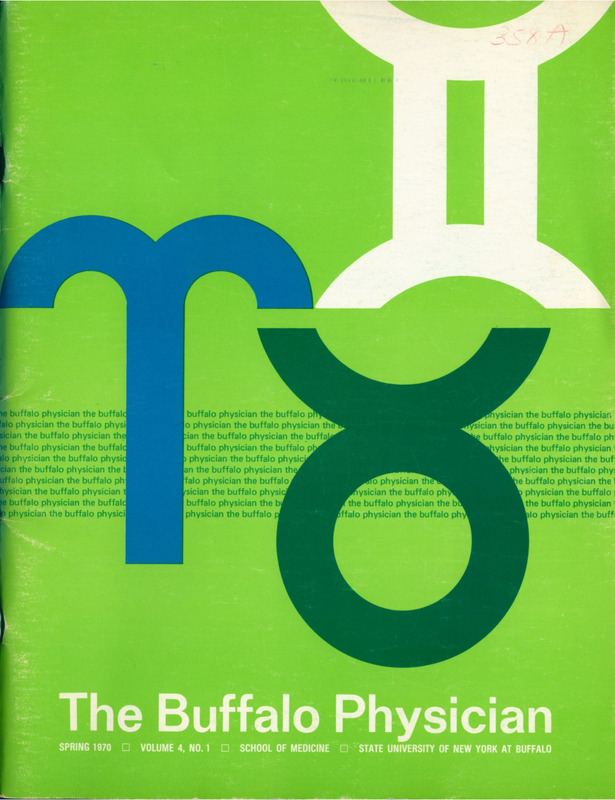
The cover design by Dick Macakanja refers to Aries, Taurus, and
Gemini, which are symbols denoting astrological influences from
March 21 through June 21.
THE BUFFALO PHYSICIAN, Spring, 1970 — Volume 4, Number 1, published
quarterly Spring, Summer, Fall, Winter — by the School of Medicine, State
University of New York at Buffalo, 3435 Main Street, Buffalo, New York
14214. Second class postage paid at Buffalo, New York. Please notify us of
change of address. Copyright 1969 by the Buffalo Physician.
From the desk of
LeRoy A. Pesch, M.D.
Dean, School of Medicine
The events which have occurred at this Medical School November 3 to 10 have served to bring into sharp focus many urgent and
deeply rooted problems in our society which are related to the
health of this nation. Health indicators from many sectors and
census tracts clearly show the inadequacy of our present health
care system. While the present focus is on disadvantaged segments
of society, the overall problem affects all people and all levels of
the health care system.
The demands which were presented to the Medical School are
not new demands nor are they directed at the Medical School alone.
They are demands directed at society, a society which has toler
ated the oppression of people and tolerated the disadvantages
imposed on one of our most important human resources — our
young people. Our disadvantaged minorities are tired of being
oppressed and tired of being called disadvantaged and oppressed.
They are tired of the handouts of society, tired of welfaresupported indigent medical care, tired of programs such as medi
caid which perpetuates second-class medical care. The demands
are for equality — equality of educational opportunity, equality of
educational effort and advantage, and equality of medical care.
In short, our society is demanding that we produce the man
power, the delivery systems, the opportunities for full and equal
participation by all people in the effort to develop the total capa
bility for elevating the health of this nation to the highest level we
are capable of achieving. We must respond, not next year, not next
week, not tomorrow, but today.
In coming to this University as Dean of the School of Medicine a
little over a year ago, I made my own demands for an action pro
gram that would respond to the urgency of the problem of health.
Among these were demands for:
—a curriculum which would be responsive to compensation for
any educational disadvantage which might result from a truly
open admission policy and yet would provide the very best of
educational and research opportunities for all of our students;
—an organization within the student body which would accept
responsibility for meaningful participation in the programs of
the school;
—appropriate identification and organization of a Faculty of
Medicine which would be cohesive in its efforts to produce
educational excellence for all students in the school, as well as
in residency and postdoctoral training programs;
—working together with our affiliated hospitals to build a com
munity-based, university-coordinated system of health care;
—an organizational structure within the university which would
cut through our own barriers of academic and governmental
bureaucracy so that implementation of our programs for
action could be immediate.
We have made progress in all of these areas; some more signifi
cant than others. We must continue to work on all of them.
The demand for health care is not the responsibility of this
Medical School or this University alone. It is the responsibility of
all of us. The community and the nation must provide the facilities,
resources, and imaginative programs if we are to get the job done.
2
THE BUFFALO PHYSICIAN
It is no longer a question 'should we?' It is a fact to which we must
respond. And we must find the answer to how it can be done.
There are many things going on at university campuses at the
present time. Some are very difficult to understand. However, this
is a quality University. We have a good Medical School and are
dedicated to making both of these institutions excellent. Further
more, we are committed to equality of educational opportunity and
to responding to the community and the region we serve. There
fore, we must say 'no' to violent confrontation, to destructive acts
as well as to coercion as tolerable techniques for change. On the
other hand we must respond with action and not words.
Thus, on the basis of our commitment, when our students who
are disadvantaged for any reason ask:
Will you provide us with equality of opportunity?
We can say 'yes'.
Will you guarantee equal educational standards and advantage?
We can say 'yes'.
Will you equalize financial assistance in such a way that we can
do our best?
We can say 'yes'.
Will you help us achieve more and better health care?
We can say 'yes'.
Not a qualified or second-class 'yes', but a resounding 'yes'. •
As we begin a new year, I would like to take this opportunity to
initiate a series of regular reports on matters of concern to all of
us. In this way it is my hope that communication may be improved
and we may be better informed about developments within the
school.
At the outset I would like to alert the faculty to a meeting which
will be called by the Secretary of the Faculty in the very near future.
Its purpose will be to consider the report of a faculty committee
on bylaws and the possible adoption of the committee report as
an amendment to the bylaws. The substance of the report calls
for the establishment of a Faculty Council which will represent
the faculty in matters of school policy. You will recall that the
committee report was distributed and discussed at the Annual
Faculty Meeting last spring. The report will be distributed with the
agenda and the call to the meeting.
The second matter concerns the current status of programs
related to increased enrollment for next year and progress in the
area of disadvantaged minority group admissions. At the present
time the following format has been established in concert with
elected representatives of student groups:
—The school will expand the size of the entering fall class by
approximately 20 places.
—There will be a single Medical School Admissions Committee
with an equitable faculty membership from groups formerly
under-represented.
—There will be a single mechanism for appeals on suspension
or dismissal from the School of Medicine.
SPRING, 1970
Dean Pesch
The Dean
Reports
The Buffalo General Hospital
dedicated the Oscar J. Oherkircher Urological Suite in De
cember. It is part of its $7.3
million addition. The national
ly known urologist, Dr. Oberkircher, M'15, left, first joined
the hospital staff in 1917. He
examines a portrait and the
plaque in the new wing with
his sons, Paul, M'59, Oscar,
M'52, and David, M'59, all
physicians. •
Buffalo Evening News Photo
—There will be a major recruiting effort for disadvantaged
students along the lines of the Career Development Program
recommended by Medicine and other Health Science Schools
in March 1969. We have developed a harmonious and con
structive relationship with the community, university faculty,
and student groups most directly involved.
It is our intention to institute a summer program, comparable to
the Harvard Career Development Program this summer. Dr. Chris
topher D'Amanda has been appointed Acting Director of the Health
Sciences Career Development Program with some exciting results
in the area of recruitment already demonstrated.
Faculty and financial resource development are presently under
study. Dr. Eric Barnard has been appointed chairman of a Commit
tee on Space and Facilities to evaluate and recommend the changes
necessary to accommodate the anticipated increase in class size for
next fall. Dr. Edward Marine has been working closely with Dean
Claude Welch of the University College to develop academic pro
grams which may include five, six or seven-year curricular tracks
with cross-registration between the College and the School of
Medicine leading to the M.D. degree. A committee for coordinating
the development of these programs will be appointed.
4
THE BUFFALO PHYSICIAN
Another important faculty committee being established is called
the ad hoc Committee on Medical Manpower. This committee has
been in the planning stages for several months. It will evaluate
current efforts in the areas of Community Medicine, Ambulatory
Care and Family Practice and will be charged with recommending
academic program development in response to the local and
regional manpower shortage with particular emphasis on com
munity and family medicine. Dr. Marine has agreed to serve ini
tially as chairman of this committee.
The final matter I would like to bring to your attention at this
time is an important and major change in the administrative or
ganization of the Dean's office. The most immediate needs of the
school call for the resolution of administrative complexities in
herent in the pattern of the organization of the school. Because we
operate major programs in a variety of institutional settings, in
cluding several within the community, the school has a continuing
responsibility in providing leadership to find imaginative solutions
to the unsolved problems of our clinical programs, postgraduate
education, and the integration of the medical center with the
community in which it functions. Consequently, several steps will
be taken over the next few months to provide a more effective and
efficient administrative organizational structure than the School
has had in the past.
The first of these changes is the establishment of the position of
Executive Associate Dean and Director of Academic Programs.
This position will have the authority and responsibility for direct
ing and coordinating admissions, curriculum development and
academic affairs, student affairs, special program development,
together with coordination of the interaction between the Student
Polity and the Faculty Council. I am delighted to announce that
Dr. Edward Marine has agreed to accept this position effective
immediately. I feel very fortunate indeed in having a person with
his capabilities assume this important administrative position, and
I have every confidence that under his leadership major progress
will be made in all these areas which are so vital to our educational
and clinical programs.
Other changes in the area of institutional relationships, fiscal
management, and planning and development are under study and
will be announced in the very near future.•
SPRING, 1970
5
I
Dr. Allen
Infectious
Disease
Dr. Allen teaching at one of
the smaller didactic weekly
sessions.
UST A MINUTE," responded an enthusiastic voice, that of Dr. James
C. Allen who came from Baltimore's Johns Hopkins last August to
head the first university-wide infectious disease program in
Buffalo. "I am just winding up this experiment." In a small office
tucked into a corner of a laboratory—in the usual disarray ac
companying the final throes of occupancy—we talked about in
fectious disease.
"Infection is mainly an acute problem," the young, tall and spare
associate professor of medicine pointed out. "The patient recovers
or dies. Or he may develop an infection during treatment for
another illness. Tuberculosis and venereal disease are two of the
major exceptions," he said.
Clinical duties in this major subspecialty of the department of
medicine are heavily teaching oriented. When house staff is faced
with a problem—increasing use of antibiotics, cancer drugs, and
corticosteroids over the past decade have changed the pattern of
hospital infections—"we are called in," he said. "We counsel them
on an approach to diagnosis and therapy." Teaching continues as
the basic tenets of appropriate infectious disease practice are em
phasized during grand rounds and at the smaller, more didactic
weekly sessions where students on service at the hospital join in.
For the first time this fall, a student elective in infectious disease
will be offered.
In his approach to research, Dr. Allen looks for the combination
of both basic and clinical application. "I want my basic question to
be a steppingstone toward the application of a practical answer
I want to find the ways and means such as hypersensitivity to bac
terial products causes tissue damage and disease manifestations.
"We pursued the literature hint that hypersensitivity may be a
tool toward answering certain basic questions in the pathogenesis
of tuberculosis," he said. Over a three-year period, TB-induced
pleural fusions in animals were investigated utilizing refined meth
ods of studying protein and water movement. The result—a specific
physiologic lesion related to this type of delayed hypersensitivity
phenomena can now be defined.
"Our studies have shown us the 'way' to demonstrate hyper
sensitivity in this type of manifestation, the 'way' delayed hyper
sensitivity can cause significant physiologic lesions in the living
animal." But even with the best available techniques, a significant
percentage of the tuberculous causes of pleurisy cannot be proven.
It is often the young, he said, who will subsequently develop
significant extra-pleural TB if not treated. "By using the 'tool' of
hypersensitivity we hope to understand this process in man. A study
is currently underway."
Is drug hypersensitivity through antibiotic use clinically signifi
cant? Dr. Allen and his assistant, Dr. William Lerner, think so. They
are zeroing in on an area in which little is known—delayed hyper
sensitivity following antibiotic use. They are combining the basic
question—how the body combats infection—with its practical ap
plication, the adverse effects of antibiotic drugs themselves.
There is a delayed hypersensitivity system, their yearlong study
on the experimental model has conclusively proven. A certain
response specifically related to the structure of antibiotics can be
defined in this system. When their studies are completed, they hope
to interpolate their findings to man.
A pioneer in the isolation and identification of meningococci anti
gens will be joining the team in July. He is Dr. Michael Apicella,
active in the study of hypersensitivity phenomena, who will be
working on problems involving the meningococcus as a casual as
well as pathogenic inhabitant of man. In a collaborative study with
Dr. Allen, he will focus on certain problems in host resistance.•
The Continuing Medical Education lecture series presented over
the two-way Telephone Network of the Regional Medical Program
of Western New York has been recognized by the American Medical
Association. Dr. Harry Alvis, associate dean for continuing medical
education, said that physicians who participate in the programs
can now receive credit for the required category towards attain
ing the AMA Recognition Award in Continuing Medical Education.
This award involves no academic credit but is a means of acknowl
edging the genuine desire of many physicians to keep up with
advances in their field.
Recognition of the network programs as an effective means of edu
cation was possible only because the programs are organized under
the auspices of the Medical School faculty which had already re
ceived accreditation for its conventional short-term courses. The
series started in the spring of 1968 with 15 hospitals in the network.
Today there are 51 hospitals in Western New York and Pennsyl
vania on the network. The regular series of programs for physicians
is presented every Tuesday at 11:30 a.m. There are several other
network programs for dentists, nurses, pharmacists, physical thera
pists, podiatrists, medical record librarians, hospital administration
and supervisory personnel, dieticians, and environmental health
personnel.•
SPRING, 1970
7
AMA
»-»
Ivt!l_.UJ=
Dr. Milch
Honored by
Albert Einstein
Medical College
A 1933 graduate who has been on the Medical School faculty
since 1938 (except for military leave during World War II) was
honored recently by the Albert Einstein College of Medicine of
Yeshiva University. He is Dr. Elmer Milch, clinical professor of
surgery. He is also acting chairman of the surgery committee at
Buffalo General Hospital and a surgery consultant at Roswell Park
Memorial Institute.
During a reception and dinner Dr. Milch was presented a plaque
for "his service to the advancement of medicine." The surgeon has
been active and honored by several other medical and civic
organizations.
Dr. Milch's address, which follows, was entered into the Con
gressional Record by Congressman Thaddeus ). Dulski of New
York on November 6,1969.
I should like, first, to express my sincere appreciation
for the honor you do me this evening. Recognition is
gratifying at any time, but it is recognition by one's
peers such as the men at Albert Einstein Medical Col
lege which is deeply and truly valued.
As an individual who has been engaged modestly in
medical education for more years than I care to admit
publicly, these moments are treasured not only for the
infrequency of their occurrence, but also for the oppor
tunity to speak out in a reflective and philosophical mood
both as a physician and a layman.
In a rapidly changing society—such as has been ours
during the past 3 to 4 decades, we have watched the
practice of medicine become a public utility subject to
federal, state, and municipal regulatory bodies and laws,
which have attempted by their actions to reduce physi
cians to one common denominator.
As a result of these actions excellence is in danger
of becoming an increasingly vestigial structure and the
resolve to pursue it may soon give way to disillusion.
This we must never permit to happen to our youth.
What course then is open to our youth, to those in
whom we intrust the future and health of our society,
and if you will, the future of all mankind?
Disillusionment? I hope not. Callous cynicism and an
attitude of "what the hell, I'll play ball their way?" I
hope not. Petulance and withdrawal from our society,
contenting themselves with pouting predictions of apoc
alypse for the world in which they feel condemned to
live? I hope not.
I hope that those who one day join the medical pro
fession will be taught to take none of the easy ways out,
but will continue to pursue excellence—for the selfrespect of knowing that one has done his best, for the
joy of the pursuit, for the very love of excellence itself.
8
THE BUFFALO PHYSICIAN
MUST TEACH BY EXAMPLE
But this hope will be in vain if we do not teach the
young by our example.
Today, as the moral vacuity of our country is replaced
by the moral vacuity of the crash pad, our society is
learning the truth of the biblical admonition that it must
reap as it has sown.
We, in medicine, as practitioners and teachers must
try not to repeat the same errors. We just cannot afford
the pious invocation of one set of values while we
conduct ourselves by another.
If we as a profession are to retain our self-respect,
we must demand excellence of ourselves first or else we
must not demand it of those who will succeed us.
Nowhere is the dual nature of that imperative more
manifest than in our medical schools.
If we are to expect our students to forget the lessons
of compromise and expediency, then we must retain the
most vigorous standards of excellence in their training.
We cannot heed the political call for instant physi
cians, in a futile, hasty effort to correct years of neglect
and mistakes.
We cannot and must not play games with our youth
and our health because of a wrong sense of priorities
permitted to exist over the years.
SOCIETY MUST DEFEND STANDARDS
If we are to preserve the self-respect of the medi
cal profession, then society as a whole must defend
the standards of excellence.
For only through such a defense by the public itself
can we hope to produce physicians who will be worthy
of their calling and our trust.
For only by being the instruments of our own support
and standards can we hope to teach the young the
necessity of integrity.
Only by ourselves turning away from the bastions of
mediocrity which would prostitute these principles in
the name of political expediency can we hope to one
day view ours as a profession which serves as an ex
ample to society rather than partaking of its present
ills.
And these facts society must understand and must
help us as teachers and physicians do.
It is because Albert Einstein Medical College in the
comparative short time of its existence has demon
strated these standards and principles of excellence.
It is because as a private institution depending greatly
upon public support it has held its head high and to
date has refused to bow to the pressures of mediocrity
—that I, as an individual, am very proud to be honored
this evening and to accept this plaque in behalf of
all grateful practitioners and teachers of medicine.•
SPRING, 1970
Mr. Edward Kavinoky, co-chairman of the
testimonial, presents award to Dr. Miich, "for
his service to the advancement of medicine."
$900,000 Grant
to Community
Services Program
The staff of the Community
Services Research and Devel
opment Program includes spe
cialists in epidemiology, so
cial work, sociology, statistics,
and medicine. Co-directors
with Dr. Sultz are Dr. Edward
F. Marra, professor and chair
man of the department of so
cial and preventive medicine
at the Medical School, and Dr.
William E. Mosher, Erie
County Health Commissioner.
J.HE COMMUNITY SERVICES Research and Development Program
at the Medical School has received a five-year grant of $900,000
from the National Center for Health Services, Research and Devel
opment of the U.S. Department of Health, Education and Welfare.
The grant will underwrite studies and projects for improving over
all medical care in Western New York.
The first-year budget will be $140,283 with the remainder of the
grant allocated over the next four years, according to Dr. Harry
A. Sultz, a former dentist and now associate professor of social
and preventive medicine and director of the program.
"Our objective is to find ways to make the advances of modern
medicine and dentistry available to all of our people," Dr. Sultz
said. "There is still much that we do not know about disease, but
there is much that we do know that is currently of little benefit to
large numbers of Americans. We must make it available to them—
and make them aware of how and where to seek it."
The several projects currently underway include:
—a study of how group psychotherapy aimed at allaying anxiety
may affect the prognosis of coronary patients—in collabora
tion with Dr. Michel A. Ibrahim, Deputy Commissioner of
Health for Erie County;
—a study, for the Regional Medical Program, of the need for
health manpower, new clinical techniques and other resources
in the care of stroke patients in the Western New York region
in collaboration with Dr. Ibrahim and Dr. Harvey Borden of
the U. S. Public Health Service;
—a study of out-of-wedlock pregnancy and contraception, in
collaboration again with Dr. Ibrahim;
—for residents of one part of the "inner city," compilation of a
Health Rights Guide by medical and nursing students who
staffed a clinic in the area last summer—so that residents will
know where and how to get medical aid quickly;
—publication of a Physician's Desk Reference of Community
Services, for the Western New York region, which will be
published in the fall and will list 400 services related to health
needs, such as hospitals, nursing homes, adoption agencies, or
places to obtain wheelchairs or counseling. This is funded by
the United Health Foundation and the Erie County Department
of Mental Health.
The research initially started in 1962 when the then community
services unit of the preventive medicine department was asked by
the New York State Department of Health to undertake the Erie
County Survey of Long-Term Childhood Illnesses. When this mas
sive study was completed, in 1965, the unit decided to stay to
gether as a full-fledged research group. Federal support of this
program, prior to this grant, has totaled approximately $500,000.
The purpose of this first study, whose results have attracted
widespread interest, was to ascertain the incidence and prevalence
of 70 long-term childhood diseases for which services were not
(yet) provided under the state crippled children's program, so that
they could be given more informed consideration in terms of state
and local health planning.•
10
THE BUFFALO PHYSICIAN
A 1940 Medical School graduate was named acting director of the
E. J. Meyer Memorial Hospital January 1. He is Dr. Albert C. Rekate
who has been on the faculty since 1947. He succeeds Dr. L. Edgar
Hummel, who retired as superintendent of the hospital December
31. The title of the top hospital post was changed from superin
tendent to director.
Dr. Rekate is also associate dean for clinical affairs in the School
of Health Related Professions, professor of medicine, and director
of rehabilitation medicine at the hospital. He has been on the Meyer
staff since completing his internship there in 1941, except for three
years in the Army Medical Corps from 1944 to 1947.
The new director has co-authored seven major articles for medi
cal journals, including a treatise on "Liver Function in Alcoholism"
in 1963. Two years later he organized a rehabilitation program at
Meyer which embraced alcoholism along with drug addiction, men
tal illness and other conditions. He has held other Meyer appoint
ments—assistant residency, attending physician, associate director
of medicine, assistant psychiatrist, and acting head of the cardiol
ogy department.•
Dr. Rekate
Dr. Rekate
Named Director
of Meyer Hospital
Dr. Hummel Retires
Dr. L. Edgar Hummel, superintendent of the E. J. Meyer Memorial
Hospital since March 1, 1957, retired December 31. He has been a
member of the hospital's medical-dental staffs since 1939, and on the
School of Medicine faculty since 1938. Dr. Hummel reached retire
ment age in April, 1968. He did his undergraduate work at UB, and
in 1931 received his M.D. from Harvard Medical School.
"It has been a fruitful and satisfying experience to have headed
up one of the great municipal hospitals of the country," Dr. Hummel
said.D
Dr. Christopher D'Amanda is the new assistant to the Dean in the
Medical School. He will be acting director of the new Health Sci
ences Career Development Program. He will also serve as interna
tional liaison officer of the Medical School and be involved with the
delivery of health services and care in the community. The 35year-old physician is also an assistant research professor in the
department of medicine at the E. J. Meyer Memorial Hospital.
In 1956 Dr. D'Amanda received his bachelor's degree in English
Literature from Harvard University. He received his M.D. degree
from the State University at Buffalo in 1962. He was an intern and
resident at the Buffalo General Hospital from 1962 to 1966. During
July, August and September of 1966 Dr. D'Amanda was preparing
himself for a special assignment at the National Communical Dis
ease Center, Atlanta, Georgia. From November, 1966 to November,
1969 he was at Upper Volta and the Ivory Coast, West Africa, in
the measles control and smallpox eradication program. This pro
gram was sponsored by the United States Public Health Service.•
SPRING, 1970
11
New Assistant
to the Dean
Dr. D'Amanda
Mr. Speer
Veteran's
Hospital
Director
"Part of the challenge in my coming to Buffalo," said new Vet
eran's Hospital Director Eugene E. Speer Jr., "is participating in the
expansion of the hospital's training and ongoing research pro
grams." For the 57-year old Alabama born director, this means
better patient care, a more active affiliation and cementing of rela
tions with the Medical School.
The 1937 graduate of Athens College in Alabama, who as a boy
really wanted to be a surgeon while his family hoped for a min
ister, pursued graduate work at George Washington University. He
later lectured there on hospital budget and outpatient records. He
received the equivalent of a master's degree in sociology and per
sonnel administration from the University of Alabama.
The blue eyed administrator, who "won't stay if I can't keep
things moving ahead" has 23 years' Veterans Administration ex
perience in four hospitals. He comes here from Louisville, Ken
tucky where he held an equivalent directorship. This was pre
ceded by five years' service with the Air Force, enlisting as a private
and discharged as a captain. He worked most of the time in military
hospitals. That's where he became interested in hospital adminis
tration.
But he has also taught at all grade levels in Decatur, Alabama
following graduation. And he has held principal and vocational
advisor positions as well.
Leisure time, if there is any, finds Mr. Speer either rebuilding
stereo equipment, dabbling in hybrid dahlias or reading sports
magazines. About 25 years ago he was a Red Cross water safety
instructor and he readily admits that both he and Mrs. Speer find
the outdoors one of the best means of relaxation. Golf and fishing
are also high on the agenda.
"Things are moving ahead," said the new director. "We are mak
ing progress."•
New Family
Practice Plan
Three young physicians, all May Medical School graduates, are
practicing family medicine as the first resident physicians in the
new specialty of family practice at Deaconess Hospital. They are —
Drs. Michael Smallwood, Timothy Harrington, and Robert J. Gibson.
Patient families will be assigned to each one of the three resi
dents, who will handle their problems personally, calling in con
sultants as necessary, including a social worker who will be
assigned to the program. The resident will practice "preventive
medicine," working not just with the sick in the family, but with
the well, to keep them from getting sick. When the resident is not
seeing patients, he will be encouraged to pursue a program that will
be helpful in whatever circumstances he elects to practice after his
residency. The residents will be encouraged to learn more about
facilities available to their patients in the community, such as
public health nursing. They may also spend some time in compre
hensive health planning, medical society or regional medical pro
gram offices.•
12
THE BUFFALO PHYSICIAN
A Unique Medical Team
The James D. Felsens form a unique medical team. Since 1967
they have been working with three tribes of Indians in Arizona
(Hualapis, Havasupais, San Carlos Apaches).
Dr. Felsen is a 1966 Medical School graduate, and his wife is a
nurse with the Head Start Program. The husband-wife team dou
bles in everything from educator to social work to pharmacist.
They have come a long way in three years—from a mule-back
clinic to administrator of a modern U. S. Public Health Service
Hospital with a staff of 75 on the San Carlos, Arizona Apache Res
ervation. Before completion of the hospital the Felsens loaded
mules with supplies every three weeks and rode horses into the
canyon to conduct a clinic for the tribe.
The Arizona and New Mexico Indians have problems of improv
ing their socio-economic status, and fitting themselves into the mod
ern world, according to Dr. Felsen. "It is amazing how far they
have come in three generations, since they were overpowered by
the cavalry."
The single most isolated group of American Indians is the 300
Havasupai who live at the bottom of the Grand Canyon. The
Apaches are a more advanced tribe, but the problems the health
workers face are similar.
"We have the facilities, but very few Indians see themselves as
responsible for their health. They shift the responsibility to the doc
tors and the Public Health Service," Dr. Felsen said. "Curative
medicine for the Indians is as modern as anywhere in this country,
but preventive medicine is only in its infancy," he said.
"I'm not so sure this doesn't carry through into Buffalo and other
cities. The facilities are there, but hundreds of thousands of people
are not getting services because they don't know they exist," Dr.
Felsen said.
The Felsens went to serve among the Indians because of the op
portunity to see "raw disease." They stayed because of the need
and the desire "to progress into community medicine."
They both agreed they are being rewarded because "the Indians
are beginning to demand services on their own rather than waiting
for us to insist on their participation."
The Felsens spent August and September in Africa giving medi
cal care to Sierre Leone's Peace Corps volunteers and gained some
new ideas for bringing better community medicine to the Indians of
the Southwest.D
SPRING, 1970
13
Pediatrics Fellowship
A
Both Julie and Dr. Rubin
admire a pretty dress.
L/rUg
Control
N INTEREST IN PEDIATRICS? A curiosity about kidney disease
following lectures on the kidney by Charles M. Elwood ? That sums
up Julie Dratch's summer fellowship at the Children's Hospital.
"I wanted pediatrics and an opportunity to work under Dr.
Mitchell I. Rubin," the petite dark haired senior said. "The daily
clinical rounds, the workups in the outpatient clinic where I can
follow my patients have been really exciting. One, an eight year old
girl, will be in again this morning. Proteinuric, we are treating her
with steroids and I am eager to see how she is responding."
It is also an opportunity to become familiar with research
and laboratory procedures. There is Dr. James Brennan's weekly
biopsy conference at the Buffalo General Hospital. And there is
Julie's study on the nephrotic syndrome. By recording laboratory
and clinical data on 55 patients who have evidence of minimal
disease documented by renal biopsy, she feels that "we may be
able to predict prognoses based on what we have seen happening."
The future? Hopefully an internship in a New York City hos
pital. She has worked at Roosevelt, one of Columbia's teaching
hospitals where many of the patients are Puerto Rican. She is
taking Spanish lessons twice a week because "if I am accepted at
Roosevelt I want to be able to talk to them."D
The recent explosion of drug use should be a warning to society
to establish a "system of anticipatory control" today for mindeffecting narcotics sure to appear in the very near future. That is
what Dr. Cedric Smith, professor and chairman of the department
of pharmacology, told the State Joint Legislative Committee in Pro
tection of Children, Youth and Drug Abuse.
"There will be new and different drugs for changing the way one
thinks. Our present system of research and education is too inertiabound to respond to the protection of the populace. It was evident
^* ve t o t e n y e a r s ago that psychedelic and marijuana use was
spreading rapidly," Dr. Smith said.
The professor called for a control system of psychedelic agents
including: [1) a monitoring group responsible for recognizing new
compounds and techniques for thought manipulation, for assessing
potential and for initiating research; (2) a research group for
studies on man and animals in both short and long range periods;
(3) a program to keep the public educated on new techniques for
combating drug abuse.
Dr. Smith warned that lack of proof that a drug does permanent
harm does not give it an automatic clean bill, noting that "both
thalidomide and DDT were widely used before it was realized that
they were harmful."•
14
THE BUFFALO PHYSICIAN
Following a year's review and analysis by University and Hospital
authorities, the up-dated contract of affiliation between The Chil
dren's Hospital of Buffalo and the University Schools of Medicine
and Dentistry was signed by Dr. Peter Regan and Mrs. Robert B.
Adam, President of the Hospital's Board of Managers on January 8,
1970. Dr. Regan is Acting President of the University.
Hospital-University affiliation originated in 1936 and was up
dated in 1942. Both the previous agreements, however, only stated
the intention of the two parties to affiliate without specific com
mitment as to what the agreement would entail.
Both institutions, realizing the necessity for maximizing their
efforts to obtain State and Federal funds of benefit to both decided
to re-draft the document spelling out specific principles within a
legal context.
The document in no way alters the status of the hospital. It still
maintains complete control of its operation as a non-profit corpora
tion chartered under the laws of the State of New York directed
by a 24 member Board of Managers from the community at large.
The document includes provisions for appointments and promo
tions within the framework of the Medical Staff Bylaws of the
hospital. It now also provides for representation of Administration
and Hospital Board members on University policy committees
which involve the Hospital including search committees for hos
pital department head positions. At the same time it provides for
recognition and representation of University representatives on the
Hospital's Board of Managers. In both cases, representation is exofficio. Both parties feel that this mutual cross representation will
provide a more complete flow of information between the two
institutions. With a singleness of purpose they can thus provide
the best possible care for children of Western New York and the
best possible teaching program for the Medical and Dental students
of the University.D
Children's Hospital
Contract Signed
President Martin Meyerson has been elected president-designate
of the University of Pennsylvania. He will assume his new position
in September. He succeeds Dr. Gaylord P. Harnwell, who will
retire in September.
Mr. Meyerson came to Buffalo in September, 1966 as the succes
sor to Dr. Clifford C. Furnas, who had reached mandatory retire
ment age. Since September, 1969 Mr. Meyerson has been spending
two-thirds of his time as chairman of the Assembly on University
Goals and Governance, which is studying the functions and pur
poses of American Colleges and Universities.
Mr. Meyerson, who was a member of the Pennsylvania's city
planning faculty from 1952-57, will become the 19th chief executive
officer of the institution.
"This decision has been the most difficult one of my life," Mr.
Meyerson said.D
Pennsylvania Lures
President Meyerson
SPRING, 1970
15
Mrs. Adam, Dr. Regan, Dean Pesch
Children's
Hospital
Addition
This is how Children's H o s p i t a l w i l l l o o k i n 1 9 8 0 . A t t h e e x t r e m e l e f t [ A ] i s the nurses'
residence. The 10-story buiiding (B] is under construction. Adjacent (CJ is the existing
Tanner Buiiding, and in the (D) area is where the research facility will be built.
A few remarks at the groundbreaking ceremony by
Mr. Frank Muddle, hospital director; Mrs. Robert B.
Adam, President, Board of Managers; Mr. B. John
Tutuska, Erie County Executive; and Dr. Jean Cortner, Professor and Chairman of Pediatrics.
Ground was broken December 3 for the first phase of
Children's Hospital's $11.5 million, 10-story addition on
Bryant Street. It includes construction of the basement,
sub-basement, installation of elevators and completion
of the first two floors plus exterior walls for the bal
ance of the 10-story building. This building, scheduled
for completion in 1973, will be financed with hospital
funds, government grants and $7 million from a com
munity-wide campaign that will be completed in 1971.
It will house administrative offices, hospital services,
the Outpatient Department and clinics. Rehabilitation
and mental health facilities will also be expanded to
meet the increasing needs of 22 regularly scheduled
clinics on subjects ranging from allergy to well-baby
care.
The master plan, scheduled for completion in 1980,
includes construction of another 10-story research build
ing fronting on Hodge Street. This building will pro
vide laboratories and offices for the hospital's burgeon
ing research programs in surgery, kidney disease, hered
ity, allergy and other conditions.
The new buildings are tailored to meet the rapidly
expanding needs of the hospital's Outpatient Depart
ment and the teaching and research requirements of the
hospital staff and the School of Medicine. The hospital
is the only Children's Hospital in New York State.•
THE BUFFALO PHYSICIAN
Dr. Robert H. Wilbee has two new assignments. He is assistant
dean at the Medical School and acting associate director at Meyer
Memorial Hospital.
At the University Dr. Wilbee's main responsibilities will be in
the areas of student and academic affairs, while at the Meyer he
will be co-ordinating planning for the new hospital and assist in
administration.
Dr. Wilbee was born in Edmonton, Alberta, Canada in 1929, but
was raised in Western New York, and graduated from Kenmore
High School in 1947. He then attended Dartmouth College and was
awarded an A.B. in Psychology in 1951. He served in the United
States Army during the Korean War and returned to the University
of Buffalo School of Medicine to graduate in 1959. His postgraduate
training included a rotating internship at the University of Cali
fornia in San Francisco and a four year residency in General
Surgery at the Buffalo General Hospital.
From 1964 to 1968, he was associated in practice with Dr. Joseph
Dziob at the Bethlehem Steel Corporation with a main interest in
trauma surgery. In 1968 he was appointed Assistant Professor of
Surgery at the University. He directs the Emergency and Trauma
Services at the E. J. Meyer Memorial Hospital.
He is a member of Alpha Omega Alpha (honorary Medical
Society), the County, State and American Medical Association,
the Buffalo Surgical Society, a Fellow of the American College of
Surgeons, and a Diplomate of the American Board of Surgery. He
is on the staff of the E. J. Meyer Memorial, Buffalo General, Chil
dren's and Veterans Administration Hospitals.•
New Duties
for Dr. Wilbee
Ten continuing medical education programs will be offered this
spring, according to Dr. Harry J. Alvis, associate dean for continu
ing education.
Continuing
Medical
Education
March 6
DEPRESSION IN THE MEDICALLY ILL PATIENT
March 12 — June 11 (12 Thursday Evenings) — Physical Examination
of the Cardiac Patient
April 9 —NEUROLOGY SEMINAR DAY
April 10 and 11 — 33rd Annual UB Medical Alumni
SPRING CLINICAL DAYS — "THE PHYSICIAN and SOCIETY"
April 23 and 24 — MODERN CONCEPTS IN CORONARY CARE
May 7 — OTORHINOLARYNGOLOGY
May 14 and 15 — NEW ADJUNCTS IN ANESTHESIOLOGY
May 27 and 28 — GERIATRIC MEDICINE
June 1 and 2 — REHABILITATION OF STROKES and
SPINAL CORD INJURIES
June 1 - 5 — REFRESHER SEMINAR IN PEDIATRICS
SPRING, 1970
17
Dr. Wilbee
As clinical clerk Kenneth Piazza examines anesthetic machine, resident
Richard Saab adjusts cystoscope and Nurse Behr explains its fiber optic
cord into light supply.
Buffalo General Hospital
Adds New Wing
A quick in/out surgery unit . . . a new
urology suite that may be the finest in the
country . . . 108 new beds in spacious, light
rooms that are accented by bright colors, print
draperies, and carpeting . . . a new reference
library. They are all located in a new four
story wing at the Buffalo General Hospital
that is only the first phase of a planned 16story tower.
18
Spelling relief to an acute hospital bed
shortage is the ground floor emergency de
partment. It is geared toward patients whose
surgical or diagnostic requirements can be
handled on a one-day basis. Four fullyequipped operating rooms are backed by an
orthopedic room large enough to treat four
patients at one time, its own x-ray facilities,
and laboratories where emergency blood
counts or urine analyses can be performed.
Laboratory work for scheduled minor opera
tions are performed on an outpatient basis a
day or two before surgery. And the patient
need report no earlier than an hour prior to
surgery.
While under observation as he recovers
from a local anesthetic, or in need of a spe
cialist or a specific test, the patient occu
pies one of the department's eight holding
beds. By nine the next morning he will either
have been discharged by the attending phy
sician or admitted to the hospital.
The new Oberkircher urology suite has
both outpatient and operative facilities for
patients suffering from diseases of the urin
ary tract and related conditions. There are
consultation rooms where minor treatment
not requiring anesthetics can be performed.
There are also three cystoscopic rooms
equipped with the most modern and up-todate equipment to allow the physician to look
THE BUFFALO PHYSICIAN
into the patient's bladder, outline the kidney,
do all of the necessary techniques, and even
operate. The fourth operating room for pros
trates, bladders and tumors is the transurethroresection room. The specially equipped
x-ray room — urology depends so much on
x-ray studies — has an adjoining darkroom
where the x-ray is developed in just 90
seconds.
Patients in the recovery room nearby are
watched through a window wall from the
nursing station directly opposite. It is not
unusual to find a renal isotope laboratory
under medicine's Dr. Charles Elwood located
in this suite. Urology and kidney disease are
closely allied. Locker rooms, toilet facilities,
dressing areas. Every nook and cranny re
veals a storage area for supplies.
The two-in-a room 108 beds are located on
3 floors, 36 on each. Each individually tem
perature controlled room has its own bath
room and shower. Each bed which can be
raised and lowered by the patient, has its
own TV set adaptable to closed-circuit use
for inhospital communications.
In the new Dr. A. H. Aaron Library, house
staff and students have access to all of the
hospital's reference volumes housed in book
stacks. Or they may relax in the comfortable
reading room at one of the study booths while
they glance through a current medical journal
located in the racks.
Space, light, bright colors, print drapes,
carpets. Just aesthetic touches to what is the
first phase of a new teaching and patient
care facility.•
On grand rounds in the new wing with medicine chief,
Dr. James Nolan.
One of the smaller student
conference rooms that are
located on all four floors of
the new wing.
SPRING, 1970
19
Medical intern John Breen listens to an elderly patient
who complains of food lodged in his esophagus.
Clinical clerk Ronald Blum works up an emergency
blood count in one of the new laboratories.
THE BUFFALO PHYSICIAN
Buffalo General (cont'd)
Associate director, Dr. Theodore Jacobs, and director
of ambulatory services, Dr. Wilfred Fuge, check emer
gency oxygen supply in one of the new 2-bed patient
rooms.
The new Dr. A. H. Aaron library located on the second floor
of the new wing.
Medical students
attend a urology
conference in new
urology suite.
SPRING, 1970
21
33rd Annual State University at Buffah
Theme: "THE PHYSICIAN AND SOCIETY"
April 10 and 11,1970
Prrofjrcim
STATLER HILTON HOTEL
Empire State Suite
FRIDAY, APRIL 10
8:15 a.m.
Registration
9:30 -10:00 a.m.
Welcome: DR. SIDNEY ANTHONE, M'50
President, UB Medical Alumni Association
Announcements: DR. HARRY J. ALVIS
Associate Dean for Continuing
Medical Education
10:00 -12:00
THE ROLE OF THE PHYSICIAN IN SEX EDUCATION: Panel Discussion
Moderator: DR. HAROLD J. LEVY, M'32
Clinical Associate in Psychiatry
"Education for Human Sexuality"
DR. MARY S. CALDERONE
Executive Director, Sex Information & Education
Council of the United States, New York City
"COMMUNITY EXPERIENCE IN SEX EDUCATION"
The Pediatrician's Role
DR. ROBERT J. EHRENREICH
Clinical Associate in Pediatrics
The Gynecologist's Role
DR. MORRIS UNHER, M'43
Clinical Assistant Professor of
Gynecology-Obstetrics
The Clinical Psychologist's Role
DR. SHEPARD GOLDBERG
Clinical Associate in Psychology in Department
of Psychiatry
12:00 -12:30 p.m.
Business Meeting
Election of Officers
12:30- 2:00 p.m.
Luncheon
2:00 - 4:00 p.m.
THE SOCIAL HAZARDS OF A PHYSICIAN'S LIFE: Panel Discussion
Moderator: DR. BERNHARDT S. GOTTLIEB, M'21
Psychiatrist, Private Practice, New York City
22
THE BUFFALO PHYSICIAN
Medical Alumni Spring Clinical Days
6:00 p.m.
The Drug Problem in Physicians
DR. RALPH B. LITTLE
Psych o - A n a l y s i s t , S e n i o r A t t e n d i n g
I n s t i t u t e of t h e P e n n s y l v a n i a H o s p i t a l ,
Philadelphia
The Alcoholic Problem in Physicians
DR. LeCLAIR BISSELL
Co-ordinator, Alcoholism Service,
D e p a r t m e n t s of Medicine a n d P s y c h i a t r y ,
The Roosevelt Hospital, New York City
The Suicide Factor in Physicians
DR. HARVEY L. P. RESNIK
C h i e f , C e n t e r for S t u d i e s of S u i c i d e P r e v e n t i o n ,
National I n s t i t u t e of M e n t a l H e a l t h ( o n l e a v e U B ,
P r o f e s s o r of P s y c h i a t r y )
Fiftieth Class Reunion
Reception and Dinner •
Georgian Room
Empire State Suite
SATURDAY, APRIL 11
8:15 a.m.
Registration
9:30 - 11:30 a.m.
PEPTIC ULCER: Panel Discussion
Moderator: DR. JAMES F. PHILLIPS, M'47
Clinical A s s i s t a n t P r o f e s s o r of Medicine
Physiology of Gastric Secretion
DR. WILLIAM F. LIPP, M'36
C l i n i cal Associate Professor of Medicine
Pathogenesis of Peptic Ulcer Disease
DR. SAMUEL SANES, M'30
P r o f e s s o r of P a t h o l o g y
Drug-induced Peptic Ulcer Disease
DR. JAMES L. A. ROTH
P r o f e s s o r of Clinica l M e d i c i n e , D i r e c t o r of
I n s t i t u t e of G a s t r o e n t e r o l o g y , U n i v e r s i t y
of Pennsylvania School of Medicine
Surgical Therapy of Peptic Ulcer
DR. STANLEY O. HOERR
Chairman, D e p t . of Surgery, C l e v e l a n d C l i n i c
11:30 - 12:00
"Adaptations and Change in the
University"
DR. PETER F. REGAN
Acting President
12:30 - 2:45 p.m.
Terrace Room
UB MEDICAL ALUMNI ANNUAL LUNCHEON
and
STOCKTON KIMBALL MEMORIAL LECTURE
"Teaching and Learning Where the
Product is Delivered — The Com
munity Hospital"
SPRING, 1970
DR. ROBERT L. EVANS
V i c e P r e s i d e n t — Me d i c a l A f f a i r s , Y o r k H o s p i t a l ,
York, Pennsylvania
23
Health
Care
Dilemma
A
NEW NATIONAL HEALTH CARE SYSTEM for all—agreed the
panelists (industrialist, labor leader, economist, mayor) at the 80th
annual meeting of the American Association of Medical Colleges.
Four revolutions, pointed out Carnegie Corporation president
Alan Pifer, will form the matrix to radically mold it. They are
emergence of consumer voice, quest for social justice, new atti
tude toward medical care as a right, and concept of health main
tenance on a national scale. A major start toward this system, this
layman believes, will appear within the next decade.
Can our country build on its present foundations a system of
health care capable of serving the entire population? Can it find the
means to bring both public and private interests together into a
single focus? Will it be the catalyst to set starts of performance,
encourage experimentation in delivery of health care, coordinate
existing resources, save private facilities from financial collapse,
design and fund a system of national insurance, meet costs of
training increasing numbers of physicians and other health work
ers? "Yes," Mr. Pifer answered, "if there is a national will and the
nation's top leadership responds to that will."
Can there be good health without improved education, housing
or economic opportunity? Health planning, he pointed out, cannot
be isolated from other kinds of social planning. There must be an
interface.
Is there a sense of outrage within the medical profession over
our present nonsystem for health care, a determination to seize the
leadership in bringing into being an equitable national system of
comprehensive care? Mr. Pifer replied, "Among individuals per
haps. The best we can expect from the medical profession—that
it not offer the kind of bitter, rear guard opposition to a national
system of health care as in the past—Medicare.
"On more limited fronts, you who direct the affairs of 350 great
medical centers, can:
—design and try out experimental new delivery programs to de
fined population groups;
—initiate new educational programs for physicians to train them
as broadly-grained in social sciences as in biomedical fields;
—institute programs to produce on an experimental basis new
kinds of professional health workers;
—mount new programs to help answer old and new questions
as nation girds for national system of comprehensive health
care."
But, he clearly stated, you can, you must get together, continue
to work together not to plead but to demand Federal support for
research, experimentation and training of physicians and health
workers, especially from minority groups.
"For you in medical centers, the day is past when you can set
your faces against change . . . with all of your great experience and
competence you have a far more demanding responsibility—how
to design the brave new world and its changes," he concluded.
A private health plan was outlined by Kaiser Industries board
chairman Edgar J. Kaiser. One of the nation's largest contracting
organizations, Kaiser Industries has experimented with a number
of medical programs since its first big Cuban highway project in
24
THE BUFFALO PHYSICIAN
1927 where arrangements for good medical care had to be made.
At Hoover Dam, their first large construction job, 5,000 employees
and their families made up a small city of 15,000. Their most
serious health care problem was in the spread of incomes between
supervision and hourly workers. At Booneville adequate medical
facilities from a Portland hospital association 40 miles away were
furnished on a fee-for-service basis. A young doctor's capitation
payment system was adopted at Grand Coulee Dam. Families
under full coverage brought hospital charges down to 7 cents per
day for wives and 25 cents per week for each child. Not only was
the system self-supporting financially, but enthusiastically received.
During the second World War, 100,000 workers employed at
each of Kaiser's two Navy yards were basically covered by the
same plan. But it was optional, and proved a great success. The
war ended. Kaiser had helped to develop one workable solution.
"As the basic incentives were good," the dynamic industrialist
said, "it was decided to open the plan to the public. Twenty-four
years later, it is the largest group practice prepayment plan in the
country. It provides comprehensive, prepaid medical and hospital
care to two million members on a direct service basis in 19 of its
own hospitals, two extended care facilities, and 52 clinics."
Mr. Kaiser further pointed out, "each group is independent and
autonomous; the contractual agreement is between the doctors
and the group."
But facing the medical care industry today is how to provide
adequate medical care to all segments of our population. Nine out
of ten Americans under age 65 are covered by voluntary health in
surance plans. But there are the aged whose voluntary health in
surance is inadequate and the totally disabled who represent a
significantly higher cost group for personal health services. It is
here, he feels, where the Federal government should play a sig
nificant role in the financing mechanism.
A promising development in experimentation is Medical School
involvement in organizing ghetto health care services. New ap
proaches, he pointed out, are not only justified but imperative if
our nation is to solve its pressing domestic problems.
"There is a gap between demand for better health care and capa
bility of present American industry to meet that demand," Mr.
Kaiser emphasized. "Government, at all levels, can help us close
the gap. I believe that working together—in a constructive coales
cence—we can and will meet the challenges within our free and
pluralistic system."
A national health service corps where students, recruited on
a volunteer basis in lieu of military service, will provide direct per
sonal health services to the poor. The charismatic United Auto
Workers' Union president, Walter P. Reuther, feels that nothing
will do more to counteract the sense of alienation of American
youth. "We must give them a feeling and a sense of purpose, relate
their education to the central problems that cry for solutions in
our great cities.
"We are in trouble in America, deep trouble," he warned the
80th AAMC audience. "It goes into the body politic because our
values are out of focus. There is too little concern about the qual-
SPRING, 1970
25
ity of our goals and too much concern with the quality of our
goods. If the national commitment is there, we can do anything."
Ninety percent of a!) scientists in history are alive today. More
technical progress, he feels, will be done over the next 25 years
than during the past 2,500. But it is how we commit this fantastic
power that is crucial. Both science and technology are neutral, he
said. They have no ideology or morality. But man has. Somehow,
he must relate his scientific and technical know-how to the knowwhy of human and social problems.
"Our cities, housing, schools, are in crisis, our environment de
teriorating dangerously through pollution. High on America's
agenda of unfinished business is the restructuring of the health care
system. The annual cost of health care services is 60 billion dollars.
It is the second largest expenditure, second only to the military,
and its costs are skyrocketing."
His argument was not directed to the American doctors but to
ward the obsolete 'model T' system that "... we remain wedded
to, a system incapable of bringing about a rational, effective ser
vice of resources, manpower, facilities. We need a new model, a
new national health care system."
A national committee on health insurance—Mr. Reuther is a
member—is directed toward this commitment. The committee does
not have all the answers, he pointed out, but "we ask your full
participation as we search for the answers. Ingenuity and social
inventiveness are essential if we are to determine how best a free
society shall structure such a national program."
A new medical care system will not be the result of one single
piece of legislation, Harvard economics professor, John T. Dunlop,
said. It will come only as a result of small changes by a great many
people working on its separate elements.
More money, he feels, is not what the medical industry needs.
The federal estimate for the 70's is five times the outlay for the
present decade. "What are we getting for what we pay?"
Training may be the answer but only if it is related to other
activities. Professor Dunlop cautioned that a new system of financ
ing care should not be confused with its method of delivery.
The consumer, poorly advised on the quality of health care,
comes to the "bargaining table" with less than equality for his
health. "Health is a kind of public good. And the sin of medicine is
that its research is determined by deliberate public expenditure
rather than the market itself."
Medicine should play a greater role. It must take the real costs
of capital into account. While medical facilities are needed Pro
fessor Dunlop feels that they should not be so closely tied in with
hospitals. And wages of hospital workers, interns, residents, can
no longer be treated as an outgrowth to industry's role, but must
reflect an evolution of our health care system.
Medical schools will not be so isolated in the future. To intro
duce students to problems of the public sector, it must interface
with social sciences. The new kind of doctor will see his career in
the public sector. Medical schools, having more to say about medi
cal practice in their communities through health care centers and
26
THE BUFFALO PHYSICIAN
programs, will play a greater role of leadership in developing
paramedical personnel, training programs and standards.
In the days ahead, the Harvard economist summed up, the medi
cal school must provide leadership to begin to pull together the
diffuse and separate developments.
As a Mayor who entered San Francisco politics two years ago,
Joseph L. Alioto feels that he has had a front seat on things hap
pening in the big cities. While 1.2 million labor union members in
California participate and contribute $750 million annually in vari
ous health plans, medical services in the ghetto are obviously in
adequate. Fifty percent of their children are not immunized against
disease and 54 percent do not see a dentist.
"We must look toward a national comprehensive health plan,"
Mayor Alioto emphatically stated. He feels that more professionals
from minority groups must be trained and it is up to the Medical
Schools to do so. "The gap between black/white communities can
and must be closed."
"The greatest free society is threatened by change—quite radi
cal," he alarmingly pointed out, "unless we are up to the com
petitive challenges. And your challenge is to work out a system of
delivery of health care services to all."D
A 1952 Medical School graduate has started a special two-year
training program for inhalation therapists. He is Dr. Jerome J.
Maurizi, an internist and specialist in pulmonary diseases and
clinical assistant professor of medicine.
There are 19 students enrolled in the first class. This special pro
gram is a cooperative venture between Erie County Community
College and three hospitals—Deaconess, Meyer and Millard Fill
more—where students receive laboratory training. The Regional
Medical Program of Western New York is funding the program.
Science courses over the two-year period include general chem
istry, anatomy and physiology, physics, microbiology, pathology,
and pharmacology. Other courses include English, ethics and ad
ministration, sociology, and psychology. Students, who complete
the course successfully, will receive an associate degree. This will
enable them to apply for registry by the American Registry for
Inhalation Therapy.
Dr. Maurizi pointed out that lung diseases are second only to
heart diseases in their incidence among humans. One out of every
five persons admitted to a hospital today makes use of some type
of inhalation machine. Furthermore, inhalation therapy has become
almost standard procedure in postoperative care.
The internist estimates that hospitals in the Western New York
area need about 200 inhalation therapists. Many working as tech
nicians now need upgrading because the machines are more com
plicated and diversified.
Dr. Maurizi predicts that within five years, the two-year program
will be made into a full four-year program offering a regular de
gree, and New York State will be licensing inhalation therapists
just as they do x-ray technicians.•
SPRING, 1970
27
Inhalation
Therapists
i
K a r l Lisnerski, c h i e f i n h a l a t i o n t h e r
apist and Marilyn Heim, inhalation
therapy technician of Deaconess
hospital, carefully inspect respira
t o r y e q u i p m e n t w i t h Dr. Jerome J.
Maurizi.
New Research Facilities
at Meyer Hospital
1. Rats, cats, rabbits, mice, guinea pigs,
and goats. Whatever the need for investi
gators, they are supplied by the Animal
Unit. Supervising technician Edward Halsted checks bacterial injections in rats—
part of an infectious disease program.
2. A seven day a week, 24 hour a day
toxicology laboratory operated by Erie
County and the School of Medicine. "We
investigate all chemical causes of death"
chief toxicologist Thomas A. Rejent
pointed out. Attempted suicides, accidental
poisonings, hospital emergencies involving
comas and causes unknown, identification
of drugs, monitoring of people in industry
exposed to hazardous agents—he gets them
all. The usual time for an ultra violet scan
of a compound to determine what patient
took and how much is circulating—45 min
utes.
3. Research problems are discussed and
information exchanged at the surgery re
search laboratory meeting.
4. Ongoing research on PKU (phenylketo
nuria) and inborn errors of metabolism.
Technician Lynn Allen operates the spectrom while administrative assistant Sally
Bloom checks research data with technician
Phyllis Pepe.
5. Six research laboratories zeroing in
on infectious diseases. Open to all area
hospitals on a no charge basis is the testing
of sera from patients suspected of having
disgammaglobulin, anemias, liver disease,
allergic reactions or skin problems. Ultracentrifuge chromatography on a blood sam
ple is performed by research assistants Do
lores Czerwinski and Charlene Romanello.
"After we isolate its particular protein, our
study really begins."
6. Dr. Morris Reichlin and technician
Nancy Bailey check the results of an ex
periment.
7. Dr. Thomas Tomasi works in one of
his infectious disease laboratories.
8. A unique collection of 3,000 teaching
slides methodically documented and most
of them photographed by Dr. Louis Bakay.
They will prove an invaluable tool for pre
senting all types of patient problems to
residents.
28
THE BUFFALO PHYSICIAN
SPRING, 1970
29
Different Kinds
of Obesity
by
Gail McBride
Miss McBride was a science
writer at the University
before joining the AMA press
relations staff.
"Just as there appear to be a number of different kinds of cancer
and mental illness, there may also be different kinds of obesity,"
says Dr. Lawrence A. Frohman, associate professor of medicine.
"Thus a weight reduction regimen that helps one person may not
suffice for another."
Dr. Kenneth H. Kurtz, professor of psychology at the University,
agrees; "We have every reason to believe how much we eat is
determined by a large number of factors, both psychological and
physiological. I suspect that the complex system regulating food
intake can break down at various points and that people overeat
for different reasons. For some, overeating may be due to poor
eating habits; for others, there may be a disturbance in the setting
of the 'fat regulator' in the body so that these individuals cannot
satisfy their hunger without becoming overweight."
To substantiate their ideas about hunger and obesity, the two
scientists and their associates are experimenting with rats — fat
ones, thin ones, young ones and old ones, and hungry and nonhungry ones.
As a result of these studies Dr. Frohman and colleagues Drs. Lee
Bernardis, assistant research professor of pathology, Jack Goldman,
assistant professor of medicine and J. David Schnatz, associate
professor of medicine, believe they are zeroing in on a major
cause of obesity.
They are advancing the theory that in some persons there is an
insidious biochemical defect in the central nervous system that is
genetically determined and results in the secretion of unusually
high insulin levels into the bloodstream. The increased insulin
levels in turn cause certain appetite control mechanisms to go hay
wire, and the subject gradually becomes obese as, for example, with
advancing age.
"High insulin levels are the hallmark of obesity," says Dr.
Frohman, "and it has been felt up to now that they result from
overeating; that is, more insulin is needed to handle the increased
amount of glucose entering the body in foods. We believe, how
ever, that the reverse is true. High insulin levels may, in a rather
complex way, actually cause obesity."
It is known that when high insulin levels and low growth hor
mone levels are present in the body for any reason, there is an
increase in the depositing of fat. This can occur even when the
person or animal is eating normally, because the excess insulin
causes more than enough glucose to be shunted into cells, and that
which is not needed for energy is converted into fat.
The controls for most of this, scientists believe, reside in a
small area of the brain called hypothalamus. It contains, among
other things, the appetite stimulating center and the appetite sup
pressing center. These are generally distinct but are interrelated
in certain ways; they also can affect other portions of the brain.
The Buffalo researchers found in their experiments that when
the appetite suppressing portion was destroyed in very young
rats with an electric current (via a needle inserted into the brain),
a number of things happened: Growth hormone levels went down,
and body growth decreased. Food intake decreased slightly, then
returned to control levels. Insulin levels in the bloodstream went
30
THE BUFFALO PHYSICIAN
Dr. A. Edward Maumenee, professor of ophthalmology at Johns
Hopkins University (right) accepts the Lucien Howe Medal from Dr.
Peter F. Regan (left), acting president of the university. Also pictured
are Dr. Eugene H. Radzimski, M'41, president of the Buffalo Ophthal
mologic Club, and Dr. Thurber LeWin, M'21, chairman of the selection
committee. The award was presented to Dr. Maumenee in recognition
of his teaching and research in his field. The award has been pre
sented only 10 times since it was established in 1930. •
up and, as they did so, followed along somewhat with the amount
of food intake. Fat levels in the blood went up and the actual
amount of fat in the body increased.
A relationship was detected between the high fat levels and
high insulin levels. Furthermore, at the end of the experiments,
the fat levels and the insulin levels in the bloodstreams of animals
that had been subjected to surgery were nearly double that of
normal rats of the same age.
The food intake levels never rose to abnormal heights but
because of the excess insulin and low growth hormone there was
a pronounced increase in the laying down of fat in the body. And
Dr. Frohman and colleagues think that something of this nature
can occur in human beings — a biochemical (probably enzyme)
defect resulting in gradually rising levels of insulin and eventually,
obesity. "It could start to happen at any age," says Dr. Frohman.
"And we have recent evidence that obesity is not determined by
the type of diet. Rats that have high insulin levels can become obese
on both high fat and fat free diets," he adds.
At present, Dr. Frohman and co-workers are studying the obese,
high-insulin rats to see how their bodies handle carbohydrates, fats
and proteins entering the body in foods. Later the animals will be
given various drugs, such as those that inhibit insulin secretion, to
see what changes might occur.
Help for human beings afflicted with a biochemical defect of
this nature is far in the future but might consist of giving drugs to
SPRING, 1970
31
speed up a chemical reaction in the brain or to suppress insulin
secretion.
In a somewhat different vein, psychologist Dr. Kurtz is studying
the general processes which regulate hunger and the amount of
food consumed. "This actually means studying weight regulation
in the normal range," he says, "since we must first understand this
in order to completely understand obesity."
Dr. Kurtz believes that eating may be influenced as much by
learning as by some innate "drive" to eat. His idea is that an ani
mal's urge to eat depends in large part on how long he has been
deprived of food. The animal has learned in prior experience to
associate food with the physiological state of hunger and when it
is hungry or deprived for some time food becomes more palatable
than usual -— the attractiveness of the reward is enhanced.
"Our older idea about eating and other behavior says that we
are being goaded or pushed by aversive stimuli to do certain
things," says Dr. Kurtz. "But another way of looking at such
behavior is that we are being 'pulled' by the attractiveness of the
reward. Presumably, food is more attractive to an animal that is
hungry than to one that is not. This view suggests that we can
measure someone's motivation for a particular goal by determining
how much effort he is willing to expend or how much discomfort
he will tolerate to get that goal."
"In India there is no obesity because there is not enough food.
But in America, there is an abundance of highly palatable foods,"
Dr. Kurtz continues. "This, coupled with other factors such as
boredom, may lead to overconsumption of foods, even at the great
cost of overweight. Improving self-control may consist of finding
some way to tip the balance so as to make the remote possibility of
weight gain more important than the immediate satisfaction of
eating. A person may find it easier to resist eating if he avoids the
environment in which the learned motive to eat is strong."
"Much more work is needed," he comments, "but we might
speculate that sometime in the future we could predict the period
of roughest going in a reducing diet and give the person some type
of treatment to tide him over."D
32
THE BUFFALO PHYSICIAN
Very few physicians who heard Dr. Glenn H. Leak lecture on
"The Solitary Thyroid Nodule" last May knew that Dr. Leak had
discovered such a nodule in his own neck and as a specialist in
cancer knew that he was probably doomed to die of the disease.
He gave the lecture over the Tele-Lecture Network of the Regional
Medical Program.
Dr. Harry }. Alvis, who did know, told the story on the network
in December after Dr. Leak's death. As associate dean for continu
ing medical education, Dr. Alvis had invited Dr. Leak to give the
lecture in the fall of 1968. When the time grew near, however, Dr.
Leak called to say that he doubted if he could keep the commitment.
He gave no reason but, when Dr. Alvis asked if he would suggest
a colleague who could pinch-hit for him, he replied "the man I've
chosen to do my own operation is the one in whom I have the most
confidence." A few days later, however, Dr. Leak changed his mind
and called Dr. Alvis to say: "I'll be able to handle that assignment
myself. Don't worry further about it."
"We met at the studio at the appointed hour," Dr. Alvis said.
"When the questions came in from physicians throughout the area,
they were searching, penetrating, asking about the prospects for
palliation and for cure, what the alternatives might be, the risks of
operation and the probable outcome.
"As we sat together in this small room, no one else knew that
this man was talking so calmly and dispassionately about his own
problem. As he answered the questions, recounted the statistical
and clinical evidence and the prospects such a patient faced — the
tension I felt became almost more than one could bear. We parted,
neither mentioning it.
"All too often people think of heroes as being military figures.
Heroes are to be found in all walks of life, and some of the bravest
are not recognized as such until they have passed from the scene."•
j/\ Tribute
,
to UT. LGQK
The new McAuley Building
of Mercy Hospital opened De
cember 12. This is the first of
three phases of construction
to make the hospital the most
automated in the Buffalo area.
The total cost will be almost
$10 million. Architect Mortimer
f. Murphy said that the concept
of a hospital where "every
thing but the patient will be on
conveyor belts" would reduce
hospital costs, since an aver
age of only 2.7 employees
would be required per patient
as compared with 3.4 in the
average hospital. •
The Gates Circle complex.
The Millard Fillmore Hospital is planning a new
150-bed hospital in Amherst, plus the expansion
of the present Gates Circle complex. Both proj
ects, costing nearly $16 million, will probably be
completed in 1972.
The four-level Amherst Hospital (near Maple and
Hopkins) will house an obstetrical department, an
emergency room, medical and surgical facilities,
radiology and pathology services.
The expansion at Gates Circle will permit dou
bling the size of emergency, radiology, and medical
records departments and an expanded surgical suite.
The pathology, central supply, physical therapy, and
outpatient services will also be expanded. When the
new wing is opened the present building will be
remodeled to provide such new units as a six-bed
pulmonary intensive care unit, a cardiac intensivecare section, and a 44-bed extended-care section
which will have its own kitchen, dining, recreation,
and occupational therapy rooms. •
Millard
Fillmore
Expansion
The 150-bed hospital in Amherst.
m- «
\..w
34
THE BUFFALO PHYSICIAN
Honors Achievement Awards
Five Buffalo-area physicians — all on the Millard Fillmore Hos
pital staff, Department of Pulmonary Research — received the
Honors Achievement Award for their creative efforts in the field
of vascular medicine and surgery.
This 5th annual national award [one of 25) is sponsored jointly
by the Purdue Frederick Company of Yonkers, New York and the
Angiology Research Foundation of New York City. The School of
Medicine also received a citation "for providing the climate and
facilities for research." Three of the physicians are on the faculty.
The five physicians are: Drs. Edward M. Cordasco, senior re
search physician at the Millard Fillmore Research Institute and
clinical associate in medicine at U.B.; Frederick R. Beerel, clinical
assistant in medicine at Millard Fillmore and clinical assistant pro
fessor at the School of Medicine; John W. Vance, attending physi
cian at Millard Fillmore and clinical assistant professor of medicine
at the University; Reinhard W. Wende, M'58, associate attending
radiologist at Millard Fillmore; R. Ronald Toffolo, M'57, attending
radiologist at the Hospital.
The physicians each received an Honors Citation Volume of the
Journal ANGIOLOGY for the month in which the honors research
was published, and an Honors Certificate commemorating this
event. The title of the published research: "Newer Aspects of the
Pulmonary Vasculature in Chronic Lung Disease."
Colonel Alfred Gentilcore, USAF (Ret.), of the Angiology Re
search Foundation, made the awards at the Medical School.
Dr. LeRoy A. Pesch, Dean of the Medical School, said he was
grateful to the Purdue Frederick Company and the Angiology Re
search Foundation for honoring his faculty members and the
Medical School. •
Regional Medical Program of Western New York
Two-Way Telephone Conferences
This year the two-way telephone conference continues in an
expanded format. Four series of programs are presented:
—a weekly series of general interest considered useful to any
and all physicians. This series is presented on Tuesday morn
ings;
—the once-a-month city-wide Obstetrics and Gynecology Con
ference meeting at 9:00 A.M., usually on the first Wednesday
of the month;
—the once-a-month Pediatrics Conference from Children's
Hospital presented at 10:00 A.M., on the second Friday of each
month;
—the once-a-month series on trauma presented on the fourth
Thursday at 10:30 A.M.;
There are now 51 hospital-outlets on the network which contin
ues to grow.D
SPRING, 1970
35
Dr. E d w a r d M. Cordasco, Dr. Fred
erick R. Beerel, Colonel Alfred
Gentilcore (USAF, Ret.) from the
Angiology Research Foundation,
Inc., and Walter H. Kaempf, Jr. of
the Purdue Frederick Company.
Alumni Head
Walter Reed
Departments
. Blohm
Blemly
Two medical school alumni are new department heads at Walter
Reed General Hospital. They are Colonel Raymond W. Blohm, Jr.,
new chief of the department of medicine, and Colonel Nelson R.
Blemly, chief of radiology service.
Colonel Blohm has served as assistant chief of the Department
since 1964, a position that was interrupted for a one year tour of
duty in Vietnam in 1966 as medical consultant to the U. S. Army
forces.
A native of New York State, Colonel Blohm received his medi
cal degree from the University in 1947 and entered the military
service that year.
He completed a year's internship at Letterman General Hospital
in San Francisco, then went to Brooke General Hospital, Ft. Sam
Houston, Tex. for a two years' residency in medicine. In 1950 he
returned to Letterman for his third year residency in medicine.
After completing the Regular Army Medical Basic Officers
Course at Fort Sam Houston, Tex., Colonel Blohm was assigned to
the 10th Field Hospital in Wurzburg, Germany as chief of medicine.
In that capacity he served consecutively at Ft. Monroe, Va., Ft.
Dix, N. J., Ft. Devens, Mass., and Ft. Ord, Calif. During the last two
assignments he was also chief of professional services. In 1964
he was assigned to WRGH.
The Colonel is a Diplomate of the American Board of Internal
Medicine, a member of the American Medical Association, a Fellow
in the American College of Physicians, a member of the Associa
tion of Military Surgeons, the Phi Chi Medical Fraternity, and the
Loyal Order of the Boars. He is an associate Clinical Professor of
Medicine at Georgetown University and is a member of the Ad
visory Board appointed by the Regional Governor of the American
College of Physicians for the District of Columbia.
In 1966, he was awarded the "A" prefix by the Surgeon General
for proficiency and experience in his specialty in Internal Medicine.
In June 1967, he was awarded the coveted Legion of Merit fol
lowing his tour of duty in Vietnam. He has twice been awarded
the Army Commendation Medal.
The colonel and his wife, Elizabeth, reside in Kensington, Md.,
with their five children, Raymond, 20, Michael, 18, Jeffrey, 15,
Steven, 14, and James, 8.
Colonel Blemly has served as assistant chief of the Radiology
Service since 1966.
A native of New York State, Colonel Blemly earned his bache
lor's degree at the University of Rochester in 1945 and his medi
cal degree at the University of Buffalo in 1949. He returned to col
lege in 1961 to earn his master's degree at the University of North
Carolina.
The colonel served in the Navy during World War II and in June
1949 entered the Army Medical Corps. He completed his medical
internship and residency at Walter Reed General Hospital and in
1954 was assigned to Tripler General Hospital in Hawaii as as
sistant chief, Radiology Service.
From 1957-1961 he served as chief of Radiology Service at
Valley Forge General Hospital in Phoenixville, Pa. After a year at
the University of North Carolina, Colonel Blemly was assigned to
36
THE BUFFALO PHYSICIAN
WRAIR for a two year fellowship in radiobiology. He then served
as chief, Radiobiology Section, Ft. Detrick, Md., prior to his as
signment at WRGH beginning in 1966.
In 1967 Colonel Blemly was awarded the "A" Prefix in radiology.
The "A" Prefix is recognized as the highest military occupational
specialty rating offered for professional accomplishment in the
Army Medical Department.
The Colonel and his wife, Phyllis, reside in Rockville, Md. with
their four children, Michael, 20, Craig, 17, Yvonne, 16, and Chris
tian, 14.•
«rn
XODAY IS A SPECIAL DAY," said Dr. Edward C. Lambert. It is the
dedication of the entire eighth floor of Children's Hospital to a
distinguished folmer chief who contributed so much to the hospital
and the community.
How do you best remember a man? A man like the late William
J. Orr? Some remember him as Buffalo's Mr. Pediatrics. Some, as
the man who brought national recognition to the hospital during
his 35 years on its staff. Others considered him Buffalo's represen
tative to the Academy of Pediatrics.
Not only is he remembered for his interest in child care but "he
anticipated community medicine" recalled Dr. Mitchell I. Rubin,
his successor as pediatrician-in-chief of the hospital. "His work in
the community—past president of the Erie County Medical So
ciety, the Eighth District branch of the State Medical Society, the
Academy of Medicine, the hospital medical board, the University
and Medical Alumni associations—should remind each of us of
our responsibility."
Earlier Johns Hopkins days were recalled by contemporary and
long-time staff member J. Wilmot Jacobsen. "While I worked on
the wards, 'Bill' worked in a basement laboratory with Emmett
Holt, Lawson Wilkins, and two others. Two years later, the now
legendary paper on calcium phosphate metabolism in rickets was
published.
"I was arbiter in the decision of order of collaborators' names to
appear on the paper. The selection was based on a piece of paper
marked "1" inserted under beer mugs in the corner tavern. Luckily,
Bill picked no. 1."
Dr. Orr, who died two years ago, taught in the Medical School
since four years after his graduation in 1920, and rose from as
sistant to clinical professor of pediatrics.
"For these many blessings we dedicate today this portion of the
building which he—Dr. Orr—helped to build."
A portrait of the late pediatrician, to hang in the hospital, was
presented by pediatrics head, Dr. Jean Cortner, to the Board of
Managers president, Mrs. Robert P. Adam.D
SPRING, 1970
37
Dedication
to Dr. Orr
Dr. Cortner with portrait
Research Team
Studies Heart
Dr. McDaniel
Named Assistant
to the Dean
McDaniel
A seven-man research team representing the Medical School, en
gineering department and Cornell Aeronautical Laboratories are
working together on heart problems. They have combined their
knowledge in the development of a probe no larger than the tip of
a needle to measure the flow of blood through the heart. The scien
tists expect that soon they will be able to insert the probe, which
has been used successfully in tests on animals, into the heart of a
human and monitor the flow of blood in the aorta.
The four physicians are Drs. Ivan Bunnell, M'43, and George
Schimert, associate professors of medicine and surgery respec
tively; David G. Greene, professor of medicine, and Herman L.
Falsetti, assistant professor of medicine. Two members of the
University engineering department, Drs. Gerald P. Francis and
Kenneth M. Kiser, associate professors of mechanical and chemical
engineering respectively are working on the project with Robert J.
Vidal, an aero dynamist with Cornell. This group began serious
research last July when they were awarded a $64,000 grant from
the Heart Association of Western New York.
"The probe will prove valuable in a number of heart problems,
including disease of the aortic valve, its circulatory control and ir
regular rhythm. I also anticipate its use in measuring distortions in
blood flow in artificial valves, which are sometimes troubled by
clotting. Until now it has been impossible to measure the flow of
blood for more than a few heart beats. Other techniques have been
tried, but have been too complicated to be successful," Dr. Greene
said.D
Dr. James B. McDaniel, Jr. has been named assistant to the dean
at the Medical School. He has been on the School of Medicine
faculty since 1963. At the present time, he is a clinical associate in
gynecology and obstetrics, and will continue in this capacity.
Dean LeRoy A. Pesch said Dr. McDaniel will also serve on the
Admissions Committee of the Medical School and work in student
affairs and in career development programs aimed at increasing
the number of minority group students. He will also represent the
gynecology and obstetrics department on the Community Medical
Manpower Committee.
Dr. McDaniel received his Bachelor of Science and M.D. degrees
from Howard University, Washington, D. C. in 1950 and 1957,
respectively. He did his internship at Freedmen's Hospital, Wash
ington, D. C. in 1957-58; and his residency at D. C. General Hospital,
1958-62. In 1965 Dr. McDaniel was appointed to the American
Board of Obstetrics and Gynecology, and in 1969 to the American
College of Obstetricians and Gynecologists. He is president of the
local chapter, National Medical Association, and on the Board of
Directors of the Erie County Cancer Society. He is on the staff of
Buffalo General, Children's, Deaconess, and E. J. Meyer Memorial
Hospitals. He has written articles on pregnancies for several pro
fessional journals.•
38
THE BUFFALO PHYSICIAN
The Dr. Max Cheplove Award
Dr. Matt A. Gajewski, M'39, president of the
Buffalo Board of Education, was honored at a
testimonial dinner recently by the Adam Plewacki Post 799, American Legion. He was
honored for his contributions as a physician,
board member, and leader of servicemen's
organizations.•
Six medical alumni are newly elected of
ficers of two Buffalo General Hospital Boards.
Elected to the Senior Medical Board are: Drs.
Everett H. Wesp, M'39, president; }. Edwin
Alford, M'34, vice president; and Marshall
Clinton, M'40, secretary-treasurer. Elected to
the Adjunct Medical Board were: Drs. James
F. Phillips, M'47, president; Paul K. Birtch,
M'43, vice president; and Albert A. Gartner,
M'52, treasurer. Dr. Nancy J. Stubbe was re
elected secretary.•
Dr. Richard J. Leberer, M'50, is the new pres
ident of the Catholic Physicians Guild.•
Dr. Thomas J. Murphy, M'51, received a
special plaque from the Firefighters Union "in
appreciation for his service."•
Dr. Steven G. Cline, M'47, has been ap
pointed clinical associate in radiology at the
Woodruff Medical Center, Emory University,
Atlanta, Georgia. He is also in the x-ray de
partment of South Fulton Hospital.•
The Erie County Academy of General Prac
tice has established an annual award, The
Dr. Max Cheplove Medal. It will honor a
physician or layman who makes "the out
standing contribution to the ideals and prin
ciples of family practice on the national and
international scene."
The first recipient of the silver medal was
State Senator William T. Conklin of Brook
lyn, co-author of the Conklin-Cook bill passed
at the 1969 session of the State Legislature.
The bill requires tax supported medical
schools in New York State to establish de
partments of family practice. Dr. Robert W.
Haines, M'54, president of the chapter, made
the presentation.
Dr. Cheplove, a 1926 Medical School grad
uate, has been responsible (more than anyone
else] for increasing the stature of the general
practitioner in Erie County. He was an or
ganizer and past president of the chapter. He
is also past president of the New York State
Academy of General Practice and the Erie
County Medical Society.
In November, 1968, the Erie County Medi
cal Society named him "Family Doctor of the
Year" for "his achievements in fostering and
maintaining the quality of family doctors to
serve the health needs of American families."
One month later The Buffalo Evening News
named him one of its "outstanding citizens"
of the year.D
The Medical Foundation of Buffalo re-elect
ed Dean LeRoy A. Pesch to a three-year term
on the board. Dr. George F. Koepf, M'37, is ex
ecutive director. Mr. E. Douglas Howard II
was re-elected president; Allen O'Donnell,
vice president; and Dwight Campbell, sec
retary.•
Dr. Syde A. Taheri, clinical instructor in
surgery and associate attending in cardiovas
cular surgery, Millard Fillmore Hospital, re
ceived the Honors Achievement Award for
his research and studies in Angiology at the
15th annual meeting of the American College
of Angiology in Las Vegas, Nevada in Oc
tober. His paper, "Abdominal Pain Due to
Isolated Narrowing of the Celiac Artery" was
selected as worthy of such recognition.•
Dr. John M. Benny, M'40, has accepted a
position as physician in the University's Stu
dent Health Services. He had been on the
E. J. Meyer Memorial Hospital staff for 24
years. He resigned as medical superintendent
December 31.•
Three of 15 physicians who signed as
incorporators of Blue Shield of Western New
York 30 years ago were honored as special
guests of the Board of Directors September
25. They are: Drs. Julius Y. Cohen, M'09;
Carlton E. Wertz, M'15; and John D. Naples.•
SPRING, 1970
39
People
Dr. Stanley }. Cyran, Jr., M'46, has been
named assistant vice president for Medical
Services for Penn Central Company. He has
been Medical Director for Penn Central in
Philadelphia since 1964. Dr. Cyran served a
rotating internship at the E. J. Meyer Me
morial Hospital, and a residency in internal
medicine at Sisters of Charity Hospital. He
then became Battalion Surgeon of the 26th
Infantry Regimental Combat Team and was
on the medical staff of the 98th General Hos
pital in Munich, Germany. While overseas he
did graduate work in medicine at the Univer
sity of Vienna and in pathology at the Uni
versity of Munich. After military service, he
entered private practice at Tonawanda.D
Dr. John C. Patterson, clinical associate in
gynecology-obstetrics, is director of the Tu
mor Registry for the Regional Medical Pro
gram of Western New York. The Registry will
provide physicians with cumulative data for
the improved management of cancer patients.
Regionally, it will provide increased experi
ence for teaching hospitals and feedback of
quality controlled data to hospital staffs.•
Three alumni are officers in the United
Health Foundation of Western New York.
Dr. Thomas S. Bumbalo, M'31, was re-elected
president; Drs. James R. Nunn, M'55, and
Stephen A. Graczyk, M'20, are vice presidents
for research and professional education, and
finances and treasurer; Dr. Frank Husted, as
sociate dean, School of Health Related Profes
sions, is vice president for program develop
ment.•
Dr. Barry M. Epstein, M'67, saved a man's
life on the Colorado River Indian Reservation
near Parker, Arizona recently. The senior as
sistant surgeon in the Public Health Service
Hospital on the reservation saved the life of
Augustine Lopez, who broke his neck in a
dive into shallow water. Dr. Epstein will re
turn to Buffalo in June to become a resident at
the Buffalo General Hospital.•
40
Dr. Eugene J. Lippschutz, a cardiologist, has
been appointed Associate Provost of the Fac
ulty of Health Sciences. He has been on the
School of Medicine faculty since 1934. Cur
rently he is professor of medicine and asso
ciate chairman of the Department of Medi
cine. The 62-year-old physician received his
bachelor and medical degrees from George
town University, Washington, D. C. Dr. Lipp
schutz interned at the Buffalo General Hos
pital in 1932-33, where he has been physician
and chief of clinical cardiology.
Dr. Lippschutz is a Diplomate of the Ameri
can Board of Internal Medicine and a Diplo
mate of the Board of Cardiovascular Disease.
He is also a Fellow of the American College
of Physicians. In 1967 he received the Award
of Merit of the American Heart Association.
Dr. Douglas M. Surgenor, Provost of the Fac
ulty of Health Sciences, said that Dr. Lipp
schutz would concentrate his efforts in the
general area of academic development and re
tain his professorship in the School of Med
icine. n
Dr. Erwin Neter, professor of microbiology,
is editor and chief of a new journal, "Infection
and Immunity" of the American Society for
Microbiology. The new journal will be de
voted to the advancement and dissemination
of fundamental knowledge concerning patho
genic microorganism and infection; ecology,
epidemiology, and host factors; antimicrobial
agents and chemotheraphy; and immunology.
This journal will be the successor to the cor
responding section of the Journal of Bacteriol
ogy, edited by Dr. Neter. He is also Director
of Bacteriology at Children's Hospital and for
mer editor of Bacteriological Reviews.•
Dr. Charles A. Bauda, M'42, was elected
secretary of the National Federation of Cath
olic Physicians' Guilds in Denver, Colorado
recently. He is chief of the General Practice
Department at Emergency Hospital and on the
staff of Columbus and Sisters Hospitals. Dr.
Bauda is also a director of the National Fed
eration's Region II and program director for
the 1970 International Congress to be held in
Washington, D. C.D
THE BUFFALO PHYSICIAN
Two faculty members have received re
search awards from the Mid-Hudson Heart
Association, Inc., Kingston, New York. They
are Drs. }. David Schnatz, M'57, associate pro
fessor of medicine, and P. D. Papahadjopoulos,
research assistant professor of biochemistry.
Dr. Papahadjopoulos will continue his work in
phospholipids and proteins, while Dr. Schnatz
is doing research on the relationship of an area
of the central nervous system and blood lipids
thought to cause blood-vessel disease. •
Dr. Riggo
Three medical alumni radiologists are lead
ing the fight against cancer and other diseases
at the Wyoming County Community Hospital
in Warsaw, New York. They are Drs. Hyman
Tetewsky, M'50, Charles Riggio, M'60, and
Charles Tirone, M'63, all of the nuclear medi
cine department.
They have a new $55,000 organ-scanning
isotope machine called a Gamma Camera used
to detect cancer and its metastases. It is used
to scan the brain, liver, lungs, kidneys, and
bones. Services of the Gamma Camera are
available to all patients. The project is funded
by the Regional Medical Program of Western
New York.
The three radiologists have also initiated a
special training program for isotope techni
cians. Currently there are six students en
rolled in the combined two-year program in
x-ray and isotope technology.D
An associate clinical professor of biochem
istry is the new associate director of the Erie
County Laboratory. He is Dr. Max E. Chilcote.
He will be working with Dr. Noel R. Rose, lab
oratory director, administering the several di
visions located at Meyer Memorial Hospital
and City Hall. •
A grant for $10,000 has been awarded to
Dr. Eric A. Barnard, Professor and Chairman,
Department of Biochemistry, by the Muscular
Dystrophy Associations of America, Inc., for
1970. The grant is for work on a project en
titled "Cholinesterases at Single Nerve Junc
tions in Developing and Dystrophic Muscle".•
SPRING, 1970
Six alumni are officers of the Meyer Me
morial Hospital medical staff. Re-elected presi
dent is Dr. Eugene V. Leslie, M'51. Returned to
office with him are: vice-president, Dr. Ross
Markello, M'57 and treasurer Dr. Joseph A.
Zizzi, M'58. Dr. Daniel A. Rakowski, M'60, was
elected secretary, and Dr. Norman Chassin,
M'45, was elected voluntary staff representa
tive. Dr. Albert C. Rekate, M'40, is president
elect. He is also acting hospital director. •
Dr. Harold Brody, professor of anatomy and
associate dean, School of Medicine, has been
named chairman of the American Biology Re
search Committee of the International Associ
ation of Gerontology for a three-year term. As
chairman of this committee Dr. Brody is an
automatic member of the American Executive
Committee for the 9th International Congress
of Gerontology which meets in Kiev, Russia in
August 1972. Dr. Brody's appointment was an
nounced by Dr. Nathan Shock, International
Congress President. •
Three alumni, who are members of the Med
ical School faculty will head departments at
the Millard Fillmore Hospital. Dr. Lawrence H.
Golden, M'46, will be chairman of the depart
ment of internal medicine; Dr. Robert V.
Moesch, M'46, chairman of the department of
obstetrics and gynecology; and Dr. James R.
Nunn, M'55, chairman of the department of
general practice. Dr. Golden is a clinical assist
ant professor, while Dr. Moesch is a clinical
associate professor, and Dr. Nunn a clinical
associate.•
41
People
In Memoriam
Dr. Sherman Little, 62, who was professor
of pediatrics and assistant professor of psy
chiatry from 1946-58, died November 15 in
London, where he was spending a sabbatical
leave. After leaving the Medical School fac
ulty he became professor of pediatrics and
child psychiatry at the University of Southern
California.•
A former clinical instructor at the Medical
School, Dr. Reeve M. Brown, died November
23. He had been medical director of the Chev
rolet Motor Division River Road plant for 31
years. He was one of the founders and chief
of occupational medicine at Kenmore Mercy
Hospital. He was also a member of the Mil
lard Fillmore Hospital staff and instructor in
the Nursing School from 1943-48.•
Dr. Albert M. Rooker, M'06, died January 18.
The 90-year-old physician retired in 1959. Dr.
Rooker was a life member of the American
College of Ophthalmology and Otolaryngology
and a Fellow of the American College of Sur
geons. He was also a member of the AMA, and
local and state professional organizations. •
Dr. William C. Byrnes, M'24, died January 14
in Sisters Hospital after a long illness. He had
been a member of the Sisters Hospital staff
since 1939. The 69-year-old general practitioner
retired last September. He had also been an
assistant pathologist at Veterans Hospital.
After interning at the Buffalo General Hospital
in 1924, he joined the staff. Dr. Byrnes was
active in several professional organizations. •
A Buffalo surgeon, who devoted his entire
professional career to the fight against cancer,
died of the disease December 15. He was Dr.
Glenn H. Leak, 53, a 1940 School of Medicine
graduate. He was a clinical associate professor
of surgery and co-ordinator of the cancer
teaching at the Medical School. He was also
president of the Medical Alumni Association
in 1962-63.
A specialist in cancer surgery, Dr. Leak was
a past president of both the Erie County Unit
and the New York State Division of the Amer
ican Cancer Society, and the James Ewing
Society, an organization of physicians and
scientists who devote most of their time to
42
cancer work. In 1958 the ACS named him the
recipient of its Division Annual Award for
outstanding service. Six years later The Buf
falo Evening News cited him as an outstand
ing citizen for his work in revitalizing the so
ciety's state division.
Dr. Leak interned and served as an assistant
resident in pathology at the Buffalo General
Hospital. In 1942 he entered the Army and
served with the 23rd General Hospital. While
in the service he received five battle stars and
a unit citation of merit. After his discharge in
1946, he took postgraduate work in cancer
surgery at the Memorial Center for Cancer
and Sloan Kettering Institute in New York
from 1947-50 before returning to Buffalo to en
ter private practice.
He was elected to the board of directors and
the Executive Committee of the Erie County
Unit of the Cancer Society in 1951, and was
still a member of the board at the time of
his death. He served as president of the unit
in 1955 and 1956. Ten years later he was
named a delegate from the unit to the state di
vision's representative assembly. On the state
level, he served as president in 1964 and 1965,
and as chairman of the Executive Committee
for seven years. He was director of the Ameri
can Cancer Society for Region I from 195763; vice chairman of its medical and scien
tific committee since 1966; chairman of its sub
committee on professional films; and a mem
ber of the research reference, Cancer Cru
sade, public education and personnel manage
ment study committees.
In 1962 at his own expense he traveled to
Moscow to attend the International Cancer
Congress. During his years with the Cancer
Society he gave many speeches to lay groups
on various phases of the disease, stressing the
importance of early diagnosis. His own dis
ease, unfortunately, gave no early symptoms
and had already spread from the original site
when it was diagnosed.
Dr. Leak was also a past president and
member of the board of directors of the Har
vard Club of Western New York; a Fellow of
the American College of Surgeons; a Diplomate of the American Board of Surgery; a
founder and member of the Society of Head
and Neck Surgeons; a member of the Erie
County and New York State Medical Societies
and the American Medical Association.•
THE BUFFALO PHYSICIAN
Dr. Witebsky Dies
Dr. Ernest Witebsky, an internationally fa
mous immunologist at the University, died
December 7 of a heart attack. He was 68
years old. Dr. Witebsky joined the School of
Medicine faculty in 1936 as associate profes
sor of bacteriology in the department of path
ology. In 1941 he was named professor and
head of the department of bacteriology and
immunology. In 1954 he was named "Distin
guished Professor." From 1958 to 1960 he
served as Acting Dean and then Dean of the
Medical School. From 1964-66 he served as
acting director of the Erie County Labora
tory. When he retired in August 1967 he was
named director of the newly created Center
for Immunology.
Dr. Witebsky's three major contributions to
medical knowledge were all made after he
came to the University as a refugee from Nazi
Germany. They were:
(1) Isolation of the blood Group "B" sub
stance, which he accomplished with Dr. Niels
Klendshoj, also a member of the University
faculty.
(2) Discovery that "A" and "B" substances,
in forms similar to powdered sugar, could be
added to "O" Group blood to produce a "uni
versal type" of blood which could be given
in an emergency to patients whose blood
groups were not known. The blood studies led
in turn to a method of determining blood
groups with greater accuracy than ever be
fore. This is done by giving "A" substance to
persons with "B" blood and vice versa, and
using their blood serum for testing other per
sons' blood groups.
(3) The discovery that it is possible for the
body to build up antibodies against constitu
ents of its own tissues, something previously
believed impossible.
One of Dr. Witebsky's colleagues said, "it
is rare to find that a whole area of medicine
owes its establishment and clarification of its
many facets to a single investigator. Dr.
Witebsky belongs to this extraordinary cate
gory."
Dr. Witebsky grew up with medicine. He
was born in Frankfurt, Germany on Septem
ber 3, 1901. His father, Dr. Michael Witebsky,
SPRING, 1970
was an obstetrician in Germany and an uncle
was a famous nose and throat specialist. At
the University of Heidelberg, where Dr.
Witebsky received his medical degree (1926),
he was a pupil of Hans Sachs, who had been
the pupil of Paul Ehrlich, the father of im
munology. Dr. Witebsky served as assistant to
Dr. Sachs in the research division of the Can
cer Institute at Heidelberg from 1925-29, and
continued as assistant professor of immunol
ogy until 1933. He and his parents went to
Switzerland, and in 1934 he became a Fellow
at the Mt. Sinai Hospital in New York City.
When he became head of the department of
bacteriology and immunology at the Univer
sity, his full-time staff consisted of one tech
nician and one laboratory assistant and his
annual budget, exclusive of salaries, was $500
for teaching 70 medical and 50 dental stu
dents. At the time of his retirement the fulltime staff numbered more than 100 and had
research grants totaling $800,000.
Over the years Dr. Witebsky authored more
than 300 publications in German, French,
English and American medical journals deal
ing with problems in immunology and bac
teriology. He was consulting editor of four
professional publications—Transfusion, Clini
cal & Experimental Immunology, Blood and in
German, Blut. He was also past editor of the
Journal of Immunology.
The teacher-researcher won many honors
for his work including:
—the Karl Landsteiner Memorial Award of
the American Association of Blood
Banks;
—"Dr. Med. honoris causa" from the Uni
versity of Freiburg (1958);
—selection as a NATO visiting professor,
University of Munich (1965);
—election as a member of the Deutsche
Akademie der Naturforscher Leopoldina
in East Germany in 1966 (one of the most
distinguished groups of scientists in the
world);
—the Cross of Merit awarded by the Neth
erlands Red Cross for exceptional service
to the Red Cross in 1968. At the recep
tion marking the 25th anniversary of the
Blood Transfusion Service of the award
ing group, he was introduced to Queen
Juliana of the Netherlands;
43
In Memoriam
—the Ward Burdick Award of the Ameri
can Society of Clinical Pathologists, 1967;
—The Chancellor's Medal of the University
of Buffalo (1950) for accomplishment
"which dignifies the performer and Buf
falo in the eyes of the world;"
—Selection as one of T h e B u f f a l o Evening
News' "outstanding citizens" for 1968;
—A plaque from the Buffalo Academy of
Medicine (1969) in recognition of his "out
standing activity as physician and inves
tigator;"
—The Stockton Kimball Faculty Award of
the School of Medicine (1963).
Although he had never attended the Uni
versity, the Alumni Association of the Medi
cal School made him a member in 1968. A
year earlier, the 1969 graduating class (as
sophomores) made him an honorary member
of the class, the last one he taught as head of
the department.
Dr. Witebsky formerly served as head of the
department of bacteriology and serology at
The Buffalo General Hospital and director of
its blood bank. He was co-founder of the In
ternational Society of Hematology, and his
prestige brought the Society to Buffalo for
its first meeting in 1948. He was a Fellow of
four societies—the American Association for
the Advancement of Science, the American
Public Health Association, the American
Academy of Microbiology, and the New York
Academy of Sciences.
The British Society for Immunology made
him an honorary member in 1960 and the
Royal Society of Medicine an affiliate in 1958.
He was also a member of the Royal Society
of Health, and the Pan American Medical As
sociation made him a Diplomate in 1964. He
was also a member of many professional or
ganizations at the local, state, regional, and
national level.
Dr. Witebsky had been certified by the
American Society of Clinical Pathologists, the
College of American Pathologists in "clinical
pathology" by the American Board of Pathol
ogy and in "public health and medical labora
tory immunology" by the American Board of
Microbiology. The first two named him a
Fellow.
Dr. Witebsky is survived by his wife and
two children — Dr. Frank G. Witebsky, a
Captain in the Medical Corps of the Air
Force, and Mrs. Grace E. Hamilton of Kenmore. Captain Witebsky had returned from
Vietnam four days before his father's death.•
Dr. Earl D. Kilmer, M'04, died November
30 in Olean General Hospital after a long
illness. The 88-year-old physician was for
merly Town of Rushford health officer. After
graduating cum laude from the Medical School,
he practiced at Rushford until 1919 when he
moved to Olean. He retired in 1947. Dr. Kil
mer was active in many local, regional, and
state professional and civic organizations.•
Dr. Harry A. Chernoff, M'26, died December
23 while attending a meeting at the Montefiore
Club. He had been a general practitioner and
specialist in internal medicine for 43 years.
He had been a member of the medical staff at
Sister's Hospital since 1926 (president in 1963),
and attending physician in parisitology. He
was also on the Medical School faculty for
several years, and was a medical consultant
in the field of compensation claims.
The 65-year-old physician came to America
from Russia. He interned at the Buffalo Gen
eral Hospital and was the company physician
at the Larkin Company from 1926 to 1930.
He served in the Army Medical Corps in Italy
and Africa during World War II, and held
the rank of Colonel in the Reserves when he
retired in 1963.
Dr. Chernoff was a founder and director of
the Rosa Coplon Jewish Home and infirmary.
He was active in many local, state and na
tional civic, religious and professional organi
zations.•
Dr. Anthony J. Manzella, a prominent Buf
falo surgeon for more than 30 years, died
December 8 in Sisters Hospital after a long
illness. He was 63 years old. He was president
of his medical school class in 1930 the year he
graduated. Dr. Manzella was a former chief
of surgery at Emergency Hospital where he
was on the board of directors. He retired in
May 1968. He was a Fellow in the American
College of Surgeons, and was active in many
local, regional and national professional or
ganizations.•
44
THE BUFFALO PHYSICIAN
Two 1970
Alumni Association Tours
I. "EXPO-70" TOUR — AUGUST 16 - SEPTEMBER 5
(21-DAYS)
$1,389.00 per person from Buffalo
$1,339.00 per person from Chicago
$1,183.00 per person from San Francisco
(plus $13.72 taxes payable at time of booking)
Stops include: San Francisco, Honolulu, Manila, Hong Kong,
Kyoto (Expo-70], Tokyo, Honolulu.
Tour Escort: Henry E. Mark of Hallmark Travel Agency, Inc.
II. "BAHAMAS HOLIDAY" — NOVEMBER 15 - 27
(8-DAYS, 7-NIGHTS)
$285.00 per person (twin room occupancy) at the exclusive
KING'S Inn & Golf Club, Freeport, Grand Bahama Island
For details write or call:
Alumni Office, 250 Winspear Avenue
State University of New York at Buffalo
Buffalo, New York 14214
(716) 831-4121
The General Alumni Board Executive Committee — M. ROBERT KOREN, '44, President;
ROBERT E. LIPP, '51, President-elect; HERMAN COHEN, '41, Vice-President for Develop
ment; MRS. ESTHER K. EVERETT, '52, Vice-President for Associations and Clubs;
EDMOND GICEWICZ, '56, Vice-President for Administration; JEROME A. CONNOLLY, '63,
Vice-President for Activities and Athletics; JOHN J. STARR, JR.,'50, Vice-President for Public
Relations; CHARLES J. WILSON, JR., '57, Treasurer; WELLS E. KNIBLOE, '47, Immediate
Past-President. Past Presidents: DR. STUART L. VAUGHAN, '24; RICHARD C. SHEPARD,
'48; HOWARD H. KOHLER, '22; DR. JAMES J. AILINGER, '25; DR. WALTER S. WALLS, '31.
Annual Participating Fund for Medical Education Executive Board for 1969-70 —
DRS. MAX CHEPLOVE, M'26, President; HARRY G. LaFORGE, M'34, First Vice-President;
MARVIN L. BLOOM, M'43, Second Vice-President; DONALD HALL, M'41, SecretaryTreasurer; JOHN J. O'BRIEN, M'41, Immediate Past-President.
SPRING, 1970
THE BUFFALO PHYSICIAN
THE BUFFALO PHYSICIAN
STATE UNIVERSITY OF NEW YORK AT BUFFALO
3435 MAIN STREET, BUFFALO, NEW YORK 14214
HARRY HOFFMAN & SONS PRINTING
1