
http://digital.lib.buffalo.edu/upimage/LIB-HSL008_v06n03-1972-Fall.pdf
Media
Part of Buffalo physician, Fall 1972
- Text
-
the buffalo physician
SCHOOL OF MEDICINE 1
VOL. 6, NO. 3, FALL 1972
^STATE UNIVERSITY OF NEW YORK AT BUFFALO
25 Seniors Honored
Twenty-five senior medical students shared 17 awards at the annual
Class Day Exercises of the Medical School May 11 at Kleinhans
Music Hall. Four earned two apiece. They are Stephen J. Levine,
Stephen I. Pelton, James A. Singer, and George C. Newman, Jr. The
awards were presented by Dr. Clyde L. Randall, acting dean and
vice president for the Faculty of Health Sciences.
Alpha Omega Alpha (National Honorary Society) — Richard DiBianco, Michael Gordon, Frederick S. Hust, Thomas J. Lawley,
Stephen J. Levine, Marc J. Leitner, William T. Murray, George C.
Newman, Jr., Stephen N. Newman, Stephen I. Pelton, Richard A.
Savage, Paul A. Seligman, Craig R. Smith.
Thesis Honors — Areta O. Kowal
Upjohn Award (advancement in medical studies) — Patricia K.
Duffner
Buffalo Surgical Society Prize in Surgery
for junior, senior years) — John W. Kraus
(academic excellence
Dr. Heinrich Leonhardt Prize in Surgery (academic excellence) —
Joseph E. Tripi
David K. Miller Prize in Medicine (demonstration of Dr. Miller's
approach to caring for the sick — competence, humility, humanity)
— Robert DiBianco
Gilbert M. Beck Memorial Prize in Psychiatry
lence) — Karen A. Price
(academic excel
Philip P. Sang Memorial Award (efficiency in practice of medi
cine, dedication to human values) — George C. Newman, Jr.
Morris Stein Neural Anatomy Award (excellence in neural anat
omy) — Thomas J. Lawley
Maimonides Medical Society Award (application of basic science
principles to practice of medicine) — Stephen J. Levine
Hans J. Lowenstein Award in Obstetrics (academic excellence) —
James A. Singer
Bernhardt and Sophie B. Gottlieb Award (combination of learn
ing, living, and service) — Gary H. Lyman
Lange Award (excellence in work) — Lynda A. Kam, James A. Singer
Mark A. Petrino Award (sincere interest, best characteristics for
general practice of medicine) — Andrew J. Kane
Lieberman Award (interest, aptitude in study of anesthesiology)
Virginia F. Hawley
—
Emilie Davis Rodenberg Memorial Fund (academic excellence in
study of diabetes, its complications) — Stephen I. Pelton
Baccelli Award (continued excellence in research) — Ira L. MintzerD
Fall 1972
Volume 6, Number 3
THE BUFFALO PHYSICIAN
Published by the School of Medicine, State University of New York at Buffalo
IN THIS ISSUE
EDITORIAL BOARD
Editor
ROBERT S. McGRANAHAN
2
Managing Editor
MARION MARIONOWSKY
Photography
HUGO H. UNGER
EDWARD NOWAK
Medical Illustrator
MELFORD J. DIEDRICK
Graphic Artists
RICHARD MACAKANJA
DONALD E. WATKINS
Secretary
FLORENCE MEYER
CONSULTANTS
President, Medical Alumni Association
DR. JOHN J. O'BRIEN
President, Alumni Participating Fund for
Medical Education
DR. MARVIN BLOOM
Vice President, Faculty of Flealth Sciences
DR. CLYDE L. RANDALL
Vice President, University Foundation
JOHN C. CARTER
Director of Public Information
JAMES DeSANTIS
Director of Medical Alumni Affairs
DAVID K. MICHAEL
Director of University Publications
3
4
5
7
8
9
10
11
12
13
15
16
19
21
23
24
26
27
28
32
36
40
41
42
THEODORE V. PALERMO
Vice President for University Relations
DR. A. WESTLEY ROWLAND
the b^^physjaan..
53
54
59
62
63
67
69
Seniors Honored
(inside front cover)
SPRING CLINICAL DAYS
Drug Addiction
Professional Corporation
Canadian Abortion
Legal Abortion
Local Abortions/Skin Cancer
Drug Ramifications
Health Crisis
Personal Touch
Health Politics
Admissions, Budget
Health Care
Flight Surgeon/Dr. Ranney
CLASS DAY EXERCISES
Class President Speaks
Medentian Response
Dr. Randall's Congratulations
Dr. Sullivan
Retiring Faculty
Residents, Interns
Dr. Eckhert
Intern Matching
Dr. Sanes
University Health Service
Medentian Honors Professors
Eden Physician/Medical Education
Working with Others for Optimum Care of Patients
by Ruth T. McGrorey, Ed.D.
Dean, School of Nursing
RMP Grant/Seniors Honor Faculty
Immunology Convocation
Summer Fellowships
VP Search Committee
The Classes
People
In Memoriam
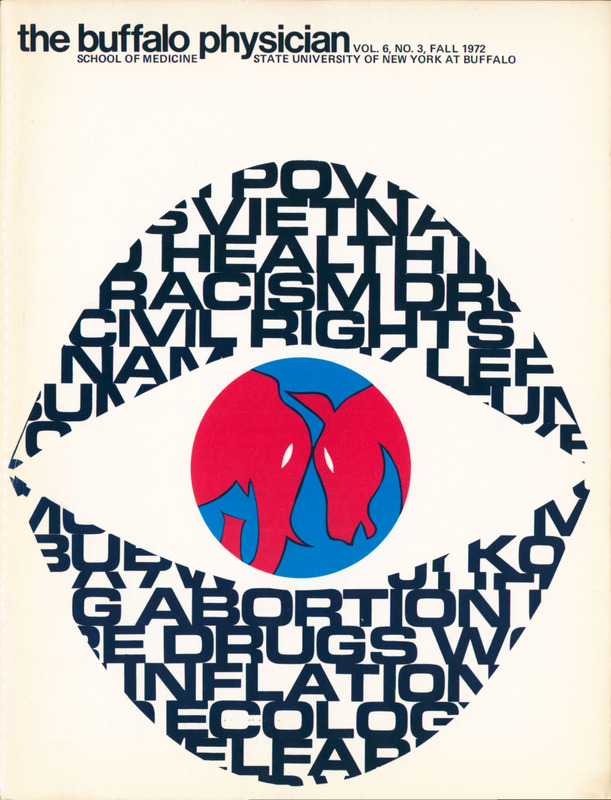
The cover design by Richard Macakanja focuses upon our national
election. Among the many campaign issues is the delivery of health
care.
THE BUFFALO PHYSICIAN, Fall 1972 — Volume 6, Number 3, published quarterly
Spring, Summer, Fall, Winter — by the School of Medicine, State University of New
York at Buffalo, 3435 Main Street, Buffalo, New York 14214. Second class postage
paid at Buffalo, New York. Please notify us of change of address. Copyright 1972
by The Buffalo Physician.
The Stockton Kimball luncheon.
Drug
Addiction
T H E PANEL on Modern Approach to Drug Addiction reviewed
a 20-minute New York State Health Department film on emergency
treatment of drug users. The film was taken over a nine-month
period at the Mt. Sinai Hospital (New York City) emergency room.
It showed patients coming off LSD trips and others with overdoses
of heroin and barbiturates. It was a moving, emotional film that
"told it like it is." It also showed follow-up person to person
talks between the patients and physicians, nurses and social workers.
In the discussion that followed Dr. Gary W. Healey, staff psy
chologist at the Masten Park Community Rehabilitation Center
said, "drug abuse is a complex, multifaceted problem. W e know
very little about the different types of addicts. We don't know
whether they have been taking drugs for two months or 20 years.
These facts are all very important to the diagnosis and treatment
of the patient.
"We must avoid relying on single uniform diagnosis and singu
lar treatment approaches. There are four distinct classes of drug
users — the experimenters, the recreational or social users, the
involved abusers (housewife on diet pills), and the dysfunctional
abusers which include the narcotics addict and non-opiate abuser
such as the methamphetamine abuser."
Dr. Healey suggests the multimodality treatment approach be
cause of the many differences that exist among drug abusers. This
approach seeks to determine what characteristics of a drug de
pendent person can be matched with a particular treatment ap
proach. This approach may also be used for non-narcotic abusers.
"There is n o universal addict o r drug abuser, but rather a
variety of drug dependent people who will respond only to a variety
of treatment approaches. That is why no single treatment approach
will work. It is a long-term process that may range from detoxi
fication to day centers."
2
THE BUFFALO PHYSICIAN
Dr. Oscar S. Lopez said we must change our concept from
punishment to treatment of the drug abuser. The Masten Park staff
psychiatrist stressed three facets — the chemical property of drugs,
personality of the patient, and the culture of the people. "Nation
ally there must be a change in the physician's prescribing of drugs.
The treatment of the drug abuser necessitates limiting drug en
forcement. There must also be changes in media concept and in
the medical school curriculum so graduates will know more about
the problem and how to cope with it."
The panel concluded the discussion by saying that there are
some centers available to send patients for treatment, but not
enough in Buffalo or any other community.D
Spring Clinical Days
Two attorneys and a dentist who are tax specialists, reviewed the
historical background of the "professional corporation" and its
benefits. They agreed that the tax shelter for earnings is the pri
mary purpose in forming such a corporation. "It also provides an
easier way for estate planning, limits personal liability and is not as
cumbersome as a partnership," attorney Raymond Roll, Jr. said.
He went on to say that a professional corporation is a legal entity,
must be operated like a corporation and that its principals must
be members of the same profession.
Attorney Jack Geller said, "we are not here to sell you
anything or badger you. Every individual has a different set of cir
cumstances. Do what is right for you. Not every physician needs a
professional corporation. We urge you to get advice from your
attorney and tax consultant. Make an individual analysis of your
Professional
Corporation
own situation.
"The employment contract is the key document of the profes
s i o n a l c o r p o r a t i o n . T h i s i s v e r y e s s e n t i a l if m o r e t h a n o n e p h y s i c i a n
is practicing. This document gives the corporation substance."
Mr. Geller went on to say that in the corporate plan you can
name your own officers, make your own investments as long as
they are prudent, name yourself as chief administrator and be an
individual trustee.
The panel listed other advantages of the professional corpora
tion such as health benefits, accumulative pension and profit shar
ing, life insurance, flexibility, the right to declare dividends and
the option to purchase a building. The panel also pointed out that
the professional corporation will not affect daily operations. But
during the first year of operation they emphasized the physician
must maintain close counsel with his tax consultant and attorney.•
Good food,
fellowship
CORPORATE VS. UNINCORPORATED PRACTICE
A Comparative Analysis of Economic Benefits and Tax Results
Gross Income of Professional(s)
Less general overhead and office staff cost
($20,000 general; $10,000 salaries - est.)
Corporation
Unincorporated
$93,000.00
$93,000.00
30,000.00
30,000.00
$63,000.00
Corporate
Salary . .
Personal Tax Exemptions and Deductions
Taxable Income
Federal Income Tax
$63,000.00
Practice
50,000.00
Income
63,000.00
10,000.00
10,000.00
$40,000.00
$53,000.00
12,140.00
18,590.00
$37,860.00
$44,410.00
Corporate "Fringe" Benefits
Profit Sharing Plan
$7,500.00
Life Insurance
500.00
Disability Insurance
2,000.00
Hospital Insurance
250.00
Total Corporate "Fringe" Benefits
10,250.00
"AFTER TAX DOLLARS"
$48,110.00
Economic Benefit from corporate practice over unincorporated:
Canadian
Abortion
Two panel members (abortion) Drs. Fortier,
Lippes, watch a demonstration.
$44,410.00
$3,700.00
"Health is the key to the Canadian abortion law that was modified
in 1967. It allows abortion when performed in a hospital after
approval of the hospital committee," according to Dr. Lise Fortier,
a gynecologist at the University of Montreal School of Medicine.
"The law as formulated can be interpreted any way one wishes to,
and hospitals are not forced to have committees. This makes for
a different kind of medicine depending on whether the patient
lives in a large city or village, whether she is French or English,
whether she attends a non-confessional or a Catholic Hospital.
We are still 25 years behind the United States in abortion, but we
are making progress. Twelve years ago we couldn't mention sterili
zation, abortion or contraception without a reprehend from the
medical society. Today we can automatically abort teenagers, all
mentally deficient women and those with physical problems."
Dr. Fortier believes the reluctance to abortion is more male
inspired than religiously inspired. "Medicine has been a man's
world, and only recently have women been accepted in medical
schools and graduated with M.D. degrees. The Canadian abortion
committees have been all male. Only recently have they included
one or two women on the committee. Our family planning clinics
have been all male. But we are making some progress in getting
women into these clinics."
4
THE BUFFALO PHYSICIAN
The gynecologist went on to say that for years physicians have
convinced women that pregnancy is normal, desirable and socially
accepted. "They have told women that not to have children is
bad. Pregnancy may not be a disease but often there are dreadful
complications, much uncomfortableness, and a higher mortality
rate after the 10th birth. Statistics show that the 10th pregnancy
is five times more hazardous than the first.
"Speaking as a gynecologist we must be sure that every woman
who ventures into pregnancy does so of her own free will with
knowledge of the dangers. Then every birth will be a happy and
desired event," Dr. Fortier concluded.•
Spring Clinical Days
Sarah Lewit, an associate of Dr. Christopher Tietze, director,
bio-medical division, The Population Council in New York City,
spoke about the early medical complications of legal abortion. She
reviewed the highlights of the Joint Program for the Study of
Abortion (JPSA) which received data on 73,000 abortions performed
in 60 hospitals and six clinics (not located in hospitals) in 12 states
and the District of Columbia between July 1, 1970 and June 30,
1971. The major findings and conclusions of JPSA are:
—While the type of patient most frequently seen in JPSA
institutions was a young, single, white woman pregnant for the
first time and aborted as a private patient, the proportions of
married, black, parous, and non-private patients increased signifi
cantly in the course of one year, with little change in the age
distribution of the women.
—About three out of four abortions were performed in the first
trimester of pregnancy, and the remaining one-fourth, at 13 weeks
or later; the proportion of early abortions increased substantially
over the year.
—Late abortions were most frequent among women under 18
years of age, nonprivate patients, black women, and mothers of six
or more children.
—Most abortions in the first trimester were done by suction
and most abortions at 17 weeks or later, by saline. Classical D & C
accounted for 4.5 percent of all abortions and hysterotomy and
hysterectomy together, for 2.4 percent. Over the year, the share
of the last three procedures was almost halved.
Legal
Abortion
The 1927 class
reunion dinner.
FALL, 1972
5
:~C
J&'$J§yS
Dr. Tarik Elibol's exhibit "Fiberoptic
Gastrointestinal Endoscopy" won third
place. He is a clinical instructor in
medicine at the University and on the
staff of Kenmore Mercy Hospital.
At the Stockton-Kimball luncheon
the Anthone twins, Drs. Roland
and Sidney, were presented with
special awards of appreciation by
the Medical Alumni Association.
The citation: "For his outstanding
leadership and years of dedicated
service to the School of Medicine
and the Medical Community
—The incidence of early medical complications, including
minor complaints, during the first trimester of pregnancy was on
the order of one in 20 abortions; the risk of major complications,
as defined in this report was one in 200 abortions.
—The risk to health associated with abortions was about
three times as high in the second trimester of pregnancy as in the
first trimester.
—Complication rates were higher for abortions performed at
6 weeks' gestation or less than at 7-10 weeks' gestation, especially
for major complications. However, the risk to health was far
smaller for the earliest abortions than for abortions in the second
trimester.
—As might be expected, the risk of postabortal complications,
and particularly major complications, was higher for women with
known pre-existing complications than for apparently healthy
women.
—Nonprivate patients had significantly higher complication
rates than private patients, especially for abortions in the second tri
mester.
—Complication rates were lowest for abortions by suction,
followed in ascending order by classical D & C, saline, hyster
otomy, and hysterectomy.
—Complication rates in the second trimester increased marked
ly with age of woman and parity; for the first trimester, there was
no association with parity and a slight downward trend with age
of woman.
—The incidence of complications increased markedly when
abortion by suction or D & C was combined with tubal sterilization,
except for sterilization by laparoscopy.
—Complication rates for abortions by suction were lowest at
7-8 weeks' gestation, from which point they increased steadily to
15 weeks or more; this trend was repeated with minor irregularities
for specific types of complications.
—Complication rates for abortions by suction, excluding
women with pre-existing complications and/or sterilizing opera
tions, were lower for clinics than for hospitals and lower for hos
pital outpatients than for hospital inpatients; these differentials
were due in part to variations in periods of gestation and in type
of service (private vs. nonprivate). Other factors which probably
contributed to the differentials were: (a) more rigorous selection of
patients, (b) greater experience of physicians, and (c) less complete
recording of complications.
—Local anesthesia was associated with a higher incidence of
complications than general anesthesia at each period of gestation
among patients aborted by suction, and with a notably higher rate
of repeat curettage.
—Complication rates for abortions by suction declined approxi
mately fifty per cent from the third quarter of 1970 to the second
quarter of 1971.•
6
THE BUFFALO PHYSICIAN
t
The 1962 class
reunion dinner.
In 1971 there were 9,462 abortions performed in Erie County
(55 per cent in hospitals), according to Dr. Emma Harrod, Deputy
Commissioner of Health in Erie County. "Women can have an
abortion performed in Erie County safely and quickly. The cost
($250 to $700) is often a big hurdle for the poor women who
are not covered.by medicaid or insurance. There has been an over
whelming demand for this service, not only in Erie County, but
nationwide."
Local
Abortions
Dr. Harrod went on to point out that in spite of more younger
childbearing age women in the last 20 years, there has been a
decline in the birth rate and fertility rate by 33 per cent. "The rapidly
declining birth and fertility rate began long before abortion services
were available. The abortion law has facilitated this decline by
providing another method of fertility control. However, the chang
ing attitude toward family size and the availability of family plan
ning resources have contributed to this decline."
In closing Dr. Harrod compared the Erie County birth rate of
1 5 per 1,000 with the death rate of 7.5 per 1,000. " W e still have
some way to go before things are stabilized," she said.D
Cancer of the face or carcinoma of the skin, the most frequent
form of cancer, was reviewed by four physicians. There are over
100,000 new cases a year but there is now a 95 per cent cure rate,
according to Doctors John Quinlivan, Gorden H. Burgess, Joseph
R. Connelly and John T. Phelan. They agreed that the successful
treatment of skin cancer depends on a team effort. "Get all the
professional heads together — dermatologist, pathologist, radiolo
gist, plastic surgeon, and chemo-surgeon — and plan the treatment."
As slides of the skin cancer patients were shown, the four
experts discussed the various types and suggested treatment. Most
of the time they agreed on the treatment, but occasionally there
were differences.
Basal and squamous cell epithelioma are the two most com
m o n f o r m s o f s k i n c a n c e r . Early- d i a g n o s i s i s i m p o r t a n t . W h i l e
basal cell exhibits slow growth it can be destructive as it invades
vital areas. However, it never metastasizes as does the squamous
FALL, 1972
Skin Cancer
The cancer of the face panel (sitting)
Drs. Corden H. Burgess, Joseph R.
Connelly, John T. Phelan, and John
Quinlivan (standing).
Drug
Ramifications
cell type that has a five to ten per cent rate and is therefore the
most dangerous. It invades underneath the skin, can ulcerate, and
be covered with a crust.
Carcinoma of the skin, it was explained, is usually caused
by solar changes, to areas of the body exposed to sun. Protection
by a beach umbrella will not afford sufficient coverage, for the
body still receives a high amount of radiation.
Most susceptible to this form of cancer are the Kelts (the Scots
and Irish) who exhibit a high incidence of skin cancer. Many of
these people immigrated to the United States, New Zealand and
Australia. How does sun damage lead to skin cancer? It is the
effect of ultra violet light that forms a bridge to the DNA molecule
which is then incapable of forming a reasonable message. The
outcome — the forming of clones of cancer cells.
Says Dr. Connelly, "the large recurrent local tumor cells have
the identical invasive features of basal cell carcinomas." Dr. Phelan
agreed with him in that the whole area of a tumor field must be
excised following a program of chemotherapy which in itself
requires certain skills.
But the panel emphasized that it was no longer necessary to
estimate the range of the tumor field involved in carcinoma of the
skin. With microscopic control now a reality by the pathologist,
there is a good cancer procedure available.
Also discussed were lesions on the nose, eyelid, lip and cheek
in which all agreed that when there are deepseated tumors, one
must forget the cosmetic appearance of the patient and go for the
"wide excision." Another pointed to the necessity of checking
for lesions to other organ systems as well as the obvious one. For
out of 50 cases there were three in which lesions were found in
other areas as well.
In the Buffalo area the basal cell lesion is the more prevalent.
A warning to use a SUN SCREEN for those with light colored hair
and eyes, who freckle easily, and are in jeopardy from heavy solar
radiation was also given.
Sailors, farmers, sun bathers and construction workers are most
prone to skin cancer. The top of the ears and head, the tip of the
nose and chin are the areas most exposed to the sun. The lips,
cheeks, eyelids, and neck are other areas of concern.•
Three attorneys and two physicians discussed the Medical and
Legal Ramifications of treating patients with new and experimental
drugs. Attorney Daniel T. Roach said "the Doctrine of Informed
Consent means that you as a physician advise your patient on the
consequences of a drug or surgery. A patient is entitled to know
this. In some cases you may want some formal written statement
from your patient. With new and experimental drugs no one knows
all the side effects, but you must tell your patient all that you know
about the drug at the time he takes it."
Dr. John Webster said that very often "informed consent" is
impossible. "I believe that every physician must assess each patient
and then decide how much information the patient needs. The
8
THE BUFFALO PHYSICIAN
physician must decide whether the information will do the patient
any good. If you aren't sure of the consequences of a new drug,
tell your patient. At Roswell Park we do get the consent from
patients before treatment and experimentation."
Attorney Roach said, "We need better ground rules and stand
ards for malpractice suits. We must get away from a lay jury
second guessing physicians two or three years after something
happens. However, you can't have a set of rules that covers every
case. There must be better ways to resolve these cases in the next
few years."
Dr. Jack Zusman said, "there are not adequate medical stand
ards and ethics. Even those outlined by the AMA are inadequate
and it is often left to the attorneys to decide and interpret. We
definitely need more guidelines on advice and consent." He went
on to say that experimentation must be carried on by all M.D.'s —
not only in a hospital or institution. "We need guidelines and pro
tection of the M.D. for research. The key question is the welfare
of the individual vs. the welfare of society. The patient doesn't
want to be experimented with only as a last resort. Society on the
other hand wants experimentation to continue as long as it isn't
on him. The physician is caught in the middle of this conflict
and held legally responsible."
Attorney William A. Carnahan said "the medical profession
has not set its own standards to guide its destiny. I believe the courts
would buy your own ground rules if you are honest and reasonable
in the treatment of your patients. Until the medical profession
takes an interest and decides on how to police itself, the courts
will do it in a way that is not satisfactory to the physicians. Of
course there is never a problem in experimental drugs if the treat
ment is successful.
"You are not judged by the realities of everyday practice, but
rather what the law considers the realities should be — and this is
the nub of the problem," Mr. Carnahan concluded.•
The panel on new developments in the delivery of health care
agreed that American medicine is faced with one of its greatest
challenges. "The crisis is of such magnitude and importance that we
cannot be allowed the luxury of opinion. What is needed is plan
ning and evaluation. Plans must be evaluated as to completeness,
comprehensiveness, quality, cost and efficiency," Dr. Timothy F.
Harrington, chief resident, Family Practice Center, Deaconess Hos
pital said.
Today's physician is often called on to do counseling. "Let
the physician who wants to counsel do so. But also let the physician
who does not choose to counsel still provide for his patient's
needs. Make the latter aware of the need and let him refer such
problems to a competent party. We must decide what the physi
cian can do well and let him do it. But let's not forget the total
welfare of the patient."
Dr. Harrington suggested the team approach to medical care.
"It is time that we decided that physicians cannot be all
things to all people, but they can be the entry point for providing
FALL, 1972
9
Spring Clinical Days
Drs. Ernest Haynes (sitting) and Hi
ram B. Curry discussed "New Devel
opments in Health Care Delivery."
Health Crisis
Dr. lames C. Dunn, exhibits chairman,
congratulates Paul H. Wierzbieniec
(class of 1974) for runnerup in the
exhibits. The "Chronic Pulmonary
Diseases" exhibit was prepared with
the help of Dr. Mario Montes, a clini
cal associate professor of pathology at
the University. He is on the Buffalo
General Hospital staff.
Personal
Touch
services outside their sphere of interest or competence. We must
stop pretending that we like to listen to social problems, if in fact,
we do not, and say to the patient "I cannot help you with this,
but Ms. X can and I will arrange for her to see you." This is pro
fessional honesty and is not passing the buck, it is seeing that the
patient receives needed care.
"To use this approach requires extraordinary people. People
who know their limitations and are able to work together. It is not
always easy to relinquish a "part" of a patient, but sometimes
it must be done if total care is to be achieved. Many physicians in
practice do this easily and refer patients to pastors, counselors and
other experts as a matter of routine. What is needed now is an
extension of this practice to physicians who have not yet done so,
without making the physician feel he has failed."•
Dr. Hiram B. Curry said the public has lost confidence in our pro
fession because physicians have not responded to problems that
lead patients to better health. Dr. Curry is professor and chairman
of family practice, Medical College of South Carolina. "Family
practice as a specialty offers the best vehicle for change, the best
opportunity to resolve the current imbalance in medical care, and
to meet the needs of families and individuals. Today there are 101
family practice programs and 665 family practice residents in
the United States," he said.
"The public wants comprehensive care with continuity and
concern. There must be a personal touch and communication
between the sick and the physician. An affluent society is not
an easy one to satisfy. The more it has, the more it wants. People
want what they want when they want it. We must meet this chal
lenge.
"The imbalance in the ratio of primary to secondary and
tertiary physicians is the greatest impediment to providing excellent
health care and a leading cause of inefficiency. Society is challeng
ing the medical profession to organize its services so as to render
comprehensive care to persons, to coordinate generalist and spe
cialist and to efficiently utilize bed and ambulatory, acute and
10
THE BUFFALO PHYSICIAN
Spring
Clinical
Days
The 1922 class reunion dinner.
chronic, diagnostic, curative, preventive and rehabilitative facili
t i e s . If t h e h e a l t h c a r e s y s t e m is t o w o r k e f f i c i e n t l y t h e r e m u s t b e
a workable balance between the problem and the solution. The
complexity of the problem must be matched with the training of
the medical personnel attending the patient. To have a highly
e d u c a t e d a n d skillful p h y s i c i a n e v a l u a t e a p a t i e n t w i t h a s o r e
t h r o a t is w a s t e f u l . It is l i k e h a v i n g a P h . D . m e c h a n i c a l e n g i n e e r
change the tires on your car. No society can wisely afford such a
health care system," the South Carolinian said.
In c o n c l u s i o n D r . C u r r y s a i d w e m u s t p e r s u a d e m e d i c a l s t u
d e n t s t h a t t h e " g o o d l i f e " is t h a t o f t h e f a m i l y p h y s i c i a n . T h e n o u r
graduates will flock to this type of program and this will eliminate
many of the complaints of the public.D
" T h e d a y o f s t a t u s q u o i n h e a l t h c a r e is o v e r . C h a n g e is t h e
key word and medicine must assume a more responsible leadership
role in working more closely with the other health professions
in the implementation of new programs and systems of health care
delivery. We talk a lot about the health team concept, but the team
is n e v e r t a u g h t . W e a r e d o i n g v e r y l i t t l e o n t e a c h i n g h e a l t h p r o
f e s s i o n a l s t o w o r k t o g e t h e r . " T h a t is w h a t D r . J. W a r r e n P e r r y , d e a n
of the School of Health Related Professions at the University told
the 100 physicians attending the Saturday morning session. He
w e n t o n t o s a y t h a t if h e a l t h c a r e c e n t e r s d o n ' t c h a n g e , t h e f e d e r a l
and state governments, augmented by consumer support, will force
c h a n g e s in t h e h e a l t h c a r e s y s t e m .
"Federal programs are being designed to respond to some of
these needs and manpower resources are being identified for the
strengthening and development of the educational and clinical
programs for the allied health professions."
D e a n P e r r y p o i n t e d o u t t h a t h e a l t h is a p o l i t i c a l i s s u e t o d a y .
He listed several other significant changes on the national scene:
—Regional Medical Programs are no longer oriented only to
medical research programs of heart disease, cancer and stroke.
T o d a y t h e m a j o r e m p h a s i s is t o w a r d s y s t e m s o f h e a l t h c a r e d e l i v e r y
and the coordinated approach to these along with availability of
care and emergency of care;
FALL, 1972
11
nnj
T) 1 '
-L fOo
± Ol/TTZLS
r
j 1
OT
j j
1J.6CllT10
Spring Clinical Days
—the VA hospitals are changing to a health care center with
out-reach programs and out-patient services to veterans and their
families; the 155 VA hospital centers represent the largest health
care delivery service in the nation;
—100 Health Maintenance Organizations (HMO's) projects have
been funded and are operating although no legislation has been
approved;
—114 new career programs — physicians assistants, specialty
programs — have been funded by the federal government, but
none in this area;
—the federal government is moving into new systems of health
care — HSO's, HCC's, AHEX — and one or more of these may be
the new design of the future for health professionals' new careers
and specialty programs;
—the Bureau of Health Manpower is one of the largest sections
of the federal government. There are five manpower divisions in this
bureau
physicians, dental, nursing, allied health and interdisci
plinary relationships among all fields;
—there are 72 colleges and universities in USA with divisions,
schools or departments of allied health. There were only 15 five
years ago.
"The National Academy of Science has just establishd its Insti
tute of Medicine. Its first task will be to look at interprofessional
relationship of health professionals. They will coordinate this proj
ect with AMA, AAMC and others. In the planning stage is the first
national and international conference on health professional inter
disciplinary education."
On the state level Dean Perry said there are 40 community
colleges in the state system that have divisions of allied health.
He went on to say that New York State has the largest educational
commitment to allied health training in the world.
In conclusion Dean Perry said "the hub of the health delivery
system of the future must continue to be the hospital even though
there is a shift in emphasis from acute and intensive care to compre
hensive care involving satellite clinics. We must also utilize all the
health manpower available to do a better job."D
AdmissionSj
Facultyj Budget
Drs. Bart A. Nigro, M'20,
Herbert f. Wells, M'15,
Walter
C.
Haywood,
M'15, and Thurber E.
LeWin, M'21.
Admissions, budget, faculty recruitment, and emphasis upon
health care delivery (as opposed to research) are major concerns
of the Medical School, according to Dr. Clyde Randall, acting dean.
He is also vice president of the Faculty of Health Sciences.
"We are sorry that your son or daughter can't get into your
school, but they are all candidates for the following year (1973).
We had 4,200 applications for 135 places, and 600 have already
been interviewed. There is emphasis on recruiting capable minority
students and those who are economically deprived. We have six
equally capable candidates for every one of the 135 places in the
first year class.
Mrs. Stockton
Kimball
at the annual luncheon.
"We are tooling up for the team concept of health care, which
you know is a national trend. The recruitment of qualified faculty,
a new Medical School dean and a new vice president for Health
Sciences, is also high on our list of priorities."
Dr. Randall pointed out the difficulties in competing with other
departments of the University for money, when so many people
think the Medical School already gets too much of the university
dollar. He pointed out that it costs twice as much to train a physi
cian as a Ph.D. He also cited the acute space problem which won't
improve until more space is available on the main street campus.
This will come about only when other schools and departments
move to the Amherst campus. Medical School classes have in
creased from 100 in 1952 to 135 in 1973, but we have had no
additional space.Q
In his Stockton Kimball lecture, entitled "Health Care and Edu
cation," Dr. Robert J. Glaser, Vice President of The Common
wealth Fund, addressed himself to the general problem of health
care delivery. He enumerated some of the factors which have
contributed to the current health care crisis, including the lack of
adequate planning on the part of government, medical educators
and physicians in general. "Despite the accumulation of data after
World War II that called attention to the impending physician
shortage, relatively little was done about expanding medical school
enrollments, and decreasing the period of training. We paid little
attention to health care delivery or to the ambulatory patient,"
Dr. Glaser said.
The enormous growth in support for research, and the result
ing expansion in the body of knowledge brought new opportuni
ties in medicine and helped focus the public's attention on the
whole subject of medical care. "Yet until very recently, the voice
of the consumer has not been heard, and relatively little attention
has been paid in most medical circles to health care delivery —
especially ambulatory care. One notable exception has been the
Kaiser-Permanente Medical Care organization," the former Stanford
University Medical School Dean said.
"In the university medical centers particularly, emphasis has
been placed on the care of patients suffering from acute, episodic
FALL, 1972
13
Health Care,
Education
Visiting between sessions.
disease. This is obviously an extremely important area, and one
which deserves continuing attention. Yet at the same time, health
maintenance merits far more attention than it has received in the
past. The care of the whole family must be made more attractive
to medical school graduates.
Dr. Cloutier congratulates Dr. Claser
on his excellent address.
Dr. joseph C. Lee, professor of anat
omy, receives his plaque from Dr.
Dunn for his winning exhibit "Frac
tionation and Transplantation of Ex
perimental Intracranial Tumors."
"In our educational programs, we must begin to take into
account factors that will impinge on health care delivery. A major
consideration in this respect is the application of technology. For
example, the computer has been introduced into medicine in a
significant way. It is incumbent on us to determine how the ap
plications of technology can enhance medical care. At the same
time, we must not lose sight of the economic factors — we must
avoid unnecessary duplication and the application of high cost
technology which cannot be justified in terms of the benefits pro
vided. For example, every hospital should not do open heart
surgery. It is too costly and an unnecessary duplication of service
and personnel. In New York City, 17 hospitals perform open heart
surgery, and three hospitals do 85 percent of the surgery.
"We must continue to concern ourselves with the expansion
of the health manpower pool. Not only do we need more physi
cians and paramedical personnel, but we must learn how to deploy
them efficiently and how to organize health care teams. Although
the physician will play a key role, we must mobilize talent of
many others (law, political science, bio-medical scientist, engineer,
economist, system analysis, and other health professionals). The
university is the ideal focal point for this mobilization.
"We must recognize that new knowledge will continue to
accrue; as we learn more about cause and treatment of certain
diseases, the health care system will be affected. For example, the
advent of a successful means of preventing poliomyelitis has erased
dramatically the need for acute care facilities during polio epi
demics as well as the need for long term rehabilitation facilities.
"It seems certain that some form of national health insurance
will be enacted in the relatively near future. Attention should be
paid to the impact of such a program on the demand for health
care and on the mechanisms by which that demand can be met.
"Finally we must pay more attention to public education. In
many instances the public understands very poorly what medical
care has to offer and what it does not have to offer; particularly
the public lacks understanding about the ways in which the indi
vidual himself can improve or protect his health status. For example,
the deleterious effects of smoking on the incidence of heart disease
and lung cancer are well documented. Yet the populace continues
to use tobacco in increasing amounts. This reflects a failure in our
educational effort. Similarly, sensible diets, adequate exercise and
other relatively simple measures, if applied widely, could do much
to decrease the morbidity and mortality of certain forms of heart
disease. F)ere again, we have been inadequate and ineffective in
getting the measure across to the public.
"We can do a lot for ourselves and the public can do a lot
for itself in preventive medicine, and this is very important to a
better health care system," Dr. Glaser concluded.•
14
THE BUFFALO PHYSICIAN
Dr. Sarah Nunneley will soon be measuring the effects of gravity
and exercise on man's heart and respiratory systems in the new
Laboratory for Environmental Physiology. The assistant professor
of physiology is a pilot and former flight surgeon at NASA's Flight
Research Center in the Mojave Desert near Los Angeles. Her work
as a flight surgeon was part of a three-year program at Ohio State
University where she received a master's degree in preventive
medicine. She has her medical degree from the University of
Minnesota. As an undergraduate at Mount Holyoke College she
was fascinated with space ships. Her parents and professors thought
she must be crazy to consider a career in areospace medicine.
Since joining the Medical School faculty in September of 1971
Dr. Nunneley has lectured students on the effects of gravity, ac
celeration, and the impact of jet fatigue or crossing a number of
time zones in a short period of time. She is also part of a research
team studying the effects of gravity on both animal and human
subjects. This will be d o n e in the new lab when the centrifuge is
completed. It is the only o n e of its kind specifically designed to
measure the physiological effects of increased gravity on man.
"From this research we hope to learn more about what
constitutes physical fitness, what exercise improves health and how
much exercise should be done by heart patients and others with
similar ailments. After studying the effect of increased gravity on
healthy people we hope to be able to apply our knowledge to
people who faint," Dr. Nunneley said.
Dr. Nunneley is not particularly excited by flying, although she
is a licensed pilot. "I consider it just like driving a car but I am
fascinated by all types of airplanes and space ships."•
Dr. Nunneley
Flight Surgeon
Studies (gravity
Dr. Ranney Honored
Dr. Helen M. Ranney, professor of Medicine at the University, was
among 36 recipients of the first Reverend Dr. Martin Luther King, Jr.
Medical Achievement Awards in Philadelphia April 11. The awards
banquet is sponsored by the Philadelphia Chapter of the Southern
Christian Leadership Conference. Dr. Ranney received the award
for her research in sickle cell anemia. She joined the Buffalo
Medical School faculty in 1970. She is a 1941 cum laude graduate
of Barnard College and received her M.D. from the College of
Physicians and Surgeons, Columbia University in 1947. Before com
ing to Buffalo Dr. Ranney had been on the faculties of three
medical schools — Albert Einstein, Columbia and Yeshiva. She has
also served in several hospitals in the New York metropolitan area.
Dr. Ranney has authored or co-authored 50 papers and articles
o n h e m o g l o b i n . S h e i s b a s e d a t t h e E. J. M e y e r M e m o r i a l H o s p i t a l ,
but also has teaching assignments at the Buffalo General and Veter
ans Administration Hospitals. Co-chairmen of the awards banquet
were Governor Milton J. Shapp and Muhammad Ali; honorary chair
m e n w e r e M a y o r F r a n k L. R i z z o a n d t h e R e v e r e n d D r . R a l p h D a v i d
Abernathy.Q
FALL, 1972
15
Dr. Ranney
Final instructions.
The Marshals, charged with the conduct of the class day exercises
at the Medical School, led the 126th class to be granted the degree,
Doctor of Medicine, to their seats. The families of the 120 graduates
— parents, wives, and infants — were waiting in Kleinhans Music Hall
to share the traditional but awesome proceedings with them.
Challenges to
Faculty., Graduates
by
GARY H. LYMAN
President, 1972 Class
I appreciate this opportunity to convey some observations on our
medical education and to express both gratitude and a challenge
to each of those involved in this process. As a class we have ex
perienced much over the duration of the past four years . . . most
of it good, some of it less so. We have seen a vitalization of the
medical curriculum, an increased enrollment of minorities in con
trast to the pallor evident in our present graduating class, and we
have witnessed an increased awareness of major health issues
among younger health professionals. Yet, unfortunately, many of
these positive changes have been offset by the narrowing of per
spective at the University level through the appointment of a
provincial president and subsequently the departure of the dean
and assistant dean most instrumental in implementing these changes.
Only with time will we know if this trend will extend into the
selection of the new dean.
But this is not the time or place for us to debate the correct
ness or incorrectness of these decisions made over the past few
years but rather a time to reflect on our educational experience in
the hope of some insight into those factors by which we have
benefited and into others that should be changed.
So I will briefly direct my comments — both of thanks as well
as challenge to the three principles involved in our education —
the administration, the faculty, and, we, the graduating class.
To the administration and others involved in the coordination
of our education I would like to extend our sincere gratitude.
We readily realize that most of what you do for us goes unnoticed
16
THE BUFFALO PHYSICIAN
until something goes awry. But we truly appreciate your help in
assisting us in the scheduling of course work and in guiding and
promoting our search of internship appointments. I'm sure that the
full significance of your endeavors will not be realized until we
ourselves assume similar administrative positions.
To the administration I offer two challenges. First, I would like
to see you play a more direct role in the medical education
process. By this I mean that first of all you should involve the
students more directly in your affairs including that of decision
making. You must not be afraid to allow the students to play signi
ficant and decisive roles in the formation of school policy, ad
missions criteria, and curriculum reform. What the student lacks in
experience he may make up for in his direct contact with other
students and in his direct involvement in the educational process.
He probably knows better than anyone else how good a course is,
what new courses he needs to complement his education, and
which should be altered. I would also ask the administration to
have more faith in the ability of the students to make thoughtful
and informed decisions of a policy nature. This, I think, should all
be considered as an important phase of our education. As I said,
many from this class will sooner or later hold positions of respon
sibility as administrators. It appears that the physician is being
forced more and more into such positions of responsible decision
beyond that of patient care. So I believe that the time to start train
ing for this responsibility is during medical school and not later
when he won't have the trained supervision to guide his decisions.
The second challenge I offer the administration is not to wait
until there is overt hostility before taking action. You must be open
to change and willing to consider student proposals before open
confrontation is necessary.
The hooding of class president Gary
Lyman by Drs. Philip Wels and
Donald Rennie.
To the faculty I would like to extend the class' thanks and
appreciation for days and weeks spent, often with little compen
sation, in instructing us and guiding our interests. Certainly this
education is only possible because of your efforts. We only hope
that we can in turn pass on some of this knowledge to others
with the dedication you have shown.
To the faculty, I also offer two challenges. First, I would
challenge you to be open to changing medical perspectives and
to recognize that we need to train not only competent scientists
but sensitive physicians with a broader concept of social respon
sibility that extends beyond that of simple physical disorders. Most
of us will be involved in the continuing care of people helping
them to solve problems of a diverse nature. We must all come
to realize that the problem of good health care is not merely
that of a localized disease.
But it is the poverty that prevents proper clothing and nutri
tion; to the inadequate education that delays the seeking of
proper medical care; it is the social injustice that allows improper
housing with lead paint on the walls and rats in the basement;
it is the commercial pollution that poisons our lungs and our
food; and it is the immorality of a war that maims and murders
in the name of peace and justice.
FALL, 1972
17
.
The Lakes Area Regional Medical
Program's
Telephone
Lecture
Network worked overtime during
the lune floods. The TLN was the
only means of communications
for the hospitals at Wellsville,
Hornell and Bath. It was also used
by the VA Hospital in Bath to
communicate with Washington,
D. C. officials.•
It is the system that assumes that the physician's primary
duty is not that of keeping you well but getting you well when you
are obviously ill; in which the physician is asked to rely for his
livelihood on those that not only come to him sick but must pay
to get well; and in which the most successful physician is he who
sees the most patients, charges the highest fees, and keeps his pa
tients sick the longest.
Secondly, I would ask the faculty not to squelch but instead
to direct and sustain student idealism. This idealism needs support
and guidance, not sarcasm. From the first year we have periodically
encountered the attitude that idealism is a dirty word. However,
directed and informed idealism is the quality that generates needed
change in institutions that have become static and ineffective.
Many of you share our idealism, but also many of you have gone
through the same dampening process as we have. We've been told
to face reality and to protect ourselves in the competitive outside
world. But I have come to believe more and more that man's great
est potential and perhaps a physician's greatest responsibility is to
actively create the world in which he lives and not simply be a
passive interactor with fate.
To my fellow graduates, I want to extend thanks for four years
of friendship and increased awareness. I have been impressed not
only with your ability to learn quality medicine but more, I think,
with the wide range of interests held beyond the confines of the
hospital. You have made me realize more than ever that a good
physician is not one who simply memorizes many medical facts
but who blends his knowledge with an awareness of the value
of life in the broadest sense.
To you I offer the challenge of radicalism. Flere I don't neces
sarily mean protest marches and draft board raids, although I
certainly wouldn't rule them out. What I mean is that none of us,
as we go into whatever area or situation to use what we've
learned, should accept the health care and social situation as it
exists. Radicalism is the fervent discontent with the way things have
been that goes beyond simple talk to action directed at changing
the situation. Whether you end up in a plush suburban practice
or in a free clinic in the inner city, medical care in this country
must be improved and more evenly distributed, social situations
must be altered, and lethal governmental policies must be elimin
ated. No matter how good a particular situation may appear, we
must remain sensitive to areas of possible improvement, especially
in the quality and distribution of health care to everyone.
I guess my biggest fear is that we might fall into the trap of
complacency. The complacency of: "Well, it isn't that bad," or
"Well, what can I do, I'm only one person?" "It might not be per
fect, but it's better than elsewhere." How can we ever become com
placent when in the wealthiest country in the history of the world,
we are currently 13th in maternity death rates, 18th in male life
expectancy, 11th in female life expectancy, and our infants die at
twice the rate of the Scandinavian countries. How can we ever
become complacent when the giant $12 billion dollar private health
insurance industry pays only 1/3 of the total cost of private health
18
THE BUFFALO PHYSICIAN
care leaving 2/3 to be paid out of the pocket of the patient at the
time of his illness and in the words of Senator Kennedy; "minor epi
sodes of illness become heavy financial burdens and serious illness
is transformed into enormous debts and even bankruptcy. Those
who can pay for care find themselves priced out of the market and
for millions of Americans in rural areas or inner cities, care is just
not available at any price."
The minute we stop searching and challenging for new and
better alternatives; that moment we begin to grow old and decay.
And, although awareness of t h e situation is t h e first step, w e must
not stop there but we must prosecute with all our effort the
changes that are necessary. The sedate acceptance that seems to
pervade any long established institution certainly has not evaded
the medical profession and the American Medical Association has
long served as an outstanding example.
So, in conclusion, my challenge is not o n e of mere question
ing and sensitivity to the health care problems around us, but one
of action; an actual direct encounter with the issues and problems
involved. Don't be ready to accept the status quo and fall back
into a state of self-complacency, but actively seek change in a direc
tion of improved and equality health care in the widest sense,
realizing that until all people are free of hunger, poverty, oppres
sion, and war will we be able to say that we are satisfied.•
"Dr. Randall, Fellow Members of the Faculty, Graduates, Parents
and Friends . . .
I must begin by thanking the students for this honor. I know
of nothing that could possibly give me more pleasure or have more
meaning to me than this dedication, even though I don't deserve it
. . . no one person does. I believe this gesture reflects your ap
preciation and perhaps a little affection for the Staff of the De
partment of Pediatrics, our House Staff and Children's Hospital.
I almost feel like I'm graduating again myself. My wife and
children are here and so are my own parents along with yours and
I'm just as nervous now as I was then . . . or perhaps even more
so. I wondered then, as you are wondering now, what would
become of me as a physician. How would I react with my first
patient when there wouldn't be anyone around to countersign
those orders? What would I do after my internship? I have a very
close friend with whom I grew up. We went through high school
together and then entered the same University, he in business
a d m i n i s t r a t i o n a n d I, i n p r e m e d . A f t e r g r a d u a t i o n , h e w e n t o n
to graduate work in accountancy and finally into his father's busi
ness, a fairly large steel pipe industry which he soon found himself
running, due to the untimely death of his father. Meanwhile, after
my internship, I trained in pediatrics, then a fellowship in genetics,
the last year of which was spent in London, England. Naturally, I
had not yet earned a farthing of income. That year, my friend
came to England on a business trip and arrived in the laboratory
to visit me. After the usual tour of the department, a department
FALL, 1972
19
Response to
JS/ledentian
Dedication
by
RONALD G. DAVIDSON,M.D.
Professor of Pediatrics
of biochemistry by the way, he asked me to tell him what I was
actually doing. So I went to the blackboard and told him all about
genes, and chromosomes, and funny looking enzyme bands on
starch gels, and after I finished my dissertation, he looked at me
for a few seconds and said "Ronnie, what are you going to be
when you grow up?"
Well, in many ways I hope I never grow up, and I tell you
this little story to emphasize the vast number of opportunities
available to you as physicians. As each year of your training begins,
regardless of what you do, you will be faced with the major
decision, what next? You will worry and sweat, weigh the pros and
cons, develop your post prandial and prechordial pains, but try
to remember, almost all your decisions lie among a large group
of good choices — there are hardly any bad ones, so do your
thinking and relax. Those kinds of decisions are indeed important,
but whatever you choose you will be right, and you can proceed
with gusto and no real need to grow up, if growing up means
that you cease to feel excited by whatever you do and that you
cease enjoying your work.
Dr. Davidson
i
If "not-growing-up" is to be my theme, let me illustrate that
notion again, this time by telling you about a study comparing pedi
atric interviewing skills of freshman and senior medical students,
carried out at the University of Colorado Medical Center in Denver.
They used video-taped interviews with programmed mothers —
by that I mean, young women who were given a set of information
about a supposed child with serious organic disease and related
psychosocial problems. The aim of the study was to test the hy
pothesis that freshmen would obtain more interpersonal and less
factual information from mothers of sick children than would
seniors, who would have "grown-up" in the system. The results
clearly indicated that, indeed, freshmen obtained significantly more
interpersonal information — like the effect of the illness on the child
and the family, and they asked fewer leading questions. Seniors
obtained more facts. Now that is not very startling. But let me give
you an anecdote from the study. One programmed mother was
supposed to have a three year old retarded child with meningomye
locele and hydrocephalus, severe defects of the central nervous
system. She was also supposed to be both three months pregnant
and most concerned about the outcome of the pregnancy. Not one
senior discovered those latter facts, the pregnancy and the worry,
in his interview. The first freshman asked, "Are you going to have
any more children?" After learning of her pregnancy, he replied,
"you must be worried that you will have another baby with the
same problem." Clearly the freshman knew little of organic disease
and had to talk about something, but the study suggests a very
worrisome possibility, that as medical students move through their
training, a certain degree of their innate ability to communicate
with mothers of sick children, and, of course, with patients in
general, is programmed out of them by the desire to obtain factual
information. So don't "grow up," if it means to lose your com
passion for the family in your haste to solve the most immediate,
the most apparent, medical problem.
20
THE BUFFALO PHYSICIAN
Finally, a subject that must surely be covered in every talk
to every graduating class: how little you know today, how much
more there is for you to learn, how important it is for you to con
tinue your medical education. The problem is how. I certainly
don't know the answer to that one and I am sure you will find
ways to d o this. I mention the problem, although it is almost
cliche, perhaps to justify some of the gadgetry; the TV, com
puters, sound/slide lectures and so on, that you have used in
p e d i a t r i c s a n d i n o t h e r d e p a r t m e n t s . D o n ' t s t o p u s i n g t h e m . If
you are practicing near a center where these teaching aids are
available, keep at them. While you are waiting for that baby to
appear at three o'clock in the morning, run through a tape on
"what's new with resuscitation of the newborn," or whatever
else you feel you need to review at that moment. I don't mean to
imply that programmed learning is the answer to continuing med
ical education, but it certainly can be helpful, especially with the
developing techniques for immediate self-evaluation and identifica
tion of various areas of weakness. Don't "grow up" to be so
sophisticated that only a week of high-powered lectures at Harvard,
or Hopkins or Buffalo is your only form of graduate education.
Lest you think that all my thoughts are with the graduates today,
let me add a final word of advice to the rest of the assemblage:
as we proudly watch these young and eager physicians take up
their internship posts and await that first patient of their very own,
I suggest to you, parents and friends, here and across the country,
t h a t if a t a l l p o s s i b l e , if t h e r e ' s a n y t h i n g y o u c a n d o t o a v o i d i t ,
don't get sick in July!"•
"Today it is my privilege to express to each of you the congratu
l a t i o n s a n d t h e b e s t w i s h e s e a c h o f t h e F a c u l t y w o u l d e x p r e s s if
there was opportunity now for each of us to shake the hand of
each of you.
As unreasonable and as questionable as you may have con
sidered us to be at times, from here on the road widens rapidly,
and the freedom of choice is yours. While w e of the faculty will,
for the most part, return to virtual repetition of the course again
next year, your horizons now appear as electives, virtually un
limited.
We realize that to date, your road has been long and not
easy, but we can assure you that the life of the profession provides
opportunity for many satisfactions, satisfactions that will always
be yours to appreciate and even more often, will be satisfactions
you can bring to others.
Today, perhaps more than before, all of us recognize the
generation gap. Today, however, I will wager most of you see
t h a t g a p i n t h e y e a r s a h e a d , b u t I'll w a g e r a l s o , t h a t b y t o m o r r o w
you will become conscious of the gap that is widening behind
you. Very soon yours will be the dual task of not only continuing
to learn, yours will also be the responsibility of attracting, by your
interest and example, ever younger generations to the studies, the
practices and the arts we call medicine.
FALL, 1972
21
More Responsible
Health Care
by
CLYDE L. RANDALL, M.D.
Acting Dean, School of Medicine
Professor of Gynecology-Obstetrics
Interesting and satisfying as we believe our profession to be,
today we shall recognize but not belabor, the deflated prestige
we carry into today's political and social arena.
Today even the medical establishment recognizes that for
too long American medicine has considered that the health needs
o f o u r p e o p l e w o u l d b e p r o v i d e d f o r , if t h e d o c t o r w a s f r e e
to develop his own knowledge and skills, was free to make his
abilities available to those who would seek his services, and, the
c i t i z e n , p a t i e n t - c o n s u m e r , if y o u w i l l — w a s f r e e t o c o n s u l t a n d
be cared for by the physician of his or her choice. In a day
when virtually all physicians might have been considered about
equally competent to recognize the cause of virtually any disease
or disability the patient might evidence, such a one-to-one system
would in all probability have been considered satisfactory by most
of the people who were in need of health care.
Today, however, we are facing stark realities and the deficien
cies of what our critics like to refer to as our non-system of health
care. We can resort to oversimplification and admit that our pres
ent critical shortages of health manpower are largely the result
of the fact that our health professionals, physicians, dentists,
nurses — all of us, have been pretty free to obtain the amount and
type of special training we have wanted, in order to be able to
practice where we want to, and how we want to, with relatively
little consideration being given to where those services are in short
supply and most needed.
Today one frequently hears current conviction that the public
w o u l d b e p r o v i d e d w i t h i m p r o v e d h e a l t h c a r e if w e g r e a t l y d e c r e a s e
the number of specialists and greatly increase the number of socalled primary family physicians, but this change alone would not
be likely to solve large parts of the problem we all share. The
well intended physician who develops a possessive interest in the
care of individual patients can all too easily convince both himself
and his patient that he is quite capable of handling the problem.
Robert Folman, Stanton Schiller, Stuart Rubin
..
This degree of interest and willingness on the part of the physician
can result in the failure of a patient to benefit from the best treat
ment for his or her disease that is readily available in the com
munity.
I do not personally believe our patients or our profession
would be well served by the often called for "complete overhaul"
of our present system of health care, nor do I believe every
physician should go into a prepaid group practice or a health
maintenance organization. On the other hand, neither do I be
lieve the physician who is satisfied with his income from an es
tablished practice should remain unmoved and uninvolved in the
profession's efforts to provide more care for many more patients
than most of us have individually felt responsible for in the past.
F a r b e t t e r f o r b o t h c o n s u m e r a n d p r o v i d e r if w e a c c e p t r e s p o n
sibility for the work that assisting personnel can d o in health teams.
No improvement in the situation is likely so long as the physician
insists (1) that h e cannot relegate his responsibilities t o a system
and (2) that h e is caring for as many patients as h e can personally b e
r e s p o n s i b l e f o r . If m a n y o f u s t a k e t h a t a t t i t u d e , c u r r e n t d e m a n d s
for more health care particularly in thinly populated rural areas
and in the overly populated areas of the inner city, seem certain
to result in legislation that will establish several degrees or types
of assisting health personnel as licensed, independent practitioners
said to be capable of providing for a portion of the health needs
of our population.
To protect all of us from the ambition and even the good
intentions of independently practicing but only partially educated
allied health professionals, the medical, dental and nursing pro
fessions must insist upon standards established as a result of gener
ations of experience in the responsibilities for health care. This
job is a big o n e and as w e assure you of our congratulations and
best wishes, we can also assure you that your interest and your
efforts will be appreciated."•
Dr. Michael Sullivan Honored
A slide presentation of works of art in medicine was the highlight
of Dr. John Talbott's talk before the Buffalo Academy of Medicine.
The dinner honored out-going president Dr. Michael A. Sullivan,
M'53. In the audience of 100 were many former students of Dr.
Talbott. He was co-chairman of the department of medicine at the
Medical School and head of the same department at the Buffalo
General Hospital from 1946-59.
Reproductions of many of the art works shown in the slides
appeared on covers of the Journal of the American Medical Associa
tion which Dr. Talbott edited when he left Buffalo. He is now edi
tor emeritus of the journal and a clinical professor of medicine at
the University of Miami, Florida. He also edits his own journal,
Seminars in Arthritis and Rheumatism.•
FALL, 1972
23
Robert DiBianco, Dr. Cummiskey
7 Faculty Members
Serve 243 Years
OEVEN RETIRING medical faculty members from the University —
six volunteer part-time and one full-time - with a combined total
university service of over 243 years — were honored at the Annual
Medical School Faculty meeting, May 19 in the Faculty Club. The
retirees, who officially will be ending their university careers on
August 31, are Dr. Max Cheplove (clinical associate professor of
family practice in the department of social and preventive medicine
and clinical associate in medicine); Dr. Francis J. Gustina (clinical
associate professor of pediatrics); Dr. Milton Kahn (clinical assistant
professor of gynecology-obstetrics); Dr. Niels C. Klendshoj (clinical
professor of toxicology in the department of legal medicine); Dr.
Harry G. LaForge (clinical professor of gynecology-obstetrics); Dr.
Werner J. Rose (clinical assistant professor of medicine); and Dr.
Mitchell I. Rubin (professor and former chairman of pediatrics).
Dr. Cheplove, educated in Buffalo (BS 1922, MD 1926 UB),
began in 1954 as an assistant in medicine. The 70-year old family
practitioner has served and held offices in many county, state, and
national medical organizations. He has been president of the Erie
County Medical Society, the county and state chapters of the As
sociation of American General Practitioners, and the Association
of Participating Fund for Medical Education.
A pediatrician, Dr. Francis J. Gustina, following his graduation
from UB medical school in 1925 and graduate training at the Buffalo
City Hospital and St. Fouis Children's Hospital, in 1928 joined the
university staff as a resident hospital instructor in pediatrics. A year
earlier he started to instruct in the nurse training school at Buffalo
City Hospital. Among his memberships are many city, state, and
county medical associations. The 71-year old physician was the first
resident in pediatrics at the E. J. Meyer Memorial Hospital, then
headed the department he literally created, and later became chief
consulting pediatrician.
Dr. Milton Kahn, gynecologist, obstetrician, is Buffalo-born
and educated. He received his medical degree in 1925 from UB,
completed an internship and residency at the Buffalo General Hos
pital from 1925-27 and continued postgraduate studies in Europe.
He joined the faculty in 1929 as an assistant in gynecology and
was also an assistant to the late Dr. James E. King. The 70-year
old alumnus is a Diplomate of the American Board of Obstetrics
and Gynecology and was the first clinician at the Planned Parent
hood Center in 1933. He has published in his field and has served
as president of the Buffalo Ob/Gyn Society (1959) and holds
memberships in other city, state, and national medical associations.
He holds staff positions in Ob/Gyn at the Buffalo General, Chil
dren's, Deaconess, and Millard Fillmore Hospitals.
Dr. Niels C. Klendshoj, a Danish-born scientist, entered medi
cine by accident. While the chemical engineering graduate from the
University of Copenhagen (1926) visited friends in Buffalo, he took
a temporary job with a small pharmaceutical concern, the Arner
24
THE BUFFALO PHYSICIAN
Company. He ended up in its research department and attended
medical school conjointly, graduating from UB in 1937. There was
much collaborative effort with Dr. Ernest Witebsky, the late dis
tinguished professor of bacteriology and immunology and many
publications resulted. In 1941 he was honored as coisolator of the
B-blood complex, considered a major step in making modern blood
transfusions safe and practicable. In 1941 he became assistant in
medicine at the University.
Gynecologist and obstetrician, Dr. Harry G. LaForge, in 1937
became assistant in pharmacology. Also Buffalo-born and educated
(PhG 1923, MD 1934 UB, and residency at Buffalo General and
E. J. Meyer Memorial Hospitals), he served as president of the soph
omore, junior and senior years at Medical School. A Diplomate of
the National Board of Medical Examiners, Founding Fellow of the
American College of Surgeons and of the executive committee, As
sociation of Participating Fund for Medical Education, he also holds
memberships in many city, county, state, and national organiza
tions. He has served as president of the Buffalo Chapter of the
American College of Surgeons, the Buffalo Ob/Gyn Society and
the UB Alumni Association. In 1961 he received the Samuel Paul
Capen Alumni Award. In 1944 he established student loan fund
for medical/pharmacy students. Four years later he established a
research fund at the Buffalo General Hospital where he has been
past president of its medical board. The 70-year old physician
served as a member of the UB Council for 12 years prior to its
merger with the State University in 1962.
Cardiologist Werner J. Rose was born in Hamburg and edu
cated in Buffalo. Following two years of premedical education at
Canisius College where he won the Pasteur gold medal for highest
honors, he completed his medical education at UB (MD 1926 and
residency at the Buffalo General and Meyer Hospitals). In 1927 he
was appointed an assistant in medicine at the University. The 70year old vice president for medical affairs at International Life
Insurance Company feels that he had opportunities that are not
available today. He served as a student assistant to physiologist
Frank Hartman who performed the first experiments leading to the
discovery of cortisone and with pathologist Anton Ghon, discover
er of the Ghon Tubercle Lesion. With clinical training in cardiology
and a fellowship in pathology, he continued postgraduate training
with Dr. Samuel Levin at Army Base Hospital (23rd) during World
War II. Dr. Rose saw service in Africa, Italy, and France and out
of 32,000 patients treated at the 23rd Army General Hospital there
were only two deaths from TB meningitis, three from infectious
hepatitis, one from meningitis septisemia, and one from Hodgkin's
Disease. Penicillin had just been introduced. He was also the last
Fellow to study under pathologist Benjamin Roman. To earn his
keep he performed postmortems at Buffalo General, Children's,
Marine, State and Emergency Hospitals plus clinical pathology
duties. Private physician to John J. Albright he lived for a time in
the Albright Mansion in Buffalo and while he took care of Ansley
Wilcox recalls that he slept in the Theodore Roosevelt Room at
the Wilcox Mansion>
FALL, 1972
25
The Telephone Lecture Network
begins its third year Tuesday,
Sept. 72 with a special program
for physicians. It will be beamed
into 40 hospitals in Western New
York and Pennsylvania at 11:30
a.m. On the third Tuesday of ev
ery month (11:30-12:30) Dr. Harry
Alvis, clinical associate professor
of social and preventive medicine,
will moderate a series of physician
programs direct from Millard Fill
more Hospital. There will also
be a special "breakfast hour" pro
gram beginning October 5 and
continuing on the first Thursday
of every month. These programs
are sponsored by the Lakes Area
Regional Medical Program.D
Dr. Mitchell I. Rubin, pediatrician, joined the University staff
in 1945 as professor and head of the department of pediatrics
and as pediatrician-in-chief of the Buffalo Children's Hospital. For
the past five years, following his resignation of the above positions
in 1967, he has continued as professor of pediatrics. A prolific
author and productive researcher in pediatrics, Dr. Rubin has dedi
cated more than 45 years of his life to teaching and to patient
care. He has also served as an advisor to the National Kidney
Foundation and the Children's Bureau of the Department of Health,
Education and Welfare among other health organizations. This
semester, Dr. Rubin has been on sabbatical in England.•
79 Residents,
49 Interns
Receive Diplomas
Diplomas were granted to 79 residents and 49 interns who have
completed their specialty training at University affiliated hospitals
— Buffalo General, Children's, E. J. Meyer Memorial, and Veterans.
Chairing the University Residency Program Committee is Dr. Wil
liam J. Staubitz, professor of surgery/urology.
GYN ECOLOGY/OBSTETRICS
Residents — Drs. Marcos B. Gallego, Myrna T. Solis Gallego, Mi
Yong Kim, Jongsook Park
GYN ECOLOGY/OBSTETRICS and MEDICINE
Internship - Drs. John M. Antkowiak, William P. Dillon
MEDICINE
Residents - Drs. Richard D. Antal, Donald P. Copley, Dennis P.
DuBois, Stephen A. Katz, Anthony Kulczycki, John Q. A. Mattern,
Jeffrey L. Miller, John R. Molinaro, Thomas A. O'Connor, Carl A.
Perlino, Douglas L. Roberts, Joseph J. Ryan, Peter R. Stahl, Ronald
W. Zmyslinski
Cardiology — Drs. John L. Carrigan, Joseph W. Cervi
Gastroenterology — Dr. George E. Davis
Medical Otolaryngology — Dr. Stephen X. Giunta
Renology — Dr. Hossein L. Keyvan
Internship/Residency - Dr. Edward H. Wagner
Internships _ Drs. Micha Abeles, Michael A. Arcuri, James A. Brennan, Gabriel E. Chouchani, Kenneth J. Clark, Philip Compeau, John
C. Daimler, Lawrence J. DeAngelis, David E. Hoffman, Mona S. H.
Kaddis, Harry Kolodner, Stanley B. Lewin, Richard A. Manch, Martin
N. Mango, Howard R. Marcus, Thomas K. Mayeda, Michael F.
Miniter, Paul M. Ness, Kenneth M. Piazza, Jack A. Resnick, Warren
M. Ross, Paul Schaefer, Bruce R. Sckolnick, James A. Scovil, Charles
A. Stuart, Daniel R. Synkowski, Morris Tobin, James Trief, llja J.
Weinrieb, Howard E. Weinstein, Robert C. Weiss, Daniel H. Yellon,
Bennett G. Zier
PATHOLOGY
Residents — Drs. Farbood Farhi, Shaukat Nayat, M. L. Janardhana,
Shamin G. Khan, Sang-Tsun Kuo, Ralph Landsberg, Anne Saldanha,
Alina Wiecha
26
THE BUFFALO PHYSICIAN
PEDIATRICS
Residents — Drs. Sogba K. Bosu, Ronald T. Bruni, James L. Cavalieri,
Alice S. Chen, Maria Colombi, James A. Dunlop, Frank G. Emerling,
Roy M. Fazendeiro, Albert B. Finch, Warren L. Gilman, Steven V.
Grabiec, Sherwood B. Lee, Paul L. McCarthy, Ellen C. Moore, Cheryl
C. Rosenblatt, Uma Viswanathan
Internships — Drs. Thomas G. Barton, Sogba K. Bosu, James L.
Cavalieri, James A. Dunlop, Frank G. Emerling, Roy M. Fazendeiro,
Albert B. Finch, Warren L. Gilman, Steven V. Grabiec, Sherwood
B. Lee, Paul L. McCarthy, Ellen C. Moore, Cheryl C. Rosenblatt
PSYCHIATRY
Residents — Drs. Martin L. Gerstenzang, Annik Mawas, Chuitataya
Panpreecha, Joong Oh Rhee
SURGERY
Residents — Drs. Refugio Andaya, Sirous Arya, Byunghak Jin, Abdul
Khan, Elias Kokkinopoulos, Pang Lay Kooi, Surendra Kumar, John
LaDuca, Hyuk Lee, Shai-Yuan Liu, Leo Michalek, Martin J. Murphy,
H. John Rubenstein
Neurosurgery — Dr. Walter Grand
Orthopaedics — Drs. Charoen Chotigavanichaya, Paul R. Danahy,
Anthony L. LoGalbo, Vergilio C. Victoriano
Otolaryngology — Drs. Robert J. Brown, Federico G. Doldan
Thoracic/Cardiovascular — Drs. Emil A. Anaya, Gizaw Tsehai
Urology — Drs. Mohammed E. Darwish, A. Reed Hoffmaster, Richard
J. Saab
Internship/Residency — Drs. Barry P. Berlin, James Hassett
Internship — Dr. Nohra ChaoukeyCH
Dr. Kenneth H. Eckhert talked about the "turmoil in our health
care delivery systems and future trends" at the 5th annual awards
Z7 Z, /
+
JLJV. LhCK,K)6YT
night of the School of Health Related Professions at the University.
p
About 150 graduates, their families and faculty attended the con-
jpeaks to tiealth
vocation.
"Despite the criticisms, we have the finest, most effective
health care system the world has ever known. But because it grew
in response to population demand it is basically a 'non-system'
with problems of cost and health care distribution with obvious
gaps in service that must be closed," Dr. Eckhert said.
"You as members of the allied health professions, have an in
creasing role to play in these better coordinated services." He
stressed the need for hospitals in a locality such as Western
New York to work as a unit and said the university will play a great
part in coordinating medical knowledge, but warned against the
creation of a "health czar" who would over-centralize health
services.
The 1935 Medical School graduate is a clinical instructor in
legal, social and preventive medicine at the University. He is also
a surgeon at Deaconess Hospital and chairman of the Western
New York Comprehensive Health Planning Council.•
FALL, 1972
27
1
jj
Ti
£
•
J
± TOJCSStOfldlS
1
j
The count down
Kenneth Lindyberg
Intern Matching
The Sanford Karshes
"There is reason to be proud of the results of this year's National
Intern and Residency Matching Program," assistant Medical School
dean Thomas Cummiskey informed the obviously nervous 120
members of the graduating class (all of whom had been matched),
and their families — wives and offspring. "Many of you will be
working in some of the most prestigious hospitals in this country,"
he pointed out to the seniors who will be distributed among 23
states.
The largest number (27) will enter straight medicine, followed
by 16 in rotating, 15 in straight surgery, 11 in straight pediatrics.
While ten will enter directly into residency programs, seven have
selected family practice programs (four at Deaconess Hospital).
Entering University affiliated hospitals will be 84 of the 1972
graduating class while four will intern at unaffiliated hospitals and
the remaining 24 at limited ones.
Three university programs filled. They are straight pediatrics
at Children's Hospital (12), straight medicine (16), and rotating
medicine (12) at the Buffalo General and E. J. Meyer Memorial Hos
pitals. The straight surgery program at the Meyer received 2 of 6
requested, while 1 of 5 at the Buffalo General was filled.
Thirty-nine will remain in Buffalo to complete their internship
training, while more than half will remain in New York State (19
in New York City and 3 in other parts of the state). The second
largest contingent of seniors will intern in Massachusetts (9) while
California and Maryland will each receive 7. Two will enter Public
Health Service in Boston, and one will join the Army Medical
Services.
Hard work on the part of the seniors, faculty effort, and out
standing performance by previous graduating classes, Dr. Cummis
key feels, have been the key to acceptance into the training pro
grams regarded as real "plums." Two seniors will intern in straight
medicine at Johns Hopkins, three will train at the University of
Virginia (two in straight medicine and one in rotating pediatrics),
and one will enter the straight pediatrics program at Los Angeles
Harbor General Hospital.
The national matching program attempts to match the student
preference with those of hospitals throughout the nation.
28
THE BUFFALO PHYSICIAN
%
V i
ANDREW ABRAMS, University of Florida, Gainesville, straight surgery
ALAN AST, University of Miami Affiliated Hospitals, Florida, anesthesiology
RICHARD A. BERKSON, Buffalo General/Meyer Hospitals, medicine
RICHARD F. BLANCHARD, Baltimore City Hospitals, Maryland, medicine
HAROLD B. BOB, Wilmington Medical Center, Delaware, surgery
WILLIAM J. BOMMER, Buffalo General/Meyer Hospitals, medicine
BRUCE T. BOWLING, Charles S. Wilson Memorial Hospital, Johnson City, N. Y., family
practice
MARTIN BRECHER, Children's Hospital, Buffalo, pediatrics
DAVID S. BUSCHER, Santa Barbara Cottage Hospital, California, rotating general
NEIL D. CARR, University of Maryland Affiliated Hospitals, psychiatry
GERALD A. CONIGLIO, 5t. loseph's Hospital, Denver, Colorado, surgery
ROBERT A. COOPER, University of Maryland, Baltimore, surgery
)OHN J. D'ALESSANDRO, Nassau County Medical Center/Meadowbrook, Fast Meadow, N. Y.,
surgery
ROBERT DIBIANCO, Buffalo General/Meyer Hospitals, straight medicine
RICHARD O. DOLINAR, Buffalo General/Meyer Hospitals, rotating medicine
PATRICIA K. DUFFNER, Children's Hospital, Buffalo, straight pediatrics
LARRY ECKSTEIN, Public Health Service, Boston, Massachusetts, rotating general
ROBERT EINHORN, N. Y. Medical College - Metropolitan Hospital, New York City, radiology
residency
RUSSELL ELWELL, Deaconess Hospital, Buffalo, rotating general
T h e Gary Lyman family
ARNOLD S. FABRICANT, Maricopa County General, Phoenix, Arizona, straight surgery
DAVID FASCITELLI, Mount Auburn Hospital, Cambridge, Massachusetts, rotating general
ROBERT FIALKOW, Talmadge Memorial Hospital, Augusta, Georgia, straight medicine
ROBERT FOLMAN, Buffalo General/Meyer Hospitals, rotating medicine
IAN M. FRANKFORT, Deaconess Hospital, Buffalo, family practice
ALAN G. GASNER, Buffalo General/ Meyer Hospitals, rotating medicine
RICHARD S. GOLDMAN, Buffalo General/ Meyer Hospitals, straight medicine
MICHAEL GORDON, Washington Hospital Center, Washington, D. C., rotating general
STUART GREENE, Washington Hospital Center, Washington, D. C., rotating general
DENNIS R. GROSS, University of Miami Affiliated Hospitals, Florida, straight pediatrics
JERRY HAMM, Medical College of Virginia, Richmond, rotating surgery
VIRGINIA F. HAWLEY, Good Samaritan Hospital, Portland, Oregon, rotating general
MARTIN T. HOFFMAN, Children's Hospital, Buffalo, straight pediatrics
SANFORD J. HOLLAND, The Brookdale Hospital Center, Brooklyn, New York, rotating
anesthesiology
FREDERICK S. HUST, University of Virginia, Charlottesville, straight medicine
ISMIL ISMAEL, Buffalo General/Meyer Hospitals, rotating medicine
DAVID L. JOHNSON, Deaconess Hospital, Buffalo, family practice
LINDA A. KAM, University Hospitals, Columbus, Ohio, straight pediatrics
ANDREW J. KANE, Deaconess Hospital, Buffalo, family practice
SANFORD KARSH, Long Island Jewish Medical Center, New Hyde Park, New York, straight
medicine
ROSS S. KENDALL, St. Christopher's Hospital for Children, Philadelphia, straight pediatrics
MARK KISHEL, Boston City Hospital, Massachusetts, straight pediatrics
ROBERT KLAW, Metropolitan Hospital Center, New York City, straight medicine
STANLEY KLUGHAUPT, Beth Israel Hospital, New York City, internal medicine residency
JOHN E. KNIPP, Hahnemann Hospital, Philadelphia, straight medicine
GEORGE KOTLEWSKI, E. J. Meyer Hospital, Buffalo, rotating medicine
KONRAD P. KOTRADY, University of Utah Affiliated Hospitals, Salt Lake City, family practice
ARETA O. KOWAL, University of Iowa Hospital, straight pediatrics
JOHN W. KRAUS, Johns Hopkins Hospital, Baltimore, straight medicine
ROBERT KROOPNICK, Sinai Hospital, Baltimore, straight medicine
PAUL S. KRUGER, Children's Hospital, Buffalo, ob/gyn rotating
ROBERT A. KUWIK, Mount Auburn, Cambridge, Massachusetts, rotating medicine
FALL, 1972
29
Paul V i l a r d i
I
THOMAS J. LAWLEY, Buffalo General/Meyer Hospitals, rotating general
MARC J. LEITNER, L.A. County-Harbor General, California, straight pediatrics
WILLIAM D. LEVIN, Medical Center of Vermont, Burlington, straight surgery
STEPHEN J. LEVINE, Buffalo General/Meyer Hospitals, rotating medicine
JOANNE E. LEVITAN, Indiana University Medical Center, Indianapolis, straight surgery
ROBERT H. LEVITT, Washington Hospital Center, Washington, D. C., general rotating
LESTER J. LIFTON, Buffalo General/Meyer Hospitals, straight medicine
KENNETH R. LINDYBERG, Letterman General Hospital, San Francisco, rotating surgery
GEORGE LOHMANN, JR., Chicago Wesley Memorial Hospital, Illinois, straight surgery
GEORGE LUNDGREN, Buffalo General/Meyer Hospitals, general rotating
GARY H. LYMAN, North Carolina Memorial Hospital, Chapel Hill, straight medicine
The lohn Krauses
ALAN MANDELBERG, Buffalo General/Meyer Hospitals, rotating medicine
JOSEPH A. MANNO III, St. Vincent's Hospital, New York City, ophthalmology residency
IRA L. MINTZER, Boston City Hospital, Massachusetts, medicine
MURRAY A. MORPHY, E. J. Meyer Memorial Hospital, Buffalo, psychiatry residency
CHARLES A. MOSS, Maricopa County General Hospital, Phoenix, Arizona, rotating general
PHILIP C. MOUDY, Buffalo General/Meyer Hospitals, rotating general
WILLIAM T. MURRAY, Buffalo General/Meyer Hospitals, straight medicine
DENNIS NATALE, Montefiore Hospital and Medical Center, New York City, straight surgery
GEORGE C. NEWMAN, JR., University of Virginia Hospitals, Charlottesville, straight medicine
STEPHEN M. NEWMAN, Meadowbrook Hospital, East Meadow, New York, rotating medicine
CHRISTOPHER N. NOELL, University of Virginia Hospitals, Charlottesville, rotating pediatrics
JOSEPH J. OLIVER, Millard Fillmore Hospital, Buffalo, straight surgery
Dr. Cummiskey
STEPHEN I. PELTON, Boston City Hospital, Massachusetts, straight pediatrics
JEFFREY S. PERCHICK, Montefiore Hospital, Pittsburgh, straight medicine
LAWRENCE S. POHL, Washington Hospital Medical Center, Washington, D. C., rotating
general
RICHARD W. POHL, Nassau County Medical C.enter-Meadowbrook, East Meadow,
New York, straight pediatrics
JEROME C. PORRETTA, Rochester General Hospital, New York, straight medicine
GLENN L. POST, Cedars Sinai Medical Center, Los Angeles, rotating medicine
KAREN A. PRICE, Grady Memorial Hospital, Atlanta, rotating anesthesiology
KENNETH C. RICKLER, Veteran's Administration Hospital, Los Angeles, straight medicine
RICHARD J. RIVERS, Buffalo General/Meyer Hospitals, straight medicine
STEVEN J. ROSANSKY, Maimonides Hospital, Brooklyn, New York, rotating medicine
GEORGE M. ROSENFELD, St. Joseph's Hospital-Upstate Medical Center, Syracuse, New York,
family practice
JAMES ROSOKOFF, St. Francis Hospital, Hartford, Connecticut, rotating general
STUART RUBIN, Deaconess Hospital, Buffalo, family practice
NOEL SALEM, Public Health Hospital, Boston, Massachusetts, rotating general
EDWIN A. SALSITZ, Beth Israel Hospital, New York City, ob/gyn residency
RICHARD A. SAVAGE, Cleveland Clinic, Ohio, pathology
STANTON R. SCHILLER, St. Louis University Hospitals, Missouri, straight surgery
LAWRENCE H. SCHREIBER, University of New Mexico Affiliated Hospitals, Albuquerque,
rotating pediatrics
PAUL A. SELIGMAN, Buffalo General/Meyer Memorial Hospitals, rotating medicine
MICHAEL J. SHREEFTER, Berkshire Medical Center, Vermont, rotating general
ARTHUR L. SIEGEL, Long Island Jewish Medical Center, New Hyde Park, New York,
rotating general
ANDREW SILVERMAN, University of Michigan Affiliated Hospitals, Ann Arbor,
straight ob/gyn
ANITA SILVERMAN, Millard Fillmore Hospital, Buffalo, general rotating
DAVID SILVERSTEIN, Buffalo General/Meyer Hospitals, rotating medicine
JAMES A. SINGER, Buffalo General/Meyer Hospitals, straight medicine
CRAIG R. SMITH, Johns Hopkins Hospital, Baltimore, Maryland, straight medicine
PAUL J. STECKMEYER,
30
THE BUFFALO PHYSICIAN
Stephen Pelton, Mr. & Mrs. Martin Hoffman
The Frederick Hust family
LEWIS STERN, Medical College of Virginia, Richmond, rotating medicine
)ACK J. STERNBERG, Mt. Sinai Hospital, Cleveland, Ohio, straight medicine
LEONARD STRICHMAN, Bronx Municipal Hospital Center, New York, straight surgery
RICHARD L. SYLVAN, Baltimore City Hospitals, Maryland, straight medicine
STUART R. TOLEDANO, Montefiore Hospital and Medical Center, Bronx, New York,
straight pediatrics
EUGENE R. TONER, Millard Fillmore Hospital, Buffalo, straight surgery
JOSEPH E. TRIPI, Presbyterian Hospital, New York City, straight surgery
STEVEN B. TUCKER, Buffalo General/Meyer Hospitals, straight medicine
PAUL J. VILARDI, Mercy Hospital Medical Center, San Diego, California, rotating general
WILLIAM T. WALLENS, Buffalo General/Meyer Hospitals, straight medicine
RICHARD N. WARNOCK, Millard Fillmore Hospital, Buffalo, straight surgery
JAMES T. WEBBER, University of Miami Affiliated Hospitals, Miami, Florida, rotating
pediatrics
HAROLD J. WEINSTEIN, Cincinnati General Hospital, Ohio, rotating general
STEPHEN W. WELK, Buffalo General/Meyer Hospitals, rotating general
KENNETH R. WILKES, Nassau County Medical Center-Meadowbrook Hospital, East Meadow,
New York, psychiatry residency
BYRON J. WITTLIN, Los Angeles County-USC Medical Center, California, psychiatry rotating
JOHN W. ZAMARRA, Buffalo General/Meyer Hospitals, straight medicine
LAWRENCE ZEROLNICK, Long Island jewish Medical Center, New Hyde Park, New York,
rotating general
MARK J. ZLOTLOW, Springfield Hospital, Massachusetts, straight pediatricsO
FALL, 1972
31
Back Row: John V. Walsh, William F. White, John Ambrusko, Rose M. Lenahan, George F. Koepf, Charles F. Banas, Soil Good
man, Francis E Ehret, Niels Klendshoj.
Front Row: Samuel A. Dispenza, Joseph M. Mele, Samuel Sanes, Augustus J. Tranella, David H. Weintraub, Charles R. Borzilleri,
Jr., William L. Ball.
Dr. Sanes Compares the 1937, 1972 Classes
Dr. David Weintraub, clinical profes
sor of pediatrics, arranged the alum
ni
reunion
dinner
program. Dr.
Charles Borzilleri, jr., chaired the din
ner. In the Class of 1933, 48 out of
60 are still living; 27 practice in West
ern New York. Eighteen are general
practitioners. Seven out of 120 in the
Class of 1972 will intern in family
practice. This is a summary of Dr.
Samuel Sanes' address.
"Incredible" must have been the response of physician alumni to
Dr. Samuel Sanes' statistics on the graduating class of 1937 and
that of its 35-year successor (1972). When the former professor
of pathology, who retired last summer following 40 years of teach
ing, pointed to an attrition rate of about 38 percent in the 1937
graduating class to that of a zero comparison in this year's class,
their expression must have turned to one of disbelief. But these
are the facts painstakingly researched by Dr. Sanes.
In 1937, 47 graduated out of a 77-freshman class compared to
120 in 1972. Over three quarters of the entering class in 1933
came from the eight-county region of Western New York as com
pared to only 49 out of 120 graduating in 1972. The graduating
class in 1937 included advanced standing students as well as
repeats — a total of 60. But in the senior class of 1972 there were
no dropouts or repeats following admission. All 104 seniors who
were originally admitted as freshmen, plus transfer students with
advanced standing, graduated.
Changes in admissions procedures in Buffalo during the early
forties, pointed out Dr. Sanes who graduated from the Medical
School cum laude in 1930, were triggered by AMA (committee on
medical education) recommendations for establishment of an ad
missions committee in Buffalo to work as an autonomous unit
outside of the dean's office. Dr. Oliver P. Jones was its first chair
man.
32
THE BUFFALO PHYSICIAN
Of the 73 men and four women admitted in 1933, few were
married. These few were "older" returnees to school who had
worked for a few years; one had become a mother. There were no
additional marriages during the next four years. In 1968 the ratio
of nine married out of a class of 104 freshmen skyrocketed by the
senior year to more than half the class (64).
While Capen Hall construction in 1953 permitted accommo
dation for 100 freshmen, budgetary restrictions limited class size
to 80. But in 1962 UB, a private university, merged with the State
University system. Albany called for a minimum freshman medical
class of 100. In 1968 the 104 admittees — 96 men and 8 women —
who graduated this year filled the request.
However in 1971, 120 students were admitted (35 were women,
blacks and third world). This fall (1972) the number of freshmen
will increase by 15, to 135 places to be filled from about 4,300
applications. This is 2,500 more than a year ago. And nationally
there are 34,000 applicants for 13,000 openings in 108 medical
schools. Some of this increase is due to participation by med
ical schools in a central clearing house that processes applica
tions and sends them to as many schools as an applicant wishes.
This national picture reveals that three-quarters of the minority
applicants (women, blacks, third world) were accepted as compared
to only 40 percent of all those applying to medical schools.
Few in 1933 applied for financial assistance to defray the $500
annual tuition for medical students. However, a good many medical
freshmen in 1971 — New York State residents — who paid $1,200
for tuition, received financial aid of some sort. For students
from families earning less than $20,000 taxable income, there is a
tuition decrease through a scholar incentive program. Regents
scholarships also provide from $350 to $1,000 a year for up to four
years of study based on income.
Regents scholarship awards based on competitive exams range
from $1000 to $4000 and depend on need. They may be held for
up to four years. Winners commit themselves to serve nine months
as physicians in a designated medical shortage area for each year's
scholarship. Certain New York State counties finance medical educa
tion without exams on commitment of subsidized students to
serve in the county. Annual tuition however for this year's entering
class will rise to $1,500 for N. Y. S. residents.
Back in the thirties there were practically no hospital or medi
cally connected opportunities for the medical student through
financially assisted summer fellowships, etc. Spare time meant
hunting for a job, from selling to construction, to earn sufficent
money to help pay for medical education.
One look at today's bulletin boards reveals a large choice of
financial opportunities for the medical student especially over the
summer where fellowships offer anywhere from $500 to $1,000
for an eight to ten week research or clinical experience in whatever
area interests the student to $750 for ten weeks at an urban teach
ing hospital for Fellows who will work from 8 to 5 with minimal
night work plus room and board for singles. One freshman worked
as an orderly in a hospital for $115 a week.
FALL, 1972
33
There are also public health opportunities vying with $85 a
week for a ten-to-12 week period plus a reasonable charge for
room and board. "Myasthenia gravis" offers $900, and the Ameri
can College of Radiology $800 to first and second years students
for an eight-week stint.
Internships? In 1937 it was up to the senior to arrange one.
Most internship experiences were of a rotating type. Today the
student receives advice and counsel from the assistant dean for
student affairs. And the National Intern Matching Program (in which
the Medical School participates) attempts to match student interest
with those of hospitals. Increasing numbers of straight internships
have been offered and accepted. Also internships today are not
required for certain specialties such as pathology. And a motion
to abolish the internship period altogether will be voted upon at the
Fall AAMC meeting.
In 1937 at the Medical School's teaching hospitals there was
no salary for an intern at the Buffalo General Hospital. However
the "Learning" servant did receive room and board plus uniforms
but little in the way of organized teaching. Residents at the Chil
dren's Hospital earned from $300 to $900 a year plus room and
board. And at the E. J. Meyer Memorial Hospital interns were paid
$750 with no room and board. They were on call every other night
and had to buy their own uniforms.
Today, through the University Internship Program in Buffalo,
Meyer (as well as other teaching hospitals) interns receive $9,500.
Fringe benefits cover full Blue Cross/Blue Shield coverage for in
tern and family, malpractice liability insurance, free uniforms and
laundry service for same, on call every third night (hot meal served),
and two weeks paid vacation. For residents there is $10,000 plus
$500 for each additional year, and all of the above fringe benefits.
Dr. L. Maxwell Lockie, M'29, clinical
professor of medicine, was among
five to receive Distinguished Alumni
Awards in May. Dr. Lockie has been
on the Medical School faculty since
7 932.•
In 1933 a medical student went to school "to learn all the
facts of medicine." There was no questioning the authority of the
dean or the faculty for little or no satisfaction could be gained
from these strict disciplinarians. There was no time or interest for
"social" awareness. Today this contrasts with a student voice in
policy, management and disciplinary actions at the University as
well as student input into search committees for a new medical
school dean and vice president for health sciences.
The curriculum, back in 1933, was a prescribed, rigidly struc
tured all-inclusive one that demanded a minimum 80 percent class
attendance. Exams were either essay, oral or practical and students
received either letter or numerical grades. But over the last few
years the curriculum features a core and track curriculum with
elective courses. Clinical instruction starts in the freshman year.
It is flexible with an all-elective senior year. Students take courses
in other schools both in the U. S. and abroad. Vacations can be
arranged at the convenience of the student. One can take anywhere
from three and a half years to more than four to complete medical
school. Exams are chiefly multiple choice or objective types. Grades
are no longer numerical or letter'type but range from satisfactory/
unsatisfactory to pass/fail.
34
THE BUFFALO PHYSICIAN
Class of 1922 at Spring Clinical Days
Franklin T. Clark; Lynn Rumbold; Carl S. Benson; Irwin M.
Walker
The student attitude in 1933 of "fear" due to faculty and peer
review has now changed to one of confidence that once you
are accepted graduation is almost assured.
Back in 1937 tuition accounted for over 103 percent of the
Medical School's operating budget of $165,137.90. This sum equaled
the dean's office budget for 1970-71. In 1971 tuition was only
six percent of the total operating budget allocated by the State
to the Medical School, $5,930,000. Sponsored research however
was set at an equal sum, while in 1933-37 it was minimal. Annual
salaries then ranged from $4,941 for a senior professor and depart
ment head to $1,750 for a fulltime instructor. However their off
spring were entitled to free tuition at the University as well as part
payment at certain other schools.
Today a fulltime instructor receives a minimum of $12,000
while a department head gets a minimum of $28,000 with fringe
benefits such as pension, medical and hospital benefits. In the
thirties all research was in the basic sciences; most supported from
the medical school's own budget. There were only 18 full-time
teachers in the basic sciences located at the School, as well as
200 outside part-time paid and volunteer teachers. There was no
clinical full-time faculty except for a professor of military sciences
and tactics detailed by the Surgeon General of the U. S. Army.
This contrasts to 280 full-time basic sciences and clinical faculty
and 1,232 volunteers in 1972.
In the early thirties, when a student took pharmacology, there
were no sulfa drugs or antibiotics to learn about for ordinary in
fections, no drug/chemical/hormonal prescriptions for tuberculosis
and cancer including leukemia. In Public Health there were no
vaccinations for polio, measles, mumps or rubella. In Internal
Medicine there were no functional tests such as PBI, radioactive
(Cont'd on page 38)
FALL, 1972
35
University
Health Service
Maureen O'l
and Allie Frej
Dr. Hoffman counsels a student.
The University Health Service offers a wide range of free medical
services. Dr. Paul F. Hoffman, medical director since 1962, points
with pride to the more than 40,000 visits by the University family —
students, faculty, staff annually. "We have 70 full and part time
professionals, some of whom are on call 24 hours a day. These
include physicians, dentists, nurses, psychiatrists and clerical per
Dr. John Benny, staff
a student.
physician, examines
Dr. Marie Kunz, an allergist, discusses
problem with a student.
a
sonnel.
"On a very busy day we may have upwards of 250 people visit
the Health Service. Only one out of every 10 are referred to local
physicians and hospitals for further treatment. Most students seek
treatment for common diseases such as respiratory infections,
mononucleosis, gastro-intestinal disorders, and strains or sprains,"
Dr. Hoffman said.
The Health Service maintains both inpatient (28 beds) and out
patient departments and five special clinics — allergy, dental, immunization, ob/gyn, and psychiatric. Other services include lab
oratory tests, first aid, preventive medicine, consultant-referral, personal health evaluation, treatment and diagnostic procedures, en
vironmental health and safety, and health education.
Dr. Hoffman and Dr. M. Luther Musselman, assistant director,
both clinical associate professors of medicine in Student Health,
head a staff of five full time and eleven part time physicians.
"We are interested in maintaining a state of optimum health
(physical and emotional) in the University family and at the same
time instilling proper attitudes and habits of personal and commun
ity health. Another main objective is to promote environmental
conditions conducive to health, safety and learning, through the
THE BUFFALO PHYSICIAN
i
Irien, student social worker, Dr. Lloyd Clarke, chief of psychiatry,
kman, director of social workers, have an informal conference.
Dr. George Coldfarb, director of the student health dental
clinic, explains the X-rays to his patient and a dental student.
Environmental health and safety are
the responsibilities of Mr. Robert E.
Hunt. He is reviewing plans for play
ground and equipment for Day Care
Center submitted by students of the
School of Architectural and Environ
mental Design. Mr. Hunt is a clinical
assistant professor of social and pre
ventive medicine.
Dr.
Musselman
talks
to
a
student-patient.
department of Environmental Health and Safety (administratively
a part of Operations and Systems).
The Center, located in the basement and first two floors of
Michael Hall, is open to all students. There is no compulsory health
fee and no health service charges for services or medication. There
may be charges for services or supplies provided by off-campus
facilities.
"Trying to provide excellent medical care with a limited budget
and rigid operational procedures is our biggest frustration. We
need more money not only for staff but for equipment and facili
ties. At this time there is no guarantee that we will have new
facilities on the Amherst campus, Dr. Hoffman said.D
FALL, 1972
37
DR. SANES (Cont'd from page 35)
isotopes, and enzyme determinations. There were no antithyroid
and hypertensive drugs. Nor was there cardiac surgery, monitoring,
recovery room, intensive care unit, blood bank, etc. And there were
no prepaid medical plans for patients such as Blue Cross/Blue
Shield, Medicare or Medicaid.
In 1937 the Medical School was part of a private university and,
except for ties to the Dental School (it shared the same dean,
Dr. Edward Koch, who also headed pharmacology and therapeutics)
it was relatively independent. Its first assistant dean, Dr. Elmer
Heath, was appointed two years earlier. Today, aside from a vice
president of health sciences who at present is also acting dean of
the School of Medicine, there is an associate dean, an assistant
dean, as well as a part-time assistant dean for admissions. In addi
tion to that in medicine, teaching is done on the graduate level and
in health sciences programs such as dentistry, nursing, and health
related professions.
As part of the State University system, the Medical School
is now subject to decisions handed down by Albany, its governor,
the legislature, Board of Regents, as well as public pressure. It is
one of five units (dentistry, pharmacy, nursing, health related pro
fessions, medicine) in the Health Sciences complex.
Social habits have also changed. From the occasional drink,
usually a beer in 1937, a recent Medical School (Buffalo included)
survey revealed that 44 percent of the students responding smoke
marijuana. Nine out of ten "drink" regularly.
Changes in sex education are just as startling. From one moral
istic lecture on sex given by the professor of dermatology and syphilology, there is now an elective course on human sexuality that
is well attended. Today there are courses offered on health prob
lems in the inner city and in one of the University's experimental
colleges, College A, plans are underway for courses in change of
the health care delivery system, new roles in health services and
personnel, etc.
Students are welcome to serve on a committee for delivery
Dr. A. H. Aaron, M'12, (right)
received the 22nd Samuel P.
Capen award for "contributing
and influencing the growth and
improvement of the Univer
sity." He is a Buffalo physician
and emeritus professor of medi
cine, known for his work in
gastroenterology. Pictured with
Dr. Aaron is Mr. Whitworth
Ferguson, Sr., (left) president of
the Ferguson Electric Construc
tion Company, winner of the
UB Chancellor's medal and Mr.
Wells Knibloe (center), chair
man of the awards committee
of the General Alumni Associa
tion.•
of health care to the Attica Correctional Facility. In recent years such
speakers as Dr. William H. Masters of the Masters and Johnson
team, and Dr. Eugene Schoenfeld who runs a syndicated column
titled Dear Dr. HIPpocrates with emphasis on problems of the
youth subculture have been featured on the student-organized
Harrington Lectureship that before 1966 was arranged through the
dean's office with speakers and subjects of its selection.
Some factors inside the Medical School and Medicine leading
to the disparities between 1937 and 1972, Dr. Sanes believes, are
the AMA inspection of the Medical School about 1940 and its subse
quent recommendations, full-time clinical teachers, World War II,
the postwar years with its national emphasis on research, the Edu
cationist movement in the fifties led by Drs. George E. Miller
and Edward M. Bridge in Buffalo, the strengthening of the basic
sciences departments through Capen and Sherman Hall additions,
the growth of knowledge, going STATE in 1961-62 with its large
doses of financial assistance, trend toward specialization, the Health
Sciences concept in 1967 as well as student "social consciousness"
and awareness and its subsequent activism that included demon
strations, protests and emphasis on health care to all as a human
right.
Concluded Dr. Sanes, "some of us may be astonished by the
changes in medical education at our Medical School during the
past 35-40 years. Others may be perturbed by specific ones. Still
others may find certain changes commendable and necessary. It
is reasonable that changes should occur in medical education as
time passes. Medicine is not taught in a vacuum for it is influenced
by social, economic, political, ethical, scientific, technological, and
medical factors in American society and in the world. Medical
education should however retain the decision as to changes in its
structure and function.
"In regard to certain changes, medical education can be faulted
for not having recognized their need soon enough. The question, in
making changes, is how to distinguish the newest enthusiasms and
latest fads, regardless of outside pressures, from the substantive and
permanent. Simplistic, impulsive answers," he continued, "to adapt
medical education to problems in medicine and society may not
turn out to be effective, long term solutions.
"Medical education must remain flexible and open to changes.
But we must be careful that forms, methods, and gimmicks do not
divert medical education from its primary goal and values — to train
scientific and humanistic physicians who eventually will prevent
disease and care for the sick within adequate standards under any
system of health care delivery.
"A medical faculty member ought not to look upon his posi
tion merely as a means of personal interest and satisfaction. His
first responsibility is to maintain and further medicine in terms of
a healing profession with the development of qualified practicing
physicians who will help human beings live as long as possible,
physically as comfortable as possible, mentally as alert as possible,
emotionally as happy as possible, and socially, economically as pro
ductive as possible."D
FALL, 1972
39
ftAedentian Honors Two Professors
I
Dr. Jung
Dr. Davidson
Two professors have been cited for their teaching skills and interest
in students in the Medentian, student yearbook for the Schools of
Dentistry and Medicine. The dental students honored Dr. Evelyn
L. Jung, and the medical students honored Dr. Ronald C. Davidson.
Dr. Jung is professor of oral diagnosis, clinical pathology and
radiology, and has been on the dental faculty since 1931. She is a
1930 graduate of the Dental School. She teaches radiology to first
and third year students. She also teaches seminars for seniors. Dr.
Jung has written several articles on her research specialty, "Demineralization and Embedment of Bone Specimens." She is a past
president of the Academy of Radiology and has been active in the
8th district dental society.
Dr. Davidson is professor of pediatrics and associate chairman.
He has been on the faculty since 1964. He received his M.D. degree
from the University of Western Ontario Faculty of Medicine, Lon
don, Ontario in 1957. At Children's Hospital Dr. Davidson is also di
rector of the Birth Defects Center, the division of human genetics
and the division of instructional communications. From 1957 to 1959
the Canadian-born physician interned and took his residency
in pediatrics at Vancouver General Hospital, Vancouver, B. C. He
was also an assistant resident in pediatric pathology, Children's
Hospital Medical Center, Boston in 1959-60, and the following
year at Boston City Hospital. He was a Fellow in pediatrics at
The Johns Hopkins Hospital, Baltimore in 1961-63. The following
year he was a Fellow in Biochemical Genetics, University of London
King's College, London, England. He has written 20 articles, 16
abstracts and contributed two chapters for books.
In the dedication to Dr. Jung the dental students said "her
primary interest is in the student. She has a one-to-one teaching
style that never fails to drive the point home. Her seminars and
weekly quizzes have given her students a real working knowledge
of radiology techniques and diagnosis. She is known by dental
educators around the world, but remains a very unassuming indi
vidual and always has time for her students. Friendly, patient,
knowledgeable, and always ready to illustrate her conversation
with anecdotes, she has made everyone's life a little better for
having known her. We, the class of 1972, thank you, Dr. Evelyn
Jung."
In the dedication to Dr. Davidson, the medical students said,
"in the third year teaching program in pediatrics he has brought to
that program some exciting new approaches to clinical teaching,
including the use of computer assisted education, television, sound/
slide productions and films."•
40
THE BUFFALO PHYSICIAN
A 1943 Medical School graduate was recently named "Man of the
Year," in Eden, N. Y. where h e has been practicing for 25 years.
Dr. Ronald Martin was honored in April for giving remarkable med
ical service along with community service. Dr. Martin came to
Eden in 1946 to practice with his Uncle. After a second stint
in the Army he returned in 1953, and opened his own office
in 1956. Ete was a school physician at Eden Central School for 12
years and gave up his only "day off" each week to serve at the
Indian Reservation Clinic at Cattaraugus.
Dr. Martin was in the Battle of the Bulge in Europe during
W o r l d W a r II. H e w a s c a p t u r e d b y t h e G e r m a n s a n d f o r c e d a s a
PW to treat wounded Germans as well as captured GIs. He bailed
out two weeks later during a counter attack. As a battalion surgeon
with the beleagured 10th Armored Division, he received the Silver
Star, Bronze Star and a cluster for the Bronze Star and a great
assortment of citations and battle ribbons.
Dr. Martin interned at St. Margaret Memorial Hospital, Pitts
burgh for nine months before entering the Army January 1, 1944.
He finished his internship in the Army and Navy Hospital, Hot
Springs, Arkansas. It was here that h e " m a d e o r missed" medical
history. He worked with Dr. Philip Hench and helped him in the
research that led to the discovery of ACTH and then Cortisone. This
led to the Nobel Prize for Dr. Hench in the field of physiology in
medicine in 1950. Dr. Martin said that the great breakthrough
was the result of a question asked in a seminar conducted by Dr.
Elench. The answer bugged him — and Hench — and the solution
was one of the great achievements in medicine.
Dr. Martin is a Diplomate of the National Board of Medical
Examiners. He is active in local and state professional organiza
t i o n s .•
Eden
Physician
Honored
Ten medical continuing education courses will be offered by the
Medical School during September, October, November and De
Continuing
Medical Education
cember.
September 20-22—"Trends in Internal Medicine"
Buffalo General Hospital
October 3-4
— "Obstetrics for the Family Physician"
Deaconess Hospital
October 20-22 —"Allergy" (In cooperation with Midwest Allergy
Forum)
Statler Hilton
November 9
— "Community Medicine"
Statler Hilton
November 10
—"Workshop in Respiratory Management"
Statler Hilton
Five additional programs have been selected but the dates have
not been established. They are: "Surgical Aspects of GynecologyObstetrics," "Exercise Testing and Training for Coronary Heart
Disease," "Advances in the Care of the Injured Patient," "Psychi
atry for Psychiatrists," "Use of Blood" (In Cooperation with Amer
ican Red Cross).•
FALL, 1972
41
Working with Others
for Optimum Care
of Patients
by
RUTH T. McGROREY, Ed.D.
Dean, School of Nursing
"New times demand new measures and new men;
The world advances, and in time outgrows
The laws that in our father's day were best."
(Source unknown)
The search for a common conceptual framework for what we have
long called the health team has been a painful growing process for
all of the health professions. In nursing the parallel development
of the nursing team with all of its ramifications introduced a variety
of communication barriers. The creation of new workers in the
midst of unprecedented medical, social and organizational change
brought about a definition and redefinition of the functional activ
ities of health workers that confused roles, opened up legal ques
tions of practice, and to a large extent closed off the informal
inter-change between professional groups that insured mutual
planning and evaluation of patient care.
For almost a hundred years from Kaiserwerth to World War
II, the art of nursing was definable, circumscribed and clearly func
tional in the context of clearly prescribed medical care. In the past
quarter century the growing sophistication of health care and the
proliferation of highly specialized health disciplines have increased
the complexity of therapy and its delivery to the patient in ways
which challenge our imagination to develop new and more effective
ways of working together to insure the best possible care for our
patients, not only to get them well, but to keep them well and
to help them achieve the highest potential of wellness that is
possible for each of them as individuals in our society.
Nursing, as one of the components of the health team has sug
gested a variety of ways to approach new ways of working together.
They involve not only a reconsideration of the ways in which people
work together as individuals and as professionals, but a reconsidera
tion and analysis of the total community and institutional environ
ment in which care takes place. Most of these concepts are not
new, they have been tried, accepted and/or abandoned and, in
many instances, studied without implementation. The successes,
I am sure, have been achieved because of mutual concern, faith,
and continuing mutual effort. The failures may (or may not) reflect
the opposite philosophy. In any event, both success and failure in
learning and achieving the art of working together must be sup
ported by environmental goals and climate that support this kind of
relationship.
Dr. McCrorey has been Dean of
the School of Nursing at the Uni
versity since 7966. She received
her master's and doctorate degrees
from Teacher's College, Colum
bia University.O
These are some of the approaches which I believe would be
helpful in fostering the health team concept in our own planning.
They are also basic approaches which I believe to be generally
applicable to working together in achieving mutual goals for health
care in any situation.
Understanding the Sociological Framework of Patient Care
The health team begins with the professionalization and sociali
zation of those students whose professional practice will be focused
upon the solution of these problems of care which serve the goal
of health maintenance in our society. High level wellness, living up
to one's fullest health potential and other synonyms arise from
42
THE BUFFALO PHYSICIAN
Class of 1927 at Spring Clinical Days
Back Bow: Joseph F. Kij, Sr., Arthur G. Elsaesser, Norman J. Wolf, Meyer H. Riwchun, Herbert Berwald, Kenneth G. Jahraus,
Richard L. Saunders, Arthur C. Hassenfratz, Raymond F. May, J. Theodore Valone, Frank M. Criden.
Front Bow: John A. Leone, William S. Ruben, Milton A. Palmer, J. Frederick Painton, Lawrence L. Carlino, William S. MacComb,
Arthur L. Funk.
time to time. Basically, as a human right, health as an optimum goal
is served by the collaboration of the health professions.
As students, professionals should learn the social factors and
processes that are relevant for patient care, particularly the inter
acting parts of a dynamic social system.
"The ways in which man thinks, believes, and acts depends
largely on the culture and society in which he dwells. It is
within these societal boundaries that his group life and sub
sequent interpersonal relationships are structured. In these
relationships man develops goals and aspirations that lead
him to action. The more a health worker understands the
development and consequences of these relationships, the
better he will comprehend patient beliefs and behavior as
well as his own."
Trends and social movements in our culture create change in
family structure, education, preceptions, values and the norms of
life as well as the conceptions of health and illness which determine
society's demands for health services.
The professional needs to understand his own role as a person
and as a professional and his need to move with the stream of
life in order to understand it. The kind of professional being who
emerges from the educational process determines to a large part
his perception of his function. If members of the health team come
to understand the cultural components of society, the factors of
communication, socialization, social movements, professions and
the family, patient perceptions, patient problems and potential
solutions for those problems together, then the probable prediction
for working together in practice is considerably enhanced.
FALL, 1972
43
Understanding the Delivery Patterns of Health Care
A.
The traditional system:
Systems of care have been organized formally in large-scale in
stitutions on bureaucratic or hierarchical lines. Such systems have
tended to create and recreate communication problems antagonistic
to achieving positive objectives of "team care" and individualization
of patient care planning.
Inherent in the traditional health care organizations are char
acteristics of a value system long esteemed in our American cul
ture. Responsibility, authority, command status, prestige, obedience
and submission were and are the operational standards which
conflict with the knowledge we now have about group dynamics
and human relations.
The conflict in a system of care which has not provided for
social change, for facilitation of horizontal as well as vertical com
munication, serves to disrupt the very services it seeks to provide.
The splitting off of a variety of health workers whose philo
sophical and personal values are different from their predecessors
serves to fragment the communication of "caring" into isolated
services on a functional basis.
The hierarchical organization which admits patients and cares
for them in a longitudinal structure of systems separated into disease
entities and specialty units disregards the fact that patients come
from a family and a community, go through a developmental proc
ess of illness to wellness and return back to that family. He is sel
dom seen in his totality as a person nor do the many people who
provide services to him coordinate their care in terms of total
patient "wellness" goals.
Back Row: Marion J. Chimera, Joseph M. Smolev, Angelo F. Leone, Hugh J. McCee, Jr., Ernest C. Homokay, Arthur W. Strom,
Marvin H. Milch.
Front Row: William W. Pierce, Elmer Friedland, Myrtle W. Vincent, Benjamin E. Obletz, Bronislaus S. Olszewski, Carlton H.
Goodman.
Class of 1932 at Spring Clinical Days
44
THE BUFFALO PHYSICIAN
Class of 1962 at Spring Clinical Days
Back Row: Joseph P. Armenia, Seth A. Resnicoff, Philip D. Morey, Robert C. Ney, Jack C. Fisher, John L. Kiley, Michael H
Madden, Adolph J. Brink.
Front Row: Morton P. Klein, David E. Carlson, George R. Tzetzo, Anthony J. Floccare, Owen G. Bossman, Gerald E. Patterson
James T. Bumbalo, Richard C. Lisciandro.
Until we move out of the traditional systems of care, the health
team can function neither effectively nor dynamically in the direc
tion of positive health.
B. N e w s t r a t e g i e s o f p a t i e n t c a r e :
Communication with coordination of and ease of movement
for patients and personnel are components of any new strategy to
improve health services to people.
Communication is critical — coordination of patient care de
pends on it. When no fewer than twenty to twenty five different
occupational groups can be counted in a typical hospital unit,
one begins to realize the enormity of the task. Studies have been
made on why lateral communication is impeded on the inadequacy
of written communication, on the nature of oral communication
and the relation of these to meeting patient's needs.
Attempts have been made to determine the effects of different
work models on motivation and to group patients into different
"need" settings for better utilization of staff. "Progressive patient
care" has been tried in many ways and degrees of operation, and
although the strategy has been known by different names, the
grouping of patients to achieve certain care goals has greatly con
tributed to improvements in recognizing the ways in which patients
move through an illness experience.
It is imperative to recognize the shift from earlier primary
tasks of care and comfort, changes in disease patterns, transforma
tion in the tasks performed in hospitals which result from greatly
improved and complicated therapies, and a growing array of new
specialized diagnostic and therapeutic techniques of a technical
and professional nature which need to be performed for an in
creasing preparation of patients.
FALL, 1972
45
I
To cope with these changes we need new strategies in educa
tional practice and in patient care and in the way^ealth profes
sionals learn together in the clinical setting. Professional care in its
supplementary and complementary relationships must identify the
mutual contributions each profession can make to patient care
goals.
C. Patient and Community Participation —
New Expectations for the Seventies
The challenge of the seventies calls for an increased aware
ness of the nature of patient care for the majority of patients who
are rational, responsive and able to do things for themselves. An
understanding of the nature of communication and its methodology,
and a sensitivity to the need of increased nurse-patient communica
tion are urgent concerns.
The rapid change in the information sciences, the demand of
the public for more information about their health services, and an
increasing citizen awareness of health related problems call for
expanding citizen involvement in planning for patient care.
The goals of patient care services and the education of health
workers are different and rightly so. The goal of a service is
care of the patient and the goal of a school is the education of
students. However, they are irrevocably linked in the development
of a product sensitive to patients' needs, able to cope with them
and to work with others to fulfill them.
Understanding the Interrelationships of Health Personnel
Whatever the future planning for clinical learning experiences
for the five schools of the Health Sciences i.e. Medicine, Nursing,
Dentistry, Health Related Professions and Pharmacy one challenge
is clear. An opportunity must be provided for moving out of the
traditional roles which have prevented professional nurses and
Back Row: Ward A. Soanes, Edwin J. Lenahan, Jr., Murray N. Andersen, Daniel E. Curtin, Hans F. Kipping, John B. Sheffer,
James F. Stagg, Raymond W. Blohm, Jr., David H. Nichols, Robert H. Wildhack.
Middle Row: Arthur J. Schaefer, Richard J. Kenline, James F. Phillips, Anthony S. Merlino, Joseph C. Todoro, Robert J. Dean,
William S. Edgecomb, William M. Bukowski, Peter J. Julian.
Front Row: Jerome I. Tokars, Carl J. Nicosia, Frederick D. Whiting, Marvin G. Drellich, Robert J. Ehrenreich, Salvatore Aquilina,
Thomas B. Clay, Jr., William C. Baker.
Class of 1947 at Spring Clinical Days
46
THE BUFFALO PHYSICIAN
Class of 1952 at Spring Clinical Days
Back Row: James F. Zeller, Alfred Lazarus, Donald F. Dohn, Colin C. MacLeod, Donald H". Sprecker, S. Jefferson Underwood,
Stanley Pogul, Albert A. Gartner, Jr., Robert A. Baumler, Joseph E. Genewich, Neal W. Fuhr.
Middle Row: Victor A. Panaro, John Y. Ranchoff, Robert M. Wilson, Phoebe E. Saturen, Oliver J. Steiner, Burton Stulberg, Kurt
J. Wegner, Leonard I. Berman.
Front Row: Melvin B. Dyster, Richard A. Bahn, Roy J. Thurn, John J. Banas, Bernie P. Davis, Francis A. Fote, Imre Szabo.
their colleagues from maintaining and promoting expert clinical
practice which is complementary to each other. Further, opportunity
must be provided for students in these respective disciplines to ex
plore their historical and educational foundations together and to
continue these relationships in the care of patients.
The principles of progressive patient care is to provide better
treatment and care by organizing hospital services around the in
dividual's nursing and medical needs rather than around the de
partmental and clinical nature of his illness. At least six elements
are incorporated in the progressive patient care concept: intensive
care, self-care, long-term care, home care, and ambulatory care,
usually provided on an out-patient basis.
The full utilization of the concepts of progressive patient care
help to integrate the flow of educational activities with clinical
facilities. Supporting this principle, the following terms are defined:
Intensive Care —For critically and seriously ill patients (includ
ing surgical postoperative cases) who are unable to communicate
their needs or who require extensive nursing care and observa
tion. These patients are under close observation of nurses who have
been selected because of their special skills, training, and experi
ence. All necessary lifesaving emergency equipment, drugs, and
supplies are immediately available.
Intermediate Care — For patients requiring a moderate amount
of nursing care. Some of these patients may be ambulatory for
short periods of time. Emergency care and frequent observation
are rarely needed. Included in this group are those patients who
are beginning to participate in caring for themselves. In addition,
the terminally ill may be cared for here.
FALL, 1972
47
I
Self-Care — For ambulatory and physically self-sufficient pa
tients requiring therapeutic or diagnostic services, or who may be
convalescing. In this homelike atmosphere, provision is made for
relaxation and recreation. Here the patient is instructed in selfcare within the limits of his illness.
Long-term Care — For patients requiring skilled prolonged
medical and nursing care. Rehabilitation, occupational therapy,
and physical therapy services may be needed for these patients.
In addition, emphasis is placed on instructing those patients who
must learn to adjust to their illness and disability.
Home Care — For patients who can be adequately cared for in
the home through the extension of certain hospital services. A
hospital-based home care program provides personnel and equip
ment from the hospital or through community agencies, such as
the local health department or the Visiting Nurse Association. The
hospital, however, usually assumes responsibility for coordinating
the services, whether they are furnished by the hospital or another
agency.
Extended Care — For patients who need medical and/or nurs
ing supervision after discharge from the hospital to provide con
tinuity for the therapeutic plan and to move toward fulfillment of
the patient's health goals of high level wellness or optimum health
potential.
Regardless of future planning for clinical facilities these con
cepts are part of system changes essential to improved patient care,
improved educational programs, and improved health service de
livery.
Back Row: Sherman Woldman, Sarantos J. Yeostros, Richard F. Miller, Ross Markello, John S. Parker, James Boncaldo.
Front Row: John K. Cusick, Sol Messinger, R. Ronald Toffolo, Jacqueline E. Ihrig, John J. Ihrig, Arthur L. Beck, Jr.
Class of 1957 at Spring Clinical Days
48
THE BUFFALO PHYSICIAN
Class of 1942 at Spring Clinical Days
Back Row: Howard N. Fredrickson, Frank M. Hall, Edward J. Zimm, Joseph E. Anderson, Vincent J. Parlante, Michael A. Jurca,
William J. Staubitz, Leon Yochelson.
Middle Row: Boris L. Marmolya, Robert Blum, Charles A. Bauda, Richard Ament, Richard Milazzo, Joseph A. Johengen, Horace
L. Battaglia.
Front Row: Kent L. Brown, O. P. Jones, Albert J. Addesa, Urban L. Throm II.
With this distribution of health services, the quality of patient
care is enhanced as a result of effective use of personnel, facilities,
equipment, supplies and funds. Through the home care program an
important link is formed with other health groups and community
agencies, which may lead to greater cooperation by all concerned
in providing health care.
The Health Team representing the several disciplines mutually
determine roles and functions for each phase of care. Each pro
fession identifies and interprets his or her own capabilities and
educational preparation. The patient's needs determine the con
stellation formed by the health professions for each patient's needs,
and a mutual determination is made through joint planning as to
the identification of the coordinator's role.
We have tended to make broad generalizations about who
does what and have put into neat little boxes our predetermined
functions whether they are appropriate to the situation or not.
I believe that our collective future as mutually concerned pro
fessions depends on our willingness to work together in ways that
benefit the patient in reaching his goals for high level wellness and
help him achieve his fullest potential.
The following diagrams reflect one way in which organizational
concepts of the health team and patient care might be viewed.
(Appendices 1, 2 and 3)
The dialogues are just beginning. We must both speak and
listen as we have never spoken and listened before.
FALL, 1972
49
Appendix 7
I
AN ORGANIZATIONAL CONCEPT FOR PATIENT CARE
The Patient's Health Goals
Appendix 7
Figure 1: The Patient's goals for high level wellness in keeping with
the maximum health potential for each patient is the
organizational base from which patient care plans, medi
cal care plans and nursing care plans can grow.
50
THE BUFFALO PHYSICIAN
Appendix 2
PROGRESSION OF CARE
Quality patient care is the goal of all members of the health
professions. The indices represent facets of care as identified in
physical, mental, etc. The factors are stated as questions to identify
the qualitative aspects of patient care practices. Evaluation of the
plan of care and its execution elicjt the why and the how.
Figure 2: The major components of progression of care in the
quest for quality.
FALL, 1972
51
Appendix 3
THE RELATIONSHIPS OF PATIENT CARE SERVICES
IN THE MODERN HOSPITAL
The excellence of patient care in the clinical setting will depend
upon the strategic professional relationships which are built into
new organization. Nursing in its present form does not, will not,
cannot meet the extra-ordinary challenges of tomorrow . . . Only
a radical shift of the nurse's professional practice from management
of the situation to management of patient care in the nursing con
text directly with patients will change the balance of priority from
those things which are peripheral to those nursing practices which
are essential for optimum quality of care. These shifts in practice
relate definitively to colleague practice relationships established in
the mutual planning of patient care.
Figure 3: Care, Cure and Coordination . . . the functional base of
good patient care.D
52
THE BUFFALO PHYSICIAN
A grant of $1,774,617 has been awarded to the Lakes Area Regional
Medical Program, Inc. by the Department of Health, Education
and Welfare. The Buffalo-based program, which encompasses seven
Western New York counties — Allegany, Cattaraugus, Chautauqua,
Erie, Genesee, Niagara, and Wyoming — and Erie and McKean in
Pennsylvania, serves over two million residents of the region. This
program has received $6,092,307 from HEW since 1966.
Dr. John R. F. Ingall, Executive Director of the Lakes Area Re
gional Medical Program, Inc., said the award covers a 14-month
period of operation ending April 30, 1973. Dr. Ingall indicated
that the funds will be used to continue present health-related
projects and initiate new ones. Regional Medical Programs are pri
marily concerned with activities that increase the availability of
quality health care and make the delivery of health care more
efficient.
Projects currently funded are: Telephone Lecture Network, a
private telephone system linking 42 hospitals and other stations
which provides continuing education programs for all health disci
plines; Tumor Service Registry, a centralized computerized regis
try designed to supply physicians with confidential cumulative
data on cancer patients; Information Dissemination Service, which
provides free library services to all health personnel in the region;
Chronic Respiratory Disease Program, a many-faceted, comprehen
sive project featuring screening and training of hospital personnel, a
home care program, and an Associate Arts degree program in
Inhalation Therapy; Model Program for Comprehensive Family
Health, a family practice center in Buffalo, New York, to be used
as a model to demonstrate the effectiveness of family physicians;
Allegany County Mobile Health Vehicle; Comprehensive Continu
ing Care for Chronic Illness, a project geared toward the inner city
population; and Master Plan for Planning and Articulation of Allied
Health Education, to identify manpower needs, training programs
and develop a master plan for linking professional education pro
grams based on need.Q
Seniors Honor Faculty
Fourteen medical faculty were "recognized for their teaching
efforts" by the senior class at the Medical School. They are Dr.
Richard H. Adler, professor of surgery; Dr. Henry E. Black, clinical
instructor in medicine; Dr. Jules Constant, clinical associate profes
sor of medicine; Dr. Mary O. Cruise, associate professor of pedi
atrics; Dr. Charles M. Elwood, clinical associate professor of medi
cine; Dr. Joseph C. Lee, professor of anatomy and research associate
professor of surgery; Dr. Margaret H. MacGillivray, associate pro
fessor of pediatrics; Dr. Joseph E. MacManus, clinical professor of
surgery; Dr. James R. Markello, assistant professor of pediatrics; Dr.
Mohamed Megahed, assistant professor of neurology; Dr. Thomas
T. Provost, research assistant professor of medicine; Dr. Samuel
Sanes, retired professor of pathology; Dr. Roy Seibel, clinical assist
ant professor of radiology and Dr. James F. Upson, clinical assistant
professor of surgery.^
FALL, 1972
53
774 617
'
'
RMP Grant
Dr. Carl E.
Arbesman
Listening to one of the scientific sessions are Professor Pierre Crabar,
Institut Pasteur, Dr. Elvin A. Kabat, Columbia University and Dr. Noel R.
Rose.
Third
Immunology
Convocation
It was a highly successful International Convo
cation on Immunology. So agreed the over
450 scientists from across the nation, Canada,
England, France, Sweden, Denmark, The Philip
pines, Australia, Israel, and Argentina who at
tended the third such biennial sponsored by
The Center for Immunology. Over four days
they exchanged data and explored areas for
future progress on three related aspects of im
54
munology — how antibodies are made, how
they react with antigen, and how this reaction
produces clinical manifestations.
Setting the stage was the Ernest Witebsky
Memorial Lecturer, Columbia University's Dr.
Elvin A. Kabat. hie described our current
knowledge on the anatomy of antibody mole
cules. By reviewing much of the chemical in
formation reported in the scientific literature
and with the aid of a computer, he was able to
construct a model of the way in which amino
acids combine to form a molecular guardian
which can recognize and protect the body
against foreign substances that invade it —
germs, cancer cells or toxic substances from
the environment.
The first day's session expanded on these
themes. Described were techniques such as
x-ray crystallography and electron micro
scopy by which immunoglobulin antibodies
(IgG and IgM) can be actually visualized. One
speaker, Dr. Thomas Tomasi (professor of
medicine, SUNYAB), described special anti
bodies (IgA) found in secretions in the gut
and elsewhere which act as the body's first line
of attack against environmental hazards. An
other, Johns Hopkins' Dr. Kimishige Ishizaka
THE BUFFALO PHYSICIAN
r e p o r t e d o n a n a n t i b o d y (IgE) h e d i s c o v e r e d
and that plays a central role in human allergy.
Opening the discussion on antigenic struc
ture was Roswell Park Institute's Dr. David
Pressman who explained how the chemical
structure of antigens determine its reactions
with these kinds of antibodies. He pointed to
the precise requirements of molecular speci
ficity in antigenic structure. Columbia Univer
sity's Dr. Samuel Beiser then gave an excellent
demonstration on the types of antibodies to
nucleic acids that can be elicited by immuniz
ing animals with nucleic acid bases conjugated
to appropriate carrier molecules. He illustrated
the potential usefulness of such antibodies in
typing chromosomes — the prospects here are
quite exciting for clinical applications.
An impressive description by Wayne State
University's Dr. Zouhair Atassi (formerly of
SUNYAB's department of biochemistry) on
how chemical modification of individual
amino acid residues in myoglobin can lead to
a comprehensive picture of antigenic structure
in a globular protein was capped by Pittsburgh
University Dr. Thomas Gill's authoritative re
view on the ways in which synthetic polypep
tides have advanced our understanding of the
antigenic structure of proteins.
Columbia University's Dr. Samuel Beiser and
Dr. Giuseppe A. Andres.
Co-chairing session on cellular sites of antigen recogni
tion are Drs. Gustavo Cudkowicz and Pierluigi E. Bigazzi.
Binding sites of antibodies were then dis
cussed. Described were several approaches
used to understand the small part of an imFALL, 1972
55
I
Dr. Stanley E. Cohen
munoglobulin molecule that interacts with
antigenic determinants. Identified was amino
acid sequence, specific components, config
uration of the molecule, and how they affect
interaction with the antigen. While Roswell
Park Institute's Dr. Allan L. Grossberg, in his
approach, first protected the antigen combin
ing site, identified it through this protection,
then removed the protective group to see
which part of the immunoglobulin molecule
was involved. Dr. Oliver A. Roholt described
isolation of peptides and amino acids that
react with a particular antigen.
A different part of the antibody molecule
was reviewed by SUNYAB professor of pathol
ogy Dr. Stanley Cohen. The part of the im
munoglobulin involved in both protective and
allergic reactions is distinct from the antigen
combining site which the previous speakers
have described. He showed how this region,
the Fc piece, functions in complement fixation
and allergic reactions. The studies made use
of both chemically modified antibodies and
Enjoying the coffee break are Dr. Felix Milgrom and
graduate student Alan Gewirtz.
56
Pittsburgh's Dr. Thomas /. Gill makes his point.
computer models based on the experimental
results. Explained Center for Immunology di
rector, Dr. Noel Rose, these fundamental kinds
of studies help us to understand how antibod
ies in some cases protect the individual against
disease while at other times produce harmful
effects such as allergies and the rejection of
grafted organs.
A major feature emerging from the Convo
cation was a tool to explore the mechanisms of
the immune system, man's defense against
disease. It is the human cancer, multiple mye
loma, that provides much information on anti
body molecule and its function. The malignant
cells in this disease are derived from a single
abnormal ancester cell that sometimes produce
a pure substance in large amounts that is very
similar to the normal antibody. Explained Na
tional Institutes of Health Dr. Michael Potter,
the information gathered by this tool will be
used not only to treat this kind of cancer but
other cancers as well as many other kinds of
disease.
But there are also other types of antibodies,
those of limited heterogeneity as well as pro
teins of multiple myeloma with antibody ac
tivity. Massachusetts General Hospital's Dr.
Edgar Haber reviewed techniques that have
led to production and characterization of hoTHE BUFFALO PHYSICIAN
mogeneous antibodies which resemble mye
loma protein. By using bacterial vaccines as
antigenic stimulants he was able to produce
large amounts of homogeneous antibody in
many of the rabbits studied, thereby creating
a tool by which to understand better the rela
tionship between this homogeneous antibody's
molecular structure and its specific function.
Although the impetus for production of such
antibody still remains unclear, Dr. Haber be
lieves that two important factors may be the
characteristics of material injected and the
genetic constitution of the animals involved.
Recent work concerning the antigenic de
terminants or "markers" on antibody mole
cules that distinguish antibody of one spe
cificity from that of another was discussed by
Dr. Alfred Nisonoff from the University of
Illinois. These individually specific markers
appear to be related to or identical with the
structure of the molecule which composes
the antibody binding site. The markers, which
are called idiotypic determinants, can be used
to study the genetic control of antibody syn
thesis. This has led to the concept that genes,
which control the biosynthesis of the constant
and variable portions of antibodies, are very
closely linked. Summed up Dr. Nisonoff, anti
bodies made against the idiotypic markers are
proving to be powerful tools in leading to
an understanding of the cellular basis of anti
body synthesis.
Drs. Erwin Neter and Caret I. van Oss.
Dr. Allan L. Grossberg, Weizmann Institute of Science's
Dr. David Givol, Professor Grabar, Dr. David Pressman.
Reception and buffet dinner
at Albright-Knox Art Gallery.
Johns Hopkins'
University's Dr.
Dr. Thomas B.
Tomasi, Jr.
Dr. Kimishi ge Ishizaka
Dov Sulitzeanu.
and
Hebrew
Program focus then shifted to "signals"
which tell a cell in the body when to synthe
size antibodies. Several speakers pointed to
cells that have a trigger which resembles anti
body and specifically recognizes antigen.
When the antigen "pulls" this trigger the cell is
switched on; it begins to multiply and produce
antibody. This trigger was first visualized by
Dr. Dov Sulitzeanu of Hadassah Medical School
in Jerusalem who labelled the antigens which
react to it. Much of this work was performed
during his stay at Roswell Park Institute several
years ago.
A banquet honored Professor Pierre Grabar,
Institut Pasteur, Paris, who has made many
important contributions to the study of anti
gens and antibodies, and has done much to
stimulate the development of immunology as
a discipline in France and throughout the
world.
The final session dealt with the means by
which the body regulates the production of
antibody. Roswell Park's Dr. Yasuo Yagi told
of studies of antibody formation in cell cul
tures while Dr. Matthew D. Scharff of Albert
Einstein College of Medicine discussed spe
cific steps (which he successfully duplicated
in the laboratory) by which antibody mole
cules are put together. New York University's
Dr. Jonathan Uhr spoke of control mechan
isms which regulate the production of anti
bodies.
58
The entire proceedings will be published as
the third in a series of international volumes
sponsored by The Center for Immunology
which was established at the University in 1967
to foster training and research-in immunology.
Staffing The Center are faculty from the Uni
versity and Roswell Park Institute, actively en
gaged in work which covers all aspects of im
munology. Its first director, Dr. Ernest Witebsky, Distinguished Professor of Bacteriology
and Immunology, died unexpectedly on De
cember 7, 1969. Its present director is Dr. Noel
R. Rose, professor of microbiology, and its as
sociate director is Dr. Stanley Cohen, profes
sor of pathology. Program committee for this
third International Convocation on Immunol
ogy were Drs. David Pressman, Thomas B.
Tomasi, Jr., Allan L. Grossberg, James F. Mohn,
and Noel R. Rose.D
Albert Einstein's Dr. Matthew D. Scharff
and Dr. David Pressman.
THE BUFFALO PHYSICIAN
J
For 96 medical students classes were not over when the academic
year ended in mid-May. Through the unique opportunity of
summer fellowships, 40 freshmen, 53 sophomores, and three juniors
will receive either a $500, $750 or $1000 stipend for an eight to ten
week clinical or research experience.
In reviewing applications received from medical students that
outlined proposed research or clinical projects under specific
preceptors, the six-member summer fellowship committee (3 faculty
from basic sciences and an equal number of clinical representatives)
under its chairman, Dr. Carl J. Bentzel, found six that were con
tinuations of outstanding projects begun last year. In some cases
these projects were as carefully planned and pursued as research
programs by senior faculty. Freshman Leonard M. Klein and sopho
mores Jon Rosenberg, Virginia Sybert, Craig A. Traugott, Robin L.
Trumbull, and Robert M. Weiss were awarded $1000 stipends.
Said Dr. Bentzel who is an assistant professor of medicine, "the
emphasis on this year's applications appears to be in research."
Over half (61) will be working on projects that encompass research
in basic medical sciences, clinical research and research in health
care delivery. The remaining 35 will seek to further their education
by preceptorships in the clinical field. Of this figure, eight will work
in rehabilitation medicine under Dr. John J. O'Connor at the E. J.
Meyer Memorial Hospital, while 17 will work closely with family
practitioners.
More than three quarters of the group (88) will remain in Buf
falo to work in University laboratories or at local hospitals. Five will
work in European hospitals or laboratories, six at New York City
medical institutions, two in California, and one each in Con
necticut and Florida.
Summer
Fellowships
CLINICAL
Local
Project
Site, Faculty
Introduction to care, management of handicapped child,
rehabilitative aspects
Tumor immunology; cell mediated cytotoxic assays in v i t r o
Brown, Ian S. '74
Endocrinology
Cohen, William F. '75
Dysnki, Sister Marguerite '75 Clinical preceptorship
Goodman, Marianne '74
Pediatric Surgery
Comparative Study of Organs controlling salt, water balance
Hochberg, Lynn B. '75
in Lebistes, Fundulus
Clinical Clerkship
Mruczek, Arthur W. '73
Stomierowski, Louise M. '74 Obstetrics-Gynecology
Clinical correlation of surgical pathology
Szymula, Norbert J. '74
Gastric secretory response to insulin infusion, other drugs;
Whelan, Kathleen M. '74
exp. visceral cryosurgery
Block, Joel '75
REHABILITATION MEDICINE — E. ). Meyer Memorial Hospital
Bauer, C. Donald '75
Colman, Marc '75
Franklin, Hal A. '75
Hanlon, Donna M. '75
Holifield, Edward W. '75
Neumann, Peter R. '75
Sadow, Stephen W. '75
Severin, Hayden '75
FALL, 1972
59
Children's Hospital—Dr. R. Warner
Roswell Park—Dr. G. Moore
Children's Hospital—Dr. T. Aceto
St. Joseph's Hospital, Elmira—Dr. F. Brand
Children's Hospital—Dr. T. Jewett
Anatomy, SUNYAB—Dr. E. Hayes
Arnold Gregory Memorial Hospital—Albion
S. Buffalo Mercy Hospital—Dr. D. J. Nenno
Sister's Hospital—Dr. P. Milley
VA Hospital—Dr. A. Gage
Foreign
Project
Site, Faculty
Alpert, Bernard S. '74
Pietraszek, James C. '74
Ramos, Carmen R. '74
IFMSA International Exchange Clinical Clerkship
IFMSA International Exchange Clinical Clerkship
Neuropathology, clinical neurology fellowship
Medical Center, Lund, Sweden
Medical Center, Lund, Sweden
Maida Vale Hospital, London, England
Studies on arrangement of nucleoproteins in sperm heads
of various urodeles and humans
Phenomenology of focal experimental epilepsy
Preceptorship in intensive care and trauma study units
Nurse training program in primary health care delivery
Biology, Canisius—Dr. K. Barker
RESEARCH
Local
Barker, Marilyn '75
Bartkowski, Henry M. '74
Boyd, Marvin T. '74
Brady, Brendan '75
Braico, John C. '74
Budny, James '74
Burdick, James P. '75
Culmer, Viola L. '74
Dahn, Michael S. '75
Ford, Leslie G. '74
Giaccio, Richard '75
Groskin, Stephen '75
Gustafson, Paul B. '74
Hart, Benjamin A. '74
Hedger, John '75
Hershcopf, Richard J. '74
Hrushesky, William '73
Kostrada, Nina C. '75
Layne, Gregory D. '75
Lee, Richard S. '74
Leffke, David '74
Licciardi, Ludwig '75
Lo, Hing-Har '74
Lovecchio, John '75
Manzella, John P. '74
Muido, Leo '74
Nakao, Michael '75
Nathanson, Jan T. '74
Piirmann, Margaret '75
Purgess, Jan R. '74
Rade, Michael P. '75
Rinow, Michael E. '75
Roehmholdt, Mary E. '75
Rosenthal, Thomas C. '75
Rowland, Michael C. '75
Sorge, Anthony C. '75
Sampson, Hugh A. Jr. '75
Sdao, Michael W. '74
Protection of animals from pulmonary oxygen toxicity by
steroids
Neutrophil physiology in infectious states and in diseases
characterized by defective neutrophil function
Kidney perfusion and preservation
Early stimulation of high risk infants
Common properties of osmotically induced, solute coupled
transepithelial water flow
Research, clinical applications of human genetics
Determination of inulin space in isolated muscles
Specimen preparation for gross anatomy
Introduction to care, management of handicapped child
stressing rehab, aspects
Improved method forT-4 assays by competitive proteinbinding analysis using anion-exchange resin and
radiothyroxine
Investigate stimulation sequence facilitating digitalis induced
arrhythmias in animal, man
Computer simulation of blood coagulation dynamics
Evaluate experimental chemotherapeutic drugs in new solid
tumor model of renal carcinoma
Nonhistone chromosomal proteins; effect on genetic
expression of normal, neoplastic tissue
Development of bioassay of androgen action on bone
maturation using Pertechnetate-99
Comparison of myocardial function determined by
angiocardiography vs. systolic time intervals
Success of bronchial, pleural biopsies in making specific
diagnoses
Objective study, evaluation of drug rehabilitation centers
in Erie County
Immunology
Anatomical techniques
Calculation of pulmonary artery pressure from P2-V peak
interval
Family constellation under stress of terminally-ill patient
Perception of stimuli alternating between receptive surfaces
in audition, somesthesis
Study of fatal methadone overdose in Erie County
Effect of intrauterine malnutrition on hepatic drug
metabolism
Cancer immunology
Adjustment of blood volume, intrarenal perfusion at birth
Attitudes, outlook of terminally-ill child
Transepithelial conductance in response to alternating
currents
Planning of demonstration health care delivery model
Lymphatic involvement in arteriosclerosis
In Vitro study of oxyhemoglobin dissociation curve of
human blood under hypothermic conditions at
pH for that temperature
Immunochemical detection of human species specific
esterase in interspecies hybrid cells
Evaluate, analyze, utilize mental health facilities at
Lackawanna Community Health Center
60
Physiology, SUNYAB—Dr. W. Noell
Meyer Hospital—Dr. J. Border
Social, Preventive Medicine, SUNYAB—
Dr. H. Sultz
Meyer Hospital—Dr. R. Markello
Children's Hospital—Dr. M. MacGillivray
Roswell Park—Dr. G. Murphy
Psychiatry, SUNYAB—Dr. N. Solkoff
Veteran's Hospital—Dr. D. Hare
Children's Hospital—Dr. R. Davidson
Physiology, SUNYAB—Dr. E. Ohr
Anatomy, SUNYAB—Dr. J. Lee
Children's Hospital—Dr. R. Warner
Children's Hospital—Dr. W. R. Slaunwhite,
Jr.
Meyer Hospital—Dr. S. Wittenberg
Biochemistry, SUNYAB—Dr. D. Surgenor
Roswell Park—Dr. G. Murphy
Biology, SUNYAB—Dr. T. Wang
Children's Hospital—Dr. W. R. Slaunwhite,
Jr.
Children's Hospital—Dr. E. Lambert
Millard Fillmore Hospital—Dr. S. Messinger
Erie County—Dr. L. Nemeth
Microbiology—Dr. N. Rose
Anatomy, SUNYAB—Dr. J. Lee
Buffalo General Hospital—Dr. J. Constant
Psychiatry, SUNYAB—Dr. M. Plumb
Psychiatry, SUNYAB—Dr. S. Axelrod
Meyer Hospital—Dr. J. Lehotay
Children's Hospital—Dr. C. Catz
Roswell Park—Dr. Minowada
Children's Hospital—Dr. W. Rahill
Psychiatry, Meyer Hospital—Dr. M. Plumb
Veteran's Hospital—Dr. C. Bentzel
Social, Preventive Medicine, SUNYAB—
Dr. H. Sultz
Meyer Hospital—Dr. G. Reading
Children's Hospital—Dr. W. J. Rahill
Center for Immunology—Dr. N. Rose
Lackawanna Clinic—Dr. R. Wolin
THE BUFFALO PHYSICIAN
Local
Project
Site, Faculty
Stratford, William '75
Stubenbord, John C. '75
Cardiovascular changes in swimming
Physiologic significance of extra oxygen deficit incurred in
man during bromide
Effect of 6-aminoicotinamide on developing nervous system
of rat
Bone pathology
Clinical Genetics: Study of Linkage in two or more families
Physiology, SUNYAB—Dr. D. Rennie
Pharmacology, SUNYAB—Dr. J. Winter
Uhl, Natalie J. '75
Varecka, Thomas F. '74
Wolman, Stuart A. '74
Pharmacology, SUNYAB—Dr. F. Kauft'man
Meyer Hospital—Dr. E. Mindell
Buffalo General—Dr. R. Bannerman
National
Cukierman, Jack '74
Campanella, Vincent '74
DiSanto, Joseph '75
Gershbein, Bart '74
Goldstein, Howard R. '74
Greene, Donald R. '74
Hirsch, Eugene H. '75
Kleinman, George M. '74
Morris, Steven J. '73
Schiff, Jill B. '75
Removal of metabolites from peritoneal cavity with new
device
Pulmonary changes secondary to bodily injury in man
Study of growth, development of newborn with hyper
bilirubinemia treated with phototherapy
Pilot study of occupation and prostatic cancer
Anatomic pathology (microscopic and gross)
Pilot study of occupational and prostatic cancer
Investigate chemical maturation of mouse brain tissue
invitro and insitu
Anatomical pathology, emphasis on neoplasms of nervous
system
Measure cardiac output, stroke volumes, myocardial con
tractility, other parameters of cardiac function by
thoracic impedance cardiography
Research, group therapy in children, adolescents with
chemical Diabetes Mellitus
Brooklyn Jewish Hospital, N. Y.
Albert Einstein College of Medicine
Elmhurst General Hospital, Queens
University of California at Berkeley
Albert Einstein College of Medicine
University of California at Berkeley
Mt. Sinai School of Medicine, N. Y. C.
Bridgeport Hospital, Connecticut
St. Barnabas Hospital, Bronx
Mt. Sinai Hospital, Miami
Foreign
Truax, Bradley T. '74
Walsh, Thomas L. '74
Neuropathology
Clerkship in radiotherapy
Maida Vale Hospital, London, England
St. Bartolomew's Medical College, London,
England
Studies in detection of anti-platelet antibodies
Bromide intoxication: text of Stein's theory of schizophrenia
Effects of cytochalasin-B in human lympocytes
Electrophoretic analysis of creatine phosphokinase isozymes
in human skeletal and cardiac muscle, pathologic sera
Characterize resistance factor product mediating tetracycline
resistance in E. Coli.
Determine cytotoxicity of antisera prepared by
immunization with neuraminidase treated
6C3H-ED lymphoma
Children's Hospital—Dr. L. MacDougal
Pharmacology, SUNYAB—Dr. J. Winter
Children's Hospital—Dr. R. G. Davidson
Biochemistry, SUNYAB—Dr. E. Massaro
$1,000 Category
Klein, Leonard M. '75
Rosenberg, Jon '74
Sybert, Virginia '74
Traugott, Craig A. '74
Trumbull, Robin L. '74
Weiss, Robert M. '74
Pharmacology, SUNYAB—Dr. A. Reynard
Roswell Park—Dr. J. Bekesi
Family Practice (arrangements by Dr. James Nunn)
Brown, Albert '74
Chmielewski, Thomas '74
Cintron, William C. '74
Jimenez, Ruffino '74
Langford, Edward '74
Lasser, Daniel '74
Meggett, Isaiah '74
Portale, Anthony '74
Purgess, Jan R. '74
Rivera-Arguinzoni, Ramon
'74
Simon, Joel A. '74
Welch, Peter C. '74
Wetter, James M. '74
Whelan, Kathleen '74
Xistris, Evangelos '74
Yang, Linda L-C. '74
Younkin, Donald P. '74
FALL, 1972
350 Alberta Drive, Amherst
826 East Delavan Avenue, Buffalo
1282 Stony Point Road, Grand Island
350 Alberta Drive, Amherst
3435 Bailey Avenue, Buffalo
3435 Bailey Avenue, Buffalo
1453 Jefferson Avenue, Buffalo
2567 Sheridan Drive, Tonawanda
41 Crowley Avenue, Buffalo
Dr. Ray G. Schiferle
Dr. John Gabbey
Drs. Robert H. Miller and Edward A. Rayhil
Dr. James R. Nunn
Dr. Herbert E. Joyce
Dr. Robert W. Haines
Dr. Frank G. Evans
Dr. Eugene C. Hyzy
Dr. Fred Shalwitz
142 Bidwell Avenue, Buffalo
1275 Delaware Avenue, Buffalo
350 Alberta Drive, Amherst
350 Alberta Drive, Amherst
509 Cleveland Drive, Buffalo
531 Center Road, West Seneca
3435 Bailey Avenue, Buffalo
33 Center Street, East Aurora
Dr.
Dr.
Dr.
Dr.
Dr.
Dr.
Dr.
Dr.
61
Max Cheplove
Philip Goldstein
Thomas W. Bradley
Robert Corretore
Charles A. Massaro
Frederick C. Nuessle
Harry L. Metcalf
Elbert Hubbard, III
Vice President Search Committee Named
President Robert L. Ketter has charged the recently named 14member Search Committee for Vice President for Health Sciences
to recommend candidates who are "visionary, who will look to
the future, who can cope with and force rapid change, who are
not tied to what each of us know as the traditional methods of
education, and who can lead Buffalo to pre-eminence as a center
for the development of new and effective health care systems."
The current vice president for the Faculty of Health Sciences,
Dr. Clyde L. Randall, will retire soon.
The Vice President for Health Sciences, Ketter told the Com
mittee, "is charged with the development, coordination and ad
ministration of the Schools, centers, institutes and programs located
within the Health Sciences Center and, at the same time, is respon
sible for the formal and informal relationships between this Uni
versity and the hospitals, clinics and other patient care facilities
with which we maintain cooperative relationships."
He "must also maintain a close working relationship within
this University community and play a key role in undergraduate
and graduate program development," Ketter said.
Also, "The Vice President for Health Sciences is our chief
spokesman and representative in matters of health to SUNY and to
the many public and private agencies with which we deal."
Ketter pinpointed the primary responsibilities of the Health
Sciences as "teaching and research," but, he said, "we cannot ig
nore the crying needs of society for better access to total health
care, which includes prevention of disease as well as treatment
of it. It would seem most logical to assume that the university
centers of our country are best equipped to mount the multidisciplinary, interdisciplinary attack which can meet those needs."
Members of the Search Committee are: Mrs. John (Mildred)
Campbell, community representative; Dr. Lawrence Cappiello, as
sistant to the executive vice president, secretary; Miss Sara Cicarelli, Medical Technology; John Coulter, assistant to the dean,
Pharmacy; Dr. James Dunn, Anatomy; Dr. Daniel Fahey, member,
U/B Council; Dr. Andrew Gage, Veterans Hospital; Dr. Milo
Gibaldi, Pharmaceutics; Dr. L. Saxon Graham, Sociology; Dr.
George Greene, Oral Pathology; Dr. Donald Rennie, Physiology;
Dr. Jeanette Spero, Nursing; and Dr. William Staubitz, Surgery,
Meyer Memorial Hospital, chairman.
Health science students elected Miss Dorothy Ackerman, a
fourth-year student in nursing and Mr. Daniel Botsford a secondyear student in medicine to the committee.D
62
THE BUFFALO PHYSICIAN
The 1915 Class
Dr. W. Gifford Hayward, M"15, is retired and
living in Cocoa Beach, Florida (131 Sunny
Lane). The urologist practiced for many years
in Jamestown, N.Y. Fie was a past president
of the W.C.A. and Jamestown General Hospital
staffs. Dr. Hayward was also a past president
of the Jamestown and Chautauqua County
Medical Societies and the Northeast Section
of A.U.A. and past chairman of the Section on
Urology, New York State Medical Society. Dr.
Hayward wrote extensively for the Journal of
Urology, the Urologic and Cutaneous Review,
from 1938 to 1953.
The Classes of the 1920's
Dr. Bart A. Nigro, M'20, who is semi-retired,
is on the Honorary Staff at Buffalo Columbus
Hospital. The former diagnostician of Buffalo
and Erie County Health Departments, is a
member of county, state and national medical
societies. He lives at 229 Irving Terrace in
Kenmore.D
Dr. Irwin M. Walker, M'20, was honored in
May by the Niagara County Medical Society
for his 50 years of medical practice in the area.
He received a certificate from the State Medical
Society.D
Dr. Joseph V. Farugia, M'21, was honored in
May for his 50 years of medical practice in
Niagara Falls. Dr. Boris Golden, M'40, was
guest speaker and Dr. Peter lannuzzi was
master of ceremonies. Dr. Farugia was de
scribed as "a unique man because he practices
good medicine and is interested in many other
things as well."D
Dr. Franklin T. Clark, M'22, was honored in
May by the Niagara County Medical Society
for his 50 years of medical practice in the area.
He received a certificate from the State Med
ical Society.D
Dr. Caryl Koch, M'23, retired from general
practice in 1966 to assume duties as full time
medical director of the Orchard Park Central
School System. He is a member of local, state
and national medical societies and on the
FALL, 1972
Board of Directors of the New York State
School Physicians Association.•
Dr. W. Yerby Jones, M'24, the only black
physician to head a department in both the E. J.
Meyer Memorial Hospital and the Medical
School, was honored at a testimonial dinner
May 3. He retired from the faculty last year
after 25 years of service. The ophthalmologist
will continue his private practice.•
The Classes of the 1930's
Dr. Thomas S. Bumbalo, M'31, was elected
to serve a one year term as Vice President,
Medical Society, State of New York at the
organization's annual convention. He is a
clinical professor of pediatrics at the Medical
School.
Currently serving as Assistant Medical Di
rector at E. J. Meyer Memorial Hospital, Dr.
Bumbalo is a Past-president of the Medical
Society, County of Erie and Immediate pastpresident of the Eighth District Branch Medical
Society, State of New York. He has acted as
Medical Society representative, and Specialty
(Pediatrics) representative to the State society
for a number of years. In this capacity he has
also acted as caucus chairman at the MSSNY
annual convention. Most recently he has served
as State Society delegate to the American
Medical Association. Dr. Bumbalo will occupy
a seat on the Council of the State Society by
virtue of his new office.D
Dr. and Mrs. Joseph D. Godfrey were hon
ored for contributions to Canisius High School
at the annual June Commencement. Dr. God
frey is a 1931 Medical School Graduate and a
clinical professor of surgery (orthopedic) at
the University and Buffalo Bills team physician.
Both of the Godfrey's sons graduated from
Canisius. They are the Reverend Joseph J. God
frey, S.J., now in graduate study at the Uni
versity of Toronto and William R. Godfrey,
who graduated from Notre Dame University
this spring.D
Dr. Edison E. Pierce, M'33, was honored in
April by the East Aurora Kiwanis Club. He
received the club's distinguished service award
for serving the community 37 years as a gen
eral practitioner. Dr. Pierce is a member of the
Buffalo General Hospital surgical staff.D
Dr. Norbert G. Rausch, M'33, terminated his
private practice of dermatology in October,
63
1970. He is now V.D. consultant to the Erie
County Health Department and attending der
matologist at Veterans Hospital. He is also a
clinical associate in medicine (dermatology) at
the University.•
After a lengthy U. S. Public Health Service
career (1939-1972), Dr. Thomas C. McDonough, M'36, is now in limited private practice,
specializing in insurance examinations. Dr.
McDonough was in charge of the USPHS Out
patient Clinic, Buffalo from 1968-1972. His
address is 41 Berkley Place, Buffalo.•
Dr. Robert B. Newell, M'36, a surgeon, has
retired from private practice in Rock Island, III.
to join North Carolina's High Point Memorial
Hospital's Emergency Room staff. He lives at
213 North. Point Avenue, No. 217A, High
Point.D
Dr. Theodore T. Jacobs, M'38, has been
elected president and chief executive officer
of the Buffalo General Hospital. He has been
on the hospital staff in various administrative
positions since 1959. Dr. Jacobs is an assistant
clinical professor of surgery at the School of
Medicine.•
Dr. Roy E. Seibel, M'39, has been named a
Fellow of the American College of Radiology.
He is a clinical assistant professor of radiology
at the Medical School.•
department of internal medicine at St. Fouis
University School of Medicine and was recently
appointed Governor of the American College
of Physicians, Missouri. His term of office lasts
until 1974. Dr. Frawley is a co-author with Dr.
George W. Thorn, M'29, of a book entitled
The Adrenal Cland.Ci
Dr. William J. Rogers III, M'45, a surgeon
who lives at 4080 Delaware in Tonawanda,
New York, has been elected president of the
newly-formed NYS Society of Orthopedic
Surgeons.D
Dr. Albert P. Sutton, M'48, a urologist who
is an assistant clinical professor at the Albert
Einstein College of Medicine, is president of
the Brooklyn-Fong Island Urologic Society. He
lives at 38 Hemlock Drive in Kings Point, Great
Neck.D
Dr. Irving R. Fang, M'49, has been named
chief of obstetrics and gynecology at Clifton
Springs Hospital and Clinic, New York. Dr.
Lang did his residency in obstetrics and gyne
cology at the E.J. Meyer Memorial Hospital and
was an assistant clinical professor at the Med
ical School before moving to Newark 10 years
ago. He is currently president of the New
York State Divisions of the American Cancer
Society.D
The Classes of the 1950's
The Classes of the 1940's
Dr. John Persse, M'42, was honored at a
testimonial dinner April 27 for his 21 years of
service as chief of surgery at Mercy Hospital
(Buffalo). He is a Fellow of the American Col
lege of Surgeons and a Diplomate of the
American Board of Surgery. Dr. Persse served
his internship at Mercy Hospital and his sur
gical residency at Alexander Blain Hospital,
Detroit.D
Dr. Alexander Slepian, M'43, received the
annual brotherhood Citation from the Cana
dian Council of Christians and Jews in Niagara
Falls in May.D
Dr. Charles J. Tanner, M'43, is president of
the South Buffalo Mercy Hospital Medical Staff
(1972). He lives at 785 Orchard Park Road,
West Seneca.•
Dr. Thomas F. Frawley, M'44, whose speci
alty is Internal Medicine (Endocrinology) is
physician-in-chief, St. Fouis University Hos
pitals. He is professor and chairman of the
64
Dr. Robert H. Burke, M'51, an obstetriciangynecologist, lives at 811 York Street, Oakland,
California. He is a member of the American
College Ob-Gyn and Surgeons (Board ObGyn).D
Dr. Bernie P. Davis, M'52, an orthopedic
surgeon who lives at 666 Colvin Avenue in
Kenmore, is president of the Western New
York Orthopedic Society and Phi Lambda
Kappa, a medical aid society, as well as vice
president of the medical staff at North Tonawanda's DeGraff Memorial Hospital. He is an
instructor of orthopedic surgery at the Uni
versity.•
Dr. Frank S. Cascio, M'54, is an associate
professor of medicine at the University of Ken
tucky in Lexington. He is Director of the Health
Service at the school. Dr. Cascio is a Diplo
mate, American Board of Internal Medicine and
a Fellow of the American College of Physicians
and also the American College of Chest
Physicians.•
THE BUFFALO PHYSICIAN
Dr. Ernest H. Meese, M'54, a surgeon who
is assistant clinical professor at the University
of Cincinnati Medical Center, is a member of
many national and state medical societies. He
has been elected vice president of the Cin
cinnati-Hamilton County unit of the American
Cancer Society and to the American Heart As
sociation of SW Ohio's board of trustees and
executive board. Dr. Meese lives at 174 Pedretti Road in Cincinnati.•
A 1955 Medical School graduate, Dr. Milton
Alter, discussed "Clues to the Cause of Mul
tiple Sclerosis" at the annual public education
program sponsored by the Multiple Sclerosis
Association of Western New York in May. Dr.
Alter is professor of neurology at the University
of Minnesota and director of the multiple
sclerosis clinic. He is also chief of neurology
at Minneapolis Veterans Hospital.•
Dr. William J. Sullivan, M'55, a psychiatrist
who is on the faculty of the University of
South California's Psycho-Analytic Institute, is
a Diplomate of the American Board of Psychi
atry and Neurology. He lives at 2204 Westridge
Road in Los Angeles.•
Dr. Germante Boncaldo, M'57, has been
elected a Fellow of the American College of
Physicians. He is a clinical instructor in medi
cine at the Medical School.•
Dr. Hilliard Jason, M'58, is stepping down
from his position as Professor and Director of
the Office of Medical Education Research and
Development, College of Human Medicine,
Michigan State University, to return to more
active teaching and research. Dr. Jason founded
the department six years ago at this new medi
cal school. For the coming year he will be on
leave of absence serving as "Scholar in Resi
dence" at Lister Hill Center for Biomedical
Communications at the National Library of
Medicine in Washington, D. C. His home ad
dress is 947 Roxburgh Road, East Lansing.D
Dr. Thomas Doeblin, M'59, has been elected
a Fellow of the American College of Physi
cians. He is a clinical assistant professor of
medicine at the School of Medicine.•
Dr. Seymour D. Crauer, M'59, a surgeon
who is an instructor at New York University
is also a member of a group-type (prepaid
medical plan) practice in Hicksvilie. The Fellow
of American College of Surgeons lives at 20
Deerpath Lane in Syosset.D
FALL, 1972
The Classes of the 1960's
Dr. Harris C. Faigel, M'60, whose'specialty
is Adolescent Medicine, is a clinical instructor
in pediatrics at Boston University. His home
address is 123 Sewall Avenue, Brookline, Mas
sachusetts.•
Dr. Marshall E. Barshay, M'63, a nephrologist
on the staff of Los Angeles' Wadsworth VA
Hospital, is a member of the American Society
of Clinical Hypnosis and an associate of Amer
ican College of Physicians. Dr. Barshay lives
at 3630 Sepulveda Blvd., Apt. 135, Los Angeles.Q
Dr. Lee N. Baumel, M'63, a psychiatrist who
lives at 9270 Warbler Way in Los Angeles, is
president of AWN (All We Need), a national
ellemosynary foundation for dialysis and trans
plantation, and vice president of Probus Pro
ductions (productions for TV). Among his other
memberships are Cedars Sinai Medical Center,
Southern California Psychiatric Society, APA,
and he serves as psychiatric consultant to
Kidney Dialysis and Transplantations Pro
grams.•
Dr. Robert S. Zeller, M'63, a pediatric neur
ologist, has moved to 302 Gentilly Place,
Houston, Texas (from Buffalo).•
Dr. Robert W. Harding, M'64, an internist,
lives at 310 Tanner Street, Rutherforten, North
Carolina. He is a Diplomate, Board of Internal
Medicine and a member of the American Col
lege of Physicians. He is Chief of Staff at
Rutherford County Hospital and County Dele
gate to the North Carolina State Medical
Society.D
Dr. Ronald S. Mukamal, M'64, a general sur
geon at the USAF Hospital, George AFB in Cal
ifornia, has been honored by the Jewish Chap
laincy in "grateful recognition of (his) loyalty
and devotion to God and country as a surgeon
in USAF Hospital, George AFB, California."
He lives at 4 California Court in Victorville.D
Dr. Bernard S. Potter, M'65, recently com
pleted his dermatology residency at Temple
University Health Sciences Center, The Skin
and Cancer Hospital of Philadelphia (7-1-69 to
6-30-72). He has now entered private practice
of dermatology at 410 Wolf Hill Road, Dix
Hills, New York.D
65
Dr. David L. Buchin, M'66, has completed
military service in July at Denver's Fitzsimons
General Hospital where he was a psychiatrist.
He plans to move to Phoenix, Arizona for ad
ditional residency training^
Dr. Ira Feldman, M'66, who was recently in
the U. S. Army at Fort Jackson, Columbia,
South Carolina, is now starting the 2nd year
of a Cardiology Fellowship (July, 1972) at Har
bor General Hospital in Los Angeles. His first
year fellowship was the same institution from
1969-1970. In March, 1971, Dr. Feldman be
came a Diplomate of Internal Medicine. He
has co-authored articles appearing in THE
AMERICAN JOURNAL OF MEDICINE, CIRCU
LATION, and CHEST Magazine.D
Dr. Marcella F. Fierro, M'66, is a resident
in pathology at the Medical School of Virgin
ia, Richmond. Her address is 2901 Wighton
Drive, Richmond.•
Dr. Robert M. Tabachnikoff, M'66, who has
been chief resident in OB/Gyn at Hartford
Hospital, (Connecticut), will open a private
practice in his specialty in Sarasota, Florida in
September.n
Dr. Eugene B. Wolchok, M'66, is in his last
year of residency in ophthalmology at Massa
chusetts Eye and Ear Infirmary and is also a
teaching fellow at Harvard Medical School. He
lives at 59 Mosman Street, West Newton.•
Dr. John R. Anderson, M'67, recently en
tered full time Emergency Medicine practice
(May, 1972) at the Community Hospital of Ro
anoke Valley, Virginia, after serving in the U. S.
Navy. Two case reports of Dr. Anderson were
published in Aerospace Medicine of October
and November, 1971. His new address is 3782
Tomley Drive, Roanoke.•
Dr. Robert M. Benson, M'67, is now finishing
up his pediatric assignment in the U. S. Army
at Dewitt Army Hospital, Fort Belvoir, Virgin
ia. In September, 1972 he will begin a fellow
ship in pediatric endocrinology at Johns Hop
kins Hospital. He took previous pediatric train
ing at the UCLA Hospital and William Beau
mont General Hospital.•
Dr. Richard H. Daffner, M'67, is a resident
in diagnostic radiology at Duke University
Medical Center, Durham, North Carolina. He
is contributing editor, radiology, THE NEW
PHYSICIAN (SAMA).Q
Dr. Douglas Roberts, M'67, is now a Cardi
66
ology Fellow at Strong Memorial Hospital,
Rochester, New York. Until July, 1972 he was
chief resident in medicine at Meyer Memorial
Hospital.•
Dr. Margaret A. White, M'67, (nee Brown)
completed her residency in pathology in July
and has been appointed to the Medical Col
lege of Virginia as an instructor in pathology.
Her new address (she was married in May) is
8830 M Three Chopt Road, Richmond, Vir
ginia.•
Dr. S. K. Bosu, M'69, is an assistant clinical
instructor (pediatrics) at McGill University Med
ical School, Montreal, Quebec, Canada. He is
also doing a 1-2 year fellowship in neonatol
ogy at the Montreal Children's Hospital.•
Dr. Lang M. Dayton, M'69, is now serving
a 2 year USPHS obligation and is also an In
structor in Medicine at the University of West
Virginia Medical Center. He was formerly a
Fellow in Pulmonary Diseases at the University
of Colorado Medical Center. His address is
916 Hawthorne Avenue, Morgantown, West
Virginia.•
Dr. John R. Fish, M'69, is a resident, ortho
pedic surgery, at the University of Minnesota.
His address is 3472 North Milton Street, St.
Paul.D
The Classes of the 1970's
Drs. Charles and Ellen Fischbein, M'70, have
both completed pediatric residencies at the
University of Cincinnati. Charles (now at Har
vard University) will do a fellowship in pedi
atric cardiology at Boston Children's HospitalEllen (Boston University) will do a fellowship
in pediatric radiology at Boston Children's
and Boston City Hospitals. Their new address
is 307 Windsor Drive North, Framingham,
Massachusetts.•
Dr. James K. Smolev, M'70, wife Linda, and
daughter, Jennifer Deborah (born February 28,
1972) are now at Fort Defiance, Arizona, where
he is on active duty, U. S. Public Health Serv
ice at the Indian Hospital. He had previously
completed his internship, department of sur
gery, Johns Hopkins Hospital. After two years
in P.H.S., Dr. Smolev expects to return to Hop
kins for a residency in urology.D
Since July 1 Drs. Donald Marcus and Allen
Berliner, both M'71, are in the National Health
Service Corps division of the U. S. Public Health
Service, Mono County, California.•
THE BUFFALO PHYSICIAN
People
President Nixon named Dr. Gerald P. Mur
phy, director of Roswell Park Memorial In
stitute, among his 18 appointees to the new
National Cancer Advisory Board. Dr. Murphy
is a research assistant professor of surgery
(urology) at the Medical School.•
Dr. Eleanor A. Jacobs, clinical assistant pro
fessor of psychology in the department of psy
chiatry at the Medical School, was awarded a
plaque and $1,000 for her research in learning
and memory in aging at a symposium at Miami
Beach in March. She is also on the staff of
Veterans Administration Hospital. Dr. Jacobs
was the first recipient of the award for "ex
cellence in research." She is trying to ascertain
if an increased oxygen delivery to the brain
can alleviate some of the symptoms associated
with senility.D
Dr. Daphne J. Hare, assistant professor of
medicine and biophysical sciences, has been
appointed to the NIH Renal Disease and Urol
ogy Training Grants Committee. She is on the
staff of Veterans Administration Hospital.•
Two members of the Department of Social
and Preventive Medicine at the Medical School
have accepted positions at the University of
Iowa, Iowa City. Dr. Peter Isacson, associate
professor and head of the Vaccine Evaluation
Unit since 1966, will become professor and
chairman of the Department of Preventive
Medicine and Environmental Health at Iowa.
Dr. Robert B. Wallace, clinical instructor and
acting director of the preventable disease
service in the Erie County Health Department,
will become assistant professor in the same
department. He has been on the Medical
School faculty since 1971.•
Three alumni have been elected officers in
the Heart Association of Western New York.
Dr. William J. Breen, M'55, is the new presi
dent; Dr. Victor L. Pellicano, M'36, is the
president-elect and Dr. Francis J. Klocke, M'60,
is the first vice president. Dr. Anthony J. Federico, clinical assistant professor of surgery,
is the new secretary. Dr. Joseph J. Zizzi,
M'58, is the immediate past president.Q
FALL, 1972
A pre-medical student, Martin Barron, (right) was one of
three to win a Clifford C. Furnas $1,000 Scholar-AthleteGraduate Scholarship. He was an outstanding breastslroker on the swimming team. Pictured (left to right)
are — Bruce Fraser, football linebacker; Gerry Philbin
(class of 1964) New York Jets defensive end, who was
master of ceremonies at the 63rd annual "Block B" ban
quet; Dale Dolmage, hockey center; and Martin
Barron.•
A fourth year medical student, David H.
Breen, is a regional trustee of the Student
American Medical Association.•
Dr. Emma Harrod, clinical assistant profes
sor of pediatrics and research assistant in
structor in medicine, is the new deputy com
missioner of health in Erie County. For the
last two years she has been director of ma
ternal and child health services in the Erie
County Health Department. Before joining
the department in April of 1970 she was clin
ical director of the Birth Defects Center at Chil
dren's Hospital. Dr. Harrod is a Fellow of the
American Academy of Pediatrics.•
Dr. David C. Dean, assistant professor of
medicine, is the new president of the Buffalo
Academy of Medicine. He succeeds Dr.
Michael A. Sullivan, M'53.D
Dr. Theodore H. Noehren is shifting from
the University of Utah Medical Center to the
Holy Cross Hospital in Salt Lake City. He will
continue as a full-time member in the depart
ment of medicine (pulmonary division) of the
University Medical Center. Dr. Noehren was a
member of the UB Medical School faculty
from 1952 to 1968. When he resigned he was
an associate professor of medicine. He is a
graduate of the University of Rochester Med
ical School.•
67
Dr. Palanker
Four alumni are officers of the Buffalo Sur
gical Society. Dr. Harold K. Palanker, M'40, is
the new president. Dr. Andrew Gage, M'44, is
the newly elected vice president, while Dr.
Ralph E. Smith, M'43, is the new secretary, and
Dr. Carroll J. Shaver, M'44, is the new treasurer.
Drs. Floyd M. Zaepfel, M'41, Charles Wiles,
M'45, and Worthington G. Schenk Jr., pro
fessor and chairman of surgery, are society
council members. The society consists of sur
geons who are active in community health
activities and interested in a progressive med
ical school. Dr. Palanker is a clinical assistant
professor of surgery at the Medical School. He
is also chief of one of the three surgical divi
sions of the Buffalo Children's Hospital, At
tending on the surgical staff of St. Joseph In
tercommunity Hospital, and on the active
teaching service of the Buffalo General Hospi
tal. Dr. Palanker is past president of the West
ern New York Chapter of the American College
of Surgeons. He served with the Harvard Med
ical Unit overseas during World War II and
later finished his training in surgery at the
Buffalo General and Children's Hospitals under
the late Dr. John R. Paine.D
Dr. S. Mouchly Small has been named official
consultant for the Jerusalem Mental Health
Center-Ezrath Nashim. He presented several
seminars in June on the treatment of the aged
with hyperbaric oxygenation. Dr. Small is pro
fessor and chairman of psychiatry.D
A biochemistry professor, Dr. Willard B.
Elliott, was honored in May for his scientific
contribution in spectroscopy, clinical chemistry,
education and concern for the community.
He received the Distinguished Service Award
of the Niagara Frontier Section of the Society
for Applied Spectroscopy.D
Dr. Felsen
Dr. Irwin Felsen of Wellsville was re-elected
president of the Lakes Area Regional Medical
Program. He is a clinical instructor in family
practice at the Medical School. Dr. Theodore
T. Bronk, clinical associate professor of pathol
ogy, was named secretary and Dr. John C.
Patterson, clinical associate in gynecologyobstetrics, was elected treasurer.D
68
Dr. Edmund Klein has been successfully
eradicating skin cancer with immunotherapy.
The research professor of medicine (derma
tology and syphilology) at Roswell Park Me
morial Institute began his research in 1963
and is using his technique as a last-ditch effort
to save patients with intractable internal can
cers manifested in the skin. In May at a Na
tional Cancer Institute conference in Gatlinburg, Tenn. the physician-researcher reported
that of 32 such cases treated so far, 24 had
achieved remissions ranging from six weeks to
six years.•
Dr. Margaret Acara, who received her Ph.D.
in pharmacology in 1971 from the university
has been awarded a "graduate women in
science grant-in-aid" from Sigma Delta Epsilon, an organization of national women scien
tists. Dr. Acara's $750 award was one of three.
She is currently working in Dr. Barbara Rennick's (professor of pharmacology) laboratory
as a Postdoctoral Fellow, supported by a
fellowship from the United Health Founda
tion.•
Dr. William A. Isaacs, a hematologist from
the University of Ibadan in Nigeria, spent the
last three months in the Medical Genetics Unit,
Buffalo General Hospital, on a research fellow
ship to study sickle cell anemia. He worked
with Dr. Robin M. Bannerman, professor of
medicine at the Medical School. Dr. Isaacs
pointed out that about 17 of every 1000 blacks
in Nigeria has this disease, compared to three
in every 1000 blacks in the United States. He
saw sickle cell patients being treated at the
hospital and did laboratory investigation of
factors which precipitate sickle cell crises.
Some of this lab work could not be done in
Nigeria, he said.D
Dr. John Edwards has been elected a Fellow
of the American College of Physicians. He is
a research assistant professor of medicine and
a Buswell Fellow at the Medical School.•
Dr. Robert M. Kohn, clinical associate pro
fessor of medicine, is president-elect of the
New York State Heart Assembly. He is also
director of the Buffalo Cardiac Work Evaluation
Unit.D
THE BUFFALO PHYSICIAN
Dr. Kunwar P. Bhatnagar, who received his
Ph.D. in Anatomy in 1972 at the university is
now an assistant professor at the University
of Louisville School of Medicine (Kentucky).•
Dr. Donald P. Shedd, chief of Roswell Park's
department of head and neck surgery, and
associate research professor in surgery at the
University, lectured to the Puerto Rico Chapter,
American College of Surgeons last February on
oral cancer.Q
Several alumni and Medical School faculty
members are serving as officers and committee
chairmen with the Erie County Medical Society.
Dr. Leonard Berman, M'52, clinical associate
professor of surgery, is the new president. He
succeeds Dr. Anthony P. Santomauro, M'56.
Dr. James H. Cosgriff, assistant clinical pro
fessor of surgery is the new president-elect,
and Dr. Frank J. Bolgan, M'51 is the newly
elected vice president. He is a clinical as
sociate in surgery at the Medical School. The
new secretary-treasurer is Dr. C. Henry Severson, M'40. Standing committee officers are:
legislation — Dr. Carmelo S. Armenia, M'49;
public health — Dr. Alfred R. Lenzner, clinical
assistant professor of medicine; economics —
Dr. James M. Cole, M'59; medical education —
Dr. John J. O'Brien, M'41; ethics — Dr. John
J. G i a r d i n o , M ' 5 8 ; p e e r r e v i e w — D r . B e r n a r d
M. Reen, clinical instructor in medicine.D
O n e alumnus, Dr. Daniel R. Tronalone, M'22,
was among the seven physicians honored for
50 years of practice by the Erie County Medical
Society. The others are — Drs. Max S. Aber,
Paul Beck, Arthur N. Bodenbender, Archibald
S. Dean, George G. Martin and Kurt Mathews.D
Dr. Ralph Sibley, research assistant professor
of pediatrics at the Medical School, is the new
president of the Citizens Committee for Chil
dren of Western New York Inc. A 1962 gradu
ate, Dr. Oscar Oberkircher, is the new treasur
e r , a n d D r . L i s e l o t t e K. F i s c h e r i s a s s i s t a n t t r e a s
urer. She is a clinical associate professor of
psychology in the departments of psychiatry
and pediatrics at the University. Mr. Steve
Knezevich is the new vice president.D
FALL, 1972
In Memoriam
Dr. William H. Hall Jr., M'43, was killed in a
one-car accident in Western New York June
10. The 53-year-old physician lived at Bemus
Point and had a general practice in Jamestown.
At one time he was chief of the medical staff
of WCA Hospital, Jamestown. He did his
residency in surgery and cancer at Memorial
Center, New York City. For the last 10 years
Dr. Hall served as medical coordinator for the
Chautauqua County Fire Service. He served
as chairman of the Public Education Committee
of the American Cancer Society, New York
State Division. Dr. Hall was also active in sev
eral other professional organizations.Q
Dr. Ethan Lee Welch, M'25, died March 16
in St. James Mercy Hospital, Hornell, N.Y.
following a three-week illness. The 70-year-old
physician-surgeon started his Hornell practice
in 1926, after interning at Buffalo General Hos
pital. He was chief of staff at St. James Mercy
H o s p i t a l a n d d u r i n g W o r l d W a r II h e w a s
medical officer in charge of the Navy unit at
Alfred University. He was also on the staff of
Bethesda Community Hospital in North Hor
nell. Following his retirement in 1968 he and
his wife traveled extensively in this country
and the Orient. His medical memberships in
cluded the AMA, medical societies of New
York and Steuben County and the American
Society of Abdominal Surgery.D
69
"p1
In
Memoriam
V1
Dr. William Brady is dead at 91. He was a
1901 Medical School graduate. Dr. Brady, who
reached out to millions through the nation's
first syndicated health column — "Personal
Health Service" — died of uremia February 25
at his home in Beverly Hills, California.
His loyal followers will remember the doc
tor for his no-nonsense health advice. He ad
vocated "oxygen on the hoof, bowling on the
green, and somersaults" — and he practiced
what he preached until he snapped a verte
bra while turning somersaults at 83.
Generations of Americans grew up with Dr.
Brady; among his most faithful readers of re
cent years were the grandchildren and great
grandchildren of his first readers.
Born March 26, 1880, he practiced medicine
in upstate New York for 15 years before finally
giving up private practice to write full-time.
Over-stating to make his point, Brady ex
plained: "I couldn't make a living in private
practice. First, I told patients the truth, and
that drove 'em to other doctors. In my inno
cence I thought patients would like that, but
I realized too late that they didn't. Second,
I had too many patients who believed a doctor
earns his money easily and hence can wait
until all other bills have been paid — which
too often proves forever."
Dr. Brady's column, which is syndicated by
National Newspaper Syndicate, started in 1914.
For 58 years he carried out a war against
"nostrum manufacturers," "klinic racketeers,"
and "merchants of medicine."
condition of modern Americans, the doctor
urged his readers to ride less and walk more.
He also favored belly breathing, better
chewing of food, and conservation of the
teeth. "Real or replacement, count each tooth
as worth $10,000," he said. The doctor him
self used a birch toothpick with soap-andwater mouthwash.
He fought the over-emphasis on new-fangled
instruments, medicines, and methods. Yet,
despite his ceaseless wars on "klinic racke
teers," Dr. Brady urged his readers to consult
reliable doctors. "Few men valued more high
ly the worth of good medicine and good den
tistry," remembers Robert C. Dille, head of
the National Newspaper Syndicate and a long
time friend of Brady's. "Perhaps more than any
other man, Dr. Brady took his readers out of
the Dark Age of mystery and mysticism and
led them to a proper respect for science and
medicine."
Pomp and ceremony held no appeal for Dr.
Brady. His last request was that no funeral or
memorial service be held for him. He willed
his body to the medical school of the Univer
sity of California.
"I never fret about eternity," he once said.
"I came to a very satisfactory conclusion about
that years ago: Leave it to God."
Dr. Brady's wife died in 1960. He is sur
vived by two daughters, Mrs. Charles (Helen)
Redford and Mrs. Willis (Elizabeth) Ader, two
grandchildren, and five great-grandchildren.•
\0
His salty style and wry humor delighted mil
lions of avid followers. Another physician once
suggested that Dr. Brady was wrong in attrib
uting the death of a patient to calcium short
age. "Autopsies reveal that adults don't have
as much calcium as children," the other doc
tor said.
"And why do you think there was an autop
sy?!" Brady retorted.
Firmly believing that nutrition is the secret
of good health, Dr. Brady strongly advocated
the use of vitamins and minerals as a basic
part of the everyday diet.
Teetotaler Brady regarded alcohol as a nar
cotic, and urged youngsters not to smoke
until they were 21. Deploring the physical
70
jV-^
Dr. Paul A. Fernbach, M'39, died of self in
flicted gun wounds June 16. The 56-year-old
clinical assistant professor of surgery at the
Medical School was an associate surgeon at
both Buffalo General and Children's Hospitals.
He served his internship and residency at the
Buffalo General Hospital. Dr. Fernbach spe
cialized in surgery of the peripheral blood
vessels. He was a Diplomate of the American
Board of Surgery and a Fellow of the American
College of Surgeons. He was also a member
of the American and International Colleges of
Angiology and the Phlebology Association of
America., During and after World War II he
served as a Major in the Army Medical Corps
in the Asiatic Pacific Theater from 1941 to
May 1946.D
THE BUFFALO PHYSICIAN
Dr. Warren C. Fargo, M'13, died December
23, 1971. He had practiced pediatrics in the
greater Cleveland, Ohio area for 50 years.
He was head of the pediatrics department of
Saint Luke's Hospital from 1929 to 1939.
Dr. Fargo was born on April 18, 1890 in
Warsaw, New York. His ancestors came from
St-Fargau in France in 1670. The Wells and
Fargo families founded an express service,
Wells-Fargo Company, which was rooted in
Western New York State and became a roman
tic part of the history of The United States.
With this background, Dr. Fargo became a
member of The National Society of The Sons
of The American Revolution.
He interned at the Buffalo General Hospital
in 1913. His residency training in pediatrics
included The New York Nursery and ChiIds'
Hospital, Seaside Hospital of St. John's Guild
and The Children's Medical Division of Belleview Hospital. He had fellowships in pediatrics
at Washington University and The Finkelstein
Clinic in Berlin, Germany.
Warren Fargo served with distinction in the
Army Medical Corps in Tries, Germany in
W o r l d W a r I. I t w a s h e r e t h a t h e m e t h i s l o n g
time friend, Dr. Willard C. Stoner, Sr., former
Director of Medicine at Saint Luke's Hospital.
It w a s D r . S t o n e r w h o p e r s u a d e d h i m t o c o m e
to Cleveland to practice. He also served in
W o r l d W a r II a s a C o l o n e l a n d w a s t h e C o m
manding Officer of the Brook General Hos
pital at Fort Sam Houston in San Antonio,
Texas. On February 25, 1946 he received the
Legion of Merit for "Exceptionally meritorious
conduct in the performance of outstanding
services" while he was in charge of this facility.
Dr. Fargo was Chief Medical Director of
The Children's Fresh Air Camp and Hospital,
now known as Health Hill, for forty-two years.
He was honored in 1963 when a hospital unit
was named for him.
The doctor was a member of the Ohio State
Medical Association, The American Medical
Association, The American Academy of Pedi
atrics and was certified by The American
Board of Pediatrics. He was a member of the
Cleveland Academy of Medicine and a former
Editor of THE ACADEMY BULLETIN. He was
also a member of Nu Sigma Nu Fraternity.D
FALU
1972
D r . L. G o r d o n L a P o i n t e , M ' 3 7 , d i e d s u d d e n l y
on January 10 of a coronary. He was living in
South Pittsburg, Tennessee at the time of his
death.
Dr. LaPointe interned at Sisters of Charity
Hospital and had seven months of surgical
pathology at Buffalo General Hospital. He did
his surgical residency at New York Post Gradu
ate Hospital from 1939-41. He continued his
work, serving as personal assistant to Dr. John
J. M o o r h e a d u n t i l 1 9 4 7 . D r . L a P o i n t e s e r v e d
in the United States Navy during World War
II.
All of Dr. LaPointe's active surgical career
was in New York City until July 1969, at which
time he resigned from his private practice and
from his position as Vice President and Medi
cal Director of the Manhattan Life Insurance
Company, to become staff surgeon at the
South Pittsburg Municipal Hospital, South
Pittsburg, Tennessee.
Dr. LaPointe was a member of various mediical and professional organizations including
Diplomate of the American Board of Surgery,
Fellow of the International College of Sur
geons, Fellow of the New York Academy of
Medicine, Member of the Chattanooga-Ham
ilton County Medical Society, State of Tennes
see Medical Society, Non Resident Member
State of New York Medical Society, and
AMA.D
D r . D o r i t a A . N o r t o n ', r e s e a r c h a s s o c i a t e
/
professor of biophysical sciences, died May 21.
The 41-year-old scientist was also executive
director of the Medical Foundation of Buffalo.
At one time she was an assistant to Dr. George
E. M o o r e , f o r m e r d i r e c t o r o f R o s w e l l P a r k
Memorial Institute.•
( ) ' D r . G e o r g e B. U b e l , M ' 1 5 , d i e d M a y 2 4 . T h e
79-year-old specialist in internal medicine had
practiced for 57 years in Grand Island and
Buffalo. He had gone into semi-retirement in
1970. He was on the Medical School faculty
(1945-59) and on the staffs of Buffalo General,
Kenmore Mercy and Millard Fillmore Hospitals.
In 1969 Dr. Ubel was named "Senior Citizen
of the Year" by the Grand Island Chamber of
Commerce. He was active in several local and
state professional organizations-^
71
/YVD
In Memoriam
Dr. Porter A. Steele, M'16, died June 4, after
a one week illness. The 79-year-old Buffalo
surgeon was a member of the Millard Fillmore
Hospital staff for 45 years and its president from
1956 to 1958. He was attending surgeon from
1927 to 1959, then consulting surgeon before
becoming emeritus surgeon in 1971. Dr.
Steele's practice spanned a 56-year period. He
was president of the Erie County Medical So
ciety in 1946. He was a Fellow in the American
College of Surgeons and studied at the Uni
versity of Vienna and the University of Buda
pest. He was an instructor in anatomy at the
Medical School from 1936 to 1945. He in
terned at the Buffalo General Hospital and
completed his residency at the New York Post
Graduate Hospital, New York City.
A member of the Sports Car Club of Amer
ica, Dr. Steele served on the medical team
at the Grand Prix in Watkins Glen from 1956
to 1971. He was also an antique car buff. He
served in the Army Medical Corps in France
during World War I and was discharged a
lieutenant. Dr. Steele was a founding member
of the Science, Progress and Research Club of
Buffalo, and a member of the AMA, American
Society of Abdominal Surgeons, New York
State Society of Surgeons and the Buffalo
Academy of Medicine. He was also active in
several other civic organizations.•
"
Dr. Howard Osgood, 82, one of Buffalo's
early allergists died May 23 at the Presbyterian
Home where he had lived for the past two
years. He was an assistant professor of medi
cine at the Medical School from 1921 to 1926.
Dr. Osgood had been chief of the allergy clinic
at the Buffalo General Hospital from 1929 to
1954 and was widely known for his research
in allergy caused by caddis flies. He also did
research in allergic chest conditions among
grain handlers. He was a 1916 graduate of the
Harvard Medical School.
Dr. Osgood served overseas as a Captain in
the Army Medical Corps in World War I. He
moved to Buffalo in 1920. From 1924-30 he
was on the staff of Buffalo City Hospital, later
Meyer Memorial. During World War II he was
an examiner in internal medicine at the Armed
Forces Induction Center and from 1924-46 he
was school physician at Nichols School. After
his retirement he served as an attending physi
cian for the Red Cross Blood Program.
Dr. Osgood became a Diplomate of the
American Board of Internal Medicine with cer
tification in allergy in 1937. He was a former
vice president of the American Academy of
Allergy and represented the Academy at the
first international congress of Allergy in Zurich,
Switzerland in 1951. He was a founder of the
International Association of Allergists. He was
a member of the AMA, Erie County Medical
Society, the New York Medical Society and a
life Fellow of the American College of Physicians.n
The General Alumni Board - MORLEY C. TOWNSEND, '45, President; DR. FRANK L. GRAZIANO, D.D.S., '65, President
elect; GEORGE VOSKERCHIAN, Vice President for Activities; FRANK NOTARO, '57, Vice President for Administration;
MRS. PHYLLIS MATHEIS KELLY, '42, Vice President for Alumnae; JAMES J. O'BRIEN, '55, Vice President for Athletics;
ROBERT C. SCHAUS, '53, Vice President for Constituent Alumni Croups; DR. GIRARD A. GUGINO, D.D.S., '61, Wee
President for Development and Membership; G. HENRY OWEN, '59, Vice President for Public Relations; ERNEST
KIEFER, '55, Treasurer; CHARLES M. FOGEL, '38 and ESTHER K. EVERETT, '52, Members of the Executive Committee; Past
Presidents: DR. EDMOND J. GICEWICZ, M'56; ROBERT E. LIPP, '51; M. ROBERT KOREN, '44; WELLS E. KNIBLOE, '47;
RICHARD C. SHEPARD, '48.
Medical Alumni Association Officers: DRS. JOHN J. O'BRIEN, M'41, President; LAWRENCE H. GOLDEN, M'46, Vice
President; PAUL L. WEINMANN, M'54, Treasurer; LOUIS C. CLOUTIER, M'54, Immediate Past-President; MR. DAVID
K. MICHAEL, M.A. '68, Secretary.
Annual Participating Fund for Medical Education Executive Board for 1971-72 — DRS. MARVIN L. BLOOM, M'43,
President; HARRY G. LaFORGE, M'34, First Vice-President; KENNETH H. ECKHERT, SR., M'35, Second Vice-President;
KEVIN M. O'GORMAN, M'43, Treasurer; DONALD HALL, M'41, Secretary; MAX CHEPLOVE, M'26, Immediate PastPresident.
72
THE BUFFALO PHYSICIAN
ALUMNI
TOUR
ROMAN CARNIVAL
Departing Oct. 6, 1972, Jet flight from Niagara
8 days and 7 nights — $429.00 complete per person double occupancy, plus 10% tax and services.
• Rome — 5 days and nights
• Romantic South — 3 days and 2 nights (Naples, Pompeii, Sorrento, Capri)
• Deluxe Accommodations
• Full American Breakfasts, Gourmet Dinners Nightly
• Free sightseeing tour of Rome
For details write or call: ALUMNI OFFICE, SUNYAB
123 Jewett Parkway
Buffalo, N. Y. 14214
(716) 831-4121
First Class
Permit No. 5670
Buffalo, N. Y.
BUSINESS
NO POSTAGE STAMP
REPLY
NECESSARY IF MAILED
IN THE
MAIL
UNITED STATES
POSTAGE WILL BE PAID BY —
Medical Alumni Association
2211 Main Street
Buffalo, New York 14214
Att.: David K. Michael
THE BUFFALO PHYSICIAN
STATE UNIVERSITY OF NEW YORK AT BUFFALO
3435 MAIN STREET, BUFFALO, NEW YORK 14214
THE HAPPY MEDIUM
Fill out this card; spread some happiness;
spread some news; no postage needed.
(Please print or type all entries.)
Name
Year MD Received
Office Address
—
Home Address
—
If not UB, MD received from
In Private Practice: Yes •
No •
In Academic Medicine: Yes •
Specialty.
No •
Part Time Q
Full Time •
School
Title
Other:
Medical Society Memberships:
—
-
NEWS: Have you changed positions, published, been involved in civic activities, had honors bestowed, etc.? —
Please send copies of any publications, research or other original work.