
http://digital.lib.buffalo.edu/upimage/LIB-HSL008_v28n01-1994-Winter.pdf
Media
Part of Buffalo physician, Winter 1994
- Text
-
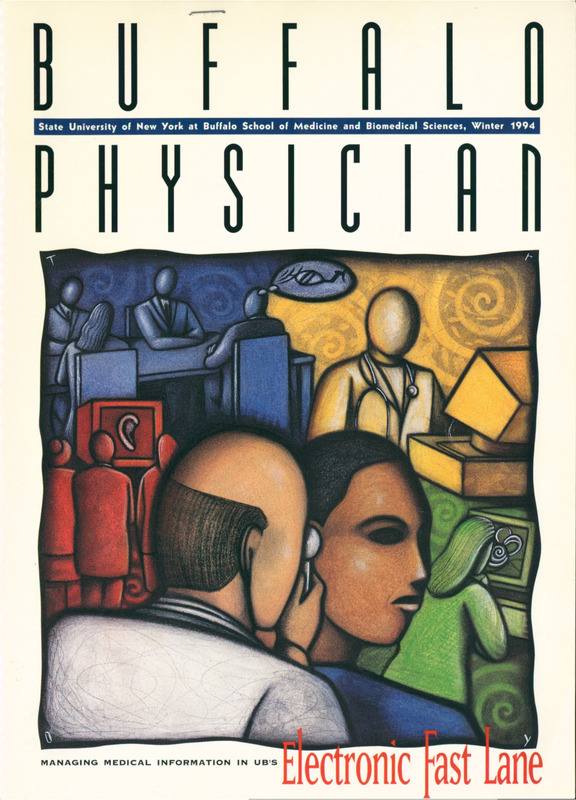
MANAGING MEDICAL INFORMATION
IN
UB'S
Dear Alumni and friends,
BUFFALO PHYSICIAN
Volume 28, Number 1
ASSOCIATE VICE PRESIDENT
FOR UNIVERSITY
ADVANCEMENT
Dr. Carole Smith Petro
DIRECTOR O F PUBLICATIONS
Timothy J. Conroy
EDITOR
Nanette Tramont Kollig, R.N.
ART DIRECTOR
Alan J. Kegler
ASSOCIATE ART DIRECTOR
Scott Fricker
PRODUCTION MANAGER
Ann Raszmann Brown
STATE UNIVERSITY O F NEW
YORK AT BUFFALO S C H O O L
O F MEDICINE AND
BIOMEDICAL S C I E N C E S
Dr. John Naughton, Vice President for
Clinical Affairs, Dean
EDITORIAL BOARD
Dr. John A. Richert, Chairman
Dr. Martin Brecher
Dr. Harold Brody
Dr. Richard L. Collins
Dr. Alan J. Drinnan
Dr. Timothy Gabryel
Dr. James Kanski
Dr. Charles Massaro
Dr. Charles Paganelli
Dr. Robert E. Reisman
Dr. Thomas Rosenthal
Dr. Stephen Spaulding
Dr. Bradley T. Truax
TEACHING H O S P I T A L S AND
LIAISONS
Batavia VA Medical Center
Arlene Kelly
The Buffalo General Hospital
Michael Shaw
Buffalo VA Medical Center
The Children's Hospital of Buffalo
Erie County Medical Center
Mercy Hospital
Millard Fillmore Hospitals
Frank Sava
Niagara Falls Memorial Medical Center
Roswell Park Cancer Institute
Sisters of Charity Hospital
Dennis McCarthy
© The State University of New York at
Buffalo
Buffalo Physician is published quarterly
by the State University of New York at
Buffalo School of Medicine and
Biomedical Sciences and the Office of
Publications. It is sent, free of charge, to
alumni, faculty, students, residents and
friends. The staff reserves the right to
edit all copy and submissions accepted
for publication.
Address questions, comments and
submissions to:
Editor, Buffalo
Physician, State University of New York
at Buffalo, University Publications, 136
Crofts Hall, Buffalo, New York 14260
A
lthough a little over two years away, a working committee co-chaired by Dr. Harold
Brody and Dr. Ronald Batt and staffed by Dr. Joyce Vana, has begun to plan the
Sesquicentennial events with special emphasis directed to UB's anniversary found
ing date on May 11, 1996. More will be reported about the proposed activities.
However, the Health Sciences Campus development on the Main and Bailey
Campus and future planning is moving forward.
1 am pleased to report that construction of the new research building is well ahead of
schedule and occupancy should be underway in late 1994 or early
1995. The program planning that will convert Harriman Hall to the
administrative locus for the medical school and serve as the main
entrance to the complex at this site is well underway. We are hopeful
that this project, together with the removal of Diefendorf Annex, can
be completed by the anniversary date. Once completed, the medical
school and its health sciences colleagues will have a core that will
I include the Health Sciences Library; the School of Dental Medicine;
the new research building; the animal facility; and the components of
»
Cary, Farber and Sherman Halls together with the Schools of Nursing
and Health Related Professions.
Despite all this, more will be needed. In the formative stage is the concept to develop
a Comprehensive Health Education Center that can house those programs that will
emphasize and direct our efforts in primary care, community medicine, epidemiology,
preventive medicine and statistics.
We hope you will join us when we celebrate the good fortune of reaching 150.
Sincerely,
John Naughton, M.D.
Vice President for Clinical Affairs
Dean, School of Medicine and Biomedical Sciences
Dear Fellow Alumni
I
n September a new activity of the Medical Alumni Association was initiated with the
first visiting lectureship by an outstanding alumnus, Dr. Joseph Chazan. Dr. Chazan,
Class of 1960, is medical director of the Artificial Kidney Centers of Rhode Island and
director of the renal division at Rhode Island Hospital. While in Buffalo, he conducted
nephrology grand rounds at the Buffalo VA Medical Center and consulted with the
nephrology service. A second visiting lectureship is planned for later in the year. This
educational activity exemplifies the strong desire of the Medical Alumni Association to
add unique dimensions to the teaching program, taking advantage of the exceptional
qualifications of many of our alumni.
The Community Physicians Program has been enthusiastically
received by the first- and second-year medical students. This year,
the program, chaired by Elizabeth Maher, M.D., Class of 1985, has
expanded to four sessions. Physicians from various specialties dis
cuss their medical practice from the viewpoint of what they do, their
practice commitments and life styles. This innovative program
provokes unlimited questions concerning the effect that different
types of medical practice have on all aspects of professional and
personal life.
The Governing Board again solicits your continued support in order to maintain and
expand these representative functions.
Best regards,
Send address changes to: Buffalo Physician,
146 CFS Addition, 3435 Main Street,
Buffalo, New York 14214
Robert E. Reisman, M.D. '56
i i r F i i
V
O
W
I
L
.
N
2
T
8
E
N
R
1
O
9
9
4
Research
Hospital News
Computing the Need • The medical school enters
the information age as it undertakes an ambitious
new program to integrate computers into every
aspect of education, research and patient care.
Building the Future • UB s plan for its Health
Sciences Campus makes sense for now and the
years to come.
Medical School
Alumni
The School of Dental Medicine's William
Feagans retires after over 20 years. Page 21.
A Spoonful of Humor
Graduate Education
Classnotes
Hcautjonary tale.
Page 22.
Alum Deborah Richter —
working for people in need.
Page 24.
RESEARCH
Chemotherapy shown effective in
treating brain tumors in infants
i
multi-center study headed by a Uni
versity at Buffalo pediatric neurolo
gist has shown that very young
children with brain tumors can be
treated successfully with chemo
therapy immediately after surgery,
postponing, and in some cases eliminat
ing, the need for radiation treatments
that are devastating to the developing
brain.
The study was the lead article in the
June 17 issue of The New England Jour
nal of Medicine.
"To understand the importance of
these results," said Patricia K. Duffner,
M.D., professor of neurology and pedi
atrics, "you need to consider the situa
tion when we began this study in 1986.
At that time, children less than one
year old with brain tumors were let
die. The only treatment available
was radiation, and the survival rate
was terrible. Children who did sur
vive were so profoundly retarded,
so damaged, that survival brought
no quality to life."
The study, which was conducted
by the Pediatric Oncology Group in
institutions in both the United States
and Europe, involved 198 children
under the age of three with malig
nant brain tumors. Following com
plete or partial removal of their tu
mors, 132 children who were less
than 24 months of age when diag
nosed received multi-agent chemo
therapy for two years. Sixty-six chil
dren between the ages of 24 and 36
months when diagnosed received
the chemotherapy regimen for one
year. Following completion of che
motherapy, all children received
radiation therapy.
The results showed that chemo
©
B
u
f
f
a
l
o
therapy produced a complete or greater
than 50 percent reduction in the tumor
size in 39 percent of the children. Cancer
had not progressed in 41 percent of the
older group after one year of chemo
therapy and in 39 percent of those under
24 months after two years of chemo
therapy. Researchers found no deteriora
tion of brain function as a result of the
chemotherapy.
Certain tumors responded better than
others, the study showed. Emryonal tu
mors did not respond well, while 61
percent of infants and very small chil
dren with ependymoma tumors were
still alive after three years.
Results showed children who had no
tumors following chemotherapy sur
vived nearly as long as children whose
tumors were removed completely
through surgery.
+
|
fPfiP
Low cholesterol levels found in
Mennonite men despite their diets
ne of the first dietary studies of clois
tered Old Order Mennonites provides
further evidence that physical activity
can help lower cholesterol levels.
The UB study found that despite
consuming a diet high in saturated
fat and cholesterol, the Mennonite men,
who do the daily farm work, not only
had lower cholesterol levels than their
female counterparts — a reversal of the
national norm — but had significantly
lower cholesterol levels and blood pres
sures than the national average for males.
Information on the community's eat
ing habits also showed that members
know they should avoid foods high in
saturated fat and cholesterol, but be
cause such foods are basic to their agrar
ian diet, they eat them regularly
anyway. In addition, half of the
members reported a family his
tory of heart disease.
The study of 250 adults was
conducted by Andrew Michel,
M.D., and Myron Glick, M.D.,
while they were medical stu
dents, and Thomas Rosenthal,
M.D., chair ofthe department of
family medicine. Resultsof the
study were published in The
Journal of the American Board of
Family Practice.
Little scientific data exist on
life among Old Order Menno
nites; anecdotal evidence sug
gests their diet puts them at
risk for heart disease. The aim
of the researchers was to assist
primary care physicians respon
sible for their care by defining
the population's cardiovascular
risk factors.
+
Hard work equals low cholesterol for Mennonite men.
P
h
y
s
i
c
i
a
n
w
i
n
1st cervical'
or Atlas.
2nd cervical -0
or Axis.
RESEARCH
3-1
New pain relief technique speeds
recovery for back surgery patients
D
B neurosurgeons have pioneered
a new method to relieve pain fol
lowing surgery to repair a herni
ated disk that increases comfort
dramatically and gets patients on
their feet and out of the hospital
two to three days sooner than conven
tional pain-control methods.
A research team headed by Kevin J.
Gibbons, M.D., assistant professor of
neurosurgery, placed an absorbable gela
tin sponge filled with morphine over the
disk-surgery site in 45 patients before
suturing the incision. The team com
pared the comfort and recovery time of
these patients with a control group of 15
disk surgery patients who received stan
dard post-surgery morphine injections
to control pain. All surgeries were per
formed at Millard Fillmore Gates Circle
Hospital.
Thirty-three of the patients receiving
the morphine sponge were able to walk
the same day they had disk surgery, and
all were walking by the following day,
Gibbons reported. More than a third
required no additional pain medication
on the day of surgery, and by the first
post-operative day, half of the patients
needed no further pain relief, he said.
Thirty-one were discharged on the
first post-operative day, 10 on the sec
ond, three on the third and one on the
fourth.
None of the 15 patients who received
conventional treatment for pain could
go home on the first post-operative day,
he reported. Three were discharged on
the second day following surgery, eight
on the third post-operative day and four
on the fourth.
"We hit upon the idea of injecting
morphine into the sponge as a possible
way to provide effective, long-lasting
u
f
f
a
I
o
P
h
New polio vaccine schedule could
eliminate vaccine-related disease
pain con
\\
trol after the
surgery," he
said.
UB
neurosurgeons
2
have been using
the morphine
sponge successfully
for 18 months. Other
surgeons have begun
using the technique as
reports of its effective
ness have spread by
word of mouth,
Gibbons said.
Additional members
of the research team
were Adrienne P.
Barth, a certified
neuroscience nurse;
Arvind Ahuja, M.D.,
clinical assistant
instructor of
neurosurgery;
James L. Budny,
M.D.,
clini
1st lumbar..
cal
I
noculating infants with two
doses of a new enhanced-potency form of inactivated poliovirus vaccine followed by a
single oral dose of live attenu
ated virus may be the best way
to protect against the disease and
guard against vaccine-related cases.
f"
A study by UB researchers
showed that children who received
the vaccines in that sequence dem
onstrated the highest antibody ti
ters during a four-year follow-up
after being challenged with a
single dose of the oral attenuated
poliovirus vaccine (OPV) at age
five.
Howard Faden, professor of
pediatrics and co-director of the
division of infectious diseases at
The Children's Hospital of Buffalo,
who directed the study, said, "The
use of sequential immunization with
EIPV (enhanced potency inactivated
poliovirus vaccine) followed by OPV
may be a major step toward ultimate
eradication of poliomyelitis." The Buf
falo study involved 158 children who
received three immunizations in one of
four sequences — OPV-OPV-OPV,
EIPV-EIPV-EIPV, EIPV-OPV-OPV or
EIPV-EIPV-OPV — at two, four and 12
months of age.
Follow-up serologic evaluation
showed that both forms of vaccine were
"highly effective" in stimulating pro
tective levels of immunity, but that
two doses of EIPV followed by a single
dose of OPV produced the highest
neutralizing antibody titers.
Faden's co-authors were Linda
Duffy, Ph.D., Martha Sun and Cynthia
Shuff.
+
tr
1
w
associate
professor of
neurosurgery,
and L.
Nelson
Hopkins
"'(MS®
III, M.D.,
professor
and chair of
neurosurgery.
Gibbons
presented the
study results at
the annual
meeting of the
American Association of
Neurosurgery.
+
— B Y
y
s
L O I S B A K E R
i
37.
-Lateral
c
i
a
n
W
i
n
t
e
r
1
9
9
4
©
HOSPITAL
N E W S
Children's Hospital appoints Dias
chief of pediatric neurosurgery
able by the new ablation procedure,
which is typically performed under lo
cal anesthesia, are generally those that
are mediated by an extra electrical path
way, according to Donald Switzer, M. D.,
UB clinical assistant professor of medi
cine and electrophysiologist at Millard
Fillmore Hospitals. He adds that physi
cians "traditionally have had to resort to
chronic drug therapies, which are often
only partially effective and may result in
side effects for these patients."
The radio-frequency ablation proce
dure uses specialized, electrode-tipped
cardiac catheters that are positioned
within the heart at specific abnormal
targets. The high-energy, radio-fre
quency current is then passed directly
through the catheter to cauterize the
abnormal pathway within the heart,
destroying only the targeted area with
out affecting the overall heart function.
Following the procedure, the heart's
electrical system stabilizes to a normal
conduction pattern.
Patients are monitored overnight and
generally resume normal activity the
next day.
Switzer adds that "over 95 percent of
these abnormal pathways can be effec
tively and permanently cured with this
procedure."
+
T
he Children's Hospital of Buffalo
has appointed Mark Dias, M.D.,
chief of the division of pediatric
neurosurgery. Dias was previously
an attending neurosurgeon at
Children's Memorial Medical Cen
ter in Chicago and assistant professor of
neurosurgery at the
Northwestern Uni
versity School of
Medicine.
Dias obtained his
medical degree
from the Johns
Hopkins University
School of Medicine.
He also completed
neurosurgical resi
dency training at the University of Pitts
burgh and neurosurgical fellowship
training at Primary Children's Medical
Center of the University of Utah. In
1987 he received the Pittsburgh Neuroscience Society Award for Clinical Re
search.
The author of various publications in
pediatric neurosurgery and developmen
tal neurobiology, Dias maintains a spe
cial interest in developmental malfor
mations of the brain and spinal cord and
in the surgical management of pediatric
brain tumors.
+
Construction begins on Summit
Park Medical Mai expansion
C
Millard Fillmore offers radiofrequency ablation procedure
onstruction began in late August
for a 21,000-square-foot expansion
of the Summit Park Medical Mall
in the Town of Wheatfield.
The expansion will accommo
date the Summit Immediate Treat
ment Center, a new service operated by
Niagara Falls Memorial Medical Center
since May. Memorial will also operate a
linear accelerator at the expanded site to
illard Fillmore Hospitals is one
of a limited number of facilities
in the country using radio-fre
quency ablation to treat certain
types of tachycardia.
The tachycardias that are cur
B
u
f
f
a
l
o
P
h
y
s
i
c
i
a
n
W
provide radiation therapy as part of its
comprehensive cancer treatment pro
gram. The expansion also includes ad
ditional space for physician office suites.
Construction is expected to be com
pleted this spring.
The Summit Park Medical Mall is a
30,000-square-foot medical office com
plex that opened in 1990. In addition to
physician offices, the complex houses
primary care and outpatient services
provided by Memorial Medical Center.
The complex includes the Summit Im
mediate Treatment Center; Niagara Fam
ily Medicine; X-ray, laboratory, physi
cal therapy and pharmacy services; and
a satellite office of the Milestones pro
gram that provides treatment for alco
hol and substance abuse.
+
Rosweil Park inks referral pact
with Daughters of Charily system
T
he Daughters of Charity National
Health System (DCNHS) and
Rosweil Park Cancer Institute have
signed a memorandum of under
standing to facilitate patient refer
rals from any DCNHS hospital to
Rosweil for specialized cancer treat
ments, including bone marrow trans
plants.
The agreement, which culminates 18
months of deliberation, is expected to
foster development in the areas of pa
tient care, research and understanding.
It will see Rosweil, the nation's first
cancer treatment and research center,
assist and consult in the development
of specific cancer treatment and educa
tion programs at DCNHS hospitals and
in the training of DCNHS physicians at
Rosweil.
The Daughters of Charity National
Health System — with more than 60
facilities in 18 states and the District of
i
n
t
e
r
1
9
9
4
HOSPITAL
N E W S
Columbia — includes acute care hospi
tals, nursing homes and psychiatric fa
cilities. Four of its hospitals are located
in New York State: Our Lady ofLourdes
Memorial Hospital in Binghamton, St.
Mary's Hospital in Rochester, St. Mary's
Hospital in Troy and Sisters of Charity
Hospital in Buffalo.
Roswell Park Cancer Institute is a
National Cancer Institute-designated
comprehensive cancer center that serves
patients from 38 states and 17 coun
tries. It is in the process of a $241
million renovation project that includes
all new clinical facilities.
The DCNHS-Roswell agreement will
explore a variety of activities, including
participation of DCNHS patients in
Roswell's special cancer registries, the
development of continuing medical
education programs and the creation of
special education programs in such areas
as cancer prevention and detection. +
Enrollment is limited to 30 to 35 cancer cases and deaths.
"We have the ways and the means to
patients with advanced cancer, particu
larly lung cancer patients, who have provide direct assistance to families who
failed to respond to either conventional may be at high risk for developing
colorectal cancer,"
or investigational
therapies.
said Miguel A.
Rodriguez-Bigas,
The research
M.D., associate chief
er's goal is to de
of the department of
termine opti
surgical oncology
mum drug dos
and director of the
ages, evaluate
registry. "Our objec
side effects and
tive is not only to
identify — and
collect research
later target —
data, but also to pro
those cancers
vide important care,
that respond best
genetic testing and
to the taxolcounseling, educa
carboplatin regi
tion and peace of
men.
mind to those who
Co-investiga
are registered."
tors on the Ros
well Park trial are:
The Family Can
cer
Syndrome Reg
VickyJones,M.D.;
Ellis Levine,M.D.;
istry identifies fami
Tracking the course of cancer.
lies in which at least
Gregory Loewen,
three members in
D.O., Neal Meropol, M.D., Raymond Perez, M.D., and two generations have had colorectal can
Lakshmi Pendyala, Ph.D., all of the de cer, with one of the members diagnosed
partment of medicine, and Youcef before age 50. Such families are known
Rustum, Ph.D., and Raymond Baker, to carry the gene for Hereditary
Ph.D., of the department of experimen Nonpolyposis Colon Cancer.
The Family Cancer Syndrome Regis
+
tal therapeutics.
try becomes the third registry estab
lished and headquartered at Roswell.
The Familial Adenomatous Polyposis
Registry was established in the mid1980s and currently lists 42 registered
families with 25 living affected persons
new cancer registry designed to and 55 persons at risk. The Gilda Radner
pinpoint, track and ultimately re Familial Ovarian Cancer Registry —
duce a family's genetic predisposi named after the comedienne who lost
tion to colorectal cancer has been her life to the disease — is an interna
established at Roswell Park Can tional listing of women with two or
more first-degree relatives who have
cer Institute.
developed ovarian cancer. Established
The Family Cancer Syndrome Regis
by M. Steven Piver, M.D., chief of the
try is designed to help individuals whose
department
of gynecology, it is the only
family medical history reveals a dispro
one of its kind in the country.
+
portionately high number of colorectal
Roswell Park conducting clinical
trials of taxol and carboplatin
B
oswell Park Cancer Institute is
one of only a handful of research
facilities in the country conduct
ing clinical trials to assess the ef
fectiveness of taxol and
carboplatin in patients with ad
vanced cancer.
Taxol has been widely publicized in
the popular media for its dramatic, but
preliminary successes with ovarian can
cer. Researchers began clinical studies
of taxol in 1983, and some reports sug
gest that the drug is also effective in
treating cancers of the breast and lung.
Patrick Creaven, M.D., Ph.D., senior
investigator, and Derek Raghavan, M.D.,
Ph.D., chief of the division of solid tu
mor oncology and investigational thera
peutics, head the studies.
B
u
f
f
a
l
o
P
h
Family Cancer Syndrome Registry
will track genetic propensity
i
y
s
i
c
i
a
n
w
i
n
t
e
r
1
9
9
4
w mi
•
B
Y
N
A
N
E
T
T
E
T
R
A
M
O
N
T
K
O
L
L
I
G
n a science as information-intensive as medicine, it was only a matter of time before
scientists would use computer technology to manage that information.
At UB's School of Medicine and Biomedical Sciences, the time is now as the
medical school and its affiliated teaching hospitals embark on an ambitious new
medical informatics and medical information processing program that puts them
in a leadership role for now and the future.
Medical informatics — the academic discipline associ
ated with the processing and management of medical
information — involves areas such as expert systems
development, clinical information systems, computer-as
sisted instruction and software programs that can bring
new information on a patient to a student or clinician. And
although the management and processing of medical data
isn't necessarily done with computers, principally nowa
days it is.
I
L
L
U
S
T
R
A
T
I
O
N
S
B
Y
T
R
O
Y
The medical school's project consists of a number of
initiatives on both the academic and clinical fronts in
various stages of development; all will serve to make
medical information more accessible to practitioners and
further the school's mission of quality education, research
and patient care. Among the initiatives are the medical
school's mandatory undergraduate medical computing
course; a database to aid the physician credentialing
process; the linkage of hospitals and physicians' offices to
T
H
O
M
A
S
iNJO ThE
to
MOUSING
the medical school, its Health Sciences Library and each
other via computer network; and real-time, on-line con
sults and sophisticated videoconferencing capabilities. A
recent $1.5 million gift will establish a chair in medical
informatics at the medical school, one of the first in the
country. Also under development is an electronic patient
index shared between the teaching hospitals, and perhaps
the ultimate realization of the promise medical informatics
holds for medicine — the computer-based patient record.
The main thrust of UB's medical information process
ing program — and the infrastructure that supports many
of its initiatives — is the development of the Western New
York Health Sciences Consortium Interfacility Communi
cations Network. When complete in 1997, this "informa
tion superhighway" will link the school and its affiliated
teaching hospitals with communications capabilities able
to transmit complex medical data such as PET images from
one to another in a matter of seconds.
The development and implementation of the network is
under the direction of John Hammond, director of infor
mation services for the Western New York Health Sciences
Consortium, a spin-off of the Graduate Medical Dental
Consortium of Buffalo, formed in 1987.
"Each hospital campus has its own internal communi
cations network already. What we establish will become a
'network of networks,' or what is known as a CHIN —
Comprehensive Health Information Network," Hammond
explains.
Phase 1 of the project, to be completed in 1995, will see
UB linked with Millard Fillmore Hospitals' Gates Circle
facility, The Buffalo General Hospital and Erie County
Medical Center via New York Telephone's FDDI (Fiber
Distributed Data Interface) Network lines. FDDI lines
operate at a band width of 100 million bites per second and
are able to accommodate the transmission of images and
real time, motion data, Hammond says.
Erie County Medical Center and Buffalo General
already have in place between them a microwave Ethernet
connection (Ethernet connections transmit informa
tion at 10 million bites per second) and a T-l existing
phone line that sends data at a "snail's pace" 1.54
million bites per second.
A chest X-ray, which requires 2 million bites of infor
mation, now takes about two seconds to transmit,
Hammond says.
Phase I also will realize Ethernet connections between
the Buffalo VA Medical Center and UB, and Roswell Park
Cancer Institute and UB via microwave.
The completion of Phases II and III (from mid-1995
until 1997) will see FDDIs emanating from a central New
York Telephone hub to Sisters Hospital, Millard Fillmore
Suburban, The Children's Hospital of Buffalo and Mercy
Hospital, as well as the existing Phase I hook-ups. Millard
Fillmore will also have a T-l between its Gates Circle and
Suburban facilities. A connection to the Southern Tier
hospitals, which have already formed their own rural
health care network supported by Sprint's Healthcare
Application Network Delivery System, New York
Telephone's fiberoptic and digital network and Compres
sion Labs Inc.'s videoconferencing equipment, will also be
established.
Other potential FDDI sites include Roswell, Blue Cross,
Blue Shield, Niagara Falls Memorial Medical Center and
the Maple Road MRI Center.
"Seventy percent of medical data is already available in
some form of digitized information already. What we have
to do is construct a central repository for the data, which
now exist in eight, nine or 10 areas.
"And we want to have automatic feeds as much as
possible," Hammond says, adding that of the affiliated
teaching hospitals, Erie County Medical Center is farthest
along in its systems development.
"After each repository has that in place, we have to find
a logical mechanism to connect them."
He estimates it will take eight to 10 years and $20
million to develop and implement the CHIN.
Representatives from UB have already engaged in dis
cussions with SUNY Central to solicit support; UB's project
could serve as a model for other academic health centers in
the system.
"We could establish it here," Hammond says, "and then
give it to Upstate and the others.
"And we're so diverse," he adds. "It's one of our strengths.
If it can work here, with all our diversity, it can work
anywhere.
"We have a federal facility, a county facility, a cancer
center, a children's facility, two Catholics and two not-forprofit privates. Our information services directors meet
regularly and the CEOs meet every two weeks."
Hammond credits those CEOs and information services
directors for working to establish the network. "The direc
tors develop a list of what each has worked on and it's my
job to broker deals to move those things along in a shared
fashion. We capitalize on ways to benefit and increase the
chances to exchange information to make it available at
multiple sites," Hammond adds.
The network and its participant hospitals will also
realize monetary savings in its economies of scale as well
as the cost- and time-savings benefits inherent in medical
information processingsystems. According toJohnLoonsk,
M.D., director of medical computing and assistant profes
sor of biophysics at UB, the implementation of these
systems in hospitals can have dramatic care and costsaving benefits.
"There's evidence that by giving quality information to
residents, attending physicians and students at the time of
decision-making and ordering, you can encourage good
practice patterns," Loonsk says.
One study, he said, demonstrated an over $800 reduc
tion in cost per hospital stay when residents were given
information on the cost and appropriate parameters of
their orders at the time they placed them.
"There are some examples of actual length of stay
reductions with similar systems," he adds.
The network will also foster the development of a
physician-credentialing database that would automati
cally track physicians credentialed at multiple facilities;
most medical staff are re-credentialed every two years. A
similar system, albeit based only at the medical school's
office of graduate medical education, tracks and aids in the
management of resident credentialing.
In addition to its benefits to the medical school and its
teaching hospitals, UB's medical informatics project meshes
well with projected health care reforms as well as the
medical school's existing primary care focus, notes John
Naughton, M.D., vice president of clinical affairs and dean.
"It makes the educational outreach to community aca
tools such asjournals (among them TheNew England]ournal
demic practice sites more real," he says, putting more
of Medicine, The Lancet, Pediatrics, JAMA) and textbooks
expert tools in the hands of primary care physicians in
(suchas Scientific American Textbook ofMedicine) with graph
both the clinical and educational arenas.
ics, the Cancerlit database, the Physician's Desk Reference,
"Bringing more information to practice is also re-engi
drug information databases and clinical information systems
neering relationships in medicine," the dean notes. "It's
such as expert systems, computer-assisted instruction and a
really on the cutting edge of reform."
health care planningand administration
And most experts agree that one of
database.
the main thrusts of reform will be in
"HUBNET is an integration of many
HUBNET
THE HOSPITALSreforming the way medical informa
resources from several difUB LIBRARY RESOURCES
tion is ordered, stored and retrieved,
ferent database providers.
and what is done with it.
NETWORK — WAS CREATED
Some are updated quar
UB's multifaceted program offers
terly, some even weekly,"
AT A COST OF $ 2 5 0 , 0 0 0
practitioners many innovative features
explains John Loonsk,
THROUGH THE JOINT EF
that will benefit both them and the
M.D., director of medical
FORTS OF THE MEDICAL
ultimate end-users of health care —
computing and assistant
SCHOOL'S OFFICE OF M EDI
their patients.
professor of biophysics and
CAL COMPUTING, UB'S HEALTH SCI
iBNE[
ENCES LIBRARY AND THE WESTERN
NEW YORK HEALTH SCIENCES
architect of the HUBNET system. Users
of the system now have access to the
equivalent of 6.5 million pages of medi
cal data, Loonsk adds.
In addition to its menu of resources,
HUBNET provides physicians, resi
dents and medical students with a uni
form access method to those resources
as they rotate from hospital to hospital.
Previously, users had to learn several
systems to gain access to only part of
the information that is now available
llhl
.^a!i
CONSORTIUM. EACH HOSPITAL
Created through the
SHIBr
CI
WILL PAY $ 9 , 1 0 0 ANNUALLY
joint efforts of the medical
I
school's office of medical
TO SUBSCRIBE TO THE ELEC
computing, the Health
TRONIC SERVICE
Sciences Library and the
hospital librarians through
the Western New York
Health Sciences Consortium, HUBNET
(Hospitals-UB Library Resource Network) provides the hos
on the system.
pitals (as well asanyone with the right computer hardware,
HUBNET also runs Internet-enabled electronic mail.
software and a password to log onto it) with immediate
"And we're bringing up a bulletin board service as well,"
access to UB's fifth-ranked-in-the-nation Health Sciences
Loonsk says.
Library and its considerable electronic resources.
Jack Freer, M.D., a 1975 medical school graduate who
HUBNET offers its users the National Library of
is now a clinical assistant professor of medicine based at
Medicine's MEDLINE resource (previously only the miniMillard Fillmore Hospitals, praises the new system on a
MEDLINE bibliography was available at UB), full-text
number of fronts.
H
"It's super for getting messages to people who have
became clear that the mini-medfile system was aging and not
mailboxes and regularly check their mail. For example,"
up to modern standards.
Freer says, "I'm the course coordinator for the third year
"Two of the hospitals were on the cusp of changing to try
ethics course, and the pediatric coordinator and I can get
to offer these types of resources to more sites than just their
messages back and forth in no time — often the same day.
single hospital sites," Loonsk says, adding, "but the costs
We also have a patient management system that prints
then go up dramatically.
progress notes and prescriptions."
"So we had interest from a num
Freer also cites FIUBNET for its po
ber of places."
tential to improve the quality of prac
Funded as well as developed
THE SCHOOL USES SOPHISTI
tice.
jointly by the medical school and its
CATED COM PUTER-ASSISTED IN
"You can use it to
teaching hospitals, HUBNET went
search in a matter of
"live" last fall when its network con
STRUCTION PROGRAMS SUCH AS
minutes virtually any
nections (existing and special phone
ADAM (ANIMATED DISSECTION
thing you could do in a
lines as well as Ethernet and micro
OF ANATOMY FOR MEDICINE), A
library.Just yesterday,"
wave connections), hardware and soft
SOFTWARE PROGRAM THAT AL
he says, "a question
ware development and acquisition were
LOWS STUDENTS TO "DISSECT"
came up about a new
completed.
treatment using beta blockers for heart
"There are some hospitals and medi
- FROM GROSS ANATOMICAL STRUC
failure, which have traditionally been
cal
schools with shared medical data
TURES RIGHT DOWN TO THEIR HIS
contraindicated. Now there are reports
bases," Loonsk says.
TOLOGY
ON A COMPUTER
that it is useful if used judiciously for
"But few have the mag
SCREEN AND MULTIMEDIA
tachycardia.
nitude of the resources
TEACHING TOOLS THAT WILL
With the MEDLINE you can search
we have, few have the
beta blockers and come up with 1,500
system's communica
BECOME COMMONPLACE IN
articles, then search heart failure and
tions capability and few
THE NEXT DECADE.
come up with 1,200 articles and then
represent the level of co
combine them and come up with 70
operation we have here."
articles.
Annual operating
"All you need is a computer and a
costs of the $250,000 library resource
modem," Freer notes, adding, "the resi
network are expected to tally about $100,000.
dents and students use it from home."
"Each hospital contributes $9,100 a year to subscribe to
At Millard, officials are trying to ensure an adequate
HUBNET," Loonsk says.
number of computers will be available for use at its large
"When people see what's available, and its potential, we
number of off-site facilities, Freer says.
hope to bring other resources on line, such as Poisondex,
In large part, FIUBNET got its impetus when the medical
a database used in emergency situations for dealing with
school and its teaching hospitals wanted to switch from
poisoning. A citation index is also attractive," Loonsk
mini-MEDLlNE to MEDLINE "over a year ago when it
adds.
©
Medical Informatics in the Classroom
screen. Other developments include computer-based
multimedia teaching tools that may eventually replace
microscopic and other conventional teaching tools and
Well ahead of most medical schools in its use of medical
techniques, as well as serve as resources that can be
informatics in the classroom, The School of Medicine and
retrieved in clinical settings.
Biomedical Sciences has required its medical students to take
A computer-based patient record (CPR), developed by
a medical computing course in their sec
Loonsk and M.D.-Ph.D. student
ond year since the mid-1980s.
Harold Litt, is also in use. Students are
"It's not really a computer literacy
assigned a patient case — each CPR
course," says John
contains a complete intake history and
Loonsk, M.D., director
physical, admitting notes, orders, labo
VIDEOCONFERENCING — WHICH
of medical computing
ratory data and radiological studies —
and assistant professor
INTEGRATES VOICE, DATA AND
and are asked to review all of the
of biophysics who
VIDEO CAPABILITIES
BRINGS
clinical information, apply medical in
teaches the course.
formation tools contained in the CPR
REAL-TIME SU B SPECIALIS T CON"But we do have to ad
to their patient and determine a diag
SULTS TO PR I MARY CARE PRACTI
dress literacy issues in a
nosis and suggested treatment.
TIONERS AT THEIR PRACTICE
remedial fashion in
some instances," he adds.
SITES AS WELL AS "BRINGS"
"The course is designed to give stu
PATIENTS IN RURAL LO
dents exposure to and the theory be
CALES TO URBAN MEDICAL
hind medical informatics tools as they
CENTERS FOR EVALUATION
would apply them to clinical cases,"
AND ASSESSMENT.
Loonsk says.
Videoconferencing —
"It's a brief overview of diagnostic
which integrates voice,
programs, designed as an introduction
data and video capabili
to ensure people are comfortable with
ties — has the ability to
computers, since they're so common in
bring real-time sophisti
hospitals," says medical student Tom
cated subspecialist consults to primary
Guttuso, currently on a leave-of-absence
care practitioners at their practice sites as
for a Howard Hughes Medical Institute Research Training
well as "bring" patients in rural locales to urban medical centers
Fellowship after completing his second year.
for evaluation and assessment.
The school has only recently begun using computer"We're doing a lot with videoconferencing," according to
assisted instruction — such as ADAM (Animated Dissec
John Hammond, director of information services for the
tion of Anatomy for Medicine), a software program that
Western New York HealthSciences Consortium. Hammond
allows students to "dissect" — from gross anatomical
has worked to establish the Western New York Health
structures right down to their histology — on a computer
Sciences Consortium Interfacility Communications Net-
B
u
f
f
a
l
o
P
h
y
s
i
c
i
a
n
w
i
n
t
e
r
1
9
9
4
"He has a video otoscope scheduled for implementation
work that will carry videoconferences from one site to
early
this year."
another.
A link between rural Cuba (New York) Memorial Hos
pital and Children's Hospital has already been in place
since last spring when physicians from Children's evalu
ated a six-year-old patient in Cuba — saving the girl and
The capability of computers to manage
her parents the 150-mile round trip
and integrate the array of diverse data
they have had to regularly travel dur
and information inherent in the prac
ing her recovery and
C
O
M
P
U
T
E
R
B
A
S
E
D
P
A
T
I
E
N
T
tice of medicine probably will realize
rehabilitation from the
its ultimate application in the com
cerebral hemorrhage
RECORD DEVELOPMENT HAS
puter-based patient record (CPR).
she suffered two years
BEEN SPURRED BY RECOMMEN
Computer-based patient record
ago.
DATIONS FROM THE FEDERAL
development and implementation have
The Cuba link is the
INSTITUTE OF MEDICINE. MOST
been bolstered by recommendations
start of a connection to
HEALTH CARE REFORM PRO
from the federal Institute of Medicine
Southern Tier hospitals
as well as by practical
that have already
POSALS ALSO CALL FOR
application
as hospitals
formed their own rural health care
AUTOMATION OF PATIENT DATA
use computers to man
network supported by Sprint's
FROM MEDICAL RECORDS TO
age the wealth of infor
Healthcare Application Network De
BILLING INFORMATION
TO
mation they amass on
livery System, New York Telephone's
AVOID DUPLICATIONAND REDUCE
their patients. Most
fiberoptic and digital network and
health care reform pro
Compression Labs Inc.'s video
PROCESSING INEFFICIENCIES
posals also call for auto
conferencing equipment.
mation
of patient data —
Using the technology, the hospitals
from medical records to billing informa
will be able to send diagnostic-quality
tion — to avoid duplication and reduce
images to specialists for viewing on
processing inefficiencies and their inherent costs.
high-resolution, gray-scale monitors or printed onto film
for traditional light box viewing, regardless of image
Toward that end, the Western New York Health Sci
modality — CT, MRI, DSA, X-ray, ultrasound, etc. "We
ences Consortium has already begun to develop the first
can use the techniques developed to exchange information
step in building a CPR — a patient index, listing the name,
address and identifying number of every patient served by
and teach," Hammond adds.
"We've identified three groups of physician practices
its members, according to John Hammond, director of
that want to move to implement. Dave Ellis [M.D., assis
information services for the consortium. The index would
tant professor of emergency medicine at ECMC] has
be shared and integrated among the teaching hospitals and
probably gone the farthest, using the technology to triage
eventually provide a complete medical record that would
"follow" a patient regardless of which hospital he is treated
patients at New York State Department of Corrections
prison sites.
at.
Computer-Based patient Rpcort
©
John Loonsk, M.D., director of medical computing and
assistant professor of biophysics, and M.D.-Ph.D. student
Harold Litt have developed a prototype computer-based
patient record used to train students using case-based
learning. The CPR includes systems for writing and dis
playing physicians' notes, orders, con
sults, lab values and radiological stud
ies, including actual images, and re
ports. Perhaps the most immediate ben
efit the CPR offers is its ability to allow
physicians to view all clinical informa
tion about a patient in one place, with
access to lab values, consults, medical
imaging and reports, ostensibly as soon
as they are completed.
The computer-based patient record
in use at the medical school also has
integrated medical information tools,
such as drug references, clinical manu
als, textbooks, literature searching, ex
pert system decision support and elec
tronic communication, that students
can use to facilitate diagnoses and the
development of treatment plans. The
CPR uses
a Win
dows
format
that
allows
users to
use and
display
several
items (or "pages" from a chart)
of information at the same time.
UB's CPR is modeled on existing
B
u
f
f
a
l
o
P
h
y
s
i
c
paper-based medical records — with data from different
sources presented independently — but with some no
table enhancements. The computer-based patient record
offers users the ability to view lab results in two different
ways: all the values for a given day and lab group, with high
and low values noted; or a single
value followed graphically over time.
Other
enhance
ments in
the works
include
increasing
the
flexibility
oflabdata
represen
tation to
allow graphical display and statisti
cal analysis of many values over time
and incorporating special computer
languages that would allow commu
nications with mainframe patient da
tabases.
But Loonsk sees almost unlim
ited potential in a newer paradigm
of medical information management
that moves away from the existing
paper-based structure of the patient
chart — the visual chart, which
would use object-oriented program
ming techniques to allow a more
visual and intuitive representation
of medical data and offer a way of
using and interacting with data that
would change the way physicians
practice medicine.
+
i
a
n
w
i
n
t
e
r
1
9
9
4
©
I
r
| 1J
y
)
"i|
J—
.
<
r
I
w/
I
N
^
J
J
r1 ^
R
y
'1
| 1J
J-
J
B
u
f
f
a
l
o
P
y
s
i
c
BY
ANDREW
BANZO
$
"I
h
U|
1 l.
1
(J)
w/
A
L-
i
a
n
W
i
n
t
e
r
1
9
9
4
UB takes the
first steps
toward an
integrated
health sciences
campus
hen Charles V
Paganelli, Ph.D., arrived at UB 35 years ago, the east
wall of Sherman Hall was several steps from the room
he now occupies. Today, there's a set of swinging doors
in that wall, and beyond them is the Hermann Rahn
Laboratory of Environmental Physiology.
The laboratory, a two-stage addition built in the early
1970s and mid-1980s, is home to the Center for Research
in Special Environments. Inside one theater-sized room
is a centrifuge that can subject a person to seven times the
force of gravity. Across the hall, in a room filled with
instruments, is a hypobaric/hyperbaric chamber that can
simulate conditions ranging from the edge of space to the
ocean floor. "It's got a pressure capability as great as any
pressure chamber in this country," proudly declares
Paganelli, professor of physiology and interim chairman
of the Physiology Department.
B
u
f
f
a
l
o
P
h
y
s
i
c
i
a
n
W
i
n
t
e
r
1
9
9
4
( J )
he laboratory addition is just
one of the developments that
have occurred in recent years
at the UB School of Medicine
and Biomedical Sciences. Any
one who's been away for a
while will still find much that
is familiar on the campus. But
from the school's new wing to
the six-story research build
ing now nearing completion, some striking changes have
been taking place.
"The campus has now had about a decade of infusion of
support that came with the promise when the state took it
over to make a health sciences complex on this campus," says
John Naughton, M.D., the medical school's dean and vice
president for clinical affairs.
Now, the university is on the verge of taking another big
step toward that goal. Officials from UB and the State Univer
sity Construction Fund started preliminary work this fall on
a new master plan that could serve as a blueprint for the final
transformation of the Main Street campus into an integrated
health sciences center.
Officials caution that it isstill too early to get into specifics,
but the outline is clear. "Our goal is to have the South Campus
operate as the health sciences campus for UB," says Ronald
Nayler, associate vice president for university facilities.
Naughton sees definite benefits.
"It's a concentration of the faculty expertise in the various
health science areas and the ability to integrate, where appro
priate, certain educational and training opportunities for
future professionals," the dean says. "As this movement
toward health reform comes, the interrelationship of physi
cians and nurses and therapists working in a team model will
evolve, and we can better structure those educational oppor
tunities."
In the early 1960s, when the state absorbed UB, it was
thought that the entire university might move to one huge
new campus. But there wasn't enough money, and it soon
became obvious that the South Campus would continue to
play an important role. The university decided to gradually
move remaining academic departments from the South Cam
pus to the new North Campus in Amherst over a period of
years, with the eventual aim of turning the South Campus into
a health sciences complex. That's why there's been so much
renovation and new construction on the South Campus in
recent years.
But until the new effort to update the master plan, the work
had been piecemeal, occurring without a comprehensive
blueprint.
"There had never been a physical layout, there had never
been detailed planning as to how that should be accom
plished," says Nayler. "So we had the goal and some specific
objectives, but we never had a physical plan. This will get us
there."
Over the coming 18 to 24 months, UB administrators will
work with faculty, state officials and others, including com
munity representatives, to develop a consensus on where the
university is headed and what facilities it needs to get there.
They will pore over everything from classroom and labora
tory requirements to plumbing and roadway design. Along
the way, they're even putting the campuses' existing blue
prints onto computer.
"It's mainly looking at what exists and what the possibili
ties are," says Naughton.
The resulting master plan will serve as the physical design
to achieve UB's long-range goals, among them the health
sciences campus. UB will forward the plan to Albany. "Then
it's a question of, given the fiscal status of the state, how
quickly that can be accomplished," says Nayler. It probably
will take years to implement larger goals like the health
sciences campus, and the work will most likely be incremen
tal. But the master plan will give UB a better platform to set
priorities and establish needs when it makes its funding
requests, Nayler explains.
"Our goal is sooner rather than later, of course," he adds.
Even without the new master plan, the South Campus
already has seen considerable progress in the shift toward
health sciences.
"I think the South Campus renovation projects to make it
B
u
f
f
a
l
o
P
h
y
s
i
c
i
more of a health sciences complex began around 1982," says
Naughton. "The first major change was the conversion of
Squire Hall, formerly Norton Union, which had been the
student union until that time, into the School of Dental
Medicine."
Nayler says dentistry still has room to grow in Squire Hall.
The school is developing plans to expand the use of dental
clinics, and he says that probably will be possible without new
construction.
Another big change was renovation and expansion of
Abbott Hall into the Health Sciences Library during the mid1980s. "We preserved all the historic aspects of that building
on the Main Street side, and now we have a first-rate health
sciences library," says Naughton, adding that the library is
rated the fifth best in the nation.
He also cites the rehabilitation of what had been cramped
space in Foster Hall for laboratory facilities and the addition
of a small wing for clinical practice activities. "We ended up
with a very first-rate facility," the dean says.
About four years ago the Department of Nuclear Medicine
began moving into Parker Hall on the southwest corner of the
campus. And this summer it finished installation of a cyclo
tron in Parker as part of the PET imaging center operated in
conjunction with the Buffalo VA Medical Center.
Of course, there is also the medical school's new wing,
known as the Cary-Farber-Sherman Addition and opened
about six years ago.
a
n
W
i
n
t
e
r
19
9
4
©
arts center opened in August, taking in the school of Arts and
Letters, which vacated Harriman and Wende halls on the
South Campus. Naughton says he would like to renovate
Harriman after next summer, then move the medical school
administration there.
Also next summer, the university hopes to move the
Chemistry Department into a new natural sciences and math
complex under construction on the North Campus. Nayler
says the first phase of that complex, including an eight-story
tower, will be ready for the fall semester, and preliminary
planning is underway for the second phase, which will
include math, computer science and geology. "That's our
next highest priority in terms of facilities for the North
Campus," Nayler says.
In all, the state has spent about $200 million on new
construction and renovation at the North and South cam
puses in recent years, he says. The flurry of activity owes
partially to the recent availability of bond funds, he adds.
When chemistry moves to the North Campus, that will
free up Acheson Hall on the South Campus. The intention is
to use Acheson for health sciences, but final decisions have
yet to be made, Nayler says. In any case, he added, "We'll need
to do almost a gut renovation."
There is no date yet for math to move from Diefendorf Hall,
but Naughton says he expects the Diefendorf Annex to be
razed by 1996, restoring the mall that the warehouse-like
building has occupied for nearly three decades.
Once the natural sciences are consolidated on the North
Campus, the only non-health program remaining on the
South Campus will be Architecture and Planning. Though
there currently is no money budgeted for it, Nayler says plans
have long called for moving that school to the North Campus,
too. "In fact, there's a site that's been chosen, and we've
intentionally kept it open," he added.
The School of Pharmacy, meanwhile, seems settled in
Amherst. "There are some natural interactions between the
chemistry and pharmacy faculties," says Naughton. "So 1
would think it would remain on the North Campus."
While it's too early to say what the South Campus would
look like as a health sciences center, administrators would
like to bring Nursing and Health Related Professions closer to
the main academic core. They are now in Kimball Tower, part
of the dormitory complex on the campus's north end.
The dormitories will probably change, too, as the number
of undergraduates on campus shrinks. The new master plan
is expected to take account of the housing and social needs of
older students, including married couples.
"It will be a changing campus," says Nayler.
+
THE FIRST MAJOR
CHANGE WAS THE
CONVERSION OF
SQUIRE HALL9
FORMERLY NORTON
UNION, WHICH HAD
BEEN THE STUDENT
UNION UNTIL THAT
TIME, INTO THE
SCHOOL OF DENTAL
MEDICINE,
"That greatly improved our teaching ability," says Paganelli.
The CFS Addition includes classrooms, laboratories, an
animal facility, a modern auditorium and offices. It was
designed to provide a more comfortable learning environ
ment, right down to the lobby space. "We furnished it so that
students, between classes and at exam time, could use the
facility more to their needs," says Naughton.
The new space also allowed the medical school to consoli
date faculty in areas like biochemistry and biophysics. They
previously were based at the old Bell Aircraft plant on Buffalo's
West Side, the Ridge Lea building in Amherst and other
locations.
As the health sciences improvements were going on, the
university was also building on the North Campus to accom
modate departments moving from Main Street. A new fine
B
u
f
f
a
l
o
P
h
y
s
i
c
i
a
n
W
i
n
t
e
r
1
9
9
4
UB'S NEW RESEARCH BUILDING
BLENDS FORM WITH FUNCTION
f all the recent changeson UB's search building may now encourage them to do that.
South Campus, the medical
"I view the new building not simply as extra space, but as
school's new research build a catalyst by which we can revamp or expand a variety of
ing is easily the most visible.
research programs," he added.
When it's ready for occu
As researchers move to the new building, UB plans to
pancy, possibly as soon as early renovate existing research space in the Cary-Farber-Sherman
1995, the 112,000-square-foot Addition. "It'll be an ongoing process over the next several
building will also be one of the years," Holm says. "There are already plans for whole floors
university's major assets. Lo to be revamped."
cated between the dental
Recently the medical school's primary care initiative has
school and the CFS Addition, its six floors will house labora been attracting grant money, and though the amount is small
tories, offices and conference rooms, as well as animal facili compared to basic science, the research effort is growing.
ties for pathogen-free work.
Primary care studies tend to rely more on offices than the
"Everyone's sort of excited about it," says John Naughton, traditional "wet" labs used in basic science, and the university
M.D., vice president for clinical affairs and medical school dean. will be reviewing those needs as it develops its new master
"The laboratories will be state of the art, flexible and easily plan.
expandable," says Ronald Nayler, associate vice president for
Holm, however, emphasized that researchers need not fear
university facilities. "It's going to be one of the better research a new competition between "wet" and "dry" laboratory needs.
facilities in the country for a medical school in terms of the "One of the messages that needs to get out to the faculty is that
we're not forsaking one for the other," he says. "We can and
way it's designed and outfitted."
will be strong in both."
+
Total cost is expected to be more than $50 million.
Bruce Holm, Ph.D., the medical school's associate dean for
research and graduate studies, says ap
plications to use the building will be
reviewed in coming months, and deci
sions are expected during the summer.
"Space will be assigned based on the
existence of interdisciplinary centers,"
he adds.
Such centers, which bring scientists
from different backgrounds together
under a common theme, provide en
hanced research capability and are more
competitive in securing grants, Holm
says. Some already exist at UB, such as
a microbial pathogenesis center that
deals with parasitology, infectious dis
ease and sexually transmitted disease.
Holm says there are other research
groups that are similar, but haven't
formally organized themselves as in The six-story, 112,000-square-foot research building will house laboratories, offices and
terdisciplinary centers. The new re conference rooms, as well as animal facilities for pathogen-free work.
B
u
f
f
a
l
o
P
h
y
s
i
c
i
a
n
W
i
n
t
e
r
19
9
4
Q
UB physicians play critical support
role in World University Games
I
Susan Udin, Ph.D., Thomas J. Guttuso, Jr. and one
of their research subjects.
Thomas J. Guttuso, Jr, receives
Howard Hughes research grant
T
homas J. Guttuso, Jr., a UB medi
cal student who recently com
pleted his sophomore year, has
received a year-long grant under
the Howard Hughes Medical
Institute's Research Training Fel
lowships for Medical Students program.
Guttuso, son of assistant dean and
director of medical school admissions
Thomas J. Guttuso, will receive a
$24,000 stipend to study the effects of
the pineal gland on neuronal plasticity
in aquatic frogs. He will take a year'sleave
of absence from medical school and re
main in Buffalo to complete his research.
"The main application of the research
is strongly related to healing and regen
eration," he says. "I'm working on de
velopmental issues. It's found that young
frogs heal a lot better — as do young
humans — because they have a 'plastic'
system." Guttuso credits Susan Udin,
Ph.D., professor of physiology, for sup
+
porting his research efforts.
ast summer, UB played host to
college athletes from around the
world as the World University
Games '93 were held in Western
New York. But while the focus was
on the athletes, another group was
hard at work behind the scenes to meet
the Games' medical needs.
Led byfour UBphysicians, this group
was responsible for managing and staff
ing the medical office on UB's North Cam
pus and coordinating care at venue sites.
The Games' four chief medical offic
ers were James Hassett, Jr., M.D., asso
ciate professor of surgery and a surgeon
at Millard Fillmore Hospitals; Richard
LaFountain, M.D., assistant professor
of emergency medicine and director of
emergency services at Millard Fillmore
Gates Circle; Richard Weiss, M.D., as
sociate professor of orthopaedic sur
gery and a surgeon at The Buffalo Gen
eral Hospital, and Gregory Young, M.D.,
clinical associate professor of emergency
medicine and clinical assistant profes
sor of internal medicine and corporate
director of Millard's emergency services.
Hassett, medical director for hospital
ization, coordinated support for patients
admitted to Millard, the designated pri
mary receiving hospital. Of the 7,000plus athletes and officials from 89 coun
tries, only five required hospitalization.
"The staff of the hospitals provided
tremendous support and expertise,"
Hassett says. "Since most of the patients
could not speak English, we had to use
translators and provide for their needs."
LaFountain, director of the Village
Polyclinic, was responsible for arrang
ing continuous coverage by 180 physi
cians and medical personnel. Together,
they treated 550 people, including ath
letes, officials and Games staff. "We
transformed dormitory and office space
into an emergency facility complete with
X-ray, pharmacy, physical therapy and
exam/resuscitation services that simply
are not available in many of the athletes'
own countries," LaFountain says, add
ing staffing was totally voluntary.
Weiss was responsible for the venues
and recruiting physicians as well cover
age for the opening ceremonies at Rich
Stadium. "A great deal of intensity ex
isted at the venue sites because minor
injuries affecting the athletes would in
volve discussion with the Games' site
physician, the country's physician and
FISU [the Games' governing body],"
Weiss says.
Young, medical director of emergency
services, coordinated spectator care, en
sured advanced EMTs were available at all
sites and worked closely with the advanced
life support coordinators of three counties
as well as the coordinator from the Prov
ince of Ontario to provide equipment and
necessary supplemental staffing.
+
Naughlon honored as Citizen of
Ihe Year by Columbus Hospilal
J
ohn Naughton, M.D., vice presi
dent for clinical affairs and dean of
the medical school, and Ernestine
Green, a Buffalo educator and Nia
gara Frontier Transportation Author
ity commissioner, were recently
honored as Citizens of the Year by the
Buffalo Columbus Hospital Foundation.
Naughton was recognized for his dis
tinguished service as dean, his leader
ship in health, hospital and medical
education issues, and for his more re
cent advocacy for and assistance to
Buffalo Columbus Hospital's develop
ing clinical affiliations with the medical
school and its resources.
+
Wrapping up a distinguished career
F ORMER DENTAL SCHOOL DEAN W ILLIAM F EAGANS
RETIRES AFTER OVER TWO DECADES AT U B
i
fter over 20 years as Dean of UB's
School of Dental Medicine, Will
iam Feagans, D.D.S., Ph.D., has
overseen the education of count
less doctors of dental surgery, and
left a brick and mortar legacy that
will live on as countless more reap its
benefits as they learn the profession of
dentistry.
That legacy — in the form of the
dental school's state-of-the-art Squire
Hall facility — is one of the many rea
sons UB's school was cited assixth in the
nation in a 1992 U.S. News and World
Report, "America's Best Graduate
Schools," another Feagans accomplish
ment, as is his bolstering of the school's
research and graduate education pro
grams.
And, perhaps ironically, if Feagans
had listened to his parents advice not to
William Feagans, D.D.S.
go into teachingwhen he graduated from
dental school in 1954, probably none of
it would have happened.
"1 practiced in Kansas City after get
ting my dental degree, but I wanted to
get more into education," Feagans says.
A graduate of the University of Mis
souri at Kansas City, Feagans taught at
the Medical College of Virginia in Rich
mond from 1960 to 1966 after getting
his Ph.D. in anatomy.
In 1970, Feagans came to UB from
Tufts University to become the dean of
the School of Dental Medicine, a posi
tion he held until he retired last year.
"I took over forJim English, who was
working on changing the course of den
tal education. He worked on combining
the clinical program with research,"
Feagans says. "My mission was to con
tinue the thrust he began," he says,
adding, "especially try
Feagans' career at UB was not without
controversy. The move to Squire Hall—
then Norton Union — the planning for
which began in the late 1970s, caused "a
big uproar because the students were
going to be left without a union," he
says. "No effort was made for an alterna
tive space for the students." Despite the
controversy, the dental school was nev
ertheless moved into Norton Hall —
now known as Squire Hall — in 1986,
leaving the students without a union
from 1982 when the move began until
1984 when the Student Activities Cen
ter opened on the North Campus.
The $30 million Squire Hall renova
tion project included the addition of
state-of-the-art clinics that feature indi
vidual operatories, each with its own
dental chair and fixed cabinetry, devel
oped specifically for the school. Stu
dents learn their profession in the same
environment in which they will eventu
ally practice. Squire Hall's support fa
cilities include laboratories, X-ray rooms
with nearby processing facilities, a plas
ter room, instrument and dispensing
rooms and a demonstration room.
ing to expand on the
research mission."
Feagans' efforts to
ward this end were re
warded in 1988 when
the School of Dental
Medicine received
Feagans' tenure as dean of the School
of Dental Medicine also realized inter
national implications with the estab
lishment of sister school relationships
with dental schools in several countries,
more funding that year
from the National In
stitute for Dental Re
search than any other
Taiwan.
institution in the na
tion.
"It was a great credit
to Jim English and to
the faculty," he says
modestly. "It gave the
dental school national
and international
publicity."
including Japan, Chile, Iraq, Israel,
Mexico, Panama, Paraguay, Poland and
Feagans' legacy will be carried on by
LouisJ. Goldberg, D.D.S., Ph.D., former
chair of the department of oral biology
at the UCLA School of Dentistry, who
took over as dean of the dental school
when Feagans retired.
Goldberg holds a dental degree from
the New York University College of
Dentistry and a Ph.D. in anatomy from
the University of California.
+
— B Y
C A R R I E
A .
L I B E R A N T E
MEDICAL
T H E N
A N D
N
0
W
SCHOOL
Physicians - Heal Thyselves!
OR, HOW TWO 1849 UB GRADS GOT EXPELLED FROM
THE MEDICAL ASSOCIATION FOR CHARGING TOO LITTLE
I
t wasn't charging too much, but too
little, that got two 1849 University
of Buffalo graduates in trouble.
John D. Hill, M.D., and Eldred P.
Gray, M.D., were expelled from the
county Medical Association for con
"wrongfully and unlawfully" of partici
pation in the association's counsels and
actions, brought him "into disrepute"
among his "professional brethren and
others" and caused "great damage."
The court issued an alternative writ
tracting with the Erie County Board of
Supervisors to render services for less
than specified in the association's
1854 fee schedule.
"Acceptance of any specific of
fice for a different amount or for
remuneration in any different way
than by salary is clearly an infrac
tion of both the letter and the
spirit of the fee bill resolutions,"
the association declared. The
member who does so, it added,
"has forfeited his claim as a mem
ber of this association."
Hill, who had been the top man
in his class at UB, ignored the
$600 salary prescribed by the
Medical Association for a physi
cian serving the county's
almshouse. Gray agreed to "visit
the jail and perform medical ser
vices" for $1 per visit — the aver
age fee for a private patient —
rather than the association's prescribed
$150 salary.
Injanuary, 1855, the association voted
to expel Hill, and in June, 1856, Gray.
Both physicians vehemently pro
tested their expulsion and continued to
attend association meetings, but as "by
standers," were not allowed to express
opinions or vote.
II, M.D
of mandamus: "either reinstate him or
show why you cannot or will not," it told
the Medical Association. The association's
answer, when it came, was laughable.
Hill should never have been expelled
because he was never truly a member,
the association said, contending that
when Hill applied for membership in
1849, he had not yet deposited a copy of
his diploma with the county clerk, and
thus was not.legally authorized to prac
tice medicine. And only those autho
rized to practice medicine could be
Finally, both physicians — first Hill
and then Gray — appealed to the State
Supreme Court to be reinstated.
Hill said his expulsion deprived him
©
B
u
f
f
a
l
o
P
h
y
s
i
c
i
a
n
w
members of the Medical Association.
Furthermore, he had not garnered the
required two-thirds vote of the members
present when his membership was con
sidered — although he was, at the time,
"admitted" — and he had neglected to
sign the bylaws and pay the treasurer $1
for a certificate of membership.
The Supreme Court didn't buy the
argument and ordered Hill reinstated.
When Gray was brought up on
charges, he argued that he was not actu
ally accepting less than the required
salary from the county by charging $1
per jail visit since his fees would
amount to more than the
association's prescribed $150
yearly salary. In fact, Gray's fees
totaled $178.
The association was, at first,
big-hearted. It offered to let him
retain his membership if he "im
mediately retires from the posi
tion which he holds in violation
of the rules of the association."
He refused, arguing that for the
association "to prescribe the rate
of compensation I may receive for
services rendered is an illegal re
striction of my individual rights
as a member. Fixing salaries for
our public institutions" is a mat
ter "over which they have no ju
risdiction whatever, such duty
being confided to other powers."
He had, he said, "obligated myself to the
Board of Supervisors for a faithful rendi
tion of my services for the term of one
year and I am unwilling to dishonor my
contract or to give up an office which
amply compensates me for myservices."
The association voted to expel him.
He was reinstated in 1858 by order of
the State Supreme Court to his "stand
ing and position" in the association.
And 30 years later, in 1888, Hill was
elected president of the association! +
—
B Y
i
n
M
I
t
L
e
D
R
r
E
D
S
1
A
9
N
E
9
S
4
T
H
E
N
N
0
MEDICAL
W
S C H O O L
Adopted by the Buffalo Medical Association
To Regulate the Medical and Surgical charges of its Members.
Adopted November 15th, and ordered to go into effect January 1, 1854.
Medical visit within the present City limits
$1.00
A single medical visit within the same limits, made to transient persons
B
Introducing a catheter or bougie, first time (in addition to visit) 2.00
Introducing a catheter or bougie, subsequent times (in addition to visit)
2.00
1.00
Detention after the first hour, except in cases of obstetrics — for each
hour during the day or night
1.00
Night visit, between 10 P. M. and sunrise
5.00
Remaining at the house, by previous arrangement, during the night,
except in cases of obstetrics
5.00 - 10.00
Rising at night and prescribing
1.00
First consultation visit, medical or surgical
5.00
Each subsequent consultation visit
2.00
Advice and prescription in ordinary cases at office
50
Investigating and prescribing by letter or orally
1.00 - 10.00
Ordinary obstetrical attendance, including abortions and premature
labors
10.00 - 20.00
For detention beyondsix hours in obstetrical cases there may be charged
for each hour additional
1.00
Instrumental delivery and turning
25.00 - 50.00
All visitsmade subsequent to the accouchement, the same as for regular
medical visits, viz
1.00
Venesection in addition to visit
1.00
Cupping
2.00
Introducing seton or issue, or applying moxa
2.00
Prescribing for gonorrhoea
10.00 - 25.00
Prescribing for primary syphilis
10.00 - 25.00
Prescribing for secondary or tertiary, not less than for primary, and
additional charge optional. In venereal case the fees, or the security
therefor, always to be required in advance.
Trephining
25.00 - 50.00
Operation for cataract
25.00 - 50.00
Operation for fistula lacrymalis
10.00 - 25.00
Extraction of nasal polypus
10.00 - 25.00
Excision of a tonsil or uvula
5.00 - 10.00
Tracheotomy
25.00 - 50.00
Reducing hernia by taxis
5.00
Application of truss to hernia
5.00
Operation for strangulated hernia
50.00 - 100.00
Operation for fistula or fissura in ano
25.00 - 50.00
Operation for haemorrhoids
25.00 - 50.00
Tapping for hydrocele
5.00
Operation for radical cure of hydrocele
10.00 - 25.00
Paracentesis abdominis (first time)
10.00 - 25.00
Paracentesis abdominis (subsequent times)
5.00 - 10.00
Removal of calculus from bladder by an operation .... 100.00 - 200.00
Removal of uterine tumors or polypi
25.00 - 100.00
Operation for phymosis or paraphyosi
10.00
Amputation at hip joint
100.00 - 200.00
Amputation at shoulder joint
50.00 - 100.00
Amputation at thigh through its shaft
50.00 - 100.00
Amputation at fingers and toes
5.00 - 20.00
Amputation at extremities at other points
25.00 - 50.00
Amputation at breast
50.00 - 100.00
Extirpation of testis
25.00 - 50.00
Extirpation of tumors
5.00 - 10.00
Reducing dislocation of hip joint
20.00 - 50.00
Reducing dislocation of shoulder joint
10.00 - 25.00
Reducing dislocation of other joints
5.00 - 10.00
Post mortem examination before a Coroner
10.00
Post mortem examination made by request of the family . 5.00 - 10.00
An opinion involving a case of law
10.00
Life insurance certificate for the company
2.00
Life insurance certificate, for your own patient
1.00
u
f
f
a
l
o
P
h
y
s
i
c
i
For all other medical or surgical services not mentioned in this bill, the
charge shall be in the same ratio, the ratio being determined by the
relative responsibility of the services and the time occupied.
Visits beyond the present City limit are to be charged as City visits, with
the addition of 1.00 per mile, for the first five miles. All fractions of a mile
shall be charged as a full mile.
Visits made to several patients in the same neighborhood, shall be
deemed regular visits to each individual, and shall be charged as such.
Incidental visits, as when a physician passing a house in the country is
called in, are to be charged as in the City, one dollar: but should it be
necessary to continue attendance, each succeeding visit shall be charged
with mileage.
It shall be considered dishonorable for any member of this Association
to attend families or individuals by the year; or to take any other bargain
or arrangement, the tendency of which will be to avoid the full purport
and effect of the foregoing list of charges.
All bills shall be considered due when services are rendered, and bills are
to be presented, at least once a year, and settlement requested. It is
particularly recommended to each member of the Association that all his
unsettled bills be presented at the close of each year. Uniformity in this
respect is considered of great importance to the interest of the profesIt shall be considered proper to make liberal deductions to all persons
in moderate circumstances, excepting in cases of venereal disease.
a
n
w
i
n
t
e
r
19
9
4©
ALUMNI
Working around the health care system
IN THE MIDST OF THE NATIONAL REFORM MOVEMENT,
DEBORAH RICHTER '86, PUSHES FOR CHANGE
f
system (similar to the Canadian system)
and President Clinton's proposed plan
is the elimination of insurance compa
nies, which Richter says would save an
estimated $20 billion a year in industry
profits and overhead in addition to re
ducing its considerable bureaucracy.
"I feel like there's a bureaucrat sitting
between me and my patients," she says.
The system she advocates would also
preserve fee-for-service. There is noth
ing in Clinton's plan for this, Richter
says.
"We treat health care as a commod
ity. I don't think people should profit
from keeping people healthy," she says.
"Let people profit from selling things
like cars."
Health care, she says, "should be a
human right, like police and fire protec
tion. You wouldn't ask someone to pay
hen Deborah Richter, M.D., got
out of medical school, she
wanted to help the poor. But the
system got in her way.
"I had to treat people differ
ently based on their insurance,"
says Richter, a 1986 graduate of the
School of Medicine and Biomedical Sci
ences. "I had to treat the insurance rather
than the patient. I have a problem with
insurance companies telling me how to
treat my patients," she says.
Richter explained that she has had
patients "beg" her not to be sent to an
emergency room because emergency
room care is not covered under their
insurance plan.
"I'm not sure I can continue to prac
tice medicine in this system." she says.
So she has looked for a way to practice
medicine without feeling trapped be
tween treating patients and pacifying
insurance companies.
At Buffalo's county-run Geneva B.
Scruggs Community Health Center,
where the poor are her patients, Richter
has struck a balance.
She joined the staff there after com
pleting a residency in family medicine at
the University of Rochester's Highland
Hospital.
A staunch advocate of health care
reform, Richter is local chapter presi
dent of Physicians for a National Health
Program, an organization she's been
involved with since 1991. She believes
the single payer system, under which a
centralized payer would pay hospitals,
HMOs and private practice physicians,
would be best for the country.
The main difference between this
B
u
f
f
a
l
o
for police protection, would you?"
As a long-time advocate for a na
tional health plan, she is very disap
pointed in Clinton's proposal. "It will
ruin health care."
"I can't disagree with the ideology.
The benefit package would be good if he
could deliver it," she says. "But man
aged care, I don't agree with."
Richter argues managed care won't
contain costs, and although Clinton's
plan would eliminate all the small insur
ance companies, it would "leave all of
the large ones owning health care lock,
stock and barrel."
" [Under Clinton's plan] the large in
surance companies will buy up the
HMOs and own the doctors and the
decisions," she says. "Treating people is
not that simple."
Richter believes one of the problems
with the way medicine is practiced today
is that everyone is interested in his or her
bottom line. "We don't want to put the
bottom line on hospitals. They shouldn't
have to worry that if they take a patient
who's on Medicaid, they won't make any
money," she says.
Deborah Richter, M.D., and a very satisfied patient.
P
h
y
s
i
c
i
a
n
W
i
n
t
e
r
1
9
9
4
Richter says that what she considers
routine care is often perceived as unnec
essary treatment by the insurance com
panies — counseling, for example —
which "renders the patient harmless,"
insurance jargon that in essence means
neither the patient nor the insurance
company is responsible for paying the
bill.
"Clinton's plan will encourage this,"
she added.
In addition to Richter's opposition to
insurance companies, she also is wary of
Clinton's plan because she questions
how it will be paid for.
"We spend about $90 billion a year
on unnecessary paperwork," she says.
"With that money, you could reinvest it
into the system."
Richter says that paying for health
care doesn't have to be as complex as the
government makes it out to be.
She is especially concerned about the
poor and elderly because they "don't do
well in HMOs," noting that this group
makes up 10 percent of the population
but uses 72 percent of the health care
resources.
Richter feels that one of the most
important parts of her job as a physician
is what she calls "mass education." Be
sides educating her patients and the
public about the single payer system,
she likes to educate her patients on a
one-to-one basis about health care.
"I had a 16-year-old mom who
brought her baby in every time he got
the sniffles," she says. "So, I gave her a
chart stating exactly when I should see
the baby. Then she only brought the
baby in when he needed it."
Richter notes that women now make
up about 50 percent of the graduating
classes at UB's medical school. "I believe
that women will change medicine," she
says. "People want their mommies when
they're sick."
+
Speaking of health care reform — First Lady Hillary Rodham Clinton, visiting Niagara Falls on
November 5, talks about the president's health care reform plan with medical school dean John
Naughton, M.D., right. Naughton greets Rep. John J. LaFalce, D-North Tonawanda, as Mark Celmer,
president and CEO of DeGraff Memorial Hospital, looks on.
Help us find your classmates! The Medical Alumni Association isseeking the
whereabouts of the following missing alumni. If you can help us, please
contact the Medical Alumni Office at (716) 829-2778.
CLASS OF 1944
Angel M. Ayala
William Burgoyne
CLASS OF 1954
Leonard Constantine
CLASS OF 1959
Ronald K. Hoyt
Eugene D. Means
Frederick Wurapa
CLASS OF 1969
William Cunningham
Peter D. Sirof
CLASS OF 1974
Ann C. Ganczewski
CLASS OF 1964
George R. Cohen
Jan M. Gorzny
Gugu R. Nxumalo
Keith F. Russell
CLASS OF 1979
Marion Alice Barnhart
Mary Louise Fedash
Theodore R. Hall
Carol H. Hinds
Avril Sampson
David M. Simpson
CLASS OF 1984
Maurice Wolin
CLASS OF 1989
Young Bum Huh
Louise LoBalsamo
John P. Osborn
Yasmin Panahy
Joseph P. Spychalski
1993 Distinguished Medical
Alumnus — William F. Balistreri,
M.D. '70, (center) receives the
specially designed crystal buffalo
award from John Naughton,
M.D., (left) vice president for
clinical affairs and dean of the
medical school, and Robert
Reisman, M.D., '56, president of
the Medical Alumni Association.
ALUMNI
Spring Clinical Day and Reunion
Mend set for April 29 - 30
M
ark your calendars and be sure to set
aside the time to attend the 57th Annual
Spring Clinical Day and Reunion Week
end at the Buffalo Marriott. Cocktail re
ceptions for all reunion classes will be
held on Friday, April 29, 1994, with
Spring Clinical Day on Saturday, April 30.
This year's Stockton Kimball Lecturer will be
Jerome Kassirer, M.D., '57, editor of The New
England Journal of Medicine and 1991 Distin
guished Medical Alumnus.
+
CLASS OF 1959
CLASS OF 1964
CLASS OF 1984
"Looking forward to see
"Step across the enchanted
"Ten years have passed, we
have a lot to catch up on.
ing all of you again at our
portal
35th Class reunion."
Reunion's Magic Kingdom!
Free up your schedules now
JOSEPH F. MONTE, M.D..
Enter joyously and cel
to return to Buffalo and see
ebrate our
old friends."
CHAIRPERSON
of
our
30th
conviviality!
Welcome home!"
NORA E. MEANEY-ELMAN.
MARVIN Z. KURLAN. M.D.,
M.D., CHAIRPERSON
CHAIRPERSON
CLASS OF 1944
"Hope to see all that are
able at the 50th."
JAMES R. SULLIVAN. M.D.,
CHAIRPERSON
CLASS OF 1969
CLASS OF 1989
CLASS OF 1974
"It's hard to imagine that
"Twenty years have gone
five years have passed. We
by fast. Let's get together
lookforward to seeingyou.
us for Spring
and renew old friendships."
Please join
JAMES A. SMITH, M.D.,
Clinical Day and the re
CHAIRPERSON
union parties."
LEE R. GUTERMAN, M.D.,
CHAIRPERSON
"Twenty-fiveyears. It's the
right time to return for a
"For the Class of '54, ev
great weekend."
ery reunion is special.
HANLEY M. HORWITZ,
Come celebrate our 40th!"
M.D., CO-CHAIRPERSON
NICHOLAS C. CAROSELLA,
"Don't miss our 25th. We
M.D. CO-CHAIRPERSON
CLASS OF 1949
need you to make it a suc
"Looking forward to see
"Come join your class
cess."
ing your attractive and in
mates for a weekend of
GERALD • . STINZIANO,
telligent faces again. Please
nostalgia at our 45th re
CLASS OF 1979
M.D., CO-CHAIRPERSON
"Come back to our 15th
come!"
union."
CARMELO S . ARMENIA,
M.D., CHAIRPERSON
EDWARD A. RAYHILL,
Reunion, reminisceand see
M.D., CO-CHAIRPERSON
how we, the school and
Buffalo have changed."
PETER E. SHIELDS. M.D,
CHAIRPERSON
©
B
u
f
f
a
l
o
P
h
y
s
i
c
i
a
n
W
i
n
t
e
r
1
9
9
4
A L U M N I
1993 reunion
classes donate
$101,050 to
medical school
I
ast year's
reunion classes
donated over
$100,000 to the
medical school.
Following is a
listing of participat
ing classmembers and
class totals.
Dr. Raphael S. Good
Dr. Myron Gordon
Dr. Harold L. Graff
Dr. Robert J. Hall
Dr. Vernon C. Lubs
Dr. Daniel G. Miller
Dr. Raymond E. Moffitt
Dr. Kenneth R. Niswander
Dr. Norman L Paul
Dr. Richard C. Proplesch
Dr. James G. Robilotto
Class of 1953 —
Dr. Max M. Bermann
Dr. James R. Blake
Dr. Anothony M. Foti
Dr. Paul A. Lessler
Dr. Donald A. Levine
Dr. Don L. Maunz
Dr. Robert M. Post
Dr. Eugene M. Sullivan, Jr.
Dr. John M. Wadsworth
Dr. Sander H. Fogel
Dr. Ronald F. Garvey
Dr. Thomas G. Geoghegan
Dr. Jack Gold
Dr. John W. Handel
Dr. Curtis C. Johnson
Dr. Milford C. Maloney
Dr. Richard J. Nagel
March — Total: $6,000
Dr. Jacob B. Shammash
Dr. Alfred S. Evans
Dr. Arthur M. Goldstein
Dr. David S. Berger
Dr. Donald L. Ehrenreich
Dr. Molly Seidenberg
Dr. Eugene M. Farber
Dr. Thomas J. Dwyer
Dr. Joseph C. Tutton
Class Total: $13,550
Dr. John M. Donohue
Dr. Patricia J. Flanagan
Total: $4,650
Dr. Stanley L. Cohen
Dr. Donald O. Rachow
Dr. Robert J. Collins
Dr. Kevin S. Ferentz
Dr. Charles S. Tirone
Dr. James M. Orr
Dr. Richard J. Buckley
Dr. Jack R. Cavalcant
Dr. Yung C. Chan
Total: $9,100
Class of 1943 —
Dr. Kenneth W. Bone
Dr. James S. Williams
Class of 1963 —
Dr. Howard C. Smith
Dr. Raymond M. Smith, Jr.
Dr. Harold Smulyan
Dr. John N. Strachan
Dr. Michael A. Sullivan
Dr. John D. Voltmann
Dr. Charles J. McAllister
Dr. Neal T. Smith
Dr. Robert J. Smolinski,
Dr. John C. Bivona,Jr.
Dr. Arthur W. Mruczek, Sr.
Dr. Anthony J. Bonner, Jr.
Dr. William E. Clack
Dr. Vincent G. Natali
Dr. Adolph Soto, Jr.
Dr. Patrick L. O'Connor
Dr. Robert S. Stall
Dr. Geoffrey E. Clark
Dr. Robert L. Penn
Dr. Mark A. Venditti
Dr. Marc N. Coel
Dr. Daniel A. Pietro, Jr.
Dr. Renata Wajsman
Dr. Gary H. Cramer
Dr. Andre Raszynski
Dr. Stuart Y. Wernikoff
Dr. Geraldine F. De Paula
Dr. Jacob D. Rozbruch
Dr. Kenneth S. Zimmerman
Dr. Barry Sanders
Dr. Gregory' Zuccaro, Jr.
Dr. George L. Druger
Dr. Stephen A. Edelstein
Dr. Michael A. Sansone
Dr. Frank G. Emerling
Dr. Ronald J. Friedman
Dr. Arthur C. Sgalia, Jr.
Dr. Robert M. Simon
Dr. Bruce H. Gesson
Dr. Gary J. Wilcox
Dr. Theodore Hopens
Dr. Lynda M. Young
Dr. Kenneth L. Jewel
Dr. Lawrence Zemel
Dr. Andrew Cappuccino
Dr. Helen M. Cappuccino
Class of 1978 —
Dr. Sandra L. Everett
Dr. Ronald E. Batt
Dr. David Kramer
Dr. Winslow P. Stratemeyer
Dr. David A. Berkson
Dr. Harold L. Kulman
Dr. James W. Taft
Dr. Melvin M. Brothman
Dr. Francis J. LaLuna
December — Total: $7,550
Dr. Gary N. Cohen
Dr. Sanford E. Leff
Dr. Bernice S. Comfort
Dr. Kenneth W. Matasar
Dr. Carl A. Contino
Dr. Robert A. Milch
Dr. Thomas G. Cummiskey
Dr. Roger B. Perry
Dr. William F. Deverell
Dr. Howard W. Raymond
Dr. Robert C. Dickson
Dr. Robert D. Rodner
Dr. Frederick W. Dischinger
Dr. Robert T. Rosen
Dr. Benson L. Eisenberg
Dr. Elias S. Rosenblatt
Dr. Domonic F. Falsetti
Dr. George P. Saba, II
Dr. John W. Float
Dr. Barbara B. Sayres
Dr. Eugene A. Friedberg
Dr. Lawrence J. Schwartz
Dr. Michael T. Genco
Dr. John E. Shields, Jr.
Dr. William L. Glazier
Dr. Timothy S. Sievenpiper
Dr. Gerard T. Guerinot
Dr. Leo A. Kane
Dr. Sara R. Sirkin
Dr. Lesbia F. Smith
Dr. Marie Leyden Kunz
Dr. Stuart C. Spigel
Dr. Jacques M. Lipson
Dr. Richard H. Stamile
Dr. Michael A. Mazza
Dr. Bruce C. Stoesser
Dr. Robert J. Perez
Total: $3,885
Dr. Lucien A. Potenza
Dr. Richard A. Rahner
Dr. William H. Bloom
Dr. Richard R. Romanowski
Dr. David P. Buchanan
Dr. Walter H. Rothman
Dr. Glenn B. Doan
Dr. Morton Spivack
Dr. Thomas J. Enright
Dr. Daniel J. Fahey
Dr. Alfred M. Stein
Dr. Richard D. Wasson
Dr. William F. Gallivan,Jr.
Dr. Reinhardt W. Wende
Dr. Morris Unher
Dr. Paul J. Wolfgruber
Class of 1948 —
Dr. Claudia Fosketl '85
Dr. Lawrence J. Dobmeier
Dr. Ralph E. Smith, Jr.
Dr. Robert W. Moyce
Dr. Gwen L. Nichols
Dr. Charles R. Niles
Dr. Daniel J. McMahon
Dr. Julian R. Karelitz
Dr. John C. Ninfo
Dr. Sharon Kuritzky
Dr. Albert W. Biglan
Dr. Roger M. Baretz
Dr. Amos J. Minkel, Jr.
Dr. Francis C. Mezzadri
Dr. Paul Kuritzky
Dr. Lawrence D. Baker
Dr. Nathan P. Segel
Dr. Anthony J. Marano
Dr. William J. Mayer
Dr. John T. Klimas
Dr. Allen D. Rosen
Dr. Gary D. Karch
Dr. C. Philip Lape
Dr. Younghee Limb
Dr. Robert Huddle, Jr.
Dr. Mark Schwager
Dr. John V. Armenia
Dr. Richard J. Jones
Dr. Fredric M. Hirsh
Dr. Mary Jane Massie
Dr. Walter R. Petersen
Dr. E. George Heus
Dr. Mary M. Lee
Dr. Joel M. Andres
Dr. Brian S. Joseph
Dr. Richard F. Kaine
Dr. John P. Guinther
Dr. Stephen L. Kinsman
Dr. Marc E. Heller
Dr. Cynthia A. Pristach
Dr. Elroy E. Anderson
Dr. Edward B. Crohn
Dr. Maxine D. Hayes
Dr. Thomas A. Lombardo, Jr.
Total: $17,350
Dr. B. Joseph Galdys
Dr. William F. Hanavan
Dr. Richard D. Jackson
Dr. Ralph R. Hallac
Total: $16.625
Dr. Ruth F. Krauss
Dr. Ronald E. Martin
Dr. Paul A. Cline
Dr. Jonathan A. Graff
Dr. Vincent J. Fuselli
Dr. Robert E. Noble
Dr. Marvin Wadler
Dr. Louis F. Ciola
Dr. Robert G. Fugitt
Dr. Dana P. Launer
Class of 1958 —
Dr. Peter A. Casagrande
Dr. Denise M. Goodman
Dr. Robert S. LaMantia
Dr. Joseph V. Hammel
Dr. Ivan L. Bunnell
Dr. Catherine A. Goodfellow
Dr. Lee A. Evslin
Class of 1968 —
Dr. Richard S. Fletcher
Dr. Ralph T. Behling
Dr. Demetrius Ellis
Dr. Arnold W. Scherz
Total: $4,675
Class of 1988 —
Total: $1,680
Dr. Stephen F. Achilles
Dr. John J. Barbaccia
Dr. Charles Everett
Dr. James E. Hohensee
Dr. Thomas R. Achtyl
Dr. Gerald P. Igoe
Dr. Stewart R. Altmayer
Dr. Kevin W. Kopera
Dr. Louise T. Barbieri
Dr. William R. Kuehnling
Dr. Michael H. Blume
Dr. Nancy J. Lisch
Dr. Daniel P. Cannucciari
Dr. Pierre T. Martin
Dr. Richard R. Curran
Dr. Robert F. Mennella
Dr. Kathleen A. O'Leary
Dr. Stuart L. Dorfman
Dr. Richard S. Elman
Dr. Karen S. Reed
Dr. Fred H. Geisler
Dr. Robert F. Reed
Dr. Kenneth L. Glick
Dr. Nicole L. Sasson
Dr. Stephen E. Killian
Dr. Robert A. Sicoli
Dr. Mark J. Kramer
Dr. Wayne R. Waz
Dr. Roberta Meltzer
Dr. Janet M. Williams
Dr. Paul Miles-Matthias
Dr. Charles W. Morgan
Editor's Note: While every effort
Dr. Matthew J. O'Brien, Jr.
is made to verify the accuracy of
Dr. Lois A. Polatnick
this listing, omissions or
Dr. Robert P. Pszonak
misprints may occur. This report
Dr. Joel J. Reich
lists all donors who have made
Dr. Paul A. Rutecki
Dr. Steven M. Seidman
gifts as of November 4, 1993. If
Dr. Richard J. Sternberg
comments or concerns, please
Dr. Jeffery S. Stoff
Class of 1983 —
call Michael E. Benzin, Acting
Dr. Robert E. White
Total: $7,860
Class of 1973 —
Total: $21,675
Dr. Bruce M. Abramowitz
Dr. William J. Ackerman
Dr. William S. Bikoff
Dr. Frederick R. Buchwald
Dr. Peter J. Accetta
you have any questions,
Director of Annual Giving, at
(716) 645-3312. Thank you.
Dr. Deidre Bastible
Dr. Melinda S. Cameron
Dr. Susan E. Champion
Dr. Michael J. Chaskes
Dr. Victor Chehebar
Dr. John A. Feldenzer
©
A
S p o o n f u l
o f
H u m o r
©
S t u
S i l v e r s t e i n ,
M
.
D
As the World Turns
BIG CHANGES I N FOREIGN AFFAIRS AND DOMESTIC HEALTH CARE
ARE ONLY T H E BEGINNING
ment eliminate paperwork? They in
vented it — in 1852. This is like putting
Ted Danson in charge of the NAACP.
I graduated from residency last year
and got my first taste of managed care. I
still don't know what it is. I thought
PPOs caused mycoplasma pneumonia.
Well, there I am billing for my ser
vices and the hospital HMO says, "Sorry,
we can't pay you."
"Why not?"
"Because you haven't paid us your
fee."
If I'm not mistaken, this used to be
called protection money and it was col
lected by the Mob. I guess HMO stands
for Higher Mafia Organization. They
might as well have some guy sitting
outside the OR with a cash register!
"HEY MAC! Before you scrub, that'll
be 10 bucks. Let's see some ID."
We are already seeing an onslaught
of news coverage on the health profes
sion. In order to facilitate proper cover
age, we offer this abridged glossary of
non-clinical terms used in medical con
text that cannot be found in any stan
dard medical dictionary or spell checker.
Last fall, we witnessed the successful
completion of the Biosphere project,
where groups of individuals were locked
inside a building for two years, having
to deal with each other and eat what
ever food was available without any
assistance from the outside world. This
used to be called Residency. At this
point I understand they're actually
board eligible in pediatrics and psy
chiatry.
Of course the biggest news was the
signing of the Middle East peace ac
cords. Lots of dignitaries were in atten
dance, including ex-presidents and vice
presidents. In a case of mistaken iden
tity, Dan Quayle asked Yasser Arafat
what it was like to play drums with the
Beatles on the Ed Sullivan Show.
Our sources tell us that Yitzhak Rabin
agreed to shake hands as long as there
was no hugging and kissing.
The Israeli prime minister looked a
bit stiff and uncomfortable — he made
A1 Gore look like a speed-addicted
aerobics instructor.
Now that he has the foreign situa
tion under control (with the exception
of NAFTA, Somalia, Haiti, Bosnia and
the Toronto Blue Jays winning two
World Series in a row), the president
has finally turned his attention to
health care reform.
As you know, the biggest
problem facing doctors today
is there just isn't enough
paperwork out there.
Bill Clinton says that
under his plan pa
perwork is going
to be totally elimi
nated. Since when
does the U.S. govern
©
B
u
f
f
a
l
o
Allied Health Professional — A person who
works in a health field that is allied with
the practice of medicine, i.e., the First
Lady.
Attending Physician — A physician on the
medical staff who is legally responsible
for the care given to a patient. He is the
physician frantically looking for a stetho
scope to borrow from the medical stu
dents.
Capitation — Formerly called castra
tion.
Cherry Picking—Accepting only healthy
people for insurance coverage, i.e., pro
viding hurricane insurance for the
midwest and tornado insurance for resi
dents of Hawaii.
Clinical Autonomy — The ability of physi
cians to make medical judgments based
on their training, experience and spe
cialty, without outside interference,
practiced during the Paleozoic Era, now
extinct.
Discounted Rate — A payment arrange
ment in which providers agree to accept
reimbursement that is based on a per
centage lower than their usual billed
rate. (See Wal-Med.)
Medical Students — Students who spend
time in a hospital learning clinical medi
cine. They can be identified by their
white coats, the 59 pounds of
medical equipment they carry
and as the ones frantically
volunteering their
stethoscopes to the
attending physi-
Stu Silverstein, M.D.,
president of Stondup
Medicine Seminars of Son
Francisco, California, lectures notionwide
on humor in medicine.
P
h
y
s
i
c
i
a
n
W
i
n
t
e
r
1
9
9
4
GRADUATE
EDUCATION
The Emergency Medicine Residency program will be
Buffalo General Hospital.
D
Emergency Medicine residency
program wins ACGME approval
B's Emergency Medicine Residency
program has won provisional ac
creditation status from the Accredi
tation Council on Graduate Medi
cal Education.
The program, which consists of
three years of training beginning at the
PGY-1 level, officially begins in July of
1994 with its full complement of 10
residents. Residents will be based at The
Buffalo General Hospital and will rotate
through Erie County Medical Center,
The Children's Hospital of
Buffalo and Millard Fillmore
Hospitals.
George Braen, M.D., pro
fessor and chairman of emer
gency medicine, will direct
the program.
Clinical trainingwill con
sist of rotations in medicine,
based af The trauma and burns, surgical
intensive care, anaesthesiology, pediatric emergency
care, orthopaedics, coronary care, plas
tic and hand, as well as rotations in
emergency health services systems and
administrations.
"We're in the process of recruiting
residents for next year," said Dan Dike,
M.D., assistant to the chair, noting that
the existing undergraduate program
rotations have "attracted some very good
people who are interested in staying in
Buffalo.
"Buffalo General Hospital is building
a new emergency department and of
fices for the overall residency program
and ECMC is building a new emergency
department," Dike said. "And Millard is
reconstructing its suburban emergency
department, which is where the resi
dents will be rotating."
+
Hand fellow joins staff of Our
Lady of Lourdes Medical Center
I cottF. Garberman,M.D.,whocom| pleted a fellowship in UB's depart
ment of orthopaedic surgery, divi
sion of upper extremity and
microsurgical reconstruction, has
recently joined the medical staff at
Our Lady of
Lourdes Medical
Center, in Camden, Newjersey.
Garberman
earned his medical degree from
Hahnemann
University in
mm \
Philadelphia and
W /
finished a residency in general surgery
at Abington Memorial Hospital in
Abington, Pennsylvania.
+
BUFFALO COLUMBUS HOSPITAL and the
UNIVERSITY AT BUFFALO
PARTNERS in PROGRESS
At Buffalo Columbus Hospital, we're incorporating
our family of community health centers into the U.B.
healthcare family to provide a new level of excellence.
By combining the resources of the University at Buffalo School of Medicine and
Biomedical Sciences with an 85-year tradition of caring, Buffalo Columbus Hospital
is taking a visionary approach to the challenges of health care in the '90s.
G
OLUMBUS
BUFFALO COLUMBUS HOSPITAL
300 Niagara Street
Buffalo, New York 14201
(716) 845-8300
For more information, call:
1-800-77-CARE-4
B
u
f
f
a
l
o
P
h
y
s
i
c
i
a
n
W
i
n
t
e
r
1
9
9
A
©
CLASSNOTES
T H O M A S P . H A M I L T O N II ' 5 7 ,
June 1993. Dr. Marks is the
Theology at Virginia Union Uni
R A L P H T . B E H L I N G ' 4 3 , of
writes, "I retired from the U.S.
Deputy Director for Public
versity in September 1987. This
San Mateo, California writes,
Army May 9,1993. Most recent
Health Practice at the Center for
fall he completed requirements
"I'm taking our five children and
positions were chief, preventive
Chronic Disease Prevention and
for a master's degree in divinity.
their 'mates' on a Caribbean
medicine division, Army Medi
Health Promotion, Centers for
cruise in September to celebrate
cal Department Center and
Disease Control and Prevention
M A R K S . G L A S S M A N ' 7 8 , has
School (chair and full profes
in Atlanta, Georgia. He is the
been named director of pediat
sor) and Deputy Commander,
son of Dr. and Mrs. Eugene M.
rics at New Rochelle Hospital
Marks '46.
Medical Center. Dr. Glassman
LINDA SHRIRO SCHENCK
ing inpatient pediatric capabili
medal is awarded for signifi
' 7 7 , has been appointed to the
ties, developing a practice in
cant contributions to the
Admissions Committee of the
pediatric gastroenterology and
University of Minnesota Medi
serving as a liaison between New
cal School and to the Governor's
Rochelle Hospital Medical Cen
our 50th Anniversary."
H E R B E R T E . J O Y C E ' 4 5 . re
Director of Medical Education
ceived the Max Cheplove medal
and Commander, Brooke Army
on October 23, 1993. The
progress of Family Medicine.
Dr. Joyce is the 25th recipient of
the medal.
Medical Center."
1
9
6
0
s
MORTON E. WEICHSEL, JR.
'62, was appointed chief of pro
fessional services, Los Angeles
EUGENE J. MORHOUS '45,
informs us that his wife of 48
years died in May of acute lym
phocytic leukemia. Dr. Morhous
resides at 57 Sherwood Drive,
White Sulphur Springs, West
Virginia 24986.
1
will be responsible for enhanc
9
County, California Children's
Services and also professor of
pediatrics and neurology at
UCLA School of Medicine.
0
lege. He is board certified in both
husband, Carlos Schenck '76, is
pediatrics and pediatric gastro
still with the Minnesota Regional
enterology and also holds a
Sleep Disorders Center at
master's degree in human nutri
tion from the Institute of Hu
R A L P H D ' A M O R E ' 6 5 , is di
ter. They have three children,
man Nutrition at Columbia Uni
rector of emergency services at
Carly, Nicholas and Teddy.
versity College of Physicians and
R O B E R T A . M I L C H ' 6 8 , medi
sis from the Southern California
'53. received Brown University's
cal director of Hospice Buffalo,
Psychoanalytic Institute in June
Senior Teaching Citation
has been appointed clinical as
1993. Dr. Seitelman teaches at
Award at the 1993 Commence
sistant professor of family medi
the institute and has a private
ment. His daughter Paula re
cine at the University at Buffalo
practice in psychiatry in Seal
ceived her MA from Columbia
School of Medicine and Biomedi
Beach, California. His son Rob,
School of Journalism in 1993.
cal Sciences. Dr. Milch will be
age 14, attends the Orange
teaching palliative care to family
County High School of the Arts;
medicine residents and devel
his wife,Judy, is a business writer
erside, California, was installed
oping a curriculum to include a
and has her own business.
as president of the Riverside
rotation at Hospice Buffalo. Dr.
County Medical Association.
Milch also serves on the Ethics
Dr. Kanel is an associate clini
Committee of the Erie County
cal professor of orthopaedic
Medical Society.
sity.
J A M E S S . M A R K S ' 7 3 , was
nounces that he is retiring from
practice in January 1994. He is
currently an AMA delegate.
©
e
u
f
f
a
i
Journal of Gastroenterology and
the Journal of Allergy and
Asthma for Pediatricians. Dr.
Glassman and his family live in
Connecticut.
1
9
8
0
s
P A T R I C I A F L A N A G A N ' 8 3 , as
sistant professor of pediatrics at
Brown University School of
Medicine, has been named the
first Fleet Scholar for Social Pe
C O V I A L . S T A N L E Y ' 7 8 , was
surgery at Loma Linda Univer
J O H N S . P A R K E R ' 5 7 . an
torial boards of the American
received a Ph.D. in psychoanaly
HERBERT P. CONSTANTINE
H A R R I S H . K A N E L ' 5 7 , ofRiv-
Surgeons. He serves on the edi
JEFFREY K. SEITELMAN '77,
Rouge, Baton Rouge, Louisiana.
s
ter and New York Medical Col
cally Engineered Organisms. Her
Hennepin County Medical Cen
the Medical Center of Baton
5
Advisory Committee on Geneti
installed as the pastor of Mount
diatrics at Brown University. The
Rona Baptist Church in New
award is for a three-year period.
port News, Virginia, in June
The scholarship was established
1993. After closing his private
to support young, promisingaca
practice in obstetrics/gynecology
demic faculty whose research
in 1987, he moved to Richmond,
will address topics of concern
awarded the Public Health
where he worked at the Virginia
for the well-being of children
Service's highest award, the Dis
Department of Health. He began
according to changing needs
tinguished Service Medal, in
taking courses at the School of
over time. Dr. Flanagan's area of
o
P
h
y
s
i
c
i
a
n
W
i
n
t
e
r
1
9
9
A
CLASSNOTES
research interest is in the evalu
D E B O R A H W H I T E ' 8 7 , and her
ation of neurodevelopmental
husband Chris White (M.S. '84),
outcome of infants born to ado
announce the birth of a daugh
lescent mothers. She is a pedia
ter in January 1993. She joins a
trician on staff at both Rhode
brother, age 4. Dr. White is in
Island Hospital and Women and
practice in internal medicine in
Infants Hospital. Dr. Flanagan's
Medina, New York.
background encompassesa wide
S U S A N L . B E H E N ' 8 8 , com
range of social issues surround
ing adolescent pregnancy. She is
pleted a residency in general
currently a member of the Rhode
surgery at the Johns Hopkins
Island Attorney General's Task
Hospital and accepted a fellow
Force on Sexual and Violent
ship at the University of Texas at
Physical Abuse of Children.
Houston.
H E R B E R T N E W T O N ' 8 4 , and
VERONIQUE JAMES '88,
his wife Cheryl, proudly an
works in the pediatric clinic of
nounce the birth of their first
Bridgeport Hospital, and Richard
child, Alexander James ("AJ")
Ho (MSTP '92) is a second-year
Newton, 8 lbs. 11 3/4 oz., born
medicine resident at Yale. They
August 24, 1993.
announce the birth of Kathryn
JOHN
V.
Veronique James '88
BOSSO '85, was
Nicole on August 7, 1993.
Forster '85 is area service chief
J E N N I F E R L . C A D I Z ' 8 7 , is
G I N A B . D I N U N Z I O ' 8 9 , joined
named chief of the division of
of pediatrics for the N orthern Vir
currently a staff oncologist at Wil
allergy at Nyack Hospital, Nyack,
ginia area of Kaiser Permanente.
liam Beaumont Army Medical
the faculty at the Medical College
New York and elected a fellow of
He is in private practice in oph
Center.
of Virginia as an assistant profes
the American College of Allergy
thalmology and is chief of the
and Immunology. He and his
uveitis service at Georgetown
wife, Janet, are expecting their
University. "We have two won
second child in October.
derful children: Christopher, 2,
sor of obstetrical anesthesia. She
B L A K E K E R R ' 8 7 , writes, "I
and her husband, Monte Cox,
work as a general practitioner in
announce thebirth of their daugh
Eastern LongIsland, andjust pub
ter, Heather Cox, injanuary 1993.
lished Sky Burial, Moble Press,
and Sara, 3 months."
about traveling to Everest in 1987
R O G E R A . D A L E Y ' 8 5 , is an
ANTHONY L. CAPOCOLLI '89.
assistant professor and head of
NICHOLAS D'AVANZO '86.
and becoming swept up in Ti
writes, "Now a neurosurgery resi
the hand and upper extremity
writes, "I am practicingin a four-
betan National Demonstrations."
dent at SUNY Downstate Medical
section in the department of
man group of pediatricians in
orthopaedic surgery at the Medi
North Carolina. We just had our
cal College of Wisconsin.
second child, Stephen Nicholas,
Center. Married "Cristy" from LIJ.
MARY
MCDONELL
Baby a-comin' in 9/93."
(O'BRIEN) '87, is in private prac
tice in Niagara Falls. She is chief
June 1, 1993, 10 lbs. 5 1/2 oz."
clinical instructor in pediatrics
A N D R E W F R I E D M A N ' 8 5 , is
now on staff at the University of
JO
for the family practice residency
ANDREW P. GIACOBBE '86.
Nebraska, Omaha, as a plastic,
writes, "I completed my plastic
program as well as assistant chief
hand and microvascular sur
surgery residency in June and 1
of pediatrics at Niagara Falls
geon. He and his wife, Susan,
am now in private practice. My
Memorial Medical Center. She
have two children,Jacob, 4, and
wife, Laura, my daughter
has two children: Seamus, 2, and
William, 2.
Cristina, and I are living in Buf
Rhiannon, 4 months. Since the
falo."
birth of her second child she has
D A V I D F O R S T E R ' 8 5 , informs
1
9
9
0
R O N A L D A . A L B E R I C O ' 9 0 , is
a member of the executive com
mittee of the resident's sections
of the New York State Radio
logic Society. He has two chil
dren: Karissa, 10 months, and
Zach, 2 1/2.
given up a pediatric clinic.
us that his wife Carol (Hammer)
B
u
f
f
a
l
o
P
h
y
s
i
c
i
a
n
W
i
n
t
e
s
r
1
9
9
4
GAIL BURSTEIN '90, writes,
training program at San Bernar
"My husband, Peter Bloom '90,
dino County Hospital and was
and I are working in a rural
its first chairman.
hospital in South Africa for nine
,, ,,
, , ,,
...
months this year. 1 shall run the
/
CURZON CADY FERRIS '46
pediatric ward and Peter plans
died July 27, 1993 in Abilene,
We are pleased to inform you
of your eligibility to purchase
microcomputer and informa
tion technology products at
special educational prices at UBMicro, the
University at Buffalo's non-profit com
puter resale program. Consulting and
pricing information is available weekdays
9:30am to 5pm, Wednesdays and Thurs
days to 7pm, or by calling 645-3554.
Holiday Specials
Texas. Before his retirement
to work on an N1H grant to study
from the US Air Force in 1970
African iron overload."
he commanded the 819th Medi
JOHN G. GELINAS, JR. '91,
cal Group and Dyess USAF Hos
$1,313
writes, "I presented a paper
pital. Following his retirement,
called 'Neuroleptic Malignant
he was in private practice in
Syndrome and Polymyositis' at
Abilene as a general surgeon. In
the 1993 Annual Convention of
1975 he was appointed Director
Features include 8MB RAM, 160MB Hard Disk, 68040 Processor, 25 MHz,
mouse, & Campus Software Set. (Monitor and keyboard purchased separately.)
the American Psychiatric Asso
of Public Health for the Abilene-
ciation in San Francisco. 1 mar
Taylor County Health Depart
Macintosh Quadra 610 8/230
Macintosh Quadra 610 8/230 (w/ CD/ROM)
ried Carole H. Buddenhagen on
ment. He retired from the
November 30,1991, and we have
Hendrick Medical Center staff
a son, Andrew John Thomas
in 1988.
Macintosh Quadra 610 8/160
SPENCER O. RAAB '54, died
of hematology-oncology at East
an internship in general surgery
Carolina University School of
at Union Memorial Hospital in
Medicine and a member of the
Baltimore and is beginning or
Board of Directors of the Ameri
thopaedic surgery at George
can Cancer Society. He started
Washington University. He in
outreach clinics in eastern North
forms us that Marie Christine
Carolina.
Durnan '92 and Michael Longo
$1,799
Insight 486DX33 4/340
Features include a 14" color monitor, a 32 bit Local Bus 1MB Graphics Acc.
SVGA card, 33MHz, 4MB RAM, 340MB hard drive with cache, 3.5" and 5.25"
floppy drives, 2 serial, 1 parallel, and 1 game ports, mouse and keyboard,
DOS and Windows.
Insight 486DX/66 Desktop
EO JOSEPH HEAPHY '56,
'92 are engaged to be married.
DCIL
Features include 33 MHz, 4 MB RAM, 1MB video RAM, 170MB hard drive,
Ultrascan 14" color monitor, 3.5" or 5.25" floppy drive, a performance
keyboard, mouse, DOS 6.0 & Windows 3.1.
June 22, 1993. Dr. Raab was chief
JAMES D. KUHN '92. finished
$1,648
$1,959
$1,979
Dell 486 Optiplex "L" 4/170
Gelinas, born December 8, 1992.
We live in West Hartford, CT."
-
$2,049
died June 4, 1993 at his residence
in Raleigh, North Carolina after a
O B I T U A R I E S
long illness. Dr. Heaphy was a
EILEEN L. EDELBERG '44.
monary diseases, particularly oc
of the pancreas. She had been an
cupational respiratory diseases.
associate physician (Emeritus) at
He testified about these mala
Smith College in Northampton,
dies before many regulatory
Massachusetts.
ROBERT W. MOYCE '44, died
in Stinson Beach, California, af
efforts were instrumental in ob
ter a long battle with cancer. He
taining federal and state legisla
was the founding president of
tion regarding worker compen
the San Bernardino, Riverside
sation
County, OB-GYN Society. Dr.
byssinosis and related diseases.
u
$125
$95
Microsoft Excel for Windows
Microsoft Excel for Macintosh
$139
$139
and safeguards
Call 645-3554 for pricing on other products.
Open Weekdays 9:30 am - 5pm / Wed & Thurs until 7pm
f
f
a
C R O
UB
for
A non-profit University program for students.;
facuity & staff
Th© Commons • North Campus • (716) 645-3554 • Fax: 645-3884
Moyce established the residency
B
WordPerfect 6.0 for Windows
WordPerfect 6.0 for DOS
agencies, including several Con
gressional subcommittees. His
^
$129
$99
nationally known expert on pul
died on April 19, 1993, of cancer
f
Microsoft Word for Windows
Microsoft Word for Macintosh
l
o
P
h
y
s
i
c
i
a
n
W
i
n
t
e
r
1
9
9
4
BUFFALO PHYSICIAN
STATE UNIVERSITY OF NEW YORK AT BUFFALO
3435 MAIN STREET
UNIVERS, , i C1/ UOPMENT
BUFFALO NEW YORK 14214
9 U A N - 3 AM IQ: t O
Non-Profit Org.
U.S. Postage
PAID
Buffalo, NY
Permit No. 311
ADDRESS CORRECTION REQUESTED
148
FRANCES WILSON
CENTER FOR TOMORROW
U8 FOUNDATION
CAMPUS MAIL
The only liability coverage
with this seal of approval
Medical Liability Mutual Insurance
Company (MLMIC) is the only professional
liability insurer approved by the Medical
Society of the State of New York.
Since its founding in 1975, the physicianowned and managed company has success
fully defended more physicians than all
other available insurers combined.
Additionally, MLMIC has the largest
and most experienced professional liabil
ity claims department in the country, the
largest risk management department of
any New York State professional liability
insurer, and the state's only true peer
review of claims experience.
Call 1-800-ASK-MLMIC (metro) or
1-800-356-4056 (upstate) for more infor
mation and an application.
MLM|C
Medical Liability 3
Mutual Insurance Company
Our defense never rests,
2 Park Ave., New York, NY 10016
250 Harrison St., Syracuse, NY 13202
90 Merrick Ave., East Meadow, NY 11554
© 1993 Medical Liability Mutual Insurance Company
Partners' Press. Inc.
14 Abgott Printing, Inc.