
http://digital.lib.buffalo.edu/upimage/LIB-HSL008_v04n02-1970-Summer.pdf
Media
Part of Buffalo physician, Summer 1970
- Text
-
The Buffalo Physician
SUMMER 1970
t
VOLUME 4, NO. 2
•
SCHOOL OF MEDICINE
•
STATE UNIVERSITY OF NEW YORK AT BUFFALO
Medical Alumni Officers
Dr. Anthone
Dr. Roland Anthone, clinical
assistant professor of surgery
at the University, is the new
president of the Medical
Alumni Association. He is a
1950 graduate of the Medical
School. He is on the staff of
the Buffalo General, Child
ren's, and Veterans Adminis
tration Hospitals. Dr. Anthone
succeeds his twin brother,
Sidney.
He did his undergraduate
work at Harvard College and
his residency at the Buffalo
General Hospital and Roswell
Park Memorial Institute.
Dr. Anthone served 20
months in the armed forces
during World War II. He and
his wife have three children.
He has published some 20
articles for professional jour
nals and is active in several
local, state, and national medi
cal associations.•
A 1954 Medical School
graduate is the new vice presi
dent. He is Dr. Louis C.
Cloutier, a general surgeon. He
is president of the Emergency
and Sisters of Charity Hos
pital staffs.
Dr. Cloutier received his
bachelor's degree from Canisius College in 1950. After re
ceiving his medical degree he
took his internship and resi
dency in general surgery at
Sisters of Charity and Emer
gency Hospitals. Currently he
is co-ordinator of the surgeryresidency program at Sisters
Hospital.
He is a member of the
Buffalo Surgical Association,
a Fellow of the American Col
lege of Surgeons, and a Diplomate of the American Board
of Surgeons. Dr. Cloutier and
his wife have five children.•
Dr. Cloutier
Dr. O'Brien
Dr. John J. O'Brien is the
new secretary-treasurer. The
1941 Medical School graduate
is a clinical assistant professor
of medicine at the University
and on the staff of the Buffalo
General and South Buffalo
Mercy Hospitals. He has been
on the faculty since 1951.
He did his undergraduate
work at Canisius College, his
internship at the United States
Naval Hospital, Philadelphia;
and his residency at the Vet
eran's Administration Hos
pitals in Buffalo and Batavia.
He was in military service
from 1941-47.
Dr. O'Brien is a past presi
dent of the Annual Participat
ing Fund for Medical Educa
tion; and the Western New
York Society of Internal Medi
cine; and a Fellow of the Amer
ican College of Physicians. He
is also active in several other
professional organizations.•
SUMMER, 1970
Volume 4, Number 2
THE BUFFALO PHYSICIAN
Published by the School of Medicine, State University of New York at Buffalo
IN THIS ISSUE
EDITORIAL BOARD
Medical Alumni Officers
Editor
inside front cover
ROBERT S. MCGRANAHAN
Managing Editor
MARION MARIONOWSKY
Dean, School of Medicine
DR. LEROY A. PESCH
Photography
2
New Health Care System
3
Medical Manpower Committee
4
International Federation Meeting
HUGO H. UNGER
EDWARD NOWAK
Medical Illustrator
MELFORD J. DIEDRICK
Graphic Artist
RICHARD MACAKANJA
Secretary
FLORENCE MEYER
CONSULTANTS
President, Medical Alumni Association
DR. ROLAND ANTHONE
President, Alumni Participating Fund for
Medical Education
DR. MARVIN BLOOM
Provost, Faculty of Health Sciences
DR. DOUGLAS M. SURGENOR
Associate Dean for Continuing Medical Education
DR. HARRY J. ALVIS
Vice President, University Foundation
JOHN C. CARTER
by Marc Leitner, Class of 1972
7
Health Care Changes
8
Water Pollution
9
Alumni Reception in New York
10
Effects of Carbon Monoxide
11
Eye Bank Anniversary
11
Dr. O'Connor Returns
12
The University as a Care Deliverer
by Dr. Peter Regan and Dr. S. Mouchly Small
18
National Intern Matching Program
21
Spring Clinical Days
26
Ten Class Reunions
28
Ernest Witebsky, A Personal Vignette
by Dr. James F. Mohn
Director of Public Information
JAMES DESANTIS
Director of Medical Alumni Affairs
DAVID M. KRAJEWSKI
President, University Foundation
DR. ROBERT D. LOKEN
Director of University Publications
THEODORE V. PALERMO
Vice President for University Relations
DR. A. WESTLEY ROWLAND
33
25 Days of Campus Unrest
34
Heart Failure Detection
35
Health Sciences Clinical Center
38
Health Sciences Library
40
People
43
In Memoriam
45
Alumni Tours
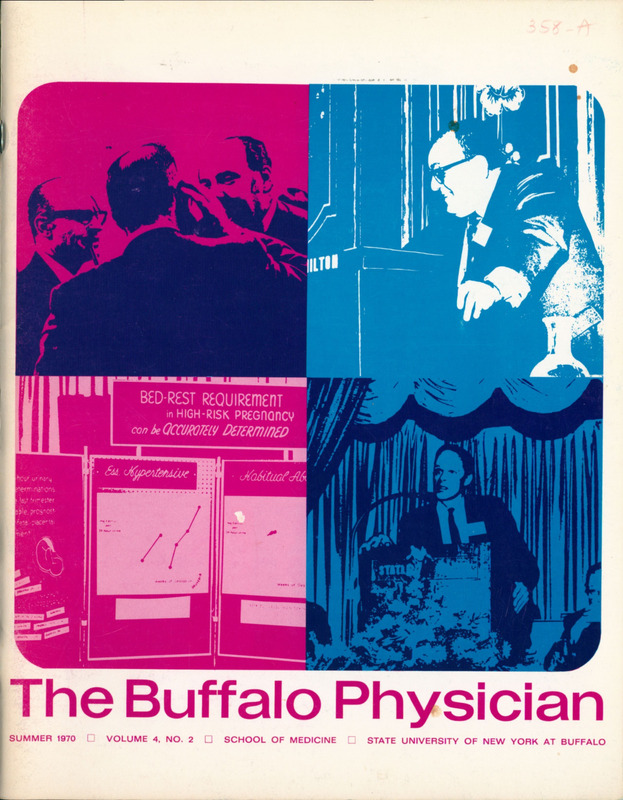
The cover features the annual Spring Clinical Days, the biggest event
of the year for the Medical Alumni Association. The story of this year's
event is on pages 21-27. The pictures were taken by Hugo Unger and
the cover was designed by Richard Macakanja.
THE BUFFALO PHYSICIAN, Summer, 1970 — Volume 4, Number 2, published
The Buffalo Physician
quarterly Spring, Summer, Fall, Winter — by the School of Medicine, State
University of New York at Buffalo, 3435 Main Street, Buffalo, New York
14214. Second class postage paid at Buffalo, New York. Please notify us of
change of address. Copyright 1970 by the Buffalo Physician.
New Health
Care System
This is a summary of what Dr.
John H. Knowles said at a
news conference February 13,
and at the third annual Har
rington Lecture at the School
of Medicine.
THE POPULATION EXPLOSION, Harrington Lecturer Dr. John H.
Knowles repeatedly emphasized, is our most serious problem.
Every other problem — including environmental pollution, better
health care — pales when confronted by this explosive force. The
general director of the prestigious Massachusetts General Hos
pital was bypassed as assistant secretary of health and scientific
affairs, Health, Education and Welfare because of reported oppo
sition by the American Medical Association. President Nixon
named Dr. Roger O. Egeberg, dean of the University of Southern
California Medical School, to the post.
Over 40 per cent of all funds earmarked for health services to
day are used to cover services to the aged 65 and over, he said.
But what about the children in this country who have been disen
franchised? In New York City over 300 children are dying from
heroin poisons. Each year in this country 400,000 illegitimate chil
dren receive no type of health service. "There is a population ex
plosion," he repeated, "and 5J/2 million women of child-bearing
age do not have family planning knowledge available to them.
And they do want it. If you are really interested in health," the
internist who is an outspoken critic of his profession implored,
"you have to be interested in these subjects."
He predicted that one day the spiraling costs for hospital care
may well rise to $1,000 per day. This, he pointed out, makes a na
tional health insurance plan inevitable. "We are the last de
veloped country in the world to reach this point. But we must first
prove to the citizens in our country that we can structure such a
health insurance plan." He pointed to the problem-ridden Medi
care and Medicaid programs. Quality ambulatory facilities and
low cost health benefits must be provided to our 45 million poor
or "we may well have a revolution on our hands." While he feels
that the role of government lies in the policy making and funding
areas, the "ultimate responsibility for health care must be in the
hands of the medical profession."
The over 300 health sciences student/and/faculty audience
heard Dr. Knowles indict American medicine which does not op
erate in a free economic system. "When it comes to medical care,
the consumer has only the most tenuous way of judging the qual
ity of the product. He's not in a position to bargain or shop for
medical services," he said.
The physician noted that competition in medical services is con
sidered unethical but economists believe the medical industry has
more of the characteristics of a monopoly than a competitive busi
ness. While he does not feel that government control is the an
swer, "our best defense is the offense of solving consumers'
problems."
He feels that our new health care system will call for a new
emphasis on health education and preventive medicine. The
changes that he is seeking will first be realized in the minds of
medical students. "Here is where the revolution in medicine will
be, they will want to get out into the community to prevent rather
than to treat disease."
2
THE BUFFALO PHYSICIAN
Dr. Knowles chats with medi
cal students prior to giving
the annual Harrington Lec
ture.
Tomorrow's hospital, envisions the man who feels that physi
cians must assume greater responsibility for solving society's trou
bles, will be an institution which will "feed" satellite health centers
located close to the poor in inner city communities. Such a center,
he noted, has been established in Boston by the Massachusetts
General Hospital to service poor whites. "The poor must be edu
cated to their health rights, but once educated, we must be pre
pared to deliver."D
The School of Medicine has named a special seven-man Com
mittee on Medical Manpower. Chairman of the Committee is Dr.
Edward }. Marine, executive associate dean and director of aca
demic programs at the Medical School.
Serving with Dr. Marine will be Drs. Edward H. Wagner, M'65,
clinical assistant instructor of medicine; James McDaniel, Jr.,
clinical associate of gynecology and obstetrics and assistant to
the dean of medicine; Richard Carter, clinical assistant professor
of social and preventive medicine; John Dower, professor of com
munity pediatrics and associate professor of social and preven
tive medicine; David L. Davidson, assistant professor of psychi
atry; Christopher D'Amanda, M'62, resident assistant professor of
medicine and assistant to the Dean of Medicine.
Dr. Marine said the committee is charged with an evaluation of
all current efforts in community medicine, ambulatory care and
family practice. This includes an analysis of existing and planned
facilities and resources in terms of their adaptability to a major
new program in family practice and community medicine. The
committee will develop specific proposals including facilities, fac
ulty and curriculum in response to the new General Practice Act,
passed by the New York State legislature March 25, 1969. The act
states in part that medical schools that are a part of a state-op
erated institution be required to establish and maintain a depart
ment of general practice under the direction of a qualified general
practitioner. The courses of study, a family care program, clinical
experience, preceptorships, internships, and residencies will also
be under the supervision of qualified general practitioners.•
SUMMER, 1970
3
Medical
Manpower
Committee
The International
Federation Meeting
by
Marc Leitner,
Class of 1972
Today the newspapers are
filled with reports of the war
in Vietnam, the Biafran Ni
gerian Conflict, and the smol
dering hostilities in the Mid
dle East. However, for us as
medical students, the only war
that should really exist is the
fight against poverty and dis
ease, a war with no geographic
boundaries, and truly global in
scope. The problem of good
health care is one of the ma
jor concerns of the Interna
tional Federation of Medical
Student Associations [1FMSA],
This organization, set up over
18 years ago, consists of na
tional medical student associa
tions of over 40 countries. As
the delegate from the Society
of International Medicine, I
hereby submit my report of
the 18th General Assembly of
the International Federation of
Medical Student Associations
which took place in Jerusalem,
Israel, August 18-31,1969.
4
'J-'he OPENING CEREMONIES included many Israeli dignitaries,
the director of the Ministry of Health, the deans of Israel's two
medical schools, and representatives from 19 countries.
The two-week conference schedule devoted the first week to
reports and discussions from various working committees fol
lowed by plenary sessions of the General Assembly which dealt
with resolutions formulated in the working committees.
For 18 years, the most successful activity of IFMSA has been
its international medical student exchange program whereby over
5,000 medical students annually enjoy international clerkships.
But many delegates, including myself, questioned whether this
program was sufficient justification for an international organiza
tion s existence. Was IFMSA willing to relegate itself to a posi
tion of just being an international student travel bureau or could
it serve a more useful role?
Basically the discussions centered around the very fundamental
question: "What are the medical student's responsibilities and in
what way can IFMSA function to fulfill these tasks?"
Two general conflicting philosophies were expressed. One, ad
vocated by the European Common Market countries and ex
pressed by the Italian delegate (other Common Market countries
were boycotting the conference] was that political, social, and
economic factors that operate in a country are very important in
the pathogenesis of disease. There must therefore be changes in
these areas if there is going to be any meaningful resolution to
health problems. The opposing view, expressed by delegates from
Canada, Czechoslovakia, and Ghana, was that IFMSA is strictly
an a-political organization dealing only with medical and health
problems and should not become involved in anything "political.'
Thus, the European Common Market countries oppose IFMSA
sending books, drugs, or supplies to a clinic in a developing
country because this would only treat the symptoms of a disease
and not try to eradicate the underlying cause of the problem.
This conflict over whether IFMSA should become "political"
was a frequent source of controversy and the subject of many
discussions throughout the entire conference.
SCOH (Standing Committee on Health]
In the past IFMSA has had some very successful projects
through the efforts of a few individual countries. Due to lack of
interest on the part of its members, such IFMSA programs as
the international book and drug appeal were completely ineffec
tive during the past year.
The major committee activity was to set general guidelines
and work procedures for MESTUDEC projects (Medical Students
to Developing Countries], In my opinion, these projects can be
come one of the most important activities of IFMSA and serve
concretely toward the realization of its goal of solving health
problems, especially in the developing countries where they are
the most severe. The idea is to have teams of senior medical stu
dents going into the "bush" areas of developing countries to set
up badly-needed health clinics. By several countries cooperating
on the project, clinics could function continuously by staffing
them on a rotational basis.
THE BUFFALO PHYSICIAN
The South African Medical Student Association has already
started such a project by sending teams of six students into the
surrounding countries of Botswanna and Malawi.
Other countries' programs and their needs follow:
. . . International Drug Appeal—Denmark and the United King
dom heavily contributed drugs which were distributed to
World University Service clinics in Sudan, Ceylon, Indonesia,
and Honduras.
. . . Textbook Drive—A severe need of medical textbooks exists
in developing countries, especially Africa. On his trip to Af
rica, the President of IFMSA reported that the Congo des
perately needed French medical textbooks. Sweden ran a suc
cessful book appeal for the benefit of Afghanistan.
. . . Medical Student Involvement—Canada sent 70 medical stu
dents to Jamaica during a three-week period over the sum
mer. The MESTUDEC project for Denmark involved 4-6 stu
dents who spent six months in Indian leprosy hospitals.
Because of the closing of their medical school as a result of
guerilla fighting, medical students in Laos expressed a desire to
continue their training in French-speaking countries.
The only specific health problem discussed was one that I in
troduced—severe health problems created by the Nigerian Biafran
Civil War. I stated that if IFMSA was truly sincere in its objec
tives to combat health problems and disease, it could not remain
silent or inactive in light of the overwhelming human suffering.
Initially there was much opposition to IFMSA involvement in
a political situation. But after considerable discussion, the follow
ing resolution was accepted:
Whereas enormous health and medical problems of mal
nutrition, disease, and starvation exist as a result of the
Nigerian-Biafran conflict; we hereby propose that
IFMSA/SCOH issue an appeal to its member associa
tions requesting them to organize a campaign to con
tribute to the existing relief efforts to both sides of the
conflict in whatever way each association is capable.
A report of each member association's activity in this
area should be sent to the Director of SCOH and the in
formation should be forwarded to SCOP and included in
the IFMSA Newsletter.
The Nigerian medical student association, in consistency
with the Amsterdam Resolution 29, be requested for its
approval before relief is sent to the Nigerian side of
the conflict.
SCOME (Standing Committee on Medical Education)
The director of SCOME criticized delegates for paucity of news
and information to IFMSA. Consequently they were unable to
print the Medical Education Newsletter or complete its booklet
on core curriculum.
The committee organized an excellent symposia on Medical
Ethics, emphasizing Human Organ Transplantation, at the Hadassah Medical School. A panel of Israeli transplantation experts—
internists, surgeons, and psychiatrists—were featured. It was in
teresting exchanging views with delegates from different parts of
SUMMER, 1970
5
Mr. Leitner
the world on such problems as: "Should human life be preserved
at all times, especially in circumstances dealing with cardiac re
suscitation?" In my opinion this was perhaps the most meaningful
discussion of the entire conference.
Virtually all of the delegates attending the General Assembly
felt that to be really meaningful IFMSA has to be more than just
a clearing house for exchange of medical students. The major
problem is how IFMSA can serve as a voice and act as a force
to help medical students meet their responsibilities throughout the
world. The answer, a very difficult one, evidenced by the philo
sophical split between countries who want IFMSA to become more
active in the political, social, and economic realm, and those
who favor activism on purely medical matters. Its future de
pends on a compromise between the two camps. I feel that by its
very nature, the international body of IFMSA has certain politi
cal connotations and cannot operate in a vacuum. It will there
fore be influenced by political reality and at certain times must
do what it deems necessary despite political consequences. Ex
amples of IFMSA acting as a force in the world community: a let
ter sent by a past president to the South African government
supporting the South African Medical Students Association's ef
forts to have equal pay scales for all African doctors; efforts by
one of its past presidents to free two Spanish medical students
arrested for protesting against the Franco government from jail.
Perhaps its entire structure, as it is now constituted, is inap
propriate for a truly active international organization. At the
grass roots level, the individual medical student is bypassed and
does not become involved. This results in apathy by member
countries.
The actions of the General Assembly reflect those of an or
ganization in crisis. Rather than elect a new president, an interim
director, Geoffrey Lloyd of the United Kingdom, served until the
special winter General Assembly was held in Chur, Switzer
land. This meeting was open to all countries and all organiza
tions interested in international health to analyze and evaluate
the present crisis of IFMSA and to make the necessary changes
so as to produce a dynamic international medical student asso
ciation.
Among the benefits derived from my trip, aside from my fan
tastic personal experiences of meeting medical students from all
over the world and traveling to Israel:
—Availability to the Medical School's registrar's office of valu
able information on international summer clerkships, and the
procedure of student exchange through IFMSA, as well as
addresses of medical students in 20 different countries.
—Valuable information based on other delegates' experiences
in setting up MESTUDEC Projects (Medical Students to De
veloping Countries], We are investigating the possibility of
sending a Buffalo medical student team to a developing coun
try such as Paraguay.
—The Society of International Medicine's participation in the
relief effort to Biafra has been continued by successfully in
volving IFMSA in the problem.D
6
THE BUFFALO PHYSICIAN
c,
IHANGE IS ESSENTIAL in today's system for delivery of health
care, a Princeton political scientist said to the pediatrics faculty
at Children's Hospital recently. But Dr. Herman M. Somers feels
that it is still too early for a compulsory national health plan.
"If you pour additional resources into our present system, a bad
one as it now stands, you will freeze it." The only pressure for
changing any system, he pointed out, is financial strain.
But how do you best reorganize a system in need of a great deal
of reform? More experimenting, the Princeton professor of poli
tics and public affairs feels, is the answer. "We need to know
more, to demonstrate projects that will work, so that we are sure
that we are financing the right thing."
An advisor to the Department of Health, Education and Welfare
on both medicare and medicaid, Dr. Somers has served on four
presidential commissions and task forces concerned with health
problems. He was the second lecturer in the Pediatrics Depart
ment's Experiment in Medical Education, a program now in its
second year to acquaint both medical students and young physi
cians with important areas outside of their traditional studies in
medicine.
Medicredit, a plan proposed by the American Medical Associa
tion, is a way of getting universal financing without making any
changes in the health system. "In this plan," he explained, "every
one makes something on it. The government subsidizes insurance
premiums paid by the taxpayer to an insurance company of his
choice through a system of tax credits. While the poor receive a
rebate of 100 percent or equivalent credit, the highest income
group also receives a tax credit in the amount of 25 percent." The
AMA, he feels, will fight for its plan but it probably will not win.
But if it does succeed in holding back other reform, there will
probably be a violent reaction. The need for change is so great
that he cautioned we may not be able to negotiate.
Many qualities of medical care can be improved, he feels. As a
result of the great success of the Kaiser Plan, a managerial mas
terpiece resulting in a string of hospitals located on the West
Coast that offer complete health care to its subscribers, a group
of prestigious physicians organized the San Joaquin Valley Plan,
their defense mechanism in answer to the Kaiser Plan.
In the licensing of physicians, Dr. Somers said that a periodic
reevaluation of medical competence by peers will lead to better
health care. But why hasn't group practice grown? Is money
really the restrictive factor? No, he says, joint patient responsi
bility is the real test.
Physicians, both individually and collectively, wield a tremen
dous amount of political influence in the field of medical care.
While new arrangements are needed, they continue to offer
great resistance to change. New problems that deal with both or
ganization and management face the physician who was attracted
to medicine because he did not want to become a businessman.
Only society in trouble is receptive to change, he concluded, but
it is difficult to attract an environment of change when the af
fluent outnumber the poor.D
SUMMER, 1970
7
Drs. Somers, Mitchel I. Rubin,
Program Coordinator.
Health Care
Changes
Water
Pollution
Dr.
Massaro
\I\IATER POLLUTION is a byproduct of any technological so
ciety and is here to stay says Dr. Edward Massaro, a young Uni
versity biochemist, who is studying the effects of water pollution
on the growth and development of fishes and fish populations.
"What we must do is to learn how to live with it, to limit it to
levels that are compatible with our health and economic well
being."
Can we do this? "Well, we can't wait for organisms to evolve
and thereby 'fit' into new environments. One way to attack this
problem may be biologically, that is, to understand the physiologi
cal limits of adaptation of aquatic organisms and to restart its
biological cycle in polluted waters with organisms that can sur
vive and reproduce in less than ideal conditions." The assistant
professor feels that this may be the only way we can hope to con
trol this major national problem.
"We cannot ask an industry that is employing large numbers of
people to leave a city and thus end up with major unemployment
and associated problems. Even if industry treats its chemical
wastes to its economic limit, it may not be able to keep from pol
luting water to a level that is deadly to organisms living in the
water. But if we can maintain pollution at low levels, find or
ganisms that can survive in polluted environments and intro
duce them into these waters, we will have gone a long way to
ward solving the problem of pollution," Dr. Massaro said.
Through a major research effort, the University of Texas grad
uate feels that it is feasible to look for organisms that may be
able to thrive in polluted environments. "Our approach to the
water pollution problem is to study the biochemistry and physiol
ogy of adaptation in fishes. But an understanding of biological
adaptation in general will be necessary to control environmental
pollution intelligently." However, he cautioned that this will mean
a national expenditure of billions for research; a major commit
ment by the Federal government, private industry, and individuals
as well.
Bodies of water that are now relatively clean probably will be
come badly polluted. And there are no existing techniques known
today that warn us of incipient water pollution. "We need to
solve very fundamental questions. For example, how do we de
tect a change in the environment of a lake before it is too late? A
biological probe, such as an alteration in the biochemical makeup
of a particular fish species, may be able to tell us when the change
— due to some alteration in the quality of the water — is taking
place." But he pointed out that we now know too little to make
this possible.
Pollutionwise, Lake Erie is in very bad shape. If we can find
answers to our questions, we may be able to save the lake. But
we must start to do something immediately. If not, Dr. Massaro
feels that we would do better to fill it in and erect on it a housing
development. In another 20 years it may be one big bog.
Why doesn't the University establish a first-rate department of
environmental sciences to attack the pollution problems of
lakes and New York State in general?
THE BUFFALO PHYSICIAN
Industry is not the only polluter of water. It may be caused by
the runoffs of agricultural fertilizers and pesticides so necessary
to make certain areas inhabitable, or to offshore oil drilling (Santa
Barbara and the Gulf Coast) which should be stopped. Certain
shell fishes that reside at the mouth of the Connecticut River are
now accumulating radioactive materials emitted from a nearby
atomic power station, and numerous shellfish beds now harbor
hepatitus virus.
Our adjacent oceans are being fished to death by Russia, Scan
dinavia, and Japan while the United States "zealously" guards
only its three-mile off-shore limits. Pollution of our fresh water
systems continuously pollutes our continental shelfs. Eventually,
at the present rate, we will destroy our ocean's capacity to supply
the world's increasing population with sufficient food.
"Nothing is going to take care of itself," Dr. Massaro con
cluded. "We have got to make a major commitment to solve
the pollution problems ourselves."•
A total of 41 alumni and faculty and their wives participated in
the annual Medical Society of New York Convention and reception
February 9 at the Americana Hotel, New York City. Mr. David M.
Krajewski, Director of Medical Alumni Affairs, hosted the informal
reception.
In attendance were: Doctors Guy S. Alfano, M'50; J. Edwin
Alford, M'34; Marvin L. Amdur, M'36; Harry Bergman, M'34; Paul
K. Birtch, M'43; Vincent I. Bonafede, M'30; J. C. Brady, M'16
Thomas S. Bumbalo, M'31; Joseph Campo, M'54, and Mrs. Campo
Max Cheplove, M'26, and Mrs. Cheplove; Louis C. Cloutier, M'54
George L. Collins, Jr., M'48; John Constantine, M'34; Thomas S.
Cotton, M'39; Kenneth Eckhert, M'35, and Mrs. Eckhert; Donald
Ehrenreich, M'53, and Mrs. Ehrenreich; Daniel Fisher, M'24; Soil
Goodman, M'37; Bernhardt Gottlieb, M'21; Donald Hall, M'41 and
Mrs. Hall.
Also — Doctors Theodore C. Jewett, Jr., M'45; Herbert E. Joyce,
M'45; Kenneth A. Kelly, M'50; Hans Kipping, M'47; Robert Kohn,
assistant clinical professor of medicine, and Mrs. Kohn; L. Maxwell
Lockie, M'29; William Major, M'44; Walter T. Murphy, M'30; Ber
nard M. Norcross, M'38; James Nunn, M'55, and Mrs. Nunn; James
F. Phillips, M'47; Edward C. Rozek, M'41; Sidney M. Schaer, M'44;
S. Mouchly Small, Professor and Chairman, Department of Psy
chiatry; William J. Staubitz, M'42; Clarence A. Straubinger, M'38;
Wayne Templer, M'45, and Mrs. Templer; Joseph C. Tutton, M'63;
Walter Scott Walls, M'31; David H. Weintraub, M'37; Carlton
Wertz, M'15.
Mr. Krajewski will host a medical alumni reception during the
AMA Convention at the Palmer House in Chicago June 22 at 6 p.m.D
SUMMER, 1970
9
Alumni
Reception
in New York
•
Effects of
Carbon Monoxide
Dr. Farhi
A
BUFFALO PHYSIOLOGIST is one of nine contributors to a pio
neering work on the effects to man of carbon monoxide, one
of our major environmental pollutants. He is Dr. Leon Farhi, pro
fessor of physiology at the University, who was invited by the di
vision of medical sciences of the National Research Council to
join a cooperative national effort to assess information known
about carbon monoxide and to recommend further research that
may provide some of the answers to those responsible for the
development of a sensible and workable solution to environ
mental problems.
Said Dr. Farhi, "Our cooperative study revealed that there is no
level of carbon monoxide in our environment that is known to be
without effect. It is therefore important that we minimize our
exposure to this pollutant."
Each contributor to the recently published report worked on a
specific aspect of the effect of low levels of carbon monoxide
found on city streets and in traffic tunnels. They evaluated new
psychologic and physiologic tests to assess the effects and at
tempted to balance the factors of optimal health to those of eco
nomic well being. While too high a level of carbon monoxide is
harmful to the health of some, limiting carbon monoxide produc
tion too severely may hurt the economy, Dr. Farhi said. With a
carbon monoxide-free atmosphere therefore an impossibility, the
question we want to answer is "what is a tolerable atmosphere?"
With this in mind, Dr. Farhi, in collaboration with Dr. Solbert
Permutt of Johns Hopkins University, reported on tissue hypoxia
and carbon monoxide.
What is the basic reaction of carbon monoxide to man? Its im
portance, the report points out, lies in its ability to combine with
hemoglobin, the oxygen-carrying pigment of blood. When it com
bines to form carboxyhemoglobin, it can no longer carry out this
function. This reaction however is reversible when exposure to
carbon monoxide is reduced and, in time, the hemoglobin will
once again be free to carry oxygen from the lungs to the body
tissues.
Attention has switched from studying carbon monoxide's acute
effects during short-term exposure to its lasting effects during
long-term exposure. In the early 1900's its sources were either
from coal-burning heating devices or leaking illuminating gas
fixtures. It was found that a healthy person could survive from its
acute effects with moderately high levels (from 20-40 percent]
of blood carboxyhemoglobin for as little as a minute to as long
as a week. But today, with cigarette smoke and the internal com
bustion engine as the two main sources of carbon monoxide, its
long-term effect may last anywhere from a month to a lifetime
and produce as little as 0.5 percent of blood carboxyhemoglobin.
While this appears to be a trivial amount, research shows that
there is a decrease in mental performance on breathing low levels
of carbon monoxide.
Also being looked at carefully is the circulatory system; recent
studies of the effects of long-term, low-level exposure to carbon
monoxide suggest circulatory effects. Further studies may prove
even more important for those whose functioning has already
10
THE BUFFALO PHYSICIAN
been affected by disease or aging. Preliminary studies on deaths
from heart attacks raise the possibility that part of the increase in
deaths associated with cigarette smoking may be caused by the
carbon monoxide content of tobacco smoke.
The report on E f f e c t s of Chronic Exposure t o L o w Levels of
Carbon Monoxide on Human Health, Behavior, and Performance,
published by the National Academy of Sciences and the National
Academy of Engineering, raises questions with important implica
tions. Further research is needed to find the answers.•
A 1927 Medical School graduate has been president of the Buf
falo Eye Bank for the last 12 years. He is Dr. Milton A. Palmer.
The Eye Bank is celebrating its 25th anniversary this year.
Dr. Charles H. Addington, clinical assistant professor of sur
gery (ophthalmology), heads the medical advisory committee.
Since its founding the Eye Bank has received 5,400 eyes, and
there has been 2,700 sight restorations through corneal trans
plants. The other eyes are used for study and research by physi
cians and medical schools.
The Lions International Clubs of Western New York and north
west Pennsylvania support the Buffalo Eye Bank through legacies
and memorial gifts. These come from people in all walks of life.
Police and sheriffs' departments assist in the speedy delivery of
eyes to the Buffalo Eye Bank.
A library on ophthalmology and eye surgery was given to the
Medical School by the Eye Bank. Ophthalmologists from India,
Brazil, Tasmania, and several other countries have sought guid
ance from the Buffalo Eye Bank.
Twenty-five years ago a patient requiring a corneal transplant
had to go to New York, Baltimore, or Boston. Today eight local
ophthalmologists transplant corneas in Buffalo hospitals.•
Eye Bank
Anniversary
"Service in Vietnam was the most broadening experience of my
life." That is what Dr. Thomas P. O'Connor said about his stint
in Southeast Asia. He is a 1967 Medical School graduate, who is
one of three physicians on the Entrance and Examining Section
of the Buffalo Induction Center.
"In Vietnam I spent eight months in the highlands among the
primitive Montagnards. These people live in thatched huts on
stilts. Underneath the hut the owner keeps his water buffalo or
cow." It was here that Captain O'Connor and his staff provided
medical aid for the seriously ill or injured Montagnards as well as
our fighting men. During his last four months in Vietnam he con
ducted a dispensary in Saigon.
Although convinced that sooner or later, we must disengage our
armed forces from Vietnam, he said, "it will be very difficult
to leave nearly 17 million people to the unscrupulous North
Vietnamese and Vietcong who are determined to impose, savagely,
their rule upon the South Vietnamese."
After his two-year term in the service Dr. O'Connor takes his
residency at the Buffalo General Hospital, where he interned.•
Dr. O'Connor
SUMMER, 1970
11
Returns From
Vietnam
The University
as a
Care Deliverer
by
Dr. Peter F. Regan
and
Dr. S. Mouchly Small
The university has long recognized its obligation to pursue the
health sciences as scholarly disciplines and to train health care
professionals. But to what extent should the university serve as
a deliverer of health care services? Aspects of this question are
considered in the following paper co-authored by S. Mouchly
Small, M.D., professor and chairman of the Department of
Psychiatry (School of Medicine) at the University, and Peter F.
Regan, M.D., professor of psychiatry and the University's act
ing president. The address was originally presented November
21, 1969, before a meeting of the New York State unit of the
American Psychiatric Association.
12
American universities have traditionally emphasized teaching
and research as their primary commitments with service as
an integral but secondary aspect of their mission. In the past,
many functioned as enclaves or sanctuaries where scholars
congregated, often in splendid isolation from the world about
them, to pursue the classical tasks of storing, creating and
transmitting knowledge. Today, universities have been swept
into the maelstrom of revolutionary, scientific and technologi
cal changes and have become intimately involved in and part
of the new social order. There are ever-increasing calls from
the public and government for the universities to engage in
applied research, to effectively communicate their knowl
edge and follow it through to the operational level to insure
its optimum utilization.
Health services are now considered a human right rather
than a privilege by all segments of our society. Medical pro
fessionals are no longer sacrosanct and beyond criticism. Sci
entific spectaculars, such as organ transplantation, continue
to evoke exclamatory approval, but it is short-lived as in
dividuals are repetitiously faced with poignant and proximate
experiences with pain, illness, disability and death. As the
people become more aware of our deficiencies in knowledge
and the lack of an effective system of health care delivery,
their mounting concern will become increasingly manifest in
social and political pressures for improved services.
The role of the university in care delivery poses innu
merable troubling and provocative questions. It is clear that
the universities and medical schools in our country do have
a major responsibility in this area. Yet there are a host of
questions asked by sincere and dedicated physicians and ad
ministrators concerning the propriety, extent, balance and
capability of universities in their commitment to service,
teaching and research. Many become almost paralyzed by the
enormity of the problem, searching frantically for guidelines
and rapid solutions in this terra incognita. It is the basic
argument of this presentation that the territory of care de
livery is not unknown to universities and that relatively
clear guidelines do exist.
The Role of the University in Society
As a first step let us review the role of the university in so
ciety. On this issue, the essential fact to recognize is that the
university's role does not emerge from within the academic
community; instead it is determined from without. Society
determines what its needs are and creates institutions to deal
with them. It is society which rewards and punishes these
institutions according to how well they satisfy its needs. So
ciety provides each of its institutions with resources and re
sponsibilities and expects them to respond dynamically to the
changes that engulf our entire body politic. Thus, the uni
versities do not determine their mission in isolation but are,
in fact, responsive to the organized communities in which
they exist.
In historical perspective, society seems constantly to call
upon the universities to satisfy three basic needs: the need for
a repository of knowledge at the most advanced levels, in a
broad variety of disciplines; the need for an adequate number
of citizens educated at this advanced level, and prepared to
work in society as intellectual leaders, scholars, or profes
sional practitioners; and the need for keeping the most ad
vanced knowledge and the education of citizens geared to the
changing configurations of the society.
THE BUFFALO PHYSICIAN
Thus, through the centuries, we can see the trends emerge.
In the early years of this millennium, the thrust of universi
ties was focused on the production of professional people
well prepared to serve the kingly elite. As special needs de
veloped, special additions were made to the universities; one
college at Oxford, for example, was founded in order to guar
antee an adequate supply of clergymen for Wales.
As the centuries advanced and population grew, a wider
leadership was necessary, and universities added a pattern of
general education, which would qualify the gentlemen not
engaged in professions to serve in more general leadership
roles in society. Over the last three centuries, in the face of
interacting industrial and scientific revolutions, more and
more fields of knowledge were added to disciplines encom
passed by universities, until now every major university em
braces more than a hundred disciplines and professions. Fi
nally, the societal changes of the last hundred years have led
society to demand that larger and larger proportions of its
citizens should have the benefit of the most advanced edu
cation in the form of specific public programs.
In the United States this change was signalled by the es
tablishment of the land grant colleges in 1862. As pointed out
by Don Price, from those colleges grew the experiment sta
tion, the extension program and a whole interlocking system
of institutions which led to the federal government playing
a more effective role in the agricultural economy than the
bureaucracy of any supposedly socialized state. Today, uni
versities, as responsive organisms trying to satisfy the everchanging needs of the society which established and which
nurtures them, are being called upon for greater and uni
versal participation in higher education and public health
programs among others.
Within this panoramic view, one can see that nations and
societies display differences in their expectations from uni
versities with changes in emphasis reflecting public values,
needs and demands. With respect to research in the United
States, for example, society appears to expect that most basic
research will be done within universities but turns to other
institutions for the bulk of its applied research needs. Thus
the effective transmission of basic research findings to benefit
the lives of our citizens depends upon the existence of in
stitutions geared to applied research. This is particularly ger
mane to our discussion of health care. It is this key linkage
—applied research on health care—which now confronts
American society and American universities with their
dilemma.
SUMMER, 1970
The remarkable advances in medicine ranging from anti
biotics and new vaccines to organ transplants are of limited
value unless we can get these wonders to the people. How is
this to be accomplished? The bitter truth is that we do not
know and that we have no adequate present means for guaran
teeing that our citizens will receive the best health care
available to them. In fact, the evidence leads to the conclu
sion that the availability of the highest quality of health care
is actually becoming more remote. Life expectancy in the
United States is less than that in a dozen other industrialized
countries. Natal and neonatal mortality rates in many areas of
our country are unconscionably high. Whole communities in
our rural areas are without ready access to physicians and
hospitals.
Analysis of Related Problems
A recent article by John W. Gardner (Reader's Digest,
September, 1969), the former Secretary of Health, Educa
tion, and Welfare, cites the need to redesign our society with
institutions capable of continuous change, renewal and re
sponsiveness. We have plenty of debaters, blamers, provoca
teurs and glory-seekers, but we do not have enough prob
lem-solvers. As part of our effort to do so let us define some
of the pertinent facts and central issues related to the univer
sity's responsibilities as a care deliverer. Outstanding among
these problems are the role of poverty as a pathogenic influ
ence, the lack and maldistribution of professional manpower,
the underrepresentation of disadvantaged minority groups
within the professional pool and in our health educational
institutions, and the delivery of care to those who are not
being served because of our lack of a comprehensive
approach.
Pathogenic Influence of Poverty
Unusually high rates of illness, disability and mortality
are commonly found among those in the poverty group. Of
various parameters that one could study, inadequate family
income correlates most highly with other common factors
which contribute to prolonged maladaptation, excessive mor
bidity and decreased life expectancy. The poor are plagued
with sub-standard housing in high population density areas
and show low utilization of preventive care either through
lack of knowledge, poorly accessible health facilities or a lack
of motivation. Poor families have three times more disabling
heart disease, five times more mental disorders, and seven
times more visual impairment than the general population.
(Reference 1: Policies Statements of the Governing Council
of the American Public Health Association adopted Novem
ber 13, 1968, published in the American Journal of Public
Health, Vol. 59, 158, January, 1969). Even more appalling
13
is the fact that as many as 60 percent of the population
eligible for public assistance does not receive payments. It is
apparent that despite great advances in the biomedical sci
ences, unless we deal with the concomitant socio-economic
aspects of health and illness, the meaningful application and
utilization of this information with those in greatest need will
fail.
Poverty in our affluent society is by no means a rarity. A
Census Bureau report issued August 19th of this year, classi
fies 25.4 million persons in the United States as poor in 1968.
One-third of the Nation's Negroes are classed as poor. Quan
titatively there are more poor white families, but the blacks
and other non-whites suffer the highest prevalence of poverty.
Although these figures suggest an improvement, the enormity
of the problem is still quite apparent (The New York Times,
Wednesday, August 20, 1969).
Dr. Regan
Dr. Small
Professional Manpower
It has been estimated that one out of every 20 individuals
employed in the labor force is engaged in the health-care
industry. Health manpower literally comprises well over
100 different types of careers totalling approximately 4 mil
lion persons. Of these, fewer than 300,000 are practicing
physicians. The need for more medically trained professionals
has been repeatedly asserted in various reports, attested to
by numerous unfilled academic and service positions and re
affirmed by our continuing to import many more physicians
from other countries than we export. The numerous accusa
tions leveled at the United States epitomized in the phrase
"Brain Drain" suggest that our debtor status extends across
the board to include experts in many different fields.
Criticism of university medical centers extends beyond the
quantitative lack of medical professionals to include lack of
sufficient general practitioners or family physicians and mal
distribution of those who have completed their medical edu
cation. Physicians tend to cluster in the larger population
centers where modern facilities and equipment are accessible
and where consultations in all specialties are readily available.
It is stated that in six years (1975) we will need an in
crease of a million persons over those now working in all
health professions. (Francis Keppel, National Responsibility
for Health Manpower. Proceedings of the Conference on Job
Development and Training for Workers in Health Sciences,
1966, p. 11. S. S. Steinberg, E. O. Shatz and J. R. Fishman,
New Careers: A Major Solution to the Environmental Health
Problem, American Journal of Public Health, 59, 1118, July,
1969). With the increasing complexity of medical practice
the number of allied health workers per physician will con
tinue to show an upward trend. Thus, it is likely that short
ages will continue to exist in medicine and in the allied health
professions as well.
There is substantial agreement on the fact that this prob
lem of health care manpower cannot be resolved simply by
playing the numbers game. The bitter reality is the fact that
we are presently educating fewer people in the health profes
sions than we need to maintain in the present inadequate
system, e.g., only 8,000 of the needed 10,000 physicians to
maintain our present level of relationship between physicians
and population are graduated each year, with the balance being
recruited from other countries. Even were it possible to dou
ble the size of the present system in less than 20 years, thereby
increasing the cost from the present level of more than six
per cent of the gross national product to a level greater than
12 per cent of the gross national product, there is no guarantee
whatsoever that such a size increase would actually achieve
the goal of bringing health care to each individual.
First t o p e r f o r m
heart surgery in
Buffalo, Dr. John
R. Paine (left), re
ceived the Roswell Park Medal
of the Buffalo Sur
gical Society from
the society presi
dent, Dr. Charles
E . W i l e s , M' 4 5 ,
(right). Dr. Joseph
T. Andrews (cen
ter), past presi
dent, formally pre
sented Dr. Paine
at the dinner meet
ing. He was the
22nd Buffalo sur
geon to receive
the honor. Dr.
Paine retired last
year as chairman
of the department
of surgery at the
Medical
School.
He is now living
at Jekyll Island,
G e o r g i a .•
Disadvantaged Minority Groups
The difficulty in communicating in a meaningful way with
disadvantaged minority groups has received increasing rec
ognition. Suspicion and distrust bred by many years of dis
criminatory treatment by the "white establishment" has com
pounded the difficulty. A greater representation of members
of minority groups in the medical and allied professions
would help immeasurably in opening channels of commu
nication.
An approach which has the advantage of broadening the
base of allied health workers, increasing the efficient use of
the most highly trained professionals and utilizing minority
group members in substantial numbers is the development
of programs for the training and employment of local resi
dents in community health service programs. These persons
have been referred to as indigenous non-professionals and
have proven to be effective bridges with the people heretofore
not receiving health services. In psychiatry new careers such
as mental health worker or technician coupled with "career
ladders" programs both for the new and well established
professions will hopefully help to minimize manpower short
ages and provide improved contact with the underprivileged.
Evaluation of University's Performance
Given this situation, what are the universities to do? To an
swer these questions we can best begin by attempting to
evaluate how well the universities and their professional
schools are meeting society's expectations in the field of
health.
• In terms of maintaining an awareness of the most defini
tive information about health, they are performing their mis
sion. Information about health care delivery systems, how
ever, is inadequate.
SUMMER, 1970
• In terms of generating a sufficient number of educated
people capable of satisfying society's needs for professional
personnel, we are doing a commendable but inadequate job.
In the medical area alone, we are satisfying only 80 percent
of the need, and those who graduate have inadequate prepa
ration and knowledge in the area of health care delivery.
• With respect to adapting to the changing needs of so
ciety, there is little evidence outside schools and departments
of public health and departments of psychiatry of concern
with methods for coping with the disease as it exists in
patients, each one experiencing his illness in a characteris
tically unique way, nor the treatment of patients as they exist
in society. The admissions criteria of university hospitals are
phrased in many ways, but they might generally be expressed
more bluntly: "Bring us the right disease, and we will give
you the best treatment available. If you don't have the right
disease, don't call us; we'll call you."
Without in any way minimizing the difficulty of changing
this system, what needs to be done is to transform a con
siderable portion of the clinical care now being provided un
der the aegis of our universities from an exclusive orienta
tion on disease and basic scientific research, to a balanced
orientation designed to study and teach improved methods of
health care delivery for all the people in a given area. An
appropriate segment of the clinical care conducted by uni
versities can and should be redesigned to provide health care
services to the poor and the minorities in facilities which are
accessible, acceptable and utilized by them. It takes extraordi
nary mental gymnastics to justify not doing so from an edu
cational point of view, for how can we expect the students
who have never had the learning experience of working in a
good health care delivery system to engage in an appropriate
practitioner's role?
15
authority to various members of the patient care team. At this
moment in time, the physician works with an average of 20
other people on such a team, and these may be drawn from
more than 100 professions and skills. New methods for inter
locking the efforts of this team must be a hallmark of the
clinical programs conducted by universities, if the future pro
fessionals are to achieve that multiplication of effectiveness
necessary to meet the health care needs of the nation.
Models for Transforming the Provision of Health Care
Within the University Setting
It is our contention that universities should in fact engage in
the applied research necessary for developing better health
care delivery systems.
At the conceptual level, one may recognize that a univer
sity or group of universities should create those clinical pro
grams which satisfy a number of educational criteria. These
are of two types: professional and social.
The clinical programs operated under the aegis of universities
may run under several different kinds of patterns. At one ex
treme, the clinical programs may be funded by university
resources, and operated in university-owned facilities, with total
university staffing. At the other end of the spectrum, the pro
grams may operate in a wide variety of affiliated agencies (in
cluding health departments and voluntary hospitals) where
major funding, the provision of facilities, and the provision of
basic personnel for the clinical program are the responsibility of
the sponsoring agency. At any point on this spectrum, it is clear
that the university's role derives primarily from its educational
mission. In almost every situation, it is equally clear that the
university can assume a potent leadership role; certainly, it does
so de facto in a university-owned facility, and can assume simi
lar leadership within the terms of most affiliation agreements.
In those pages which follow, an attempt was made to establish
those guiding principles which might be used by universities,
as they carry on their educational activities in clinical settings.
For purposes of simplification, it is assumed that these principles
will be similar, irrespective of the detailed sponsorship of the
agency in which the education takes place.
In such a context the clinical programs operated under the
aegis of a university should reflect the highest standards in the
following areas:
1. All patients who enter the clinical programs conducted
by a university should receive the highest quality of in
dividual medical care now available. This is a standard now
adhered to by all university-conducted programs. And en
larging its scope from a disease orientation to include a social
orientation should in no way diminish this level of excel
lence. Especially in psychiatry, we must be cognizant of both
intrapsychic conflicts and those resulting from the interaction
between the individual and society, differentiating psychopathology and social pathology.
3. It seems apparent that a clinical program operated un
der university auspices should reflect a system of regional
or sub-regional coordination. A store-front health informa
tion center or core area clinic, for example, would constitute
a heartless deception if it was not linked to other facilities
which could provide comprehensive and specialized services
of all kinds. Similarly, an ivory tower citadel is a deception if
it is not linked to satellite operations extending through sev
eral levels of sophistication, with its roots firmly planted in
community health centers located in the neighborhoods in
which patients live. The specifics of how best to organize a
broad pattern of care delivery which encompasses preven
tion, ambulatory patients, partial and 24-hour hospitalization,
rehabilitation, extended care facilities and home care, re
quires the kind of experimentation which universities can
readily undertake.
4. A university operated clinical program will necessarily
involve active participation in the decision-making processes
by the community in which it operates. At this point, we
should take note of a strange dichotomy which exists in mod
ern society, which can recognize that the faculty of a univer
sity can appropriately deal with the board of trustees of
a major metropolitan affiliated hospital, but has difficulty
in giving more than titular "advisory" responsibility to the
representatives of a community in which a so-called "com
munity" health center is established. As the clinical programs
of universities extend into operations within the community,
ways must be devised in which the people in the neighbor
hoods and towns which are served have a legitimate and
permanent role in the decision-making processes which can
affect their lives and the lives of their families and neighbors.
5. The clinical programs operated by universities should
be geared to the reality of the nation and the world. While
it is self-evident that additional costs and supplementary man
power must be associated with educational clinical pro
grams, in order that appropriate teaching and research can
be conducted within those programs, the hard core essence
of the programs must be replicable. The core clinical pro
gram must be designed and operated in such a fashion that
similar programs can be replicated outside of university
auspices, without bankrupting the financial
or human re
sources of the nation.
2. The clinical programs conducted by a university should
reflect the contributions that a variety of professional people
must make, if care is to be provided to all of our citizens.
Thus, there should be a planned teaching and research pro
gram concerned with the assignment of responsibilities and
16
THE BUFFALO PHYSICIAN
6. If the clinical programs operated by universities are to
avoid moving rapidly back to a preoccupation with disease,
and to avoid the danger of becoming hot-house plants in
capable of survival elsewhere, they must be subjected to
continual and objective scrutiny and evaluation. As the
health professional schools engage in such programs, they
should draw upon the research resources of other university
disciplines. Research teams including economists, political
scientists, architects, sociologists, and lawyers, to name but a
few, must be drawn into an ongoing appraisal of the pro
grams. Only by this means, can the excellence and viability
of the programs in application be continually assured.
run by universities should be geared to educational excel
lence and to social reality. The concept which we have pro
posed can be expressed in terms of a matrix, with check
points along educational and social axes. While it may be
true that one or another of our nation's university health
centers cannot take affirmative action at each one of the
checkpoints on the matrix, almost all clinical programs op
erated by universities can, if the university desires, satisfy
most of the criteria called for by the matrix. By coordina
tion among medical schools and universities, there is no
reason why adequate insurance at a national level cannot
be provided.
The clinical programs operated by universities should also
satisfy certain social education criteria:
With respect to these models, detailed or general, several
minor points should be noted:
1. They should embrace all points in the socio-economic
spectrum of society. There is little doubt that clinical pro
grams now operated by universities tend to focus their clini
cal efforts on one or another segment of the socio-economic
system in the United States. Some university medical centers
cater to the affluent white, some to the poverty-stricken
black. If a clinical system is to be a proper vehicle for
teaching and research, however, it must be more, rather than
less, comprehensive. Thus, the population covered by clinical
programs operating under university aegis should be de
signed in such a way as to cover an area which includes sev
eral points on the socio-economic spectrum, so that crossvalidation of the system's effectiveness can be attained. In the
first period of emergence for such systems, the deplorable
lack of care now provided to the poor and to the black and
Puerto Rican minorities should claim particular attention, as
it is difficult to defend even a developing system which tol
erates such discrimination.
1. Financially, the role of the university should be to en
gage in its education and research programs. Insofar as it
conducts the clinical programs which have been described
or postulated directly, and not through affiliations with other
agencies, funding should be provided in a joint fashion.
Those portions of the program which are dedicated to the
education and research ends should be funded through direct
university support. Those portions which are dedicated to
the delivery of patient care itself, should be supported by
appropriate national resources; in this connection, such re
sources may be given to the university directly for patient
care, may be provided by governmental support programs,
or by national health insurance. Whichever method is used, it
should be the responsibility of the sponsoring university to
insure that the core clinical program (as distinguished from
the educational and research association) operates at a cost
level commensurate with that of national potential.
2. Equal attention must be paid to the age distribution of
the population. It is all too easy to turn our attention away
from the unglamorous needs of children and the aged—
after all, preventive medicine and the care of chronic disease
do not provide the virtuoso satisfaction of a spectacular cure
of a rare disease. It is just such unglamorous areas, however,
that can mean the difference between a good life and a poor
life, for tens of millions of citizens. The programs operated
by universities, therefore, must pay careful attention to in
suring that the design of the health care system reflects the
true distribution of the population, and the true needs of
people within that population.
3. Health care systems operated by universities should
take care to insure adequate geographic distribution. Already,
there is apparent a tendency to cluster medical facilities and
professional personnel in those geographic areas more marked
by comfort and convenience than by unmet patient care
needs. With the transportation availability now present in the
United States, there is no reason why every clinical program
conducted by universities should not provide care to at least
a representative sample of the population in the densely
crowded urban centers and in the sparsely-populated rural
areas which surround them. The helicopter can be as im
portant in transporting patients from the hills of Appalachia to Buffalo or Rochester, for example, as it is on the
plains of Texas.
No listing of the criteria which should be incorporated
into a clinical program run by a university can expect to be
complete or final, nor can it expect to be infallible. It does
seem reasonable, however, to think that clinical programs
SUMMER, 1970
2. Nothing could be so destructive to the educational in
tegrity of universities (in satisfying the needs for which so
ciety has established them) as to engage in clinical programs
which are of larger size than that which is called for by the
educational mission of the university. The size of the clinical
programs operated by the university indeed must be limited to
that size which is the minimum necessary for its educa
tional mission, and not the maximum available to entrepre
neurial greediness. Realistically, the size of such a clinical
program will always be sufficient to satisfy most of the edu
cational and social criteria which we have put forth in our
general model.
Summary
It is all too evident that this nation confronts a paradoxical
crisis in its health care delivery system. In the midst of
affluence and technical excellence of the highest order, too
many of our citizens are deprived of health because we have
not learned, and we have not taught, the best methods for
delivery of health care. Yet good health care is not only the
right of every citizen, but universal availability of comprehen
sive high quality health care is a goal to be cherished by every
one. It is within our American universities that the poten
tial for this health care has been built up over the last 50
years. At this moment, it is their responsibility to so range
their educational and clinical programs and to design and op
erate those model systems of health care delivery which will
bring the fruits of basic research to every citizen, without
in any way diminishing the continued excellence that they
have already achieved in other areas.
17
National Intern
Matching Program
Everyone in the class is matched. The tension exhibited by the
94 seniors who assembled in G-22 (March 16) to learn the results
of the National Internship Matching Plan seemed to ease a bit.
It is better this year than ever before.
They waited to receive from associate dean Harold Brody the
envelope that would reveal the results of the program which at
tempts to match the preferences of the students with those of the
hospitals. A quick exit, for some, to the nearest telephone to inform
anxious relatives where "home" would be for the following year.
Over one third, he said, will remain in Buffalo, while 23 others
will complete their internships in New York State (21 in New York
City, two in Rochester). California, which has received as many as
15 over the past years, matched only six. Fifteen other states
accounted for the remaining 31.
Two university programs filled. "Our contribution to medicine
at Buffalo General/Meyer Hospitals is 16 and to pediatrics at Chil
dren's is eight," he said. Other area hospitals are Meyer (one in
psychiatry), Millard Fillmore (one in surgery), Veterans (one in
medicine) and Deaconess (three rotating and two in family prac
tice). More than half the class, he pointed out, received their first
choice.
"While 57 will participate in straight programs, 34 are matched
in rotating programs," he said. Over two-thirds of the class (74) will
intern in hospitals with major medical school affiliations, six will go
to those with limited affiliations, one to a hospital with a graduate
training program under a medical school, eight to nonaffiliated, and
two to public health hospitals.
"All of you are to be congratulated," Dr. Brody said to his third
and final senior intern matching class. "If there is to be any im
provement in internships for future graduates, it will depend on
how well you perform."
18
THE BUFFALO PHYSICIAN
JAMES M. BAKER, Providence Hospital, Seattle, Rotating General
WILLIAM F. BALISTRERI, Cincinnati General Hospital, Cincinnati, Straight Pediatrics
RONALD H. BLUM, Baltimore City Hospitals, Baltimore, Straight Medicine
BRIAN A. BOEHLECKE, Buffalo General/Meyer Memorial Hospitals, Buffalo, Straight Medicine
DENNIS L. BORDAN, North Shore Memorial Hospital, Manhasset, Long Island, Straight Surgery
ELLIOTT BRENDER, The New York Hospital, New York City, Straight Surgery
PETER L. CITRON, Buffalo General/Meyer Memorial Hospitals, Buffalo, Straight Medicine
MARY E. CLEMENS, Buffalo General/Meyer Memorial Hospitals, Buffalo, Rotating Medicine
SEBASTIAN CONTI, St. Lukes Hospital Center, New York City, Straight Surgery
DONALD P. COPLEY, Buffalo General/Meyer Memorial Hospitals, Buffalo, Straight Medicine
VINCENT G. COTRONEO, Buffalo General/Meyer Memorial Hospitals, Buffalo, Rotating Medicine
SETH C. CRAIG III, Children's Hospital, Buffalo, Straight Pediatrics
RICHARD T. CZERNIEJEWSKI. Children's Memorial Hospital, Chicago, Straight Pediatrics
ELLIOTT S. DACHER, Michael Reese Hospital & Medical Center,Chicago, Straight Medicine
ALLEN DAVIDOPF, Kings County Medical Center, Brooklyn, Straight Medicine
WILLIAM P. DILLON, Children's Hospital, Buffalo, Rotating Oh/Gyn
FREDERICK R. DOWNS, Deaconess Hospital, Buffalo, Family Practice
JULIE L. DRATCH, Hun tington Memorial Hospital, Pasadena, Straight Medicine
THEODORE N. DRATCH, Kings County Medical Center, Brooklyn, Straight Medicine
DENNIS P. DuBoiS, Buffalo General/Meyer Memorial Hospitals, Buffalo, Straight Medicine
NANCY L. ECKHERT, Cleveland Clinic Hospital, Cleveland, Rotating Medicine
CARL ELLISON, Cincinnati General Hospital, Cincinnati, Rotating General
ROGER A. EVANS, Medical College of Virginia, Richmond, Straight Surgery
STEVEN J. FAIGENBAUM, Montefore Hospital & Medical Center, Bronx, Rotating Medicine
EBEN FEINSTEIN, Kings County Medical Center, Brooklyn, Straight Medicine
WILLIAM J. FIDEN, JR., Deaconess Hospital, Buffalo, Family Practice
ARNOLD E. FINGERET, Cincinnati General Hospital, Cincinnati, Straight Pediatrics
ALAN FINK, Buffalo General/Meyer Memorial Hospitals, Buffalo, Rotating Medicine
ALLEN J. FINLEY, Bronx Municipal Hospital Center, Bronx, Straight Pediatrics
CHARLES A. FISCHBEIN, Cincinnati General Hospital, Cincinnati, Straight Pediatrics
ELLEN FISCHBEIN, Cincinnati General Hospital, Cincinnati, Straight Pediatrics
JOHN D. FOLEY, Children's Hospital, Buffalo, Straight Pediatrics
ROGER FORDEN, Children's Hospital, Buffalo, Straight Pediatrics
LAWRENCE S. FRANKEL, Georgetown University Hospital, Washington, D.C., Rotating Pediatrics
DONALD J. GABEL, Strong Memorial Hospital, Rochester, Straight Oh/Gyn
ROBERT P. GALE, University of California Medical Center, Los Angeles, Straight Medicine
NEIL W. GARROWAY, Barnes Hospital, St. Louis, Straight Medicine
FRED E. GENSLER, Cincinnati General Hospital, Cincinnati, Psychiatry
JOSEPH D. GENTILE, Veterans Administration Hospital, Buffalo, Rotating Medicine
CHARLES GOLDBERG, Buffalo General/Meyer Memorial Hospitals, Buffalo, Straight Medicine
ARTHUR R. GOSHIN, E. J. Meyer Memorial Hospital, Buffalo, Rotating Psychiatry
STEVEN B. GRABIEC, Children's Hospital, Buffalo, Straight Pediatrics
ELLIOTT L. GROSS, Meadow Brook Hospital, New York, Rotating Surgery
THEODORE J. HAJEK, Children's Hospital, Buffalo, Straight Pediatrics
FRANK M. HALL, JR., Rochester General Hospital, Rochester, Rotating General
MARVIN W. HARRISON, University of Oregon Medical School Hospitals, Portland,Rotating
DAVID S. IRWIN, U.S. Public Health Service Hospital, Boston, Rotating General
RICHARD A. JUSTMAN, University of Chicago Clinics, Chicago, Straight Pediatrics
MARILYN R. KASSIRER, St. Elizabeth's Hospital, Boston, Straight Medicine
DENNIS J. KRAUSS, Brookdale Medical Center, Brooklyn, Rotating General
THOMAS V. KRULISKY, Buffalo General/Meyer Memorial Hospitals, Buffalo, Rotating Medicine
JOEL KRUMERMAN, Jackson Memorial Hospital, Miami, Straight Surgery
(ContinuedJ
SUMMER, 1970
19
ROBERT E. LEE, University of Connecticut, Medical Sociology
ALAN I. LEIBOWITZ, Brookdale Hospital Center, Brooklyn, Straight Medicine
LAURENCE LESSER, Buffalo General/Meyer Memorial Hospitals, Buffalo, Straight Medicine
MICHAEL LIPPMAN, Bronx Municipal Hospital Center, Bronx, Straight Medicine
BRUCE H. LITTMAN, New England Medical Center Hospitals, Boston, Straight Medicine
BARIS LITVAK, Jackson Memorial Hospital, Miami, Straight Pediatrics
RUSSELL MASSARO, Buffalo General/Meyer Memorial Hospitals, Buffalo, Straight Medicine
JOSEPH V. MCCARTHY, U. S. Public Health Service Hospital, Boston, Rotating General
FRANK MILLER, Deaconess Hospital, Buffalo, Rotating General
SUSAN M. MOSHMAN, Montefiore Hospital, Bronx, Straight Medicine
PAUL R. MOYCE, LOS Angeles County - USC Medical Center, Los Angeles, Rotating General
JAN M. NOVAK, Bronx Municipal Hospital Center, Bronx, Straight Medicine
THOMAS A. O'CONNOR, Buffalo General/Meyer Memorial Hospitals, Buffalo, Rotating Medicine
DANIEL PALCZYNSKI, Long Island Jewish Medical Center, New Hyde Park, Rotating General
JEFFREY R. PINE, Buffalo General/Meyer Memorial Hospitals, Buffalo, Rotating Medicine
ALAN M. PODOSEK, Deaconess Hospital, Buffalo, Rotating General
BRUCE M. PRENNER, Presbyterian Hospital, New York, Straight Pediatrics
JOEL P. PURSNER, St. Vincents Hospital, Staten Island, Straight Psychiatry
HERBERT H. RABINER, Long Island Jewish Medical Center, New Hyde Park, Rotating General
CAROL (FARBER) REDDY, Children's Hospital, Buffalo, Straight Pediatrics
JOHN A: RIDER, Children's Hospital, Buffalo, Straight Pediatrics
JEFFREY S. ROSS, Massachusetts General Hospital, Boston, Straight Pathology
DAVID J. ROSSMAN, Temple University Hospitals, Philadelphia, Straight Medicine
JEFFREY G. ROTHMAN, University of Pennsylvania Hospital, Philadelphia, Straight Medicine
DANIEL J. SCHAFFER, General Rose Memorial Hospital, Denver, Rotating General
STEPHEN SCHLESINGER, Children's Hospital of Pittsburgh, Straight Pediatrics
JOHN G. SECRIST, U.C.L.A. Medical Center, Los Angeles, Straight Medicine
SAMI SEHAYIK, Bronx Municipal Hospital (Einstein), Bronx, Straight Surgery
ARTHUR M. SEIGEL, Buffalo General/Meyer Memorial Hospitals. Buffalo, Rotating Medicine
PETER E. SILVERSMITH, Millard Fillmore Hospital, Buffalo, Straight Surgery
JAMES K. SMOLEV, Johns Hopkins Hospital, Baltimore, Straight Surgery
BRUCE A. SOBIN, Long Island Jewish Medical Center, New Hyde Park, Rotating General
AGNES V. S. SZEKERES, Buffalo General/Meyer Memorial Hospitals, Buffalo, Rotating Medicine
BRENDAN D. THOMSON, Good Samaritan Hospital, Phoenix, Rotating General
SHAFIC Y. TWAL, Children's Hospital, Washington, D.C., Straight Pediatrics
ROBERT M, UNGERER, Hartford Hospital, Connecticut, Rotating Surgery
HAROLD M. VANDERSEA, Deaconess Hospital, Buffalo, Rotating General
STEVEN F. WEINSTEIN, University Hospital of San Diego County, San Diego, Straight Pediatrics
HENRY L. WHITED, Rhode Island Hospital, Providence. Rotating Medicine
HOWARD A. WIENER, New York University Medical Center (Bellevue), New York City.Straight Pediatrics
ALLAN S. WIRTZER, Veterans Administration Center, Los Angeles, Straight Medicine
RONALD W. ZMYSLINSKI, Buffalo General/Meyer Memorial Hospitals, Buffalo, Straight Medicine
20
THE BUFFALO PHYSICIAN
Spring Clinical Days
Dr. Bisseli
Three major challenges facing the physician today — sex edu
cation, social hazards, peptic ulcer — were this year's theme at
the 33rd alumni Spring Clinical Days that opened on a snowy and
35-degree day at the Hotel Statler.
"What our children want and need to know is here to stay,"
said national director of sex information and education council
Mary S. Calderone. Sex education, she pointed out to the 250
alumni, student and faculty audience, is needed to make a better
world. The physician has a key role to play in the community —
educating adults and serving as a consultant to schools. But she
cautioned that physicians must be aware of sex-related problems.
"There are patients who may not realize what these problems
are and are now suffering from their effects." For the woman
who has lost a breast, had a colostomy or a historectomy per
formed, and is deeply concerned as to "what this will do to my
sexual life," the physician needs to assure her that it will not
interfere.
Another high anxiety problem is masturbation, she pointed
out. Many physicians do not even understand that as an integral
part of the "self" it is harmless. Moderator Harold J. Levy intro
duced a panel that presented its personal experiences on sex
education in the community. "It is far better to give sex informa
tion too early," pediatrician Robert J. Ehrenreich said, "than too
late." While the Medical Society has initiated a new program
in human sexuality for hospitals and schools, "we as physicians
are only consultants and it must be the hospital that becomes
involved." He believes that the physician's role is to educate the
parents, to teach them healthy sexuality attitudes to pass on to
their own children. He noted that medical students, perhaps more
than ordinary citizens, have sexual hangups.
A sex education activist (as gynecologist Morris Unher calls
himself] insisted that a program in sex education is a "must"
for children in kindergarten through grade 12. Psychologist
Shepard Goldberg concurred that parent education is the key to
a sex education program. At best a film is an audiovisual tool
and will not do the whole job. "You must therefore answer all
questions completely and honestly," he said.
Psychoanalyst Bernhardt Gottlieb pointed out "we may be
making history this afternoon. As far as I know this is the first time
that we as physicians are looking at ourselves and situations that
occur in our everyday life in order to arrive at an understanding of
what we can do, not only for our colleagues but others who come
to us as drug addicts."
The easy availability of drugs frequently leads to its improper
use, a Philadelphia psychoanalyst said. Dr. Ralph B. Little warned
that in self medication "you eliminate the doctor/patient rela
tionship." He pointed out that "it can never happen to me" often
presages the drug problem in physicians. But, he continued, one
SUMMER, 1970
21
Dr. Calderone
Dr. Evans
Dr. Gottlieb
Dr. Hoerr
Dr. Roth
M e d i c a l students a t t e n d t h e sessions.
Mrs. Stockton K i m b a l l w i t h Drs. L o c k i e a n d H e i l b run.
I t was an interesting panel.
The annual Stockton K i i
Drs. C h e p l o v e , S t a f f o r d , Pesc h .
n b a l l luncheon a t t h e S t a t l e r H i l t o n
Drs. Herbert W e l l s , Oscar J. Oberkircher.
D r s . Morhous a n d F u g i t t during a c o f f e e b r e a k .
D r s . M i l f o r d C h i l d s , S a m u e l B 1e i c h f e l d .
Drs. Regan, Anthone.
Drs. Block, Goldstein, Gottlieb.
Drs. Anthone, Mindell.
Drs. Chepiove, Milch, Berman.
has to be ripe or preconditioned before he becomes an addict,
and the physician may be unaware of his vulnerability. "Expect
poor motivation in the beginning of treatment," said the physi
cian who has been involved in a continuing study of drug prob
lems in physicians for the past eight years. "In your initial con
tact with the patient, be certain that you use the term 'addict' to
convey the seriousness of the problem."
Alcohol-addicted physicians, pointed out Roosevelt Hospital
internist, LeClair Bissell, drift into other addictions. Suicide
attempts, arrests, jail sentences for many of those studied, few
sanctions by colleagues appeared to be the picture. She predicted
that between 13,000 — 22,400 physicians are or will become alco
holics and after looking around the room cautioned that one out
of every 100 physicians sitting there will end up an alcoholic.
What can we do about it?
"We as physicians should not join the addict in his own
denial. We must show concern and when necessary impose
sanctions — loss of job or license. But, don't threaten without
offering help and the location of that help."
Physician suicides, psychiatrist Harvey L. P. Resnik pointed out,
exceeds the number of graduates from a large medical school.
When dealing with a patient with multiple complaints, consider
asking him whether he is depressed or has felt so badly that he
has considered taking his own life. It is a myth, he said, that by
doing so you will precipitate a suicide. The chief of the National
Center for Studies of Suicide, who is on leave from the UB
Medical School, said "what it does is to open up an avenue of
communication."
He cautioned that 80 percent of the suicide attempts — and
there is a relation between drugs and alcohol — utilize physician
prescriptions. "Control a prescription," he admonished. Psychia
trists have the highest overall suicide rate, he said, followed by
otolaryngologists who are significantly older.
"As physicians we are less prone to seek treatment for our
selves. We should be more aware of mental illnes in ourselves
and our fellow physicians."
The final session on modern concepts of treating peptic ulcer
moderated by James F. Phillips opened with an overview of the
physiology of gastric secretion. Gastroneurologist William F. Lipp
traced its history from Pavlov in 1889 who developed the nervouscephalic theory of digestive secretion to the Gregory/Tracy team
who in 1959 reexplored gastrin and isolated two pure forms.
By characterizing natural gastrin and proving its structure by
total synthesis they made available both for the first time.
Hunter's theory of the viability of tissue as a factor in the ageold question of why the stomach does not digest itself — the
food that we eat plus the mucosa preventing this from happen
ing— should lead to the development of the entire peptic ulcer
story.
Ulcers do heal, Dr. Samuel Sanes optimistically opened his
discussion on the pathology of the peptic ulcer. A peptic ulcer,
he pointed out, is a defect in that section of the mucosa in the
24
THE BUFFALO PHYSICIAN
alimentary tract that is exposed to acid peptic juice. Focusing
on the duodenal ulcer he noted that it takes between 30-60 years
for its development for the ratio of five males to every female.
A drug may participate in pathology of ulcers, warned a
University of Pennsylvania internist, Dr. James Roth, by inciting
localized damage to the mucosa, stimulating mucosal increase,
or reducing mucosal resistance and thereby interfering with the
healing process. He pointed to the general agreement that aspirin
is a dangerous drug and that with its ingestion one or more
mechanisms may operate to cause erosion and bleeding. He
pointed to phenylbutazone as potentially ulcergenic, the cellular
toxicity of caffeine, as well as ACTH and the still controversial
adrenal steroids that may interfere with the healing process.
A surgeon from the Cleveland Clinic described his experience
in surgical therapy for peptic ulcer. In performing gastroresection,
vagotomy, or the several different drainage processes for the
chronic duodenal ulcer patient, Dr. Stanley O. Hoerr cautioned
that you must pick the operation that is best for the patient.
His experience revealed that a vagotomy with the appropriate
drainage procedure works in nine out of ten cases and offers
the patient the lowest possible risk. He predicted that no matter
what you do, 80 percent will heal but there is the 20 percent
who don't respond to the stomach rest program of hourly feed
ings in small quantities.
At the annual alumni luncheon the Stockton Kimball Memorial
Lecturer emphasized that the "quality of care and continuing
education are not just inseparable, they are the same." A pro
gram of continuing education, Dr. Robert E. Evans emphasized,
is part of a "basic charge to a learned profession, to assure the
ability and performance of its members." Two recent court
decisions, the York Hospital director of medical education and
professional services said, mandate vital involvement at all levels
of hospital staff and administration in both quality of care and
continuing education. One makes the "governing board, medical
staff, and administration responsible for the quality of care
within the institution." The other means a doctor "must be able
to practice at a national level of competence and his failure to
do so can be interpreted as criminal neglect."
Governing treatment is the standard of medical care for an
immediate area, past court decisions indicate. More efficient use
of a physician's time in the hospital is needed to benefit his
patients, his continuing education, and that of other physicians.
Dr. Evans believes that one way to do so would be to lengthen
service for hospital staff. This would not only avoid 'total
anarchy' that results in administrating a multimillion dollar
budget for short tenure personnel but will offer consistent staff
operation.
Attendance he feels should be required at these continuing
education sessions that should be pertinent to identified medical
needs in the hospital. Research, which in all hospitals is vital,
should feed back into medical care. It can either focus on bio
medical problems or on how best to perform or improve a hos
pital function, he concluded.
SUMMER, 1970
25
Six members of the 1920 class
attend the reunion dinner Fri
day evening. They are: (stand
ing) -— Drs. Cecil L. Schultz,
Leon J. Leahy, Salvatore F.
Sorgi and Stephen A. Graczyk.
Seated are Drs. Carl C. Koester
and Alvah L. Lord.
Among the fourteen scientific
exhibits displayed, first prize
went to Drs. Leonard Berman
and Robert Milch's exhibit on
Newer Endoscopic Techniques
in the Diagnosis of Esophageal
and Gastric Disease. Drs. Eu
gene V. Leslie, George J. Alker,
Jr., Edward G. Eschner, Victor
A. Panaro and Mr. Benjamin J.
Kutas' exhibit on X-ray Sub
traction earned second place
while third prize was awarded
to the Clinical Application of
Computers exhibit prepared by
Drs. Ronald J. Foote, Elemer
R. Gabrieli, Worthington G.
Schenk, Jr. and George P.
Reading.
NEWER ENDOSCOPIC TECHNIQUES IN THE
DIAGNOSIS Of E05PHAGEAL AND
GASTRIC DISEASES
7%, V-
McicA 3%t>.
Dean LeRoy A. Pesch told the alumni that the last two years
seemed more like two decades. "The last year has been reward
ing. We have strengthened our ties with our alumni with the
appointment of David Krajewski as director of medical alumni
affairs. We have more interaction and visibility between the
Medical School and our alumni."
The Dean also told the physicians that the Medical School
would play an important part of the University's 125th celebration
in 1971. He also noted the "hole in the ground at Children's
Hospital" is proof of continuing affiliation between the Medical
School and the hospital.
Dean Pesch acknowledged alumni support as well as the con
tributions of the volunteer faculty. He mentioned specifically
the financial contributions of Drs. Charles Heyd and Bernhardt
S. Gottlieb.
Dr. Peter Regan told the physicians that we need "positive,
forward action and educational experimentation so we can keep
on going on the tight rope between stability and change — but
more rapidly. The threat comes from change that is not an added
improving element, but that destroys what is good."
The acting president emphasized that all groups in our society
must be drawn more closely together to find new ways of doing
things better and faster.
"We need changes to meet the demands of society just as
physicians must find new ways of delivering better health care."
Three days after Spring Clinical Days (April 14) Dr. Regan
submitted his resignation as executive vice president effective
August 31. He will become professor of psychiatry in the Medical
School.•
Dr. Graczyk
Dr. Block
Dr. Howard
Ten Class Reunions
A total of 178 physicians and almost as many wives attended
10 class reunions during spring clinical days. The 1920 class had
its reunion Friday evening, (April 10) while the other nine classes
met the following evening. Mr. David Krajewski, director of
medical alumni affairs, organized the dinner reunions.
The physicians attending were:
Class of 1920: Dr. Stephen A. Graczyk, Chairman; Drs. Carl C. Koester,
Leon J. Leahy, Alvah L. Lord, Cecil L. Schultz and Salvatore F. Sorgi.
26
THE BUFFALO PHYSICIAN
Dr. Zittel
Class of 1925: Drs. Marvin A. Block, William M. Howard, Harold
E. Zittel, Co-Chairmen, Drs. William T. Clark, Emerson J. Dillon,
Francis J. Gustina, Margaret L. Hogben, Norbert W. Kuch, Lucian C.
Rutecki, Milton J. Schulz and Ethan L. Welch.
Class of 1930: Dr. Irving Wolfson, Chairman; Drs. Vincent I. Bonafede, Anthony R. Cherry, Benjamin S. Custer, R. Edward Delbridge,
Raymond L. Feldman, Raymond J. Germain, Carleton A. Heist, James
G. Kanski, Leo M. Michalek, Walter T. Murphy, Samuel Sanes, Harold
H. Saxton, Frank B. Smarzo, Richard G. Taylor and Herbert J. Ulrich.
Class of 1935: Dr. Kenneth H. Eckhert, Chairman; Drs. Carl E.
Arbesman, John F. Argue, Willard H. Bernhoft, Russell F. Brace,
James H. Gray, Miles W. Kelly, James A. Mark, Domenic S. Mesina,
Herman S. Mogavero, Paul N. Stoesser, Carl J. Streicher, Harry N.
Taylor, Clayton G. Weig and Philip Willner.
Class of 1940: Dr. Albert C. Rekate, Chairman; Dr. Harold K. Palanker, Toastmaster; Drs. Julian J. Ascher, John M. Benny, Victor M.
Breen, Milford N. Childs, Marshall Clinton, Stuart V. Collins, George
A. Harer, William Hildebrand, Robert D. Hubbard, Corydon B. Ireland,
Bernard W. Juvelier, J. Richard Kline, Warren R. Montgomery, Lyle
N. Morgan, Russell E. Reitz, James P. Schaus, Charles H. Severson,
Allan W. Siegner, Louis A. Trippe, William O. Umiker, Stanley T.
Urban, John D. White and John G. Zoll.
Class of 1945: Dr. H. Paul Longstreth, Chairman; Dr. George W.
Fugitt, Jr., Toastmaster; Drs. Richard H. Adler, William S. Andaloro,
Raymond S. Barry, Craig L. Benjamin, Norman Chassin, Paul Barry
Cotter, James A. Dejute, Martin J. Downey, Jr., George M. Ellis, Alton
A. Germain, A. Arthur Grabau, Donald N. Groff, John F. Hartman,
Theodore C. Jewett, Herbert E. Joyce, Vito P. Laglia, Victor C. Lazarus,
William D. Loeser, Milton J. MacKay, Cornelius A. McGrew, William
N. Mcintosh, Stuart J. Miller, Eugene J. Morhous, John K. Quinlivan,
John G. Robinson, Lillian E. Rowan, Joseph E. Rutecki, Robert C.
Schopp, K. Joseph Sheedy, Jacob M. Steinhart, William R. Taylor,
Wayne C. Templer, Peter Terzian, Edward L. Valentine, Charles E.
Wiles and Jane B. Wiles.
Class of 1950: Dr. Mary Jane Tillou, Chairman; Dr. William S.
Webster, Toastmaster; Drs. Guy S. Alfano, Roland Anthone, Sidney
Anthone, Herbert L. Berman, Charles Brody, Carl A. Cecilia, Vincent
Ciampa, Anthony Conte, Joseph F. Dingman, Adelmo P. Dunghe, James
C. Dunn, Charles A. Howe, O. P. Jones [Guest], Richard J. Leberer,
Karl L. Manders, Leo E. Manning, Joseph M. Mattimore, Henry L Pech,
Roy W. Robinson, George M. Sanderson, Jr., Helen F. Sikorski, George
E. Taylor, Hyman Tetewsky, Anne A. Wasson and Myra R. Zinke.
Class of 1955: Dr. Laurence T. Beahan, Chairman; Dr. James R.
Nunn, Toastmaster; Drs. William J. Breen, Vincent S. Celestino, James
R. Collins, John F. Foley, Albert A. Franco, James M. Garvey, Frank
J. Gazzo, Michael J. Gianturco, John H. Kent, Winifred G. Mernan,
Anthony B. Schiavi, Ray G. Schiferle, Jr., David F. Weppner and John
A. Winter.
Class of 1960: Dr. Roger S. Dayer, Chairman; Drs. Theodore S.
Bistany, John M. Budzinski, Gerard J. Diesfeld, Algirdas Gamziukas,
Edward J. Graber, Thomas J. Guttuso, Donald A. Hammel, James R.
Kanski, Francis J. Klocke, Erwin R. Lamm, John I. Lauria, Marshall A.
Lichtman, Robert L. Malatesta, Harry L. Metcalf, Eugene T. Partridge,
Daniel A. Rakowski, Charles J. Riggo, William J. Stein and John A. Tuyn.
Class of 1965: Dr. Joseph G. Cardamone, chairman; Drs. Anthony V.
Grisanti, Patrick J. Houston, Myron H. Marshall, David G. Publow
and Robert N. Schnitzler.
SUMMER, 1970
27
Dr. Eckhert
Dr.
Dr. Longstreth
Ernest Witebsky
A Personal Vignette
by
Dr. James F. Mohn
This special tribute was pre
sented at the International
Convocation on Immunology
Banquet to Honor Dr. Witeb
sky Monday evening, June 17,
1968 by Dr. Mohn, professor
of microbiology. Dr. Witebsky
died December 7, 1969.
Had he selected the alternative pathway at that moment of cru
cial decision in his teen years, we immunologists would not be
assembled here to honor him. Instead this gathering might be com
posed of distinguished musicians. Perhaps his early intense in
terest in playing the violin, at which he became so skilled that he
seriously considered this as a professional career, may have been
the direct result of a very outstanding, indeed unique musical in
fluence. As a consequence of the geographic partition agreements
made at the conclusion of the first World War, many Germans
migrated from Strasbourg to Frankfurt am Main. His father, Dr.
Michael Witebsky, an obstetrician, and his uncle, an otolaryngolo
gist, who were long residents in Frankfurt, became physicians to
this group.
Most prominent among these refugees was the magnanimous,
noble, late Dr. Albert Schweitzer. The families developed social as
well as professional contacts and this friendship afforded young
Ernest Witebsky the rare privilege of privately listening to
Schweitzer as he practiced on the organ. Later in a church in
Heidelberg, he had the signal honor of sitting next to him on the
organ bench to turn the pages of the music during one of
Schweitzer's recitals. Many years later after finishing his medical
training he was now so impressed with this facet of Schweitzer's
career that he journeyed to Lausanne in 1933 to discuss joining
him in Lamberene. But, as he told me personally, he quickly
discovered during their discussions that Schweitzer desperately
needed physicians who were also carpenters, and in such manual
arts Dr. Witebsky possessed no dexterity whatsoever. Most for
tunately for us in Buffalo, he decided to immigrate to the United
States instead.
To go backward in time now once again to pick up the chrono
logical thread, on graduation, if that is what it is referred to in
Germany, from the Goethe Gymnasium in Frankfurt, he ma
triculated in the University of Frankfurt Medical School. During
these first university years and similarly the last year at the gym
nasium, he became an avid skiing enthusiast. He was among the
first students in 1920 of the internationally famous Austrian ski
instructor, Hannes Schneider, who later founded skiing schools
in this country. It was at Vorarlberg in the Austrian Tyrol that he
came under Schneider's tutelage. This athletic interest continued
on completion of his medical studies and every winter from 19261933 while he was working in Heidelberg he traveled to St.
Moritz to ski.
Alternating as was customary in Germany in his medical school
training between Frankfurt and Heidelberg, he received his Doctor
of Medicine degree from the University of Heidelberg in 1926.
During these formative medical school years, he was profoundly
influenced to pursue the study of human blood groups by the late
Dr. Ludwig Hirszfeld during the latter's working visit to Heidel
berg in 1922-23. As a senior medical student, he presented a stu
dent seminar on blood groups in the Department of Medicine in
1924. Research studies on blood group antigens and antibodies
were to play a very prominent role in his investigations for the
next thirty or more years.
28
THE BUFFALO PHYSICIAN
To digress briefly, it is more than of casual interest to note that
his successor as chairman of our department of microbiology,
Felix Milgrom, known among some of us as Felix Maximus, was
the senior student and long-time associate of Hirszfeld. How in
terwoven are the threads of our lives!
From 1925-1933, Ernest Witebsky was attached to the research
division of the Cancer Institute of the University of Heidel
berg Medical School, headed by Dr. Hans Sachs, the famous pupil
of Paul Ehrlich, first as assistant from 1925-29 and then as Privat
Dozeut until 1933. It is significant that his public address in 1929
as part of the ceremony in connection with his promotion to
Privat Dozeut dealt with his preliminary experiments on the organ
specificity of extracts of the thyroid gland which he attributed
to thyroglobulin.
He made an auspicious or inauspicious entry—depending upon
the eternal difference in viewpoints between the senior research
hierarchy and the young, upstart investigators—into scientific
meetings with his first presentation of a paper on his own investi
gative studies in 1926. The occasion was a meeting on legal
medicine presided over by Dr. Fritz Schiff. His paper was pre
ceded by one presented by a now nameless professor from the
University of Kiel. This hoch geheimurat reported the results of
his study on the blood group distributions among the faculty, es
pecially the professors, at Kiel and among the prisoners in the
Kiel jail. He found a higher percentage of the professors to belong
to blood group A and a higher frequency of blood group B among
the prisoners than among the normal population.
Naturally his conclusion on the basis of such scientific evidence
was that group A was a characteristic related to superior intellect
and group B one that was linked to criminal behavior. Gulping a
few times, I feel quite sure, the young investigator then spoke on
the findings of his research that 40% of German swine possessed
a group A antigen. As you can well imagine, Sachs was furious
at such an audacious performance by a young intern, but as a di
rect consequence he was forced to take Dr. Witebsky's deep in
terest in studies of blood groups seriously and he shortly for
gave him.
Following this same vein of interest, in 1927 the fresh young
man delivered an address on the validity of blood group determi
nations in cases of disputed paternity before a distinguished as
sembly of lawyers and judges in the court house at Frankfurt.
Far too few blood group geneticists and immunologists are aware
that Dr. Witebsky published one of the earliest and best mono
graphs on the existing knowledge of human blood groups in 1932.
This was entitled "Die Blutgruppenlehre Unter Besonderer Berucksichtigung Physiologisch-Serologischer Fragestellungen" and
appeared in the Ergebnisse der Physiologie. As recently as three
weeks ago I heard a speaker refer to the great gap between the
book by the Italian Lattes which appeared in 1923 and that of
Wiener published in 1935.
By 1933 dark clouds of hate had thickened in the skies over
Germany and especially over the academic halls with their con
centrations of superior intellects, such as the University of
SUMMER, 1970
29
Drs. Milgrom, Witebsky
,-L
Immunology Summer School
Heidelberg, always a threat to the survival of any political dema
gogue. The final impetus to a decision to leave Germany came
when Dr. Witebsky could not exclude a prominent, local mem
ber of the Nazi party from the paternity of an illegitimate child on
the basis of his blood group examination. Where should they go?
Since his father was a citizen of Geneva and he, Ernest Witebsky,
possessed similar dual citizenships (Germany and Geneva) by vir
tue of Swiss inheritance laws the answer was Geneva.
Where however would he continue his research and how
would it be supported? No doors were opened to him in any of
the departments a bacteriologist and immunologist would naturally
gravitate to. Finally Dr. Franceschetti, the professor of ophthalmalogy at the University of Geneva—isn't that something for us
to ponder over—gave him a laboratory in his department of clini
cal ophthalmalogy. Perhaps this explains the soft spot Ernest
Witebsky has had in his heart for opthalmalogists which I discov
ered after working with him years later. It could hardly be prop
erly referred to as a laboratory since it was in a dark corner of
the basement and was devoid of all furniture and any laboratory
glassware or other supplies. This he proceeded to furnish in a
make-shift fashion and he bought a few pipettes and test tubes
from his own funds.
Yet in spite of these physical limitations and the obvious in
adequacy of such a research environment, his investigations
here in roughly one year's time—from 1933-34—resulted in four
publications from the Laboratories of Normal Anatomy and of
Clinical Ophthalmalogy. These papers reported his studies on the
Forssman antigen with his demonstration of so-called primary
serum toxicity.
In 1934 he emigrated from Geneva to the United States to be
come a research fellow at Mt. Sinai Hospital in New York City.
Here he was joined by a former student of his in the University
of Heidelberg, Dr. Erwin Neter, an association that continues to
this day. In 1935 while working here, Dr. Paul Klemperer, the
eminent pathologist, brought Dr. Kornel L. Terplan, then professor
of pathology in The University of Buffalo School of Medicine,
who was visiting Klemperer to Ernest Witebsky for him to demon
strate his chick embryo-Forssman antibody serum toxicity experi
ments. This led to an invitation to join Dr. Terplan's department in
Buffalo as associate professor of bacteriology, a position he held
from 1936-40.
In 1940, he was promoted and his title changed to that of pro
fessor of bacteriology and immunology. The University of Buf
falo created the Department of Bacteriology and Immunology as
a separate entity distinct from the Department of Pathology in
1941 and named Dr. Witebsky its head. This morning we were
privileged to hear Dr. Terplan's gracious remarks on Dr. Witebsky's contributions in those early developmental years of our
medical school. In recognition of his many accomplishments as a
devoted teacher and renowned investigator he was made Distin
guished Professor of Bacteriology and Immunology in 1954, a
rank held by only three other members of the entire University
faculty.
30
THE BUFFALO PHYSICIAN
Dr. Witebsky honored by sophomore class January 21, 1967
As a young, slightly overwhelmed, and I'm sure equally bewil
dered, freshman medical student, in the spring of 1942 Dr. Witeb
sky invited me to join him in some student research project, if I
were at all interested. This extraordinary offer, from my humble
position and freshman viewpoint, became the turning point of my
professional career.
The "new" department in those days consisted of one room
approximately 14 x 20 feet, which during the teaching portion of
the year was completely used for making media, cultures, and all
other student materials. Much of the research therefore was
carried out in the Bacteriology and Serology Laboratories of The
Buffalo General Hospital. This was possible because Dr. Witebsky
had been appointed bacteriologist and serologist to this univer
sity-affiliated hospital in 1936 when he joined the University fac
ulty. This was a tangible expression to me of one of his most
fundamental philosophies concerning pedagogy in our basic sci
ence—that successful teaching of medical microbiology and im
munology was dependent on the triad of teaching, research, and
service.
My indoctrination to this field as a student was to serve as a
routine, diagnostic bacteriology technician trainee after successful
completion of adequate probationary periods in glassware wash
ing and media preparation. Again this approach reflected his
strong feeling that successful administration of such a diagnostic
laboratory service at a postdoctoral period required personal fa
miliarity with each aspect of the operation.
The entire full-time staff of the medical school department at
that time consisted of a devoted technician, Miss Anne Heide, and
what we then referred to as a laboratory diener, Mr. August
SUMMER, 1970
31
Dr. Charles Banas presents alum
ni award to Dr. Witebsky at the
1968 Spring Clinical Days.
Dr. Witebsky meets Her Majesty,
Queen Juliana of Holland in the
Royal Palace in Amsterdam in
June, 1968. Dr. Witebsky received
the Cross of Merit from the
Netherlands Red Cross.
Fischer. The total budget for supplies required to teach about 70
medical students and 50 dental students was roughly $500 per
annum. Things were tight in other ways too.
This was the period of the "conscience cigars." I couldn't be
lieve he had really said that the first time I heard it so I begged
his pardon whereupon to my disbelieving ears I heard again
"conscience cigars." He must have appreciated I wore a most
confused countenance because he promptly proceeded to demon
strate what he meant. One of his real pleasures he told me was
smoking cigars, instantly adding that this was a foul habit. Every
time he pulled out his desk drawer he was conscience smitten
over what his children, Frank and Grace, were being denied for
him to afford this personal pleasure. To solve his conscience,
therefore, he kept in a drawer right below the more expensive
ones, a box of nickel cigars—yes, five cents bought a White Owl
cigar then—which were his "conscience cigars," ones he could
smoke on such occasions joyfully. The better ones were saved to
celebrate successful experiments at which time conscience did not
enter into the picture.
The rest is history which is familiar to all of you—I joined the
faculty in 1945, followed by Noel Rose in 1951, Sidney Shulman
in 1952, Almen Barron in 1954, Ernest Beutner in 1956 and Felix
Maximus in 1958. Dr. Witebsky has won many honors in his
career, but if he had the choice I seriously believe that deep in
his heart he covets most the Chancellor's Medal of the University
of Buffalo. This is an award made annually from the bequest of
Chancellor Norton, specifically to one who has brought honor to
this University and has dignified Buffalo in the eyes of the world.
And I would like to read to you the concluding remarks of the
late great Chancellor Samuel Paul Capen in 1950 when he awarded
this medal.
His University which now honors him has still another
reason for bestowing upon him its accolade. Throughout
the prosecution of his work he has exemplified the high
est standards of the university scientist. He has been at
pains to see that the associates who have assisted him
should share with him whatever professional credit
might come as a consequence of their joint labors. He
has insisted that any profits derived from patents on his
discoveries should go to the support of further research
and not to his personal gain. Despite his constantly
growing reputation and the recognition he has received
from all over the scientific world, he has remained the
simple, modest scholar whose courtesy and helpfulness
and wisdom his colleagues have come to cherish in equal
measure with his great scientific attainments.
Well, sir it has taken 26 years to present to me the occasion, the
situation, the audience and the opportunity, and now I have it. So
I would like to say to you personally how much of my deep af
fection and appreciation you have for what you have taught me,
what it has meant to me and my family and to my associates, and
I have for you a non-conscience cigarlD
32
THE BUFFALO PHYSICIAN
"On strike, shut it down!" That was the shout heard on campus
between February 24 and March 21, the beginning of the spring
vacation. During this 25-day period of campus unrest, many classes
were boycotted [peaceful and violent] by students and faculty. No
Medical School classes were cancelled. There were charges and
countercharges by hundreds of individuals and many groups. There
were thousands of words spoken and written.
The Medical School's "Project Themis" [a $300,000 Naval Re
search contract awarded to the physiology department] was one of
the focal points of the student demonstrations. Among the other
demands were — the immediate resignation of Acting President
Regan; self determination for the colleges; support of engineering
students and black student demands; open admissions; lifting of
the court restraining order; reinstatement of Luigi Bianchi and Jon
Hamann, former faculty members; dropping of disciplinary charges
stemming from campus demonstrations; removal of Buffalo Police
from campus [they were removed after 18 days]; and immediate
abolition of Air Force ROTC.
The crisis had been brewing for several months, perhaps years.
Then suddenly there was active violence — broken windows,
police-student skirmishes, arrests, injuries, and other types of van
dalism. Many investigations were launched and are still going on
by student/faculty groups, the grand jury, as well as other city,
county and state committees, commissions and task forces. •
SUMMER. 1970
33
25 Days of
Campus Unrest
As we go to press the Univer
sity community is hard at work
talking and trying to solve its
many problems. There has been
peace on the campus. Then on
May 5 the students here and
across the nation began demon
strating against the war in
Cambodia and the four student
deaths at Kent State University
(Ohio). This national protest is
continuing and no one knows
when or how it will end. •
A
. SENSITIVE PROCEDURE to measure contractility of the heart
holds promise for earlier detection of heart failure. It is the
result of a combined medical/engineering approach at the Uni
versity to estimate how well the heart muscle is functioning. A
paper on " v max as an Index of Contractile State in Man" was
presented March 1 at the 19th Annual Scientific Session of the
American College of Cardiology. Co-authors are Drs. Herman L.
Falsetti, assistant professor of medicine; Robert E. Mates, profes
sor and chairman of the department of mechanical engineering;
David G. Greene, professor of medicine; and Ivan L. Bunnell, as
sociate professor of medicine.
Dr. Falsetti
Heart Failure
Detection
Over a two-year period, a group of 45 patients with various
types of heart disease were studied by the investigators. The 16
males and 29 females ranged in ages from 17 to 65 and included
those whose heart was forced to pump more blood (volume over
load]; those with a narrowed heart valve (pressure load); and
those with a poor heart muscle (no volume or pressure load].
Dr. Falsetti explained, "Hoping to find a sensitive indicator to
the heart's performance, we assessed the various indices of con
tractility by two methods. The first was by use of cardiac pres
sure measurements alone. The second was by use of cardiac pres
sure measurements together with cardiac geometry. In this latter,
Dr. Mates was instrumental in developing a simplified mathemati
cal model to describe the pumping action of the heart. A oneplane cineangiography method (movies of the heart], developed in
Buffalo by Drs. Greene and Bunnell a decade earlier, made
measurements and statistical correlations of heart function pos
sible."
Dr. Falsetti pointed out that consistency with clinical evidence
was also an important factor in assessing the various indices of
contractility. While this procedure has been applied in children by
other investigators, he noted that "ours is the first comparative
study of the most commonly measured parameters of contractility.
Our procedure — to estimate how much damage there is to the
heart muscle — is the most sensitive as well as the most accurate
indicator of the heart's performance of all indices for contractility
that we have tested."
Dr. Falsetti started his research on stress/strain relationships
three years ago under grants from the Western New York Heart
Association and United Fund. The results of this preliminary
work has been published in the January issue of Circulation
Research.O
34
THE BUFFALO PHYSICIAN
The changing nature of health, including the increasing demand
for health care by a more sophisticated public, the rapid increase
in medical knowledge, the realization within the profession of
the importance of both environmental and personal preventative
services and many others has put an acute strain upon the present
concept of the hospital.
From the Desk of
Dean Le Roy A. Pesch
The new Health Sciences Clinical Center will strengthen exising community health systems and develop new ones. This facil
ity will offer a range of services from general medical care
through referral service to the larger medical institutions. It will
function primarily on an out-patient basis. It will reach many
people in need of health care: those who don't know where
to go for help; those who are unable to travel to health care
sources; those who are overwhelmed by the nature of the hos
pital; and those who are unaware of their need for medical
attention.
Health Sciences
Clinical Center
We are planning a facility that is sensitive to the constantly
changing needs of physicians, administrators, nurses, and other
professional students and patients — as affected by medical and
technological progress. The new facility will provide for ongoing
activities of health professionals; flexibility to permit conversion
of any area to a new use; integration of the expansion or addition
of any health related function into the already existing circulation
systems (of personnel, supplies, patient, etc.]; structural and
mechanical efficiency; and human scale environments.
SUMMER, 1970
35
Health Facilities Planning Personnel:
Gyo Obata, principal in charge of
design; Terrence Cashen, vice presi
dent for design; Alvin Lever, vice
president for design. The State Uni
versity Construction Fund.
Copyright © 1970
by
Hellmuth, Obata & Kassabaum, Inc.
zq
BLJ
* * Inpatient
•
Out Patient
A
Research
R
Therapeutic
*-
The concept of the module is being used
in the design of the new Health Sciences
Clinical Center.
Each module
provides
enough air, light, mechanical services and
space for the needs of one person. In this
new "activity oriented module" concept we
are developing space for a variety of func
tions — diagnostic treatment centers, ambu
latory and in-patient areas, research labora
tories, teaching space and common facilities
related to patient care and health delivery
(food preparation, maintenance, information
resources, etc.]. Investigations indicate that
an area of approximately 10,000 square feet
(one-fourth the size of a football field) is a
very effective space for the conduct of these
various activities.
^ H Dx Diagnostic
LL
J
I i LJ
Teaching
The cores link modules together vertically
and horizontally. Expansion of a particular
activity can be accomplished by plugging in
more modules to the existing network. This
system eliminates disruption and disorgani
zation caused by erratic and incoherent
growth.
The network provides the physical basis
for connecting related activities. Each module
can have as many as six adjacent modules:
one above, one below, and four on the hori
zontal plane. This allows formation of hori
zontal, vertical and combination activity
clusters.
Modules must serve many different uses
and must have the built-in capacity to change
functions to accommodate new programs.
This means every module must be designed
to be capable of accepting sophisticated
equipment if the program requires it. Since
each module is a large open space partitions
can be mounted and demounted as the pro
gram dictates.
In concept, the entire complex is organ
ized on the modular grid. The open-space
volumes between the major functional areas
are also modules of approximately 10,000
square feet. At the main levels, these mod
ules provide floor space and additional ver
tical and horizontal circulation for the coremodule network. Above, the module vol
umes are open and admit light and air into
the complex. The network is the basis of all
circulation of personnel, patients, students,
materials, equipment, etc.
To achieve the program flexibility neces
sary for major health care facilities it is
necessary to establish a network to tie the
modules together. Each module is related to
four cores which contain stairs, elevators,
mechanical and electrical distribution, etc.
The modular concept does not impose solu
tions on health care administrators. Rather,
it offers them the means to implement their
philosophy,
growing as
programs
are
planned and the funds to back these activ
ities become available.•
SUMMER, 1970
37
The Health Sciences Library
Mr. M e y e r h o f f
FACULTY AND STUDENTS are impressed with the new
improvements of the Health Sciences Library at 141
Capen Hall. Librarian Erich Meyerhoff is happy with the
acceptance of the "new look" and the increased use of
the library.
A $19,000 Medical Library Resources Grant from the
National Library of Medicine triggered the improve
ments. Everything is new — tables, chairs, desks, files,
racks, and lights — not to mention drapes and carpet.
It all adds up to a pleasant, noiseless atmosphere that
makes for easy and improved study.
"We changed the flow of traffic and are utilizing our
floor space (14,490 sq. ft.] to better advantage," Meyer
hoff said.
Some 750 people visit the library daily. They are in
search for something in one of the 107,585 volumes (twothirds are journals and one-third books) or from one of
the 3,275 periodicals. •
THE BUFFALO PHYSICIAN
Dr. Carel J. van Oss, associate professor of
microbiology, has been appointed Honorary
Dutch Vice-Consul for Western New York.
Previously he had been named in a royal
commission by Queen Juliana of the Nether
lands.•
Dr. Joseph L. Campo, M'54, is the new presi
dent of the medical staff of St. Joseph Inter
community Hospital, Cheektowaga. Other of
ficers are — Drs. Eugene Cisek, vice president;
John S. Sauer, secretary; and Eugene F. Nor
man, treasurer. •
Three alumni were elected officers of the
Mount St. Mary's Hospital medical staff,
Niagara Falls. Dr. Boris A. Golden, M'40 is the
new president; Dr. Glenn R. Arthur, M'47, vice
president, and Dr. Melvin B. Dyster, M'52,
secretary-treasurer.•
Four alumni have been elected officers of
the Buffalo Gynecologic and Obstetric Society.
The new president is Dr. Harry E. Petzing,
M'46. Others named are Drs. Carmelo S.
Armenia, M'49, vice president; Morris Unher,
M'43, secretary; and Donald W. Hall, M'41,
treasurer. Three alumni were elected to the
executive council — Drs. William A. Potts,
M'44; Harold J. Feldman, M'43; and Henry L.
Pech, M'50. •
The first joint meeting of the 132-year-old
New York Academy of Science and a foreign
scientific society will be co-chaired by Dr.
Ernst H. Beutner, professor of microbiology.
The meeting will be in Stockholm May 13-15,
and will focus on Developments in the
Application of Defined Immunofluorescent
Staining.D
THOUGHTS IN A MICROBIOLOGY LAB
(1968)
The cry of the wheezing guinea pig
Screams through the rainy day's air
To shatter my ears with its impending Death.
It suffers the pain of asphyxiation
To educate us with irrelevancies.
You say that you want to bring humanity
Back into medicine. You say that you
Live for life and the human race.
Physician, heal thyself of thine ills
And stop this wanton murder
Of a lowlier species, and, with this,
Return life not to the dead rodent,
But return life to your dead soul.
— Ken Solomon, '71
State University of New York at Buffalo
Dr. Bloom
(Reprinted from THE NEW PHYSICIAN, June 1969)
Dr. Marvin L. Bloom, M'43, is the new presi
dent of the Annual Participating Fund for Med
ical Education. Other officers are Drs. Harry
G. LaForge, M'34, first vice president; Kenneth
H. Eckhert, M'35, second vice president; Don
ald W. Hall, M'41, secretary; and Kevin M.
O'Gorman, M'43, treasurer. The immediate
past president is Dr. Max Cheplove, M'26. •
40
THE BUFFALO PHYSICIAN
Dr. Eric A. Barnard, professor and chairman
of biochemistry, is editor of the Journal of
Molecular Evolution. He is also chairman of
the Medical School's negotiating committee
with minority group representatives.•
Dr. John F. Moran, assistant professor of
biochemistry, has been elected to the Board
of Directors of the United Health Foundation
of Western New York for a three year term.D
Dr. Charles E. Wenner, research associate
professor of biochemistry, is associate editor
of Cancer Research.•
Co-authors of a book, "Roentgen Diagnosis
of Rheumatoid Arthritis", is Dr. Ru-Kan Lin,
clinical assistant professor of radiology, and
Dr. David L. Berens, clinical associate. Both
are on the staff of Buffalo General Hospital.•
Dr. Joseph D. Godfrey, M'31, has been
elected vice-president of the American Acad
emy of Orthopaedic Surgeons. He is clinical
professor of surgery at the University and
team orthopaedist for the Buffalo Bills. Dr.
Godfrey is also chief of orthopaedics at Mercy
and Children's Hospitals and attending ortho
paedic surgeon at Buffalo General Hospital.
Dr. Godfrey became a Fellow of the Academy
in 1948, the nation's largest organization for
specialists in bone and joint surgery. He has
directed postgraduate education programs in
sports medicine in the Buffalo area the last
two years. He is a founder member of the
Orthopaedic Research and Education Founda
tion, a member of the Orthopaedic Associa
tion, International Society of Orthopaedics
and Traumatology, and Pan American Medical
Association, and is a former Governor of the
American College of Surgeons.•
Dr. Godfrey
GEORGE MILLER STERNBERG (1838-1915)
bacteriologist and epidemiologist of the US Army
Medical Corps, was born in Otsego County, New York,
the son of a Lutheran minister. He attended the Buf
falo School of Medicine and the College of Physicians
and Surgeons in New York city. He enlisted in the
Federal Army early in the War Between the States
and was captured in the Battle of Bull Run. Sternberg
held various posts in the Medical Corps and during
the Spanish-American War became Surgeon General.
Maintaining meanwhile, a deep interest in basic bac
teriology and immunology and experimental epidemi
ology, he recommended Walter Reed to the patho
logical laboratory at Johns Hopkins University in
preparation for his experimental studies on yellow
fever in Cuba. Sternberg's most important treatise,
A Manual of Bacteriology, appeared in 1892 followed
by a monograph, Infection and Immunity. While in
the Surgeon-General's office he supported the program
which provided for a corps of female nurses for per
manent Army hospitals and sponsored the founding
of the Army Medical School. He served as President
of the American Medical Association in 1897-1898.
(Composite by G. Bako with permission from the Editor of
The Journal of the American Medical Association)
SUMMER, 1970
41
A 1921 graduate of the Medical School was
honored in February for his 21 years as a
member of the Erie County Board of Health.
He is Dr. Antonio F. Bellanca, a 71-year-old
physician, who was appointed to the board in
1948, when the Buffalo Health Department
was merged into a county health department.
Dr. Bellanca, who retired December 31,
1969, is confident that he and his colleagues
on the board have done an outstanding job
for the citizens of the county. He pointed out
that the Erie County Health Department has
kept abreast of health care advances such as
health clinics and immunization programs.
He was president of the Western New York
Heart Association in 1953; the Erie County
Medical Society in 1954; and is chief of medi
cine at Columbus Hospital. He served almost
four years in the Army in World War II, most
of the time as chief of the 40th Medical Sta
tion in North Africa.
Looking back on almost 50 years he has en
joyed meeting patients face to face in his of
fice. He doesn't believe he could fit into the
computerization that will soon be the pattern
of modern medicine.
"The personal touch will be gone. I feel too
old and rigid to accept computerized medicine,
even though I know we must reconcile our
selves to it if we are to offer good quality
medical service to everyone," Dr. Bellanca
said.
"I want to continue my own practice on a
personal basis. I like to sit down in my office
and talk to my patients. This is what I intend
to continue doing."D
Three alumni have been re-elected officers
at Lafayette General Hospital. They are Drs.
Lucien Potenza, M'58, vice president; Mario
Collura, M'53, treasurer; and Victor Lazarus,
M'45, secretary. Dr. Alexander Perlino was
re-elected president. Dr. Franklyn Campagna,
M'58, chief of medicine was elected to asso
ciate membership.•
Dr. Jules Constant, clinical associate profes
sor of medicine, has authored a new book,
"Bedside Cardiology."0
42
Dr. John K. Dustin, clinical assistant profes
sor in medicine, is the new president of the
medical staff of Millard Fillmore Hospital.
Three alumni were elected to other staff of
fices. Dr. Kenneth S. Kelly Jr., M'50, is presi
dent-elect; Dr. Paul M. Walczak, M'46, is
treasurer; and Dr. Donato J. Carbone, M'46,
was re-elected secretary. The immediate past
president is Dr. Pasquale A. Greco, M'41.D
Dr. Vincent Scamurra, M'50, won the Buffalo
Squash Racquets Association's Veterans Tour
nament for the first time. The former city
champion defeated defending champion Jinx
Johnson, University Club, in the finals.•
Dr. S. Mouchly Small, professor and chair
man of the department of psychiatry, has been
elected to "corporate membership" of the
Muscular Dystrophy Association. He has been
on the national advisory board since its in
ception.•
Dr. Paul M. Walczak, M'46, is the new presi
dent of the New York State Society of Sur
geons Inc. He is an attending surgeon at Mil
lard Fillmore Hospital.•
Two physicians were installed Fellows of
the American College of Obstetricians and
Gynecologists recently. They are: Drs. Ronald
E. Batt, M'58, and Theodore Schulman, a clini
cal instructor.•
Dr. Walter S. Walls, M'31, is the new presi
dent of the New York State Medical Society.
He is also clinical associate professor of sur
gery at the University.•
Three alumni and their spouses were in a
special group that participated in a combina
tion "business-pleasure" trip to Africa. They
were Drs. Thomas Syracuse, M'33, Harry
Schweigert, M'39, and Elizabeth Olmstead,
M'39. The trip included medical and surgical
seminars, a tour of the American Hospital
Ship, the SS HOPE, and a camera safari. The
physicians also visited hospitals in Rabat, Nai
robi, and Tunis.•
THE BUFFALO PHYSICIAN
In Memoriam
Dr. Heyd
Dr. Charles Gordon Heyd, M'09, died Feb
ruary 4 in New York City at the age of 85.
The distinguished surgeon, who retired in
1955, was president of the AMA in 1936-37.
He was the oldest living past president.
Dr. Heyd was a former director of surgery
at New York Post Graduate Hospital and Med
ical School, and a professor of clinical sur
gery at Columbia University. He had also
served as president of United Medical Service,
a prepaid medical insurance service, from
1948 to 1951.
A native of Brantford, Ontario, he became
a United States citizen in 1917. He graduated
from the University of Toronto in 1905. After
graduating from the UB Medical School, Dr.
Heyd took post-graduate work at Harvard,
and in London, Berlin, and Vienna. In World
War I as a major, he commanded a hospital
unit in France.
He was president of the County Medical
Society in 1932, the state society in 1933, and
was vice president of the American College
of Surgeons in 1932-33. He was a former con
sulting surgeon to Greenwich (Conn.) Hospital
and the New York City Police Department.
He was also a former president of the Ca
nadian Society of New York.
Dr. Heyd received the Legion of Honor of
France in 1932, and was author of "Liver and
Its Relation to Chronic Abdominal Infection,"
and about 200 monographs on surgery.
Dr. Heyd opposed compulsory health insur
ance and socialized medicine but advocated
voluntary medical insurance and public health
testing. He urged free state medical service
for those who required it but were unable to
pay.
He maintained close relationships with the
University throughout the years. Dr. Heyd
founded the first New York City Area Alumni
Club, was its first representative to the Gen
eral Alumni Association and was a former
trustee of the School of Medicine Alumni As
sociation. He played a leading role in explain
ing the University's merger with State Univer
sity and the need for continuing alumni sup
port, through a pamphlet entitled "The Chal
lenge of Adaptation," which was widely dis
tributed to his fellow alumni in the early
1960's. •
SUMMER, 1970
A clinical professor of medicine, who re
tired in 1968, died February 14. He was 71year-old Dr. Donald R. McKay. He was former
president of the American College of Chest
Physicians, Buffalo Academy of Medicine, and
the medical staffs of E. J. Meyer and Millard
Fillmore Hospitals. He was director of the
Buffalo and Erie County Tuberculosis Asso
ciation for more than 20 years, and president
for seven years. He was also president of the
Tuberculosis and Respiratory Disease Associa
tion of Western New York. After graduating
from the University of Toronto Medical
School in 1925, he interned and did his resi
dency at Buffalo City Hospital (predecessor
to the Meyer). He stayed on at the Meyer in
charge of tuberculosis service until 1939. He
was also consulting physician at Millard Fill
more and nine other Western New York Hos
pitals. He authored many papers on pulmo
nary disease, held honorary memberships in
tuberculosis associations of Brazil and Mex
ico, and was active in many professional so
cieties at the regional, state, and national lev
els. In 1960 the American College conferred
upon Dr. McKay the degree of master of the
College of Chest Physicians.•
Dr. Carlton C. Rausch, M'43, died January
29, after a short illness. The 48-year-old gen
eral practitioner was on the medical staffs of
Millard Fillmore (obstetrical anesthesia divi
sion) and St. Francis Hospitals. Dr. Rausch
was a Captain in the Army Medical Corps in
World War II and the Korean War. He re
ceived a presidential citation for his service
in the Philippines. He interned at Millard Fill
more and Buffalo General Hospitals. He was
active in several local, state, and national pro
fessional associations.•
43
In Memoriam
Dr. Lauren G. Welch, M'34, died March 17 at
the Niagara Falls Memorial Medical Center.
The 62-year-old physician was Niagara County
Health Commissioner. He was appointed to
this position in October of 1969, after serving
as assistant commissioner for several years.
He was also quarantine medical officer at
Niagara Falls International Airport. Dr. Welch
enlisted in the U.S. Navy at the outbreak of
World War II and was discharged six years
later. During his four-year tour of the Pacific
theater, he received the Bronze Star and the
Purple Heart. Following the war he entered
Columbia and Ohio State Universities for
postgraduate work in medicine. At one time
he was chief of staff of Mt. St. Mary's Hospital
in the town of Lewiston and at the former
Memorial Hospital of Niagara Falls. Dr. Welch
also worked in industrial medicine with the
Carborundum Company. He was active in sev
eral civic and professional organizations. •
Dr. Carol B. Graham, M'43, a former inter
nist and associate professor at the Medical
School, died March 22 at Roswell Park Memo
rial Institute after a long illness. She retired
eight years ago. Dr. Graham was on the faculty
for 19 years, specializing in endocrinology.
She joined the staff of the E. J. Meyer Memo
rial Hospital in 1943 and was head of the En
docrine Service when she retired.•
Dr. Gerald W. Grace, M'42, died March 2
of a heart attack. The 54-year-old physician
was director of Sisters Hospital Outpatient
Department and Canisius College Student
Health Office. He was also head physician for
Mt. St. Joseph Motherhouse, and on the staff
of Emergency Hospital. Dr. Grace was a Cap
tain in the Army Medical Corps in the Pacific
during World War II. He was active in sev
eral local, state, and national professional as
sociations.•
44
Dr. Frank A. Kruse, M'15, died March 3
after a brief illness. Two years ago he was
honored by the Erie County Medical Society
for his 50 years in medicine. Dr. Kruse served
with the army in World War I.O
Dr. Anthony Romeo, M'43, died March 6 in
the Pamona, California Community Hospital
of a heart attack. The 53-year-old physician
practiced in Buffalo from 1947 to 1960. He was
on the staffs of Millard Fillmore, Deaconess
and Columbus Hospitals. Dr. Romeo served in
Europe during World War II with the Army
Medical Corps.•
Dr. Bernard J. Dolan, M'24, died March 11
in Sisters Hospital after a long illness. The
70-year-old physician had practiced medicine
in Buffalo for 41 years, after interning at the
E. J. Meyer Hospital. Dr. Dolan was a past
president of the staff of Sisters Hospital, and
active in several professional organizations.•
Dr. Thomas G. Allen, M'21, died March 17
in Buffalo General Hospital. The 76-year-old
physician took over an industrial practice
from his father. Dr. Allen served in the medi
cal corps during World War I, and was a
draft board physician during World War II.
He was active in several professional organ
izations at the local and national levels. •
Dr. Arthur L. Runals, M'll, died March 19
in Fort Lauderdale, Florida at the age of 81. He
was chief of staff and head of the department
of surgery at Olean General Hospital, Olean,
N.Y. until his retirement in 1953. Dr. Runals
was a Fellow of the American College of Sur
geons, a member of the Medical Society of the
County of Cattaraugus, the Medical Society of
the State of New York and the AMA.D
THE BUFFALO PHYSICIAN
Two 1970
Alumni Association Tours
I. "EXPO-70" TOUR — AUGUST 16 - SEPTEMBER 5
(21-DAYS)
$1,389.00 per person from Buffalo
$1,339.00 per person from Chicago
$1,183.00 per person from San Francisco
(plus $13.72 taxes payable at time of booking)
Stops include: San Francisco, Honolulu, Manila, Hong Kong,
Kyoto (Expo-70), Tokyo, Honolulu.
Tour Escort: Henry E. Mark of Hallmark Travel Agency, Inc.
II. "BAHAMAS HOLIDAY"—NOVEMBER 15-27
(8-DAYS, 7-NIGHTS)
$285.00 per person (twin room occupancy) at the exclusive
KING'S Inn & Golf Club, Freeport, Grand Bahama Island
For details write or call:
Alumni Office, 250 Winspear Avenue
State University of New York at Buffalo
Buffalo, New York 14214
(716)831-4121
The General Alumni Board Executive Committee •— M. ROBERT KOREN, '44, President;
ROBERT E. LIPP, '51, President-elect; HERMAN COHEN, '41, Vice-President for Develop
ment; MRS. ESTHER K. EVERETT, '52, Vice-President for Associations and Clubs;
EDMOND GICEWICZ, '56, Vice-President for Administration; JEROME A. CONNOLLY, '63,
Vice-President for Activities and Athletics; JOHN J. STARR, JR.,'50, Vice-President for Public
Relations; CHARLES J. WILSON, JR., '57, Treasurer; WELLS E. KNIBLOE, '47, Immediate
Past-President. Past Presidents: DR. STUART L. VAUGHAN, '24; RICHARD C. SHEPARD,
'48; HOWARD H. KOHLER, '22; DR. JAMES J. AILINGER, '25; DR. WALTER S. WALLS, '31.
Annual Participating Fund for Medical Education Executive Board for 1970-71 —
DRS. MARVIN L. BLOOM, M'43, President; HARRY G. LaFORGE, M'34, First Vice-Presi
dent; KENNETH H. ECKHERT, SR., M'35, Second Vice-President; KEVIN M. O'GORMAN,
M'43, Treasurer; DONALD HALL, M'41, Secretary; MAX CHEPLOVE, M'26, Immediate
Past-President.
SUMMER, 1970
THE BUFFALO PHYSICIAN
THE BUFFALO PHYSICIAN
STATE UNIVERSITY OF NEW YORK AT BUFFALO
3435 MAIN STREET, BUFFALO, NEW YORK 14214
Address Correction Requested
§SH§
•»*S—