
http://digital.lib.buffalo.edu/upimage/LIB-HSL008_v37n02-2002-Autumn.pdf
Media
Part of Buffalo physician, Autumn 2002
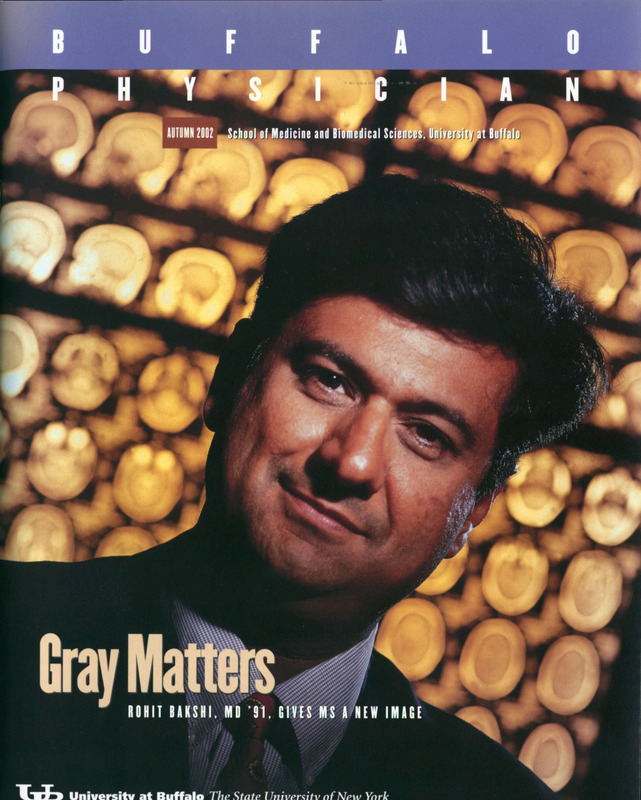
- Text
-
Universitv at Buffalo The State University nf New Ynrk
M
THE
Buffalo Physician
ASSOCIATE VICE PRESIDENT FOR
UNIVERSITY COMMUNICATIONS
Dr. Carole Smith Petro
DIRECTOR OF PERIODICALS
Sue Wuetcher
Dear Alumni and Friends,
EDITOR
Stephanie A. Unger
ART DIRECTOR
Alan J. Kegler
n August 21, 2002, new affiliation agreements between the University at Buffalo and its
DESIGN
David J. Riley
teaching hospitals were announced. These agreements mark a seminal event in the history
of the UB School of Medicine and Biomedical Sciences because they represent a 'sea
DESIGN ASSISTANT
Karen Lichner
change' not only in the school's relationship with its affiliated teaching hospitals, but also
CONTRIBUTING WRITERS
Lois Baker and Ellen Goldhaum
with its faculty and residents.
By recalibrating these relationships to better support our school's primary mission,
which is to educate students and train residents, we are putting in place girders upon
PRODUCTION COORDINATOR
Cynthia Todd-Flick
which we can help build a healthcare system that more effectively serves our region.
The new affiliation agreements, which you can read more about on page 21 of this
issue of Buffalo Physician, will result in our school's faculty being paid
either through the state or through the faculty practice plan. Over time, it
is hoped that this will result in faculty members establishing a primary
allegiance to the school in lieu of the individual inpatient facilities with
which they are affiliated in the community. If this change in culture can be
accomplished, I believe it will greatly strengthen our school's foundation
over the next 25 to 30 years.
With regard to graduate medical education, the agreements take the
hospitals out of the educational system and place the onus for training residents square
ly under the purview of the school, where it should be. This, in and of itself, is a historic
change in view of the fact that the residency programs in New York State were originally
sponsored by hospitals. In fact, UB did not sponsor any of the residency programs until
the Buffalo Graduate Medical-Dental Consortium was formed in 1983, and even that
was only a partial sponsorship. The hospitals had in essence taken ownership of residency
training, so these new agreements bring our community—which was about 45 years
behind the rest of the country—in line with where it should have been a long time ago.
Also, as I look to the future, I anticipate that the federal government will mandate
changes in Medicare law. Under the new affiliation agreements, the school will be in a
much better position to react in a timely way to these changes.
Lastly, from the community's perspective, there is now the potential to undertake
UNIVERSITY AT BUFFALO
SCHOOL OF MEDICINE AND
BIOMEDICAL SCIENCES
Dr. Michael Bernardino, Dean
EDITORIAL BOARD
Dr. John Bodkin
Dr. Martin Brecher
Dr. Harold Brody
Dr. Linda J. Corder
Elizabeth Volz, Class of 2005
Dr. James Kanski
Dr. Elizabeth Olmsted
Dr. James R. Olson
Dr. Stephen Spaulding
Dr. Bradley T. Truax
Dr. Franklin Zeplowitz
TEACHING HOSPITALS
Erie County Medical Center
Roswell Park Cancer Institute
Veterans Affairs Western
New York Healthcare System
KALEIDA HEALTH:
The Buffalo General Hospital
The Children's Hospital of Buffalo
Millard Fillmore Gates Hospital
Millard Fillmore Suburban Hospital
CATHOLIC HEALTH SYSTEM:
Mercy Health System
Sisters of Charity Hospital
strategic healthcare planning for our region, should its leaders have the critical will to
do so. This will certainly require a willingness to give-and-take among the various hos
pitals. But if this flexibility can be managed, the school will have an opportunity to graft
on to a single, high-quality clinical program rather than participate in multiple smaller
Niagara Falls Memorial
Medical Center
© UNIVERSITY IIBIIFFUO.
THE STATE UNIVERSITY OF NEW YORK
programs, none of which can compete locally, regionally or nationally.
If this type of planning is made a priority, then I envision our school serving as an
umbrella under which such initiatives can move forward. This does not mean that the
school would be interested in dictating outcomes for healthcare in our region, but it does
mean that it could serve as a facilitator for change in a new climate of cooperation where,
ultimately, quality of patient care is the only measure of success.
- it i $ t
M I C #h A E L E . B E R N A R D I N O , M D , M B A
Dean, School of Medicine and Biomedical Sciences
Vice President for Health Affairs
Letters t o t h e Editor
Buffalo Physician is published quarterly
by the University at Buffalo School of
Medicine and Biomedical Sciences in
cooperation with the Office of
Communications.
Letters to the Editor are welcome
and can be sent c/o Buffalo Physician,
330 Crofts Hall, University at Buffalo,
Buffalo, NY 14260; or via e-mail to
bp-notes@buffalo.etlu. Telephone:
(716) 645-5000, ext. 1387.
The staff reserves the right to edit
all submissions for clarity and length.
University a t B u f f a l o
The State University of New' YorK
P
H
Y
S
I
C
I
A
N
Features
2
10
16
Gray Matters
Rohit Bakshi, MD '91, neurologist
and mentor extraordinaire, gives
multiple sclerosis a new image
B Y Lois B A K E R
Pain's Mystery, a Mindful Approach
Funded by a $2 million grant, UB
researchers study biobehavioral
treatments for irritable bowel syndrome
BY S. A. UNGER
Budget Talks
A conversation with Michael
Bernardino, MD, MBA, dean of the School
of Medicine and Biomedical Sciences
Stephen Pollack, MD '82. welcomes Jodi-Ann Oliver at the White Coat Ceremony. Jodi-Ann's
twin. Leri-Ann. Is also a member of the Classof 2006. For more on this event, turn to page 22.
COVER PHOTO BY K. C. KRATT
FJgHH
^PmLVKY ^
Medical School
22 White Coat
Ceremony
23 Toni Ferrario
receives 2002
Humanism in
Medicine
Award
24 Inaugural
Student
Clinician's
Ceremony
Research News
26 Update on
Pathways
30 News about
Buffalo Center
of Excellence in
Bioinformatics
28 Anthony
Campagnari's
research
stimulates
industrial
collaboration
faculty, staff,
students and
alumni
31
GonzalezFernandez joins
UB as inaugural
chair holder
34 Faculty awards
Student Column
36 Fourth-year
student and
volunteer
fire fighter
Laura Rendano
reflects on her
dual roles
Development
39 A DNA
research gift
40 Annual list of
endowments
Classnotes
44 News from
your UB
classmates and
other alumni
en years ago people with multiple sclerosis (MS)
could expect little from the medical profession
other than drugs to help relieve their symptoms
and canes or walkers to help them get around as
their physical disabilities mounted.
That was before researchers were able to focus
the full power of advanced neuroimaging techno
logies on the disease.
By using the latest magnetic resonance imaging (MRI)
methods in tandem with one of the most powerful
supercomputing systems in the world, University at
Buffalo researchers in the Buffalo Neuroimaging Analysis
Center (BNAC) are providing insights into the disease
that were never before possible.
Some are creating three-dimensional images of the
brain and brain structures of MS patients that show the
process of atrophy under the onslaught
of the disease.
Others are linking stages of atrophy
Perhaps the most im
with physical and cognitive symptoms
portant development to
and are developing a "standardized" im
come out of the center
age of one affected brain structure, which
will serve as a model for assessing disease
to date is the research
stage and predicting progression.
ers' discovery that the
Still other scientists are using advanced
imaging techniquesand computing power
brain's gray matter,
to study the amount of whole-brain shrink
where higher function
age that occurs in MS and to develop accu
rate ways to measure brain deterioration.
ing is centered, is involved in MS.
A Neuro Image of Atrophy
Perhaps the most important development to come out of
the center to date is the researchers' discovery that the
brain's gray matter, where higher functioning is centered,
is involved in MS.
"Traditionally, MS was thought to be strictly a
In addition to pursuing his own research. Rohit Bakshi. MD.
University at Buffalo associate professor of neurology, front.
has assembled a group of energetic student researchers to
work in the Buffalo Neuroimaging Analysis Center. "The students
are the lifeblood of the center." says Bakshi. "Their enthusiasm,
dedication and fresh ideas make our research go forward."
Pictured, back row. left to right, are medical students
Michael Sanfilipo. Rob Bermel and Andrew Fabiano.
'white matter disease,"' explains Rohit Bakshi, MD '91,
Autumn 2002
!u ff aI a Physician
UB associate professor of neurolo
gy and director of the BNAC. We
thought it affected only the 'road
ways' in the brain." (White matter, or
myelin, is the covering that allows
various gray matter structures to
communicate with each other.)
This finding resulted from the re
searchers' work with a brain structure
situated deep in the gray matter called
Class of 2003
fourth-year medical
of Neurology, Alpha Omega Alpha
conducted research in neuropharm
student at the University at Buffalo
medical honor society and the Uni
acology as a Howard Hughes Under
School of Medicine and Biomedical
versity at Buffalo.
!u If a I i P h y s i c i a n
A u t u m n
graduate Research Fellow. In 1998, he
Sciences, has been chief research
In May 2001, Bermel was awarded
worked at the U.S. Oepartment of
assistant at the Buffalo Neuroimag-
the American Academy of Neurology's
Energy's Brookhaven National Labora
ing Analysis Center since May 2000.
G. Milton Shy Award for medical stu
tory, where he studied addiction con
His work includes an honors thesis on
dent research in clinical neurology,
trol and breast cancer therapy using
the use of MRI in detecting brain
based on studies he conducted onthe
brain positron emission tomography.
atrophy in multiple sclerosis (MS),
use of the bicaudate ratio as an MRI
Bermel is interested in pursuing
mentored by Rohit Bakshi, MO '91.
marker of brain atrophy in MS.
This research was funded by student
While pursuing his bachelor of
grants from the American Academy
arts degree in biology at UB, Bermel
the caudate nucleus, an important nerve center for con
trolling movement and cognitive processing. Other labo
ratories have studied the role of the caudate nucleus in
Alzheimer's Disease and Huntington's Disease; however,
the BNAC is the only center studying it in MS patients
with state-of-the-art MRI techniques.
"Through our computerized imaging analysis capa
bilities we have been able to visualize the caudate nucleus
in MS patients in new ways, and we found it was atro
phied," explains Bakshi. "Moreover, the atrophy is not
4
associated with the amount of white matter damage.
"If we are going to treat this disease," he says, "we have
to know where the damage is."
MS strikes people primarily between the ages of 20 and
40, and there is no cure. The most common cause of
progressive neurologic disability in young adults, the dis
ease is most prevalent in mid-North America and North
ern Europe. Symptoms vary widely, depending on where
and how much brain damage is involved.
A leap forward in treatment occurred in 1996 when a
2 0 0 2
a residency in neurology following
graduation from medical school.
drug developed by the late Lawrence Jacobs, MD, chair of
UB's Department of Neurology, was approved by the
Federal Drug Administration after several years of clinical
trials that were supervised by Jacobs. The drug, interferon
beta-la (Avonex), slows progression of disability in the
relapsing-remitting form of the disease and reduces the
frequency of flare-ups. It is now the most widely prescrib
ed treatment for MS.
"Our challenge today is to uncover mechanisms in the
brain that could lead us to a new therapy, building on
T
"We've been able to correlate gray matter hypointensity
with brain atrophy and physical impairment. This leads us to
think that hypointensity in the deep gray matter is a strong
predictor of disability, progression of the disease and sub
sequent brain atrophy."
a third-year medi
Kenmore, New York, before matricu
After five semesters. Fabiano
cal student at the University at
lating to the University of Illinois at
graduated with Highest Bepartmen-
Buffalo School of Medicine and
Chicago (UIC). While at UIC, he parti
tal Distinction and was elected to
Phi Beta Kappa.
Biomedical Sciences, has been a
cipated in research with Br. John
research assistant at the Buffalo
llekis and Br. Erol Bnel, isolating nov
Fabiano's work at the BNAC fo
Neuroimaging
el genes involved in spermatogene
cuses on assessing gray matter
sis. He also contributed to research
damage in multiple sclerosis and
Analysis
Center
(BNAC) since May 2BB1.
A native of Buffalo and the third
at the UIC Medical Center on positron
diabetes using MRI diffusion imaging
of six children, Fabiano attended
emission tomography screening for
and T2 relaxation.
St. Joseph's Collegiate Institute in
coronary calcification.
Dr. Jacobs's work," says Bakshi. "One possibility might be a drug cocktail that in
cludes interferon and a neuroprotective agent to target and preserve the gray matter."
Bakshi's own research could point to one possible drug approach. He is first au
thor on a study published in the January 2002 (Vol. 59) issue of Archives of Neurology
that reports that brains of MS patients appear to contain excess iron deposits.
"In our imaging studies, the gray matter structures of MS patients appear very
dark on one type of MRI scan," says Bakshi. "This evidence points to high levels of
iron in the brain, which suggests that iron could be causing cell damage. The brain's
mechanism to regulate iron could be impaired or shut down in MS.
"We've been able to correlate gray matter hypointensity with brain atrophy and
physical impairment," he adds. "This leads us to think that hypointensity in the deep
gray matter is a strong predictor of disability, progression of the disease and
Autumn 2002
I ii f f a I n P h y s i c i a n
5
subsequent brain atrophy."
If these findings hold up through
longitudinal studies, a treatment de
signed to prevent iron buildup could
prove beneficial.
Student Scientists
In addition to pursuing his own re
search, Bakshi has assembled a group
of energetic student researchers from
various disciplines to work with senior
neurologists on several projects.
"The students are the lifeblood of
Michael
SanfiliDO
Class of 2005
the BNAC," says Bakshi. "Their enthusiasm, dedication,
and fresh ideas make our research program go forward.
"Our goal is to train the students in the necessary
neuroimaging analysis techniques and then rapidly help
them to develop their own line of investigation under
supervision," he continues.
"This mentor-mentee approach has led to each student
taking the lead on projects, including data analysis and
interpretation, presentation of data at national research
meetings, and manuscript preparation."
Among the researchers is Robert Bermel, a fourth-year
medical student at UB, who is concentrating on the cau
date nucleus. Bermel is collaborating with specialists in
UB's Center for Computational Research who are taking
ology internship at the Manhattan
Summer Research Fellowship to
medical student at the University at
Psychiatric Center,he was a research
study whether cerebral gray matter
Buffalo School of Medicine and Bio
associate at New York University,
abnormalities in MS are related to
medical Sciences, joined the Buffalo
where he conducted neuroimaging
cognitive impairment.
NeuroimagingAnalysis Center (BNAC)
research (PET, MRI. fMRI) in schizo
He has authored 31 research
in 2002 to perform quantitative MRI
phrenia under Dr. Adam Wolkin. He
articles, six as first author. His cur
research in multiple sclerosis (MS).
then conducted fMRI researchin sub
rent research interests include
A native of Buffalo, Sanfilipo
stance abuse at the Medical College
MS. schizophrenia, neuroimaging.
of Wisconsin under Dr. Elliot Stein.
MRI, biostatistics and neuropsy
earned his bachelor's and master's
degrees in psychology from Syracuse
Sanfilipo received a UB School of
University. After completing a psych
Medicine and Biomedical Sciences
chology. In the future, he plans a
career in academic neuroscience.
"Our goal is to train the students in the necessary neuroimaging
analysis techniques and then rapidly help them to develop their own
line of investigation under supervision." —Rohit Bakshi, MD '91
6
I u If aI o Physician
A u t u m n
2 0 0 2
data from high-resolution MRI scans of the structure in
MS patients and converting them into three-dimensional
images that can be displayed on a computer monitor and
rotated in any direction interactively. The studies are aimed
at looking at how disease of the gray matter is detected in
the brain and how it relates to MS progression.
"Before we had the ability to create three-dimensional
images, we were able to use computers only to obtain
quantitative data, such as the structure's volume and di
mensions," says Bermel, who is working in Bakshi's labo
ratory. "Now we are able to visualize structures, to actually
see where atrophy is occurring."
Bermel presented a poster at this
year's American Academy of Neurol
ogy meeting detailing his findings,
which showed that caudate nuclei in
MS patients were smaller than in
healthy controls. The atrophy of this
brain structure wasn't associated with
any other measures of disease pro
gression, such as whole-brain atro
phy, duration of disease or extent of
brain lesions.
"This suggests that another unde
termined mechanism may play a role
in gray matter disease," notes Bermel.
"The study also demonstrated that
new computer-assisted imaging ca
pabilities can show gray matter dis
ease, which previous MRI's could not
detect. It opens a new window into
the brain."
Bermel and his colleagues in the
UB Center for Computational Re
search noware establishing a database
of three-dimensional images of cau
date nuclei from MS patients and cor
relating each image with each patient's
ability to function. This will allow re
searchers to track the association be
tween atrophyand MSsymptoms and, by matching images
from new patients to the database, to predict their disease
stage and progress.
Another young researcher is Andrew Fabiano, a thirdyear medical student at UB, who is analyzing diffusionweighted MRI scans of gray matter structures in MS pa
tients. This type of scan measures the amount of water that
passes through a brain structure: the higher the diffusion
rate, the less dense the tissue.
Fabiano is assessing the diffusion rates of two different
categories of disease—relapsing-remitting and secondaryprogressive—and comparing them to patients' symptoms.
In results presented at this year's American Academy of
Neurology meeting, Fabiano reported that the diffusion
rate was higher in secondary-progressive patients than in
relapsing-remitting. In the caudate nucleus, a higher diffu
sion rate was linked to greater physical disability.
His findings suggest that this type of scan could be used
as a noninvasive method to determine and monitor gray
matter tissue damage in MS patients. Fabiano was awarded
a prestigious research grant from the Alpha Omega Alpha
Medical Honor Society to continue this work in Bakshi's
lab this past summer.
As the newest member of the BNAC team, Michael
Sanfilipo, a second-year UB medical student, is applying his
Autumn 2002
Buffalo Physician
7
prior neuroimaging experience in the area of schizophre
nia to address the question of whether the specific cortical
gray matter areas responsible for "higher" cognitive abilities
are atrophied in MS. Sanfilipo recently received a UB
Summer Research Fellowship to carry out this project us
ing a statistical brain mapping program to be run in part
nership with the Center for Computational Research.
Also within the BNAC, Jitendra Sharma, MD, a graduate
student at Roswell Park Cancer Institute, is collaborating
with a researcher at the University of Trieste in Italy to
develop a highly reliable measure of whole-brain atrophy.
Jin Kuwata, a UB psychology graduate, is administering
cognitive tests to MS patients and comparing their perfor
mance with the amount of atrophy shown on their brain
scans, making the connection between gray matter damage
and mental function. Christopher Tjoa, a computer science
and premed major at UB, is performing brain mapping in
an effort to develop a standardized image of a healthy brain
against which MS brain images can be compared.
Rohit Bakshi
While current work at the center will continue to con
centrate on MS, in the future researchers will be analyzing
brain scans of persons with juvenile diabetes, as well as
those with other conditions, such as lupus, stroke, demen
tia and epilepsy.
"Our main thrust is to determine through MRI analysis
the sites and mechanisms of disease in the brain and to
provide new information about how diseases progress,"
explains Bakshi. "The applications of this work include a
more accurate diagnosis of neurologic disorders and the
ability to accurately predict the disease course at the time
of the earliest symptoms.
"Also, through studying diseases with sophisticated
MRI analysis, we begin to untangle the great mystery of
how the brain functions. Ultimately, this information
could lead to new treatments and—in the best scenario—
to cures for a variety of brain disorders. This is what we all
work toward.''CT>
is founding director of
Upon graduation from medical
scientific papers in such journals as
the Buffalo Neuroimaging Analysis
school in 1991, Uakshi served a one-
the NewEngland Journal of Medicine,
Center (BNAC), an associate profes
year internship at the Massachu
Journal of Neuroscience, Neurology,
sor of neurology in the University at
setts General Hospital and Harvard
Multiple Sclerosis, and Journal of
Buffalo School of Medicine and Bio
Medical School, followed by a neur
Neuroimaging. He is also first author
medical Sciences and a neuroimager
ology residency at the University of
of a 200-page chapter on brain MRI
at the Jacobs Neurological Institute
California at Los Angeles, where he
for the textbook Baker's Clinical
in UB's Department of Neurology.
conducted neuroimaging research
Neurology, updated for 2001.
A Buffalo native.Bakshi is a grad
with Ur. John Mazziotta. He returned
Oakshi received the 1998 William
uate of Cornell University and the
to Buffalo in 1995 to complete an
H. Oldendorf Award for his neuroim
UB School of Medicine and Biomedi
MRI/CT neuroimaging fellowship at
aging research in multiple sclero
cal Sciences. As an Alpha Omega
the Uent Neurologic Institute.
sis. In 1999,he was appointed to the
Alpha scholar, he completed a neuro
Bakshi is board certified in neu
board of directors of the American
science research fellowship in neu
rology and is certified in MRI/CT by
Society of Neuroimaging and joined
ropharmacology and stroke with
the American Society of Neuroimag
the faculty of Medscape.In 2000.he
Dr. Alan Faden at the University of
ing. A neurologist and neuroimager.
was appointed to the editorial board
California at San Francisco.
he has published 7U peer-reviewed
of the Journal of Neuroimaging.
wealth of Talent and Resources
Multidisciplinary research program thrives in Buffalo
&
W
he Buffalo Neuroimaging Analysis
Center (BNAC) is located in the Jacobs
Neurological Institute at Kaleida Health's
Buffalo General Hospital, part of the Buf
falo-Niagara Medical Campus. The center,
which is affiliated with the Department of
Neurology in the University at Buffalo
School of Medicine and Biomedical Sci
ences, has received more than $1 million in
funding since opening two years ago.
The sources of funding, which reflect the center's
multidisciplinary research program, include the Na
tional Multiple Sclerosis Society, the Juvenile Diabetes
Foundation, the National Institutes of Health and the
University at Buffalo. (Computer systems at the BNAC
are maintained by the Engineering Node Service of
UB's School of Engineering.)
"One of the strengths of the BNAC is that we have
thrived on various collaborations with UB investiga
tors from other departments and other schools, taking
advantage of the wealth of talent and resources avail
able right here in Buffalo," says Rohit Bakshi, MD '91,
UB associate professor of neurology and director of
the BNAC.
Other neurologists at the Jacobs Neurological Insti
tute who have participated in the work of the BNAC
include: Bianca Weinstock-Guttman, MD, UB assis
tant professor of neurology; Steve Greenberg, MD, UB
associate professor of neurology; and Frederick
Munschauer, MD, UB clinical professor of neurology.
In addition, Ralph Benedict, PhD, a neuropsychologist
and UB associate professor of neurology, has collabo
rated with the BNAC on numerous projects that involve
the study of cognitive and behavioral disorders using
magnetic resonance imaging (MRI).
. s & v
r-A" -
«v v,
r,uv|
•
m
Bakshi has also
:? sr
i \ i ' " f \ % *K ,xv> '5 ^%vs
formed a collabora
-f.
• .
tion with Julian
g\'*y 8BJS
Ambrus Jr, ScD,
T- ;iCi
'3 ® T
MD, UB research
•
^• ~t> •
^
• i
professor of medi
cine, to study au
toimmune diseases,
such as antiphospholipid antibody syndrome. Richard
Chan, MD, UB assistant professor of neurology (affiliated
with the Jacobs Neurological Institute), and Adnan
Qureshi, MD, UB assistant professor of neurosurgery
(affiliated with UB's Toshiba Stroke Research Center), are
partnering with the BNAC to use MRI to study brain
changes associated with cerebrovascular disease. Murali
Ramanthan, PhD, UB associate professor of pharmaceu
tical sciences, is working with the BNAC on a $500,000
study supported by the National Multiple Sclerosis So
ciety to correlate changes in gene expression with lesions
and atrophy on brain MRI scans in patients with MS
using powerful DNA microarray technology.
In addition, Bakshi has been named the imaging point
person for the Buffalo Center of Excellence in Bioinformatics, according to Bruce Holm, PhD, senior vice
provost at UB. "This [collaboration] will allow the BNAC
to assist in fostering imaging applications toward a
variety of disease states in public-private partnerships,"
says Holm.
"I am confident," says Bakshi, "that the imaging data
obtained through the bioinformatics program will de
velop better patient care and research, as well as economic
spin-offs to benefit our community."
The BNAC is also involved in national and interna
tional collaborations with research groups in Florida,
England and Italy.
For more information on the research described in this
article or other studies under way at the Buffalo
Neuroimaging Analysis Center, visit the BNAC website at
www.bnac.net. e>
y
S
sterv.
roach
$2 million NIH grant to study irritable bowel syndrome
RRITABLE BOWEL SYNDROME (IBS) IS A GASTROINTESTINAL DISORDER
CHARACTERIZED BY RECURRENT ABDOMINAL PAIN AND ABNORMAL BOWEL MOVEMENTS.
/
Second only to the common cold as a cause of work absenteeism in the United States, IBS affects an estimated
one in six Americans and accounts for some three million visits to physicians annually. Although the etiology of the
disorder is poorly understood, the enormous impact IBS has on society is clearly documented by these and other
statistics, which leave little question as to why medical researchers are stepping up their efforts to find new, more
effective ways to treat this often debilitating condition for which there is no standard medical treatment.
One such effort is being undertaken by Jeffrey Lackner, PsyD, a University at Buffalo assistant professor of
medicine, who is collaborating with researchers from the University at Albany to conduct a four-year clinical trial to
test the effectiveness of cognitive therapy and self-help support in relieving symptoms of IBS.
10
Buffalo Physician
A u t u m n
2 0 0 2
[ j
I
Pain's Mystery; a m i n d f u l a p p r o a c h
he study, funded by a $2 million grant from the National Insti
tutes of Health, builds upon a series of smaller studies Lackner
and his group have conducted in recent years that demonstrate
significant promise for these biobehavioral approaches to treat
ment of IBS.
"Irritable bowel syndrome affects quality of life as much or
more than congestive heart failure. It can seriously disrupt
virtually every aspect of life, from work and travel to recre
ational activities and relationships with family and friends,"
says Lackner, who points out that 70 percent of individuals with
J.V1
any patients
—
address a patient's beliefs and attitudes toward their pain, their
coping skills or job satisfaction could result in ineffective treat
ment or continued pain."
IBS is a good example of a disorder whose painful symptoms
are poorly understood in terms of underlying disease, according
to Lackner. "Because of the nature of IBS symptoms and the
fact that standard medical tests do not indicate a problem with
the physical structure of the bowel, the disorder is often wrongly
dismissed by healthcare providers as something other than a real
medical condition," he explains.
and even their physicians—are
surprised to discover that more effective strategies for managing
pain can be learned and that the research supporting cognitivebehavioral treatments is some of the most stringent and
impressive in the chronic-pain literature—Jeffrey Lackner
IBS are women. "Sufferers often feel like they are spectators in
their own lives as they struggle with emotions of helplessness,
embarrassment, anxiety and frustration."
The result, unfortunately, is that many patients suffer in
silence, failing to discuss their symptoms with friends, family
and health professionals.
Diagnostic Criteria Established
A
s director of UB's Behavioral Medicine Clinic in the UB
Pain Center at Erie County Medical Center, Lackner focus
es his research on identifying the biobehavioral factors that
worsen pain and limit function, as well as on devising ways to
help people suffering from chronic pain resume productive lives.
"Most physicians and patients see pain as a symptom of an
underlying disease," observes Lackner. "However, with chronic
pain, there frequently is no clearly discernable physical cause.
This doesn't mean that these patients are weak malingerers or
that the pain is only in their heads; it means that, like all of us,
their experience of pain is influenced by a distinctive mix of
physical, psychological and environmental factors. Failing to
12
if13 Io Physician
A u t u m n
2 0 0 2
While no one knows for sure what causes IBS, the consensus
among experts now is that it is not a psychiatric disorder, nor is
it caused by a specific biological or anatomical abnormality.
Instead it is considered a functional disorder of the bowel in that
its symptoms cannot be explained by an underlying structural
abnormality, such as inflammatory bowel disease, or by bio
chemical abnormalities, such as lactase deficiency.
Because IBS symptoms mimic other diseases whose symp
toms correspond with physical abnormalities, patients with IBS
often undergo extensive workups before receiving a correct
diagnosis. While these tests may have utility in evaluating certain
gastrointestinal problems, they are not necessary to establish a
diagnosis of IBS.
"Because there is no objective marker of IBS symptoms,
establishing a diagnosis requires recognizing the clinical features
associated with IBS and excluding other medical disorders that
may have a similar clinical presentation," explains Lackner. "The
old view that IBS should be viewed as a 'wastebasket diagnosis'
has been supplanted by an empirically validated symptombased diagnostic system known as the 'Rome criteria.'"
These criteria were developed with the consensus of more
than 30 international authorities and describe the symptoms,
clinical features and diagnostic guidelines for IBS. Currently,
the criteria characterize patients with IBS as having 12 or more
weeks (not necessarily consecutive) in the preceding year of
abdominal pain accompanied by at least two of the following
features: (1) pain is relieved by defecation; (2) onset of pain is
associated with change in stool frequency and (3) onset of pain is
associated with a change in stool appearance. (For more details
on these guidelines, visit www.romecriteria.org.)
Pain Theory and Therapy
D
espite the difficulty in diagnosing IBS, the good news is
that the disorder is treatable, and some of the most
promising interventions include the biobehavioral plans
devised by Lackner and his team at UB.
The rationale for behavioral medicine interventions comes
from research showing an association between IBS and dys
function in the interaction between the central nervous system
and the enteric (small intestine) nervous system. Scientists now
believe that this dysregulation of the "brain-gut" neuroenteric
systems leads to abnormal patterns of motility (the ability to
move spontaneously; in this case, the gut), enhanced pain sensi
tivity and increased hyperactivity of the autonomic nervous
system (the part of the nervous system that controls involuntary
bodily functions).
"Because 'crosstalk' between the brain and gut is bidirec
tional, the higher-order brain processes—such as information
processing, attention, beliefs, moods and attitudes—have the
capacity to modify signals between the brain and the intestinal
tract," says Lackner.
Beyond their influence on gut motility and sensation, behav
ioral factors have been found to influence pain reporting, phy
sician visits, medication use and treatment outcome, according
to Lackner. "This is particularly true regarding patients with IBS
who seek treatment, versus those with the disorder who don't
seek treatment—not in terms of the severity of their symptoms,
but in terms of psychosocial makeup," he emphasizes.
What this finding has suggested to scientists is that not only
does the learning of these higher-order brain processes play an
important role in the development and maintenance of IBS, but
the 'unlearning' of the same processes can result in a reduction
of IBS symptoms.
"This information led our research team to develop a learn
ing-based behavioral treatment program that teaches patients a
set of practical, concrete skills to reduce gastrointestinal symp
toms in much the same way as patients can learn to lower their
blood pressure by modifying health behaviors," says Lackner.
The 10-week program, designed by Lackner and his colleague
Leonard Katz, MD, and Susan Krasner, PhD, are collaborators on the study.
Susan Krasner, PhD, is individualized for each patient based on
an intensive interview aimed at assessing the different aspects
of a patient's pain, including its quality, location and triggers, as
well as factors that maintain it.
"We get far beyond 'Does it hurt?' and 'Where does it hurt?"'
Lackner says. "For us, the important question is, 'What per
sonalized treatment plan based on available scientific research
stands the best chance of improving this patient's function
ing for his or her specific pain syndrome?' By integrating data
from our medical pain specialists with data from behavioral
A u t u m n
2 0 0 2
Buffalo Physician
Pain's
Mystery, a m i n d f u l a p p r o a c h
BRAIN IMAGING S t u d y
rritable bowel syndrome (IBS) is a com
Study participants undergo a positron
with IBS. Goals of the current UB study
mon gastrointestinal condition present in
emission tomography (brain imaging) scan
include adding to this body of research, as
an estimated 25 million people in the
and sensory testing prior to commencing a
well as discovering whether brain areas
United States. While the cause of IBS is not
10-week nondrug biobehavioral program
that do not function correctly in IBS pa
completely understood, scientists believe
for IBS (see article, opposite, for a descrip
tients are normalized following completion
that symptoms are provoked by hyper
tion of this program).
of the 10-week biobehavioral program.
sensitive nerves sending abnormal levels of
pain signals to brain regions that register
At the conclusion of treatment, a sec
ond set of tests is conducted.
The study's principal investigator is
Jeffrey Lackner, PsyD, a University at Buf
pain sensations. Research has shown that
The sensory testing task involves place
falo assistant professor of medicine;
these pain signals—which follow intestinal
contractions, stress, hormonal changes,
ment of a balloon catheter in the lower large
coprincipal investigator is Alan Lockwood,
intestine (colon) by a board-certified gastro-
food intake and bloating—trigger a differ
enterologist. The balloon catheter is connec
MD, UB professor of neurology, nuclear
medicine and communicative disorders
ent pattern of brain activity in IBS patients
ted to a computerized pump that inflates the
and sciences and director of the UB-VA
than in individuals without IBS.
balloon to specific pressure levels, which, at
PET Center. Thomas Mahl, MD, UB associ
their highest, are moderately uncomfortable
ate professor of clinical medicine, and
These findings suggest that IBS involves
"faulty wiring" of the nerves connecting
for a short period of time. The patient's re
Leonard Katz, MD, UB emeritus professor
the gastrointestinal system and the brain.
sponse to the balloon inflation is measured
of medicine, are serving as the study's gas
The Behavioral Medicine Clinic of the Uni
by taking the PET scan, which creates pic
trointestinal specialists. Funding is provided
versity at Buffalo School of Medicine and
tures of brain blood flow patterns that allow
by an Interdisciplinary Research and Cre
Biomedical Sciences and the University at
scientists to visualize not only the fine struc
ative Funds award from the University at
Buffalo-Veterans Affairs' PET center are
tures of the brain but also the level of activ
Buffalo and the National Institutes
currently conducting a study designed to
compare brain activity to visceral (bowel)
ity taking place in various parts of the brain.
of Health.
To date PET research has been very im
For information on this study, or how
stimulus of individuals with IBS versus
healthy volunteers.
portant in identifying specific regions of
to participate in it,contact the UBBehavioral
the brain that are more active in patients
Medicine Clinic at (716) 898-6254.
—S. A. UNGER
evaluations, we identify the environmental, physical and per
sonal factors that contribute to pain and then work to improve
functioning."
Armed with a clear picture of the type of pain and the type of
person, Lackner and Krasner set out to teach their clients how to
work around the pain and return to a better quality of life. To
accomplish this, they draw on a variety of clinically proven
behavioral techniques. A plan may include learning behavioral
self-management tools to challenge information processing
errors that influence pain and response to treatment.
"For example, pain patients learn to recognize the earliest
thoughts and reactions that accompany a pain flare-up and to
modify their responses to them," says Krasner, who is also a pain
psychologist and UB clinical assistant professor of anesthesiol
ogy. "Patients are taught that 'automatic thoughts,' such as 'the
pain will never end' and 'there is no hope,' can be replaced with
substitutes, such as 'the pain has always lessened in the past'
and 'change is possible; there is always hope,' to help to reduce
pain and related distress."
1 4
Buffalo
P hf s i ci a n
A u t u m n
2 0 0 2
Impressive Results, Further Research
O
ver the past 15 years, this behavioral self-management
approach has been subjected to rigorous scientific stan
dards in a series of clinical trials. The results show that 70 to 80
percent of IBS patients achieve a clinically significant—50 per
cent or more—reduction in IBS symptoms and maintain these
gains for up to three months of follow-up.
"A major goal of our current NIH trial is to assess the extent
to which treatment gains are maintained at 12 months after the
completion of treatment," says Lackner.
"Many patients—and even their physicians—are surprised to
discover that more effective strategies for managing pain can be
learned and that the research supporting cognitive-behavioral
treatments is some of the most stringent and impressive in the
chronic pain literature," he continues.
"Cognitive-behavioral therapy can't promise patients total
freedom from a medical problem as complex as IBS pain," he
says, "but it can teach patients to feel less hampered by it."
To date, 200 people from Buffalo and Albany have been
enrolled in the NIH clinical trial. In addition to monitoring the
effectiveness of the treatment a year after its conclusion, the
researchers are seeking to determine if participation in cogni
tive therapy or a support group improves symptoms compared
to a control group. They are also attempting to establish which
aspects of treatment are responsible for a decrease in symptoms,
as well as which symptoms may predict positive outcomes.
Working alongside Krasner, who is a therapist on the Buffalo
study, is Leonard Katz, MD, UB emeritus professor of medicine,
who is serving as the study's gastrointestinal specialist.
"We think the findings from our preliminary studies are very
promising, but we don't help our patients as much as we'd like,"
says Lackner. "We need to improve on what we're doing. There
is still a lot we don't know, and we think our current work will
provide many more answers."
B
'rimary care physicians can treat an estimated
70 percent of patients with irritable bowel syn
drome. Only 30 percent of patients have moderate
to severe symptoms that occur two or more
times per week and interfere with daily activities.
In complex cases, patients do not typically re
spond to treatments that only target normaliza
tion of the gut; instead they may require formal
instruction in symptom self-management skills.
Studies show that, even in severe cases, treat
ment such as that offered at the University at
Buffalo's Functional Gastrointestinal Disorders
Center can significantly reduce IBS symptoms by
up to 80percent.
To learn more about the ongoing National
Institutes of Health clinical trial for treatment of
Lois Baker, senior editor in News Services at the University at
Buffalo, contributed to this article.
IBS described in this article—or criteria for refer
ring a patient to this trial—call (716) 898-6254
or (716) 898-5671.
G>
We practice law
for those who practice health care.
Phillips, Lytle understands that health care providers face unique legal challenges.
HIPAA, STARK,
compliance issues, DOH regulations, reimbursement, the OPMC, and let's not forget about MFCU
audits. These are all hot topics that we are prepared to help you with.
Experience
Breadth
Depth
Have questions or concerns? Call or e-mail Lisa McDougall, Esq., the health care practice group
coordinator, at (716) 847-5478 or lmcdougall@phillipslytle.com.
P H I L L I P S ,
L Y T L E ,
H I T C H C O C K ,
T
T
O
R
N
E
B L A I N E
Y
8
H U B E R
L L P
S
est. 1834
3400 HSBC Center, Buffalo, N Y 14203
(716) 847-8400 website: www.phillipslytle.com
B UFFALO
•
F REDONIA
•
|AMESTOWN
•
N E W Y ORK
•
R OCHESTER
Autumn 2002
Buffalo Physician
M
E
D
I
C
A
L
S
C
H
O
O
L
N
E
W
S
A Conversation with Dean Michael Bernardino
N APRIL 1998, Michael Bernardino, MD,
MBA, was named vice president for health
affairs at the University at Buffalo, respon
sible for overseeing the clinical and col
laborative activities of the university's five
health sciences schools: medicine and bio
medical sciences, dental medicine, health
related professions, nursing, and pharmacy
and pharmaceutical sciences. In this role, he
has also been responsible for spearheading
• 1 0 0OO<
• ,/IMOaom
• /Miooeai
///IGOODOJ
^•/MOOOOAM
0D«0*
•"HI Ooo^t
teaching hospitals and for leading the
Woatao
cuting joint and cooperative programs of
teaching and research.
In June 2001, UB Provost Elizabeth D.
Capaldi announced that Bernardino
would also serve as dean of the School
of Medicine and Biomedical Sciences.
Buffalo Physician
/«A»
*0«B<
the university's relations with its affiliated
health-science deans in planning and exe
16
•
A u t u m n
20 0 2
^mioa*
rior to coming to UB, Bernardino was direcI tor of managed care for the Emory University
Ql Where do revenues come from to support the School of
Medicine and Biomedical Sciences?
I System of Health Care. He also served as
professor of radiology at Emory University
A; The school receives revenues from multiple sources
School of Medicine, director of magnetic
that include the state, tuition, practice plan, endow
resonance imaging and abdominal radiology
ments, and in indirect costs recovered from grants.
at Emory University Hospital and professor
The money we receive from
the State of New York
comes primarily in lines for faculty and administrative
in the Winship Cancer Center.
A native of North Canton, Ohio, Bernardino is a
graduate of Case Western Reserve University and
salaries, and it varies by department, but I'd say, in the
aggregate, it's somewhere between 10 and 15 percent.
Ohio State University, where he earned his medical
degree. He completed his residency training in
diagnostic radiology at George Washington Uni
versity and earned his master's in business admini
stration from the Goizueta Business School at
Emory University.
That's not a lot of support from the state.
Al No, and what many people don't realize is that the
type of money we receive makes a big difference. If it's
state money we receive for salaries, it carries fringe
benefits. However, if we use philanthropic money
At our invitation, Dean Bernardino
from the UB Foundation to hire some
recently sat down to talk with Buffalo
Physician about issues he faces as he
attempts to position the School of
Medicine and Biomedical Sciences for
The reason why the
hiring freeze is selective
the future in a healthcare environment
is because there are
that, by many standards, is under
certain departments
going change and upheaval to a degree
that is unprecedented.
Because funding considerations
underlie all decisions he must make,
we focused the conversation on the
that are critical to the
school's mission and
these core departments
must be healthy if the
topic of the school's budget.
Future issues of Buffalo Physician
will intermittently publish other con
school is to be healthy.
versations with the Dean on a variety of
topics, as well as conversations with the
school's senior associate deans: Margaret Paroski, MD,
(medical education and admissions), Roseanne Berger,
one, we have to come up with another
30 to 40 percent to cover benefits,
which means that money doesn't go
as far as state money does.
So, if you look at our state tax sup
port, it's certainly not increasing. As a
matter of fact, over the last five years,
we've had two UUP [United University
Professions) increases to absorb. The
state signed the contract approving the
increases, but didn't fund them. There
fore, we haveto come up with the money
for the increases, which means there's
less money available.
Q: How much are these increases, and how are they
being absorbed?
MD, (graduate medical education) and Suzanne
Al The most recent raise [effective in August 2002] was
Laychock, PhD, (research and biomedical education),
3.5 percent, and our school's component amounted to
each of whom will be asked to talk about issues perti
$1.4 million. In lune, Provost Capaldi said she will
nent to her respective areas of responsibility.
cover the raise for all schools throughout the univer
The goal in publishing this series of interviews is to
sity, including ours. The caveat, however, is that the
inform our readers about the complex economic, po
deans are being asked to trim costs in their respective
litical, regulatory and historic considerations school
schools, although no firm number has yet been pro
leaders must weigh in making decisions and to pro
vided to us by the provost. Further complicating the
vide a larger context within which to understand the
picture is the fact that one week after the provost
many new developments taking place on campus.
agreed to cover the UUP increases, we were informed
Comments and questions, and suggestions for
that there will be an additional 1 percent state budget
future topics, are welcome and can be emailed to
cut, SUNY wide, effective January 1, 2003. What that
bp-notes@buffalo.edu or mailed to the address listed
means is that we're going to have to turn over 1 percent
on the inside front cover of the magazine, below the
in state operating dollars, and this will be done pri
heading "Letters to the Editor."
marily through retirements. That money will go back
—S. A. UNGER, EDITOR
to SUNY Central, to the governor's office.
Autumn 2002
Buffalo Physician
17
M
E
D
I
C
A
L
S
C
H
O
O
L
N
E
W
S
Not everyone gets what they want, but in an era that demands management with zero
growth in resources, there's no other way to do it. Essentially, it requires prioritization in a
global budgetary sense, which is very difficult in any kind of academic situation.
We also have been alerted to the fact that there may
yet be another tithe next spring after the elections.
Nothing is for certain, but this "alert" and the other
uncertainties in revenue stream that I've described
puts me in a very difficult position because how can I
in all good conscience tell people to go ahead and hire
if I may not have the money to fund the positions?
Q: Is this why you announced a selective hiring freeze this
summer, effective July 1?
Al Yes. It makes it very difficult to manage with these
types of funding variables, these uncertainties. The
reason why the hiring freeze is selective is because
there are certain departments that are critical to the
school's mission and these core departments must be
healthy if the school is to be healthy. This may offend
and anger some chairs and faculty; but on the other
hand, it's a fact of life: If you're looking to the future,
you must have core departments, such as medicine,
pediatrics and surgery, that are functioning well, or
else we will have difficulty teaching 135 students.
So what we've done is delay some of the hiring. If
I feel that we have enough money in the future to
cover what might be the tithe, then we'll go back to
the original game plan for hiring.
Q" What were the budgetary challenges you faced when
you first came to UB four and a half years ago? What have
open records, and there are boards that oversee
their operation.
A significant result of this is that we now have a
budgeting process that is consistent and uniform, as
well. We meet with departmental chairs about 6 to 7
months in advance of the new fiscal year and we look
at what their wish list is and give them a budget of
how much we can spend in their departments. This
planning has been very beneficial.
In the past, this process varied a great deal. There
is still some variation—especially in terms of
knowledge—but the chances of significant financial
shortcomings have been dramatically lessened. That
doesn't mean that any one of the departments won't
have trouble in any one year, depending on the local
healthcare environment, but it's far less likely to take
place than in the recent past.
Not everyone gets what they want, but in an era
that demands management with zero growth in re
sources, there's no other way to do it. Essentially, it
requires prioritization in a global budgetary sense,
which is very difficult in any kind of academic situa
tion. 1 would absolutely love to make everyone hap
py, but the fact is we don't have that kind of money,
and it's unlikely we'll have it in the next few years.
Another significant outcome of this reform pro
cess is that there is now a clear understanding of the
school's—not just the practice plan's—sources of
revenue and expenses. All sources can be identified.
you done to confront these challenges?
A? When I first came to UB, I focused on trying to gain
some semblance of understanding about the practice
plan, which varied from department to department
and was very fragmented. We have reformed the plan
as far as possible within the parameters of the state's
rules, regulations and labor contracts. We now have a
single accounting system for all of the practice plans—
a single 'lockbox'—that operates under an umbrella
organization called UB Associates. All departments
have a uniform accountingsystem; they all 'look alike,'
and theyare all nonprofit organizations. All plans have
II
f f a Io Physician
Autumn 2002
Q: In a recent Town Hall meeting*you said that there has never
been a comprehensive plan for using the state money that the
school receives but that, in the future, these funds would be
allocated in a more systematic way. Can you elaborate on this?
Al To put
this in perspective, you have to remember
that there was a plethora of money coming into the
school in the late '70s and early '80s; the school had a
lot of money and was very well off. However, what
happened is that between 1990 and 2000, over $10
million was taken out of the school, primarily for the
North Campus. Money is no longer being redirected
from the South Campus to the North Campus, but
the fact of the matter remains that if this had not
happened, the school's state operating budget would
have been $10 million more than it is now.
Secondly, if you look at how state funds have been
distributed to clinical faculty, there doesn't appear to
have been a formula governing this disbursement.
Granted, the rationale for these disbursements may
have been more evident in years past, but, in retro
spect, it doesn't make sense that certain departments
receive a disproportionate amount of money in rela
tion to the number of medical students taught.
In the future, what I think we need to look at is
this: There should be for both the clinical and the
research faculty a standard method for determining
how money is allocated. For example, if a clinician
comes in at an associate professor level, his or her
salary will be in the 'x' dollar range, while a clinician
who comes in as an assistant professor will qualify
for a salary in the ly' dollar range. If an individual
comes in and is going to conduct research half time,
then he or she gets compensated for that propor
tionally because we are buying that research time.
I think, in the past, some people could have argued
that certain departments in the school were subsidiz
ed by the state and to some extent their affiliated hos
pitals were also being subsidized. So, this is problem
thing over the last five years, so there's no new money
for facilities, and it's going to be very, very difficult to
progress with refurbishing projects on the South
Campus over the next year.
However, in the last five years we have done a lot
of rehabbing of laboratory space and classrooms,
which we've equipped with state-of-the-art educa
tional technologies. Going forward to the next fiveyear plan, we had hoped to refurbish Acheson and
move the School of Pharmacy into it, but that has
been delayed.
So, this extension of the capital plan does not just
affect the medical school, but all of the health sci
ences schools. Everyone needs new classrooms and
laboratory space, but it's all had to be delayed.
Ql You have talked a lot about the importance of the school
increasing the amount of philanthropic dollars it receives,
especially unrestricted dollars. Why are these dollars so
important to the school, both now and into the future?
Al When I look at the whole budgetary picture, this is
a glaring weakness as we go forward. There are prob
lems in the local environment and there are problems
in the state environment, but our school currently has
some 9,000 living graduates, yet receives only about
$200,000 annuallyfrom its alumni. I would very much
like
to see this increase to a minimum of $1 million a
that is not going to be solved overnight because of
year;
ideally, to $4 or $5 million.
existing labor laws and contracts, but it is something
This
is the single biggest piece that needs to be fixed
we are looking at as we move ahead.
in terms of funding. And I think about this when I hear
people say that a priority for the school should be to
Qi In the Town Hall meetings, you have also discussed the
gather top faculty. Quite frankly, we cannot do this
fact that the university is in the fifth year of a five-year bud
until we have increased philanthropic support.
get capital plan that has been extended another year. Can
Making philanthropy a top priority is going to
you explain how this extension affects the school's budget?
require a paradigm shift in culture on the part of
Al The capital plan is of course for the refurbishing of
faculty and administrators alike. Our primary mission
our facilities—buildings, classrooms and laborator
must be to support our students in any way necessary
ies. If there had not been a budget crisis in the state
to ensure that they have the best and most positive
this year, the five-year capital plan would have ended.
medical education experience possible. We currently
Instead, it has been extended another year. What
are assessing all aspects of the medical school experi
this means is that we've pretty much expended every
ence at UB to determine ways we can do this.
But programs that sup
* In October 2001, Dean Bernardino began hosting a series of ongoing Town Hall meetings
port our students require
for faculty, staff, students and residents a t various community hospital sites and on t h e
more than a commitment
South Campus. The purpose of these meetings is t o update attendees about developments
of
time and energy; they
a t the School of Medicine and Biomedical Sciences and t o provide them with an opportunity
require
a financial invest
t o ask questions of t h e dean and t h e school's three senior associate deans. Because the
school is so geographically disbursed, many of the challenges it faces are unique t o a
ment as well, and this is
particular clinical or academic site. Dean Bernardino has viewed the Town Hall meetings
where we need to look to
a s an integral part of t h e school's commitment t o addressing these challenges and t o
our alumni and friends of
recognizing solutions that have been implemented in response t o them.
our school for assistance.
Autumn 2002
Buffalo Physician
19
M
E
D
I
C
A
L
S
C
H
O
O
L
N
If our students leave here and have not had a good experience,
then they are not going to remain connected to the school and
give back to it.
If we can do the right things for our students now, then they
will be motivated to help their fellow alumni once they graduate
and move on in their careers. We can talk in great detail as we have
here today about the difficulties of obtaining and equitably dis
tributing support from external government sources, but ulti
mately, I believe the key to securing the school's future and to
maintaining its stature lies with the support we can receive from
our alumni.
If this problem were solved, this school would be sailing.
fji In general, how do you feel about the school's financial future, given
the budgetary changes you've implemented? Are you optimistic?
A; The bottom line is that the school is no longer in the red. With
the changes we've discussed, I will say that the school is poised to
withstand an adverse environment much better that it was four
or five years ago.
And it should be noted that a lot of other medical schools,
E
W
S
even those within the SUNY system, are experiencing serious
financial problems. There's a tendency to just look at what is
happening in Buffalo, but quite frankly there are other places
that are in much worse shape. Some of the other SUNY health
science centers had to absorb the 3.5 percent UUP increase, plus
the state's one percent, so they're facing a 4.5 percent setback.
I'm not saying that things are perfect at our school, but if you
look at it in relationship to what is going on around the country,
there are many states that are not doing well; in fact, my under
standing is that as many as 40 state governments are operating in
the red this year.
To answer your second question, yes, I am optimistic about
the school's future. I'm even more optimistic now that we have
signed new hospital affiliation agreements [see story opposite, as
well as "From the Dean" on the inside front cover of this issue].
These agreements are the structural building blocks for our
school and I am confident they will be a very good foundation
upon which to build its future. So, I feel the school will survive
financially.
And, again, if we can look forward to an increase in philan
thropy, I believe it will not only survive, but it will thrive.
When is a house more
than a home?
...When it is a
Patio Home at
Canterbury Woods.
Come and learn more
about what makes our
new Patio Home
Community so unique.
ml
Informational
Seminar
Seating is Limited
Call 929-5817
To Reserve your Date and Time
Episcopal Church Home and
Buffalo Physician
Autumn 2002
705 Renaissance Drive, Williamsville, NY 14221
New Hospital Affiliation Agreements
N
Set the stage for revitalizing delivery of region's healthcare
ew affiliation agreements negotiated between the University
at Buffalo and its teaching hospitals have defined and fun
damentally changed the working relationship between the
UB School of Medicine and Biomedical Sciences and these
entities. The new agreements also lay the groundwork for
improved and more cost-efficient healthcare in Western New York.
The agreements between UB and
Kaleida Health and UB and the Erie
County Medical Center announced
on August 21, 2002, spell out the roles
of the university and the hospitals in
the healthcare system. In particular,
they stipulate that the university will
have responsibility for medical re
search and educating medical students
and residents, while the hospitals will
have responsibility for patient care.
A similar agreement between UB
and Roswell Park Cancer Institute, the
Veterans Affairs Western New York
Healthcare System and the Catholic
Hospital System are expected to be
finalized by the end of the year.
At the press conference held on
August 21, 2002, to announce the new
agreements between UB and ECMC
and Kaleida Health, Michael E.
Bernardino, MD, MBA, UB vice pres
ident for health affairs and dean of
the School of Medicine and Biomedi
cal Sciences, said the agreements are
designed to enhance the mission of
all parties.
"This new order provides the gird
ers for building a high-quality regional
healthcare system," Bernardino said.
"These new affiliations can set the stage
for revolutionizing and revitalizing
healthcare delivery in this region."
Noting that this is the first time the
relationship between the hospitals and
the medical school has been so clearly
defined, Bernardino described the de
velopment as "a seminal event in the
medical school's history that promises
tremendous rewards for the commu
nity." He added that the agreements
could serve as the basis for regional
health planning "by helping us strate
gically plan for academic missions.
The community could end up with
the best thing of all: rational alloca
tion of healthcare resources. Better
planning for care will mean better
care and more cost-efficient care."
Major features of the new affilia
tion agreements between UB and
Kaleida Health and ECMC include:
• UB will become the sole sponsor of
the training of resident physicians and
dentists in affiliated hospitals, bringing
this training in line with that of medical
schools across the country. (The resi
dency programs in Buffalo have been
sponsored by the Graduate Medical
and Dental Consortium of Buffalo.)
UB also will assume responsibility for
all medical student educational activi
ties that take place in the hospitals.
• Hospitals will pay the medical school
for the clinical services provided by UB
faculty, rather than paying faculty or
departments directly. In turn, those
funds will be deposited into the respec
tive departmental practice plans,which
are managed by UB Associates, a sepa
rate nonprofit organization.
• All research funds generated by UB
faculty conducting research in affili
ated hospitals, with the exception of
Roswell Park Cancer Institute, will be
managed by the SUNY Research
Foundation or the UB Foundation.
The new affiliation agreements ac
knowledge the need to ensure that the
clinical practice plan of each depart
ment supports the medical school's
academic programs; to promote faculty
collegiality and excellence in teaching,
research and clinical activities; to guar
antee maintenance of common goals
and a common clinical philosophy
among the medical school's depart
ments and faculty, and to make sure
affiliated hospitals can provide highquality medical care for patients.
Bernardino and the chief operat
ing officers of affiliated health sys
tems will form the Joint Affiliation
Committee (JAC), which will advise
the medical school in its academic
strategic planning and approve the fi
nancial plan for operation of all resi
dency programs. In turn, the JAC will
provide the structure under which
the hospitals can develop mutually
beneficial working relationships. CD
—Lois BAKER AND ARTHUR PAGE
nggS!
•SSSSi
" ' "
A u t u m n
2 0 0 2
I
f a
I D
Physician
21
%
M
e
d
i
c
a
l
S
c
h
o
o
l
N
e
w
s
Donningthe White Coat
First-year students initiated into their new roles
O
n August 16, 2002, the University
at Buffalo School of Medicine and
Biomedical Sciences welcomed its
Class of 2006 at the fifth annual
White Coat Ceremony, held in
Slee Hall on the North Campus.
The ceremony is a rite of pas
sage for first-year medical students, who
are reminded of their responsibility to
care as well as cure patients by endorsing
a psychological contract of professional
ism and empathy at the start of their med
ical careers. To formalize this commitment,
they are officially "cloaked" with their first
white coat, after which they recite the
Physician's Oath, a modern version of the
ancient Hippocratic Oath.
Opening remarks were delivered by
Michael E. Bernardino, MD, MBA, vice
president for health affairs at the Uni
versity at Buffalo and
dean
of the School of
"Of all the skills you
Medicine and Biomedical
are going to learn in
Sciences, who then intro
medicine, learning to duced the keynote speak
er, Richard Sarkin, MD,
communicate with
clinical associate profes
patients and family is sor of pediatrics.
Sarkin talked to the
the most important."
students about the re
sponsibilities and privi
leges inherent in the profession they are
entering and shared with them advice
about how to make the journey through
medical school as healthy and positive an
experience as possible, despite the great
pressure each student will feel.
"It's not easy being a physician, which
you all are going to find out very soon, and
gatherings like the White Coat Ceremony
are just a start to understanding what the
role of the physician really is," Sarkin said.
22
Buffalo Physician
A u t u m n
2 0 0 2
Stephen Pollack, MD '82. vice president of the Medical Alumni Association, cloaks Marilyn Augustine. Class of 200G.
He then shared simple, yet profound, ad
vice he received from an older physician
many years ago—advice, he says, that has
influenced him throughout his career.
"This person said to me that I should
treat each of my patients with the same
respect and compassion that I would ex
pect a member of my family to receive,"
he recalled.
Sarkin then set forth "a few suggestions
for the coming years" for the students to
follow in order to bring balance to their
lives. "First, learn to communicate very
well with patients and family," he advised.
"Of all the skills you are going to learn
in medicine, learning to communicate
with patients and family is the most im
portant. The average physician conducts
more than a hundred thousand inter
views over the course of his or her career.
Learning to communicate and learning
to listen are essential qualities of out
standing physicians.
"Second, find some balance. Work
hard, but find some things to do outside
of medical school that are meaningful to
you. That could be family, friends, hob
bies or community service. These are
things that should be meaningful to you
and important to you. I can't tell you what
they are, but seek them out.... Balance is
hard to find, but it's essential.
t
"M ext, take care of yourself. If you don't
rest and find balance, you will become
I stale," cautioned Sarkin, who used the
analogy of a tree cutter who had to work
much harder to accomplish his goal be
cause he hadn't taken the time away from
his work to sharpen the blade of his saw.
"This is the story of all of our lives," Sarkin
noted. "It's the story of everyone here on
this stage today, of your family and friends.
You need to figure out how to find time to
sharpen your saws. You've got to eat well,
exercise, rest, find ways to reduce stress,
find a way to do some fun things. You're
going to tell your patients to do just this,
so you have to find a way to do it yourself.
"Lastly, make medical school fun,"
Sarkin concluded. "You're going to work
long and hard; I can promise you that. But
don't take school too seriously and don't
take yourself too seriously.
"Things go by so quickly. If you can
think about ways to make med
ical school fun, it's going to be
much more useful to you."
Following Sarkin's address,
Toni Ferrario, MD, UB clinical
assistant professor of surgery,
was presented with the Human
ism in Medicine Award (see
article, opposite).
Margaret Paroski, MD '80,
MMM, senior associate dean
for academic affairs and admis
sions, then gave an overview of
the Class of 2006 and intro
duced each of the students as
he or she was being cloaked.
The ceremony concluded with
Dean Bernardino leading the
students in reciting the Phy
sician's Oath. G>
—S. A. UNGER
2002 Humanism Award
Toni Ferrario, MD, clinical assistant professor of sur
gery, was presented with the University at Buffalo
School of Medicine and Biomedical Science's Human
ism in Medicine Award at this year's White Coat
Ceremony. Nominations for the award are made by
students in the clerkship years.
In presenting the award, Charles Severin, MD
'97, PhD, assistant dean for
years one and two in the
If I
Office of Medical Education,
read a composite of the com
k
%
;§
ments made by students who
nominated her for thisaward.
"Dr. Ferrario is absolutely
outstanding in every category
that you listed. I watched her
deal with terminally ill patients
at the VA medical center with
The annual White Coat Ceremony
is sponsored by the Arnold P. Gold
Foundation, UB's Medical Alumni
Association, and the Medical School
Parents' Council.
phenomenal compassion and
empathy. One patient in par
Ferrario
ticular comes to mind who
had inoperable colon cancer. Dr. Ferrario made all the
arrangements for the family to work with hospice and
others in order to help them come to terms with their
"Class" Profile—2
loved one's prognosis. In that sense, she was like no
other surgeon I have had the opportunity to observe.
"Dr. Ferrario was always available and enthu
siastic in her interactions with me when it came time
Number of Applicants: L ,819; INTERVIEWED 454
to showing me what surgery was all about, both in
Class Size: 135
and out of the operating room.
Male-Female Ratio: 59 MEN> 76 WOMEN
off hours for extra help and was always friendly and
Where They Call Home: 44 FROM WESTERN NEW YORK.;
approachable. She treated everyone around her with
27 FROM EXTENDED WESTERN NEWYORK ; 10 FROM UPSTATE;
respect, whether they were students, residents, hos
46 FROM DOWNSTATE; 8, OTHER
pital staff or fellow attendings.
Age: AVERAGE AGE IS 23; THE OLDEST IS 44; THE YOUNGEST, 20;
from the standpoint that I think that she, as a woman,
"She made herself available to students during
"She was an outstanding role model, especially
17 ARE OVER 26
must have faced additional obstacles in becoming a
Academic Background: AVERAGE GPA IS 3.54; OVERALL
surgeon."
AVERAGE MCAT SCORE IS A LITTLE UNDER 29. TWELVE HAVE
Support for the Humanism Award is provided by
MASTER'S DEGREES; 95 ARE SCIENCE MAJORS AND 40 ARE
the Healthcare Foundation of New Jersey.
NON-SCIENCE MAJORS.
—S. A. UNGER
Autumn
2002
grees in statistics from the
LEONARD
—S.A. UNGER
scholar in the
A u t u m n
2 0 0 2
!u 11a I o
Physician
^jjjj
area of addictions, has
received a prestigious MERIT
Award for his research from
the National Institutes of
Health's National Advisory
Council of the National
Institute on Alcohol Abuse
and Alcoholism (NIAAA).
Leonard is a senior
research scientist in UB's
Research Institute on
Addictions (RIA) and
director of the Division of
Psychology within the
Department of Psychiatry in
the UB School of Medicine
and Biomedical Sciences.
The MERIT (Method to
TIP
Extend Research in Time)
Award is a selective and
highly coveted award that is
extended to investigators who
have demonstrated superior
creativity, skill and outstand
ing productivity during the
course of their research
careers. They relieve investi
gators from writing frequent
renewal applications by
providing the opportunity to
gain up to 10 years of
uninterrupted support.
Leonard's award is one of
only five made in the last
decade by the Prevention
Research Branch of NIAAA.
Marshall Heads RPCI's
Cancer Prevention
Program
A member of RIA since
1986, Leonard focuses his
research on marital/family
processes, parenting and
infant development, interper
sonal aggression, bar violence
and domestic violence. He
currently is the principal
investigator on three projects
funded by the NIAAA.
In 1996 Leonard was
named a fellow in the
Division of Addictions by the
American Psychological
Association. He has coauthored three books and
numerous book chapters.
—KATHLEEN WEAVER
James R. Marshall, PhD, has
been appointed senior vice
president for Population
Sciences and Cancer Preven
tion at Roswell Park Cancer
Institute (RPCI), following an
extensive nationwide search. In
this role, he will be responsible
for the overall direction of the
Cancer Prevention Program of
the institute's cancer center
support grant and expansion
and oversight of prevention
and populations sciences
programs at RPCI. Marshall
SURVIVAL 101
Expect the unexpected.
PACT You'll need stuff.
SAVE TIME...
Order your
medical books
online at
efollett.com
University at Buffalo
The State University of New York
UNIVERSITY BOOKSTORE
Main Street
I II I f a I o P h y s i c i a n
Autumn 2002
MARSHALL
comes to RPCI
Buffalo, where he served until
and book chapters and is an
a Finalist Award of The
from the Arizona
1981. Between 1981 and 1996,
associate editor for the
Endocrine Society and
Cancer Center
Marshall was a faculty member
American Journal of Epidemiol
Pharmacia Corporation
in Tucson, where
of UB's Department of Social
ogy and Cancer Epidemiology,
International Award for
he served since
and Preventive Medicine,
Biomarkers and Prevention.
Excellence in Published
1996 as associate
School of Medicine and
—DEBORAH PETTIBONE
Clinical Research
director of
Biomedical Sciences, rising
Cancer Preven-
in rank from assistant to full
tion and Control
professor (1981-1983), and in
and professor of public health
UB's School of Health Related
and medicine at the University
Professions (1991-1996).
of Arizona College of Medicine.
Marshall earned his doctoral
Marshall's research interests
focus on the identification and
degree in sociology from the
testing of chemoprevention
University of California at Los
strategies in human popula
Angeles in 1977. He joined the
tions. He has authored or
faculty of the Department of
co-authored more than 200
Sociology at the University at
journal publications, abstracts
in The Journal of
Dandona's Research
Publications
Recognized
Clinical Endocri
Paresh Dandona, MD, head of
award was
the Division of Endocrinology
in University at Buffalo's
School of Medicine and
Biomedical Sciences and
director of the DiabetesEndocrinology Center of
Western New York, received
nology and
Metabolism. The
presented during
The Endocrine
Society Awards
DANDONA
dinner, held
during the society's annual
meeting in San Francisco.
—SUE WUETCHER
"We practice law for
your peace of mind."
Estate Planning ~ Personal Injury
Real Estate ~ Matrimonial
Elder Law
HOGAN & WlLLIG, PLLC
Attorneys at Law
hoganandwillig.com
One John James Audubon Parkway • Amherst, New York 14228 • 716.636.7600
Autumn 2002
I II I f a I o P h y s i c i a n
#
PA
T
H
W
A
Y
S
Louis A. and Ruth Siegel leaching Awards
FACULTY
AWARDS
The Louis A. and Ruth Siegel Awards are presented annually in order to recognize the importance of
superior teaching in the clinical and preclinical years, as well as to encourage ongoing teaching excel
lence. Recipients of the awards are chosen by students through a nomination process, with final input
The following
from a committee comprising representatives from each of the school's four classes.
awards were
sity at Buffalo School of Medicine and Biomedical Sciences for 21 years. In 1977, he and his wife, Ruth,
Louis A. Siegel, MD '23, served as an assistant professor in obstetrics and gynecology at the Univer
endowed the Siegel Excellence in Teaching Awards.
presented at the
University at
Buffalo School of
Medicine and
Biomedical
Preclinical
Volunteer
Clinical
Linda Wild, MD
Jack Coyne, MD
Steven Noyes, MD, associate
'76, associate
'85, associate
professor of clinical medicine
professor of clinical
professor of
pathology
clinical pediatrics
Sciences' Annual
Faculty Meeting,
House Staff and Special Awards
held on
May 29, 2002.
RENEE
DAVID
ELEFTHERIOS
BAUGHMAN, MD '99,
PIERCE, MD,
MERMIGAS,
gynecology/obstetrics
instructional
support
Stockton Kimball Award honors a faculty member for academic accomplishment and worldwide recognition as an investigator and
researcher. Stockton Kimball, MD '29, was dean of the University at Buffalo School of Medicine from 1946 to 1958, and his
contributions to the training of physicians in Buffalo spanned more than a quarter of a century.
The 2002
recipient
of the
StocktonKimball
award is
L.Nelson
(Nick)
Hopkins, MD, professor and
chair of neurosurgery and
professor of radiology at the
University at Buffalo.
Hopkins, who also serves
as director of UB's Toshiba
Stroke Research Center and as
Buffalo Physician
chair of neurosurgery at
Millard Fillmore Hospitals,
has published extensively in
areas involving endovascular
neurosurgery, including the
microsurgical treatment of
intracranial and extracranial
vascular disease. Most
recently, he has focused his
research on experimental an
eurysms, cerebral vasospasm
and intravascular stents.
Hopkins has served in
numerous leadership
capacities in the Congress of
Autumn 2002
Neurological Surgeons, the
American Academy of
Neurological Surgeons, the
New York State Neurosurgical
Society, the American
Association of Neurological
Surgeons, and the American
Heart Association. In
addition, he has been a
visiting professor at many
major research universities
and has served on the editorial
board of Neurosurgery.
"Dr. Hopkins has been
an active researcher and
respected professional
colleague at the University
at Buffalo for most of his
career and exemplifies
excellence in its broadest
sense, which is the hallmark
of the Stockton Kimball
Award," says Suzanne
Laychock, PhD, senior
associate dean for research
and biomedical education
at UB, who presented
the award.
—S. A. UNGER
Dean's Award
The Dean's Award is given in special recognition of extraordinary service to the School of Medicine
"Dr. Duffner
and Biomedical Sciences.
has done many,
many things
This year,
Dean
Bernardino
presented
the award
to Patricia
K. Duffner,
MD '72,
professor of neurology and
pediatrics and a physician in
the Department of Neurology
for the school,
and has really
gone above and
beyond in all
her efforts."
at Kaleida Health's Children's
Hospital of Buffalo.
Duffner served the school
as interim chair of neurology
for 18 months and was elected
president of the UB Medical
Alumni Association this past
spring. She also respresented
the school as a member of
Kaleida Health's board of
directors. "In addition, Dr.
Duffner did yeoman's work
on the LCME self-study this
past year and chaired a
separate sub-committee for
this study," said Dean
Bernardino. "She has done
many, many things for the
school, and has really gone
above and beyond in all her
efforts, which are greatly
appreciated,"he added.
634-4100
Laura Rendano is a student at the University at Buffalo
keysercadillac.com
School of Medicine and Biomedical Sciences. She will
graduate in 2003 with an MD/MBA degree.
I»f f a Io Physician
Autumn 2002
N
A DNA Research Gift
By Linda J. Corder, PhD, CFRE
LLAN WADE PARKER has never been on the campus of the
University at Buffalo nor seen the city of Buffalo. He was
born in Seattle, graduated from the University of Wash
ington and completed graduate studies at Harvard. He
served in the United States Air Force during World War II
and retired a lieutenant colonel. Mr. Parker had a success
ful business career in the food industry, with special ex
pertise in manufacturing machinery for food process
ing. He lives in San Francisco, where he has both a
professional relationship and personal friendship with
Martin Terplan, MD, a 1955 graduate of our school.
Through discussions with Dr. Terplan, Mr. Parker
revealed his belief in the importance of medical research
and his personal dream of underwriting promising sci
entific initiatives that might further the understanding
of life—through elucidating its smallest and often elusive
components. At the same time these private
conversations were taking place, there was an
exciting public announcement in Buffalo re
garding the collaboration between the Uni
versity at Buffalo and Hauptman-Woodward
Medical Research Institute to form a new De
partment of Structural Biology within the UB
School of Medicine and Biomedical Sciences.
Dr. Terplan shared this information with
Mr. Parker, and then asked me to visit and
join in those discussions.
IT IS HIS HOPE
THAT THESE TWO
UNIVERSITIES
WILL BE ABLE TO
COMBINE
KNOWLEDGE AND
The ultimate result is that this year
Mr. Parker saw one of his dreams come true.
Realizing that research tends to be collabo
rative in nature, and often synergistic, he
established research funds at two major
medical schools: at the University of Wash
INNOVATIVE
ington, his alma mater, for the Department
STUDIES ALREADY
of Genome Sciences; and at UB for the De
UNDER WAY AT
partment of Structural Biology. His DNA
EACH
Research
Gifts will give future generations of
INSTITUTION.
selected doctoral student researchers, post
doctoral fellows and young faculty research
ers in both medical schools the opportunity to delve more
deeply into the mysteries of the human genetic code, its
CONTINUE THE
attendant proteins and other
component parts. It is his hope
that these two universities will
be able to combine knowledge
and continue the innovative
studies already under way at
each institution. He also hopes,
by his example, to encourage
other scientifically minded and
philanthropically inclined in
dividuals to participate in what
is ultimately important for
everyone, the betterment of all life on Earth.
Endowment gifts comprise a small, but increas
ingly significant, source of future income for the
school. As with all endowment (perpetual) gifts to the
school, the principal of Mr. Parker's gift will be held
and invested, with a small percentage of its market
value disbursed each year. These annual disbursements
provide a steady income stream for a designated pro
gram, for a specific department or for a stated pur
pose, such as student scholarships. These resources are
a hedge against inflation, economic downturns, fluc
tuations in the state's political climate and variations
in the numbers of alumni and friends who support
the school through annual gifts. Today's students,
residents, faculty and staff benefit from earlier en
dowment gifts. Tomorrow's school is being creatively
strengthened by today's contributions.
In the pages that follow, the school's endowments
are listed. If you would like information about initiating
a named endowment, making a gift to an existing fund
or have questions about the school's combined endow
ment, please contact me. All of us who learn, teach and
conduct research in this unique institution extend our
appreciation and thanks to alumni and friends who
made endowment gifts during the past year.
Linda (Lyn) J. Corder is associate dean for alumni affairs
and development. She can be contacted at 1-877-8263246 (UBMDBIO) or via e-mail at ljcorder@buffalo.edu.
Autumn 2002
Buffalo Physician
D
E
V
E
L
O
P
M
E
N
T
N
E
W
S
., , Medicine
iomedical Sciences
elow we list the endowments held by both the UB Foundation and the state for the benefit of the School of Medicine and
Biomedical Sciences and the Health Sciences Library. Endowments that received additional contributions between 7/1/01
and 6/30/02 are in bold print. An asterisk (*) indicates a new fund that was established during this time frame. A bold
name combined with an asterisk represents a new endowment that also received initial gifts to fund the principal
and/or associated "spendable" account. If you would like more information about initiating a named endowed fund,
or if you have any questions regarding the school's combined endowment, please contact Linda (Lyn) J. Corder, asso
ciate dean for alumni affairs and development, toll free at 1-877-826-3246, or via e-mail at ljcorder@buffalo.edu.
MARVIN A. AND LILLIAN BLOCK FUND
icaf Sciences
H.W. ABRAHAMMER MEMORIAL SCHOLARSHIP
DR. WILLARD AND JEAN BOARDMAN FUND
SIDNEY ADDLEMAN MEMORIAL
DR. SOLOMON G. BOOKE AND ROSE YASGUR BOOKE FUND
DR. GEORGE J. ALKER FUND FOR NEURORADIOLOGY
JAMES H. BORRELL UROLOGY FUND
THEODORE & BESSIE G. ALPERT SCHOOL OF MEDICINE SCHOLARSHIP
ANNE AND HAROLD BRODY LECTURE FUND
ALPHA OMEGA ALPHA LIBRARY FUND
CLAYTON MILO BROWN MEMORIAL
ALPHA OMEGA ALPHA ENDOWMENT
GEORGE N. BURWELL FUND
AMERICAN ACADEMY OF FAMILY PHYSICIANS PRESIDENT'S AWARD
DR. WINFIELD L. BUTSCH MEMORIAL LECTURE IN CLINICAL SURGERY
ANESTHESIOLOGY DEPARTMENT ENDOWMENT
VINCENT CAPRARO LECTURESHIP FUND—CLASS OF 1945
BACCELLI MEDICAL CLUB AWARD
DR. CHARLES F. CARY MEMORIAL
L. B. BADGERO MEDICAL SCHOOL FUND
DR. AND MRS. JOSEPH A. CHAZAN MEDICAL SCHOLARSHIP
VIRGINIA BARNES ENDOWMENT
CLINICAL PREVENTATIVE MEDICINE FELLOWSHIP
DR. WALTER BARNES MEMORIAL SCHOLARSHIP
ALMON H. COOKE SCHOLARSHIP
DR. ALLEN BARNETT FELLOWSHIP IN PHARMACOLOGY
PATRICK BRYANT COSTELLO MEMORIAL
DR. CHARLES A. BAUDA AWARD IN FAMILY MEDICINE
CTG ONCOLOGY FUND
THOMAS R. BEAM, JR. MEMORIAL FUND
JAMES H. CUMMINGS SCHOLARSHIP
GILBERT M. BECK MEMORIAL FUND
EDWARD L. CURVISH M.D. AWARD
DR. ROBERT A. BENNINGER FUND IN ORTHOPEDICS
ALFRED H. DOBRAK, M.D. RADIOLOGY LECTURE FUND
ROBERT BERKSON MEMORIAL AWARD IN THE ART OF MEDICINE
ALFRED H. DOBRAK, M.D. RADIATION RESEARCH FUND*
ERNST BEUTNER SKIN IMMUNOPATHOLOGY AWARD
MAX DOUBRAVA, JR. SCHOLARSHIP FUND
LOUIS J. BEYER SCHOLARSHIP
THE ELIZABETH MEDICAL AWARD
PAUL K. BIRTCH M.D. FUND
DR. ROBERT M. ELLIOT SCHOLARSHIP
Buffalo
Physician
A u t u m n
2 0 0 2
THESE ANNUAL DISBURSEMENTS PROVIDE A HEDGE AGAINST INFLATION, ECONOMIC DOWN
t u r n s , FLUCTUATIONS IN THE STATE'S POLITICAL CLIMATE AND VARIATIONS IN THE NUMBERS OF
ALUMNI AND FRIENDS WHO SUPPORT THE SCHOOLS ANNUAL APPEAL. —LYN CORDER
ENDOWMENT FUND FOR MEDICINE
DR. FRANK WHITEHALL HINKEL SCHOLARSHIP FUND
ELEANOR FITZGERALD FAIRBAIRN SCHOLARSHIP
RALPH HOCHSTETTER MEDICAL RESEARCH FUND
EXPERIMENTAL NEUROLOGY FUND
DR. SUK-KI HONG MEMORIAL FUND
FAMILY MEDICINE ENDOWMENT
ABRAHAM M. HOROWITZ FUND
FEYLER FUND FOR RESEARCH IN HODGKIN'S DISEASE
LUCIEN HOWE PRIZE FUND
DR. GRANT T. FISHER FUND
DR. MYROSLAW M. HRESHCHYSHYN MEMORIAL ENDOWMENT*
L. WALTER FIX, M.D. '43 ENDOWED SCHOLARSHIP FUND
R.R. HUMPHREY & STUART L. VAUGHAN NU SIGMA NU ALUMNI
EDWARD FOGAN MEMORIAL FUND
SCHOLARSHIP
FORD FOUNDATION FOR MEDICAL EDUCATION
HILLIARD JASON AND JANE WESTBERG FUND FOR EDUCATIONAL
THOMAS FRAWLEY, M.D. RESIDENCY RESEARCH FELLOWSHIP FUND
INNOVATION
FUND FOR CELEBRATING PHILANTHROPY
JAMES N. JOHNSTON SCHOLARSHIP
MARCOS GALLEGO, M.D. CLINICAL EXCELLENCE FUND
C. SUMNER JONES LIBRARY FUND
RONALD GARVEY M.D. STUDENT LIFE ENRICHMENT FUND
HARRY E. AND LORETTA A. JORDON FUND
JAMES A. GIBSON ANATOMICAL PRIZE
H. CALVIN KERCHEVAL MEMORIAL FUND
LAWRENCE AND NANCY GOLDEN LECTURESHIP IN MIND & BODY MEDICINE
DEAN STOCKTON KIMBALL MEMORIAL AWARD
WALTER S. GOODALE SCHOLARSHIP
DEAN STOCKTON KIMBALL MEMORIAL SCHOLARSHIP
IRENE PINNEY GOODWIN SCHOLARSHIP
DR. JAMES E. KING POSTGRADUATE FUND
CONGER GOODYEAR PROFESSORSHIP OF PEDIATRICS
MORRIS LAMER AND DR. ROBERT BERNOT SCHOLARSHIP
GEORGE GORHAM FUND
DR. HEINRICH LEONHARDT PRIZE
DR. BERNHARDT S. AND DR. SOPHIE B. GOTTLIEB AWARD
DR. CHARLES ALFRED LEE SCHOLARSHIP
ADELE M. GOTTSCHALK SCHOLARSHIP FUND
DR. GARRA K. LESTER STUDENT LOAN
CARL GRANGER, M.D. ENDOWMENT
LLOYD LEVE FUND
DR. PASQUALE A. GRECO LOAN FUND
THE LIEBERMAN AWARD
GLEN E. GRESHAM, M.D. VISITING PROFESSORSHIP
HANS J. LOWENSTEIN AWARD
GLEN E. AND PHYLLIS K. GRESHAM FUND FOR CLINICAL RESEARCH*
LUPUS SCHOLARSHIP FUND
ADELAIDE AND BRENDAN GRISWOLD SCHOLARSHIP*
WILLIAM E. MABIE D.D.S. AND GRACE S. MABIE FUND
DR. THOMAS J. AND BARBARA L. GUTTUSO SCHOLARSHIP & AWARD
DR. WILLIAM H. MANSPERGER FUND
GYNECOLOGY-OBSTETRICS DEPARTMENT ENDOWMENT
MEDICAL ALUMNI ENDOWED SCHOLARSHIP
JEAN SARAH HAHL MEMORIAL
ANNUAL PARTICIPATING FUND FOR MEDICAL EDUCATION ENDOWMENT
EUGENE J. HANAVAN SCHOLARSHIP
MEDICAL SCHOOL CLASS OF 1957 SCHOLARSHIP
FLORENCE M. & SHERMAN R. HANSON FUND FOR MEDICAL EDUCATION
MEDICAL SCHOOL CLASS OF 1958 SCHOLARSHIP
DEVILLO W. HARRINGTON LECTURESHIP
MEDICAL SCHOOL CLASS OF 1963 SCHOLARSHIP
THE HEKIMIAN FUND
MEDICAL SCHOOL CLASS OF 1973 SCHOLARSHIP
HEWLETT FAMILY ENRICHMENT FUND FOR PSYCHIATRY
MEDICAL SCHOOL PROFESSORSHIP FUND
CHARLES GORDON HEYD MEDICAL RESOURCES FUND
ENDOWMENT FUND FOR MEDICINE
A u t u m n
2 0 0 2
BUFFALO
PHYSICIAN
MARIAN E. MELLEN FUND
IRA G. ROSS AND ELIZABETH P. Ross, M.D. CHAIR OF OPHTHALMOLOGY
MICROBIOLOGY ENDOWMENT FUND
DR. SHELDON ROTHFLEISCH MEMORIAL FUND
DR. DAVID KIMBALL MILLER AWARD
HAROLD S. SANES AND THELMA SANES MEDICAL SCHOLARSHIP
EUGENE R. MINDELL, M.D. CHAIR IN ORTHOPAEDIC SURGERY
PHILIP P. SANG MEMORIAL FUND
G. NORRIS MINER, M.D. MEMORIAL AWARD
MARIA NAPLES SARNO, M.D. SCHOLARSHIP
COLLEEN C. AND PHILLIP D. MOREY, M.D. SCHOLARSHIP
SCHAEFER FUND IN CARDIOVASCULAR DISEASE
RICHARD NAGEL, M.D. ANESTHESIOLOGY RESEARCH
SCHOLARSHIP OF THE PROGRESSIVE MEDICAL CLUB OF BUFFALO
DR. ANGE S. NAPLES MEMORIAL SCHOLARSHIP
SCHOOL OF MEDICINE AND BIOMEDICAL SCIENCES UNRESTRICTED
THE DR. S. ROBERT NARINS MEMORIAL AWARD
ENDOWMENT FUND
NATIONAL MEDICAL ASSOCIATION BUFFALO CHAPTER SCHOLARSHIP FUND
LILLIE S. SEEL SCHOLARSHIP
JOHN P. NAUGHTON AWARD ENDOWMENT
IRENE SHEEHAN FUND
NEPHROLOGY RESEARCH ENDOWMENT
DEWITT HALSEY SHERMAN AND JESSICA ANTHONY SHERMAN FUND
DR. ERWIN NETER MEMORIAL
DR. LOIS A. AND RUTH SIEGEL TEACHER'S AWARD
ANTOINETTE AND LOUIS H. NEUBECK FUND
S. MOUCHLY SMALL, M.D. AWARD IN PSYCHIATRY
FUND FOR NEUROANATOMY MUSEUM
S. MOUCHLY SMALL, M.D. EDUCATION CENTER FUND
NEUROLOGY DEPARTMENT ENDOWMENT FUND
IRVINE AND ROSEMARY SMITH CHAIR IN NEUROLOGY FUND
DR. BENJAMIN E. & LILA OBLETZ PRIZE FUND IN ORTHOPAEDIC SURGERY
DR. IRVING M. SNOW FUND
DR. ELIZABETH P. OLMSTED FUND IN BIOCHEMISTRY
MARY ROSENBAUM SOMIT SCHOLARSHIP FUND
OPHTHALMOLOGY FUND
MORRIS AND SADIE STEIN NEUROANATOMY PRIZE FUND
JOSEPHINE HOYER ORTON TRUST FUND
DIANE AND MORTON STENCHEVER LECTURE FUND
VICTOR A. PANARO MEDICAL SCHOOL FUND
JOHN J. AND JANET H. SUNG SCHOLARSHIP FUND
F. CARTER PANNIL, JR. M.D. MEMORIAL ENDOWMENT
JOHN H. TALBOTT VISITING SCHOLARSHIP FUND
STEPHEN J. PAOLINI, M.D. MEMORIAL FUND
KORNELL L. TERPLAN M.D. LECTURE FUND
ALLAN WADE PARKER DNA RESEARCH GIFT*
TREVETT SCHOLARSHIP
PARKINSON RESEARCH FUND
RICHARD E. WAHLE RESEARCH FUND
JOHN PAROSKI MEMORIAL AWARD FUND
MILDRED SLOSBERG WEINBERG ENDOWMENT
ROBERT J. PATTERSON RESIDENT AWARD
E. J. WEISENHEIMER OPHTHALMOLOGY AWARD
DR. MARK PETTERINO MEMORIAL
DR. MARK WELCH AND BEULAH M. WELCH SCHOLARSHIP
PHI CHI MEDICAL FRATERNITY SCHOLARSHIP FUND
JAMES PLATT WHITE SOCIETY ENDOWMENT
PRIMARY CARE ACHIEVEMENT FUND
WILLIAMS/BLOOM MEDICAL RESEARCH FUND
PROGRESSIVE MEDICAL CLUB OF BUFFALO FUND
DR. MARVIN N. WINER FUND FOR DERMATOLOGICAL RESEARCH
PSYCHIATRY DEPARTMENT ENDOWMENT FUND
WITEBSKY FUND FOR IMMUNOLOGY
DR. HERMAN RAHN MEMORIAL LECTURE ENDOWMENT
DR. ERNEST WITEBSKY MEMORIAL FUND
REHABILITATION MEDICINE ENDOWMENT
FARNEY R. WURLITZER FUND
ALBERT AND ELIZABETH REKATE CHAIR IN CARDIOVASCULAR DISEASE
DR. MARK ZALESKI AWARD
ALBERT C. REKATE REHABILITATION MEDICINE LIBRARY FUND
HERMAN AND ROSE ZINKE MEMORIAL SCHOLARSHIP
DONALD RENNIE PRIZE IN PHYSIOLOGY
DOUGLAS RIGGS AWARD IN PHARMACOLOGY AND THERAPEUTICS
Health tees
Library
THE RING MEMORIAL FUND
ROBERT L. BROWN HISTORY OF MEDICINE COLLECTION
MEYER H. RIWCHUN, M.D. PROFESSORSHIP IN OPHTHALMOLOGY
DR. BERNHARDT S. AND DR. SOPHIE B. GOTTLIEB COLLECTION IN THE
BEHAVIORAL SCIENCES
EMILE DAVIS RODENBERG MEMORIAL AWARD
THOMAS A. RODENBERG AND EMILE DAVIS RODENBERG SCHOLARSHIP FUND
C. K. HUANG LECTURE FUND
ELIZABETH ROSNER FUND
STOCKTON KIMBALL SCHOLARSHIP IN MEMORY OF SYLVIA KIMBALL
DR. EDGAR R. MCGUIRE HISTORICAL MEDICAL INSTRUMENT FUND
4 2
BUFFALO
PHYSICIAN
A u t u m n
2 0 0 2
MEDICAL ALUMNI ASSOCIATION
Dear Fellow Alumni,
hope you're having a great autumn! In the midst of the beautiful weather in Buffalo this time of
year, the Medical Alumni Association has been busy organizing student activities and making plans
for next year's Spring Clinical Day and Reunion Weekend.
One of our most important student-related activities is the Physician-Student Mentoring
Program in which freshman are assigned a mentor from the medical community who
remains in contact with the student throughout his or her four years of medical school.
This has been a valuable experience for both students and mentors and would be
particularly worthwhile for those physicians who do not teach on a regular basis. Our
medical students are wonderful and seem to get better every year. Why not become a
mentor and get to know them? If you're interested, please contact the Medical Alumni
Office at 829-2773 as soon as possible.
The 2003 Spring Clinical Day and Reunion Weekend (April 25-26) will be moving
downtown! The topic will be "Bioinformatics," or "How Computers are Changing
Medicine." In view of the multi-million dollar federally funded Buffalo Center of Excellence in
Bioinformatics to be built on the Buffalo-Niagara Medical Campus, we thought we'd hold this event
downtown so you could experience firsthand the exciting developments under way (see related
article on page 26).
The Friday night cocktail party will be held at the beautiful Jacobs Executive Mansion on
Delaware Avenue (if you've not been there, don't miss this opportunity to see what Buffalo was like
in its glory days). Lectures will be held at Roswell Park Cancer Institute's Hillboe Auditorium
(a state-of-the-art facility), and lunch will be served at the classic Buffalo Club. In the afternoon,
tours of the Buffalo-Niagara Medical Campus will be provided. I suspect that even many local
alumni haven't seen the Buffalo-Niagara Medical Campus or heard about the updated plans for it.
The area and the campus are generating a lot of excitement, and I'd like our medical alumni to be
part of it!
Sites for the class dinners, as usual, will be chosen by the class chairs. In subsequent mailings,
additional information will be provided on events at Shea's Buffalo, Studio Arena, Irish Classical
Theater, the Philharmonic, and more.
Finally, with the falling stock market and sluggish economy, many medical students are having
difficulty paying their tuition. To make matters worse, tuition went up $2,000 for the 2001-2002
academic year, and went up another $1,000 for 2002-2003 academic year. The Medical Alumni
Association Scholarship Fund is able to give out only eight $2,000 scholarships per year. If our
endowment increased, however, we could give many more scholarships to our students. We don't
want to lose the opportunity to recruit bright, caring students just because we have less scholarship
money available than competing schools. Please consider donating to the scholarship fund, either in
the envelope provided in this magazine, in your dues statement, or as part of your class gift.
I hope the rest of your autumn goes well. In the next issue of Buffalo Physician, I will report on
the Distinguished Medical Alumnus dinner and the White Coat Ceremony and update you on the
events and programs discussed above.
-
PATRICIA K. DUFFNER, MD '72
President, Medical Alumni Association
Autumn 2002
Buffalo Physician
43
> f t
O
L
A
1940s
"Every
Douglas Rosing. MO '67.
Rheumatology at Con
thing!"
lives in Bethesda, MD,
necticut Children's Medi
Vincent S. Cotroneo. MD
E-mail
James Zeller. MD '52, lives
where he practices cardi
cal Center in Hartford
'42, is retired from family
address:
in New Philadelphia,
ology in a group practice
and professor of pediat
practice and lives in Buf
jaegermd
OH. He retired from
and is on staff at Subur
rics at University of Con
falo, NY. Favorite medical
@aol.com.
general surgery in 1985.
ban, Shady Grove
necticut. My clinical
Favorite medical school
Adventists Hospital and
interests include Lyme
disease, chronic pain in
school memories: "Pro
fessors that were wonder
Hans Kipping. MD '47.
ful; student association;
Favorite medical school
memories: "Meeting [my
wife] Lorraine. Mike
Washington Hospital
Center. Favorite medical
childhood, and rheumatic
ability to graduate."
memory: "My telephone
Greengold, Class of '51."
school memories: "(1)
disorders. Jesse and I cel
Saturday morning ana
ebrated our 15th anniver
call to the office at the
Glenn R. Arthurs. MD '47.
Medical School and after
Richard F. Mayer, MD '54.
tomy quizzes with
sary this year, and we're
writes: "I live in Stuart,
several
writes: "I am now pro
Dr. O.P. Jones (2) party
going strong. Josh is 25,
FL, from October to
minutes
fessor emeritus of neu
ing with Armstrong,
living in Boulder, CO,
June, then Point Com
of wait
rology at the University
Lagratta, Lieberman,
and passionate about
fort, Quebec, Canada,
ing at the
of Maryland School of
(Maisel), Smith, (3)
playing music and
during the summer, with
phone,
Medicine." E-mail
preceptorship with
building a spiritual
one or two cruises in
the sec
address is: rmayer@som.
Dr. Donald Becker, and
community; Michael
between. Lots of fishing,
retary
umaryland.edu.
(4) working on research
is 14, starting high school
bridge and some golf.
returned
projects with Dr. Francis
and is discovering the joys
Sorry to have missed the
to state I was accepted for
Klocke." E-mail address
of adolescence; Noah is 9
reunion. My best to all."
the Class of 1947."
is drosing@erols.com.
and agreed to hike the
E-mail address is
Henry S. Gardner. MD '47,
hanskip@aol.com.
lives in Sedalia, CO, and
is a semi-retired consult
Jack Lippes, MD '47, lives
ant to the Social Security
in Buffalo, NY. Favorite
Disability Branch. Favor
medical school memory:
ite medical school mem
"Joking around in the
ory: "Primarily the
anatomy lab." E-mail
great classmates. Also,
address is: jlip@acsu.
Dr. Hubbard, who taught
buffalo.edu.
pharmacology and was
somewhat absent mind
ed. He gave one lecture
without missing an idea
AUTUMN 2002
while he kept searching
his pockets. Near the
end, he found a slip of
paper, and said, 'There
they are—my lecture
George H. Mix, MD '47,
notes.'" E-mail address
writes: "I was in the prac
is: ahgardner@pol.net.
tice of anesthesiology
until 1970, at which time
1960s
John Randall "Andy"
Anderson, MD '67, lives
in Depew, NY. He is
semi-retired from family
practice and works two
and a half days a week
at the Research Institute
on Addiction.
White Moutains (NH)
James Strosberg, MD '67,
with me every year,
lives in Schenectady, NY.
'forever.' It doesn't
He is board certified in
get much better."
internal medicine, geriat
rics and rheumatology
Nedra J. Harrison, MD'77,
and is on staff at
writes: "I'm doing breast
Sunnyview Hospital Re
surgery in private, solo
habilitation Center and
practice again. I'm in
Ellis Hospital. Favorite
Scottsdale, AZ, and abso-
assnotes
James Giambrone, MD '67,
lives in Williamsville,
NY, where he practices
internal medicine. Favor
medical school memory:
lutely love it! It is the best
"Dr. Donald Becker's
decision I ever made.
welcome speech for
Favorite medical school
freshman."
memory: My one-month
Robert Mason Jaeger. MD
we retired to the Florida
ite medical school
'47, is retired from neu
Keys. We are now back in
rosurgery and lives in
the Melbourne area,
memory: "Saturday
anatomy sessions with
1970s
Allentown, PA. Favorite
where I practiced in a
O.P. Jones, MD."
Larry Zemel, MD '73, writes:
medical school memory:
retirement community."
Buffalo
Physician
A u t u m n
2 0 0 2
"I am currently chief of
the Division of Pediatric
elective as a senior medi
cal student at Millard
Fillmore Hospital on
Dr. Philip Wels' service."
E-mail address is:
njharriso@hotmail.com.
RELOCATION
HUNT REAL ESTATE ERA
in epidemiology at
Harvard University
School of Public Health,
augmenting my work in
health services research."
E-mail address is dgood
man@northwestern.edu.
Andrew Friedman, MD '85.
writes: "I left the Univer
sity of Nebraska and the
Richard Berkson. MR '72, lives in Rancho Palos Verdes. Gi, and
practices endocrinology in Long Beach, CA. Favorite medical
school memory: "While working in the Ruffalo General Clinic,
I came across notes my father had made at the clinic many
years before." E mail address is: rberkson@medicity.com.
Pictured above is Richard, his wife. Andrea, and daughters
Meredith. Kathryn, Alanna and Elisabeth.
U.S. Army Reserves and
commissioned as a lieu
tenant colonel, active
duty in the U.S. Army.
I am practicing plastic
surgery at Walter Reed
Army Medical Center in
Washington, DC."
Duret Smith. MD '77. lives
in Bay Village, OH. He is
an orthopaedic surgeon
E-mail address is: andrew.
1980s
friedman@us.army.mil.
Dave Weldon. MD '81. was
in group practice and on
elected to his fourth term
staff at Lakewood Hos
in the U.S. House of Rep
pital, Fairview Hospital
resentatives in November
and St. John's Westshore
2000. This year he is run
Hospital (in Cleveland).
ning for a fifth term. He
E-mail address is:
is involved in healthcare
dddes@aol.com.
policy and serves on the
Science Committee.
Marciana Washington
Wilkerson. MD '77. lives
Denis M. Goodman. MD '83.
in Bethesda, MD. She is
writes: "I continue to en
an OB/GYN in group
joy my work in the pedi
practice and on staff at
atric intensive care unit
George Washington
at Children's Memorial
University and Columbia
Hospital in Chicago and
Hospital for Women in
Northwestern University
Washington, DC. She
School of Medicine. I
and her husband, Dwight
recently completed a
Ford, have two children:
master of science degree
Drew, 19, and Christina,
17. Favorite medical
school memories:
"Biochemistry with
Dr. Murray Ettinger,
and gross anatomy
with Dr. Lee."
we help people move.
writes: "This spring I
Call for a free relocation portfolio
regarding your destination city.
Call 1-800-688-1170 or go on-line
and visit our web site at
was named acting senior
huntrealestate.com
David S. Kountz, MD '85.
associate dean for clinical
affairs at UMDNJ-Robert
Wood Johnson Medical
School, and was selected
as a Master Educator at
the university, one of 36
out of 2,000 faculty
members. I continue to
practice general internal
medicine, teach and con
duct research in medical
education. Last year I had
the opportunity to travel
to Minsk, Belarus, as part
of a grant from the
Totally customized
service portfolio including
• Nationally trained relocation experts
• Complete family needs analysis
• Global home sale assistance
• Special services for seniors
• Full community tour
• A complete cost of living analysis
• A list of all school systems
throughout WNY
• Complete spousal placement
assistance including resume
writing and corporate contacts
• 24 hour or less response time
• Confidentiality assured
American International
E-maiL j
>1
?
*•> I
)
MARY CROGLIO
Corporate Relations
Officer
Classnotes can also be submitted by
e-mail to: bp-notes@buffalo.edu
Hunt ERA Relocation Center
5570 Main Street
Williamsville, New York 14221-5410
Email: huntrelocation@huntrealestate.com
A u t u m n
2 0 0 2
Buffalo
Physician
C
L
A
Health Alliance to
return to hematology/
Susan Bank. MD '88, lives in
develop a clinic model to
oncology with Century
Chicago, IL, where she
screen patients at high
Medical Associates in
practices psychiatry. She
risk for developing cor
Williamsville."
writes: "Am expecting in
onary artery disease."
E-mail address is:
October 2002!"
E-mail address is:
RRRomanow@cs.com.
E-mail address is:
kountzds@umdnj.edu.
susanbank@aol.com.
Lorie Leonard. MD '87,
Roslyn Romanowski
writes: "Big numbers for
Thomas Joly. MD/PhD '89.
MD '86. writes: "My
us—29 years of marriage
lives in Cleveland
husband, Robert
for Marty and me, 12
Heights, OH. He com
Campo, son Richie
years with Amherst
pleted his residency in
(4) and I welcomed
Pediatrics. Our 24-year-
ophthalmology at Case
twins Jocelyn and Peter
old daughter, Kim, is a
Western Reserve Univer
on May 14, 2002. I'm
fourth-year medical
sity in 2001 (and training
medical school memo
(now Gais) and Sharon
getting up at night again
student at UB and our
in oculoplastic and or
ries: "Skipping lectures to
Ziegler at night to find
just like a resident, but
daughters Lindsey and
bital surgery at the Uni
stay home and read all
out what was actually
we're having lots of fun.
Kristen are ages 17 and
versity of British Colum
day, then getting together
covered in lectures."
After maternity leave, I'll
12 respectively!"
bia in 2002). Favorite
with Dawn Jedrzejewski
Tom and Lee Joly with their children, left to right:
Amelia, Celeste, Grayson and Nathaniel.
"Hi, I'm Susan Hunt. I invite
you to come to see my Mom's
new home . . . the Amberleigh
Retirement Community.
Are you interested
in publishing an
advertisement in
Buffalo Physician?
If so, contact:
Sharon Russell-Moore
Account Representative
Sharmore Enterprises
248 Broad Street
Tonawanda, NY 14150
(716) 863-1569
You'll smile too!"
AMBERLHGH
A Rental Retirement Community
2330 Maple Road, Williamsville
For a free brochure or personal tour, call
689-4555
4 6
Buffalo
Physician
Autumn
2002
1990s
Cynthia (Leberman) Jenson, MD '92, lives in
Which can
you afford
to waste?
Bangor, ME, and is board certified in anes
thesiology. She is in group practice and staff
FEATURES
Cindy and Mark Jenson with their chil
dren Erica, age 4, and Alexandra, age 7,
March 2002.
at Eastern Maine Medical Center. Favorite
medical school memories: "The Follies, Dive
of the Week, Dermatones." E-mail address is:
mcaejenson@adelphia.net.
Eva M. Rorer. MD '92, lives in Germantown,
MD. She completed residency training in
ophthalmology in 1996 at Brookdale Univer
sity Hospital and a fellowship in ocular im
munology and uveitis in 1999 at the Wilmer
Eye Institute, Johns Hopkins School of Medi
BENEFITS
• Electronic submission of all
major insurance claims
• Increase your accounts
receivable turnover
• Follow-up of all unpaid claims
and open patient accounts
• Improve collection ratio and
reduce bad debts
• Advisement on and assistance
with insurance carriers and
government regulations
• Optimize revenue through
proper monitoring of charge
master
• Choice of processing
options including on-line
or full-service
• Eliminate costs associated
with computer software and
maintenance
• Easy start-up or conversion
from present billing system
• Transition smoothly and quickly
while maintaining cash flow
• Appointment scheduling
software available on request
• Improve office efficiency and
patient satisfaction
• Expertise on existing and new • Assure your patients' rights are
corporate compliance guidelines protected
• Practice management with
• Gain peace of mind from
professionally trained staff and
knowing that your finances are
experienced C.P.A.'s
being managed optimally
cine. She is currently on staff at the Johns
Hopkins Hospital.
Thomas A. Maher, C.P.A.
Katharyne M. Sullivan, MD '92, lives in
President
Leesburg, VA. She is board certified in
general psychiatry, child and adolescent
psychiatry and is on staff at Graydon Manor
in Leesburg. She and her husband, Alan, have
two children: Robert, age 4, and Hannah, age 2.
Richard J. Kozak, MD '94, writes: "I've been
PROFESSIONAL BUSINESS SYSTEMS
MEDICAL BILLING
SPECIALISTS
J
50 Alcona Avenue
Amherst, NY 14226
Tel: (716) 834-1191
Fax: (716) 834-1382
e-mail: pbs50@aol.com
living in Eugene, OR, (Go Ducks!) since
|CONTINUED ON PAGE 48
Servihg tha.MedicaljProfesHion Since 1960
Autumn 2002
H
Buffalo Physician
Monica J. Simons. MD '97,
completed her residency
Cheryl Taurassi. MD '00.
Mt. Sinai Hospital in
writes: "I am in the sec
New York City. She is
ond year of my pediatric
currently a staff member
residency at Schneider
Howard Wallace, II, PhD '99
at Bronx Lebanon
Children's Hospital,
Howard L. Wallace, II, died on June 20, 2002, as a result of injuries he sustained in
Hospital Center.
Long Island Jewish
an automobile accident. A member of University at Buffalo's Department of Micro
Center." E-mail
biology, Wallace conducted breast cancer research in the laboratories of Drs. Nejat
David Lin, MD '98, is
address is: ctaurassi
K. Egilmez and Richard B. Banker! He joined the department in 1991 and per
currently in a cardiology
@hotmail.com.
formed his doctoral work in the laboratory of Dr. John (Ian) Hay. After earning his
fellowship program at the
doctorate in 1999, Wallace worked for two years at Roswell Park Cancer Institute,
University of Rochester,
before returning to UB, where he distinguished himself as a highly competent and
having finished
his inter
meticulous researcher. Wallace was held in high regard by his co-workers for his
nal medicine residency at
scientific acumen, and he will always be remembered for his charming wit, humor
the University of Michi
and the very thoughtful and sensitive way he interacted with all of his colleagues.
gan. E-mail address is:
lindavel@hotmail.com.
Keith D. Herr. MD '99,
|C O N T I N U E D F R O M P A G E 4 7
writes: "I am currently in
residency in emergency
Bronx, NY, in 2001. She
residency in family prac
medicine—a hippie col
is in a group practice and
tice in 2001 at North
lege town in the Pacific
also on staff at Southern
Colorado Family Medi
Northwest—
Maryland Hospital Cen
cine in Greeley, CO. She
paradise. I recently mar
ter. Favorite medical
is currently on staff at
ried (7-28-01) my long
school memories: "Match
Fairbanks Memorial
time love since medical
Day and graduation!"
Hospital. Favorite medi
school, Patricia
E-mail address is:
cal school memories:
Bledinger. She just fin
ayannaj@earthlink.net.
"Driving cross-country—
from Washington State
ished optometry school.
No plans for kids yet and
Janine McAssey, MD '97,
to Maine—interviewing
no plans to leave Eugene.
lives in Pittsburgh, PA.
at residency programs."
I'm working in a com
She completed her resi
munity ED and as EMS
dency in internal medi
medical director.... Life
cine/women's health in
is good." E-mail address
2000 and a Fellowship
is: rkozak2020@aol.com.
in general medicine/
women's health in 2002,
Thomas Elmer. MD '97, is
both at the University of
chief resident in pediatric
Pittsburgh Medical Cen
ophthalmology at Louisi
ter, where she is currently
ana State University.
on staff. Her husband,
E-mail address is:
Robert Frank, is an emer
thomaselmer@hotmail.com.
gency medicine physi
cian. E-mail address is:
Ayanna James. MD '97,
jmmcassey@hotmail.com.
lives in Largo, MD. She
4 8
2000s
in OB/GYN in 2001 at
completed her residency
Gina Parlato Pender. MD
in OB/GYN at Our Lady
'97. lives in Fairbanks,
of Mercy Medical Center,
AK. She completed her
Buffalo
A u t u m n
Physician
2 0 0 2
my fourth and final year
of psychiatry at Emory in
Atlanta, and I am toiling
over deciding between a
fellowship in forensic
psychiatry versus private
practice/academics. Any
sage advice welcome.
Well wishes to all."
E-mail address is:
kdherr@ yahoo.com.
Paul A. Guttuso, MD '97,
lives in Lakeland. FL. He
completed his residency in
family practice at UTMB in
Galveston, TX, in 2000 and a
sports medicine fellowship
in June 2001. Favorite
medical school memory:
"Finkelstein laughing at his
surprise birthday party."
He is pictured here with
his wife, Trinia, and twins,
Christopher Paul and
Anthony Peter, born
February 13,2002.
|C O N T I N U E D F R O M P A G E 2 9
Bacteria
However, the results
contribute to the grow
ing body of evidence
that bacteria cause a
significant portion of
exacerbations.
"This new infor
mation will act as an
important guide in
developing novel ways
to treat and prevent
exacerbations. More
importantly, it is pos
sible that such inter
ventions could actually
slow the progressive
loss of lung function
that occurs in COPD.
That will be one of
the goals of our on
going research in
the study clinic."
Additional research
ers on the study were
Nancy Evans, a re
search nurse with the
VA Western New York
Hospital System, and
Brydon J.B. Grant,
MD, UB professor
of medicine and
physiology. O
Removal of stones from the bladder was one of the earliest and most frequently performed operations.
By the 19th century, it had become a highly successful procedure and carried one of the lowest mortality
rates. However, the sequelae, in addition to frequent infection and lack of anesthesia, made the operation
dreaded by most patients and led to the development of instruments such as these
Lithotomy Forceps
from a set manufactured by Charriere in Paris, circa 1840.
The instrument is part of the Edgar R. McGuire Historical Medical Instrument Collection, housed in
the Robert L. Brown History of Medicine Collection, Health Sciences Library, Abbott Hall, on the University
at Buffalo's South Campus.
Buffalo Physician
Non-Profit Org.
University at Buffalo
U.S. Postage
The State University of New York
•
PAID
3435 Main St.
Buffalo, NY
Bldg. 22
Buffalo. New York 14214-3013
P
C
1
A
N
Permit No. 311
Address Service Requested
UB ' s HISTORY
OF MEDICINE
COLLECTION PRESENTS
PHARMACOPOEIA
This illustration was dig
itally reproduced from
offizinellen Gewachse, a
four-volume edition of
pharmaceutical plants
and their medicinal uses,
published in German in
1863. The pharmacopoeia
by Otto Karl Berg (18151866) is part of the Rob
ert L. Brown History of
Medicine Collection, lo
cated in the Abbott Hall
Health Sciences Library.
Picture here is the
Almond, one of a series
of botanical images digi
tally restored as part of
an initiative to preserve
and highlight unique re
sources from the library's
collection.
Reproductions
are
available for purchase
through the library, and
can be viewed online at
iMedia.buffalo.edu/art/.
Image restoration was
performed by iMedia, the
instructional media ser
vices department of Com
puting and Information
Technology at UB.
BP 00 04-02