
http://digital.lib.buffalo.edu/upimage/PCMS-0132_1_82.pdf
Media
Part of Page 582-583 of The Nation and The Athanaeum Vol. XXXVI, No. 17 with Mew's Moorland Night, 1925
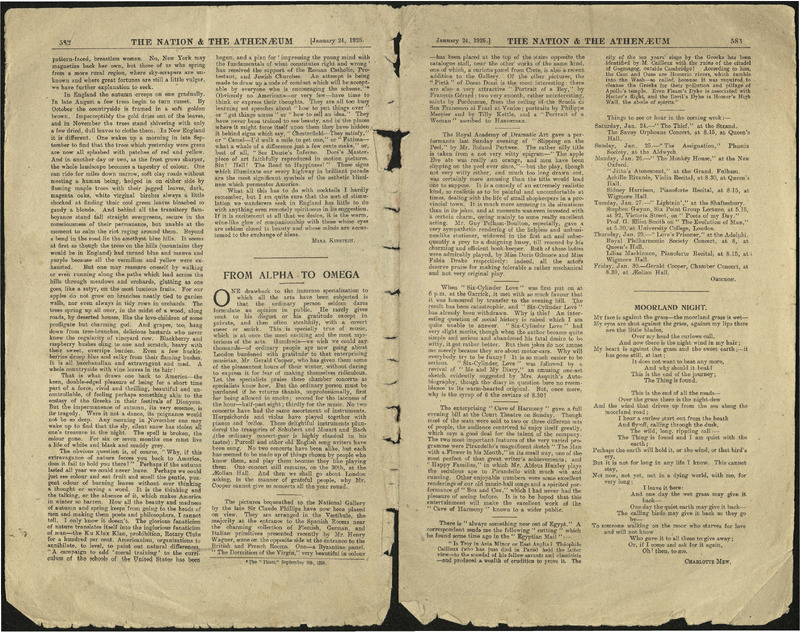
- Text
-
THE NATION & THE ATHENAEUM
January 24, 1925.
begun, and a plan for impressing the young mind with
pattern-faced, breastless women. No, New York may
the
fundamentals of wha,t constitutes right and wrong'
magnetize back her own, but those of us who spring
has received the support of the Roman Ca.t holic, Profrom a more rural region, where sky-scrapers are, untestant, and Jewish Churches. An a,t tempt is being
known and where great fortunes are still a little vulgar,
made to draw up a code of conduct which will be .acceptwe have further explanation to seek.
able by everyone who is encouraging the scheme."*
In England the autumn creeps on one gradually.
Obviously no Americans--or very few--have time to
In late August a few trees begin to turn russet. By
think or express their thoughts. They are all too busy
learning set speeches about "how to put things over''
October the countryside is framed in a soft golden
or " get things across " or " how to sell an idea." They
brown. Imperceptibly the gold dries out of the leaves,
have never been trained to see beauty, and in the places
and in November the trees stand shivering with only
where it might force itself upon them they have hidden
a few dried, dull leaves to clothe them. In New England
it behind signs which say, " Chesterfield-They saitisfy,"
it is different. One wakes up a morning in late Sepor "Camel-I'd walk a mile to get one," or "Fatima-tern ber to find that the trees which yesterday were green
what a whale of a difference just a few cents make," or,
are now all splashed with patches of red and yellow.
best of all, " See Dante's Inferno. Dore's Master
piece of art faithfully reproduced in motion pictures.
And in another day or two, as the frost grows sharper,
Sin ! Hell ! The Road to Happiness ! '' These signs
the whole landscape becomes a tapestry of colour. One
which illuminate our every highway in brilliant parade
can ride for miles down narrow, soft clay roads without
are the most significa.n t symbols of the aesthetic blindmeeting a human being, hedged ·in on either side by
ness which permeates America..
flaming maple trees with their jagged leaves, dark,
What all this has to do with cocktails I hardly
magenta oaks, white virginal birches always a little
remember, but I am quite sure that the sort of stimushocked at finding their cool green leaves bleached so
lation we wa.nderers seek in Engla.nd has little to do
with anything even remotely spirituous: in its suggestion.
gaudy a blonde. And behind all the transitory flamIf it is excitement at all that we desire, it is the warm,
boyance stand tall straight evergreens, secure in the
wine-like glow of companionship with those whose eyes
consciousness of their permanence, but unable at the
are seldom closed to beauty and whose minds are accusmoment to calm the riot raging around them. Beyond
tomed to the exchange of ide·as.
a bend in the road lie the amethyst blue hills. It seems
Mina KIRSTEIN.
a.t first as though the trees on the hills (mountains they
would be in England) had turned blue and mauve and
purple because all the vermilion and yellow were exhausted.
But one may reassure oneself by walking
or even running along the paths which lead across the
hills through meadows and orchards, glutting . as one
goes, like a satyr, on the most luscious fruits. For our
NE drawback to the immense specialization to
apples do not grow on bra.nches neatly tied to garden
which all the arts have been subjected 1s
walls, nor even always in tidy rows in orchards. The
that the ordinary person seldom dares
formulate an opinion in public, He ra.r ely gives
trees spring up all over, in the midst of a wood, along
vent to his disgust or his gratitude .except m
roads, by deserted houses, like the love-children of some
private, and then often stealthily, with a covert
profoligate but charming god. And grapes, too, hang
sneer or smirk. This is specially true of music,
down from tree-branches, delicious bastards who never
which is at once the most exciting and the most, mysknew the regularity of vineyard row. Blackberry and
terious
of the arts. Hundreds--we wish we could say
raspberry bushes chng to one and scratch, hea.vy with
thousa,n ds-of ordinary people are now going about
their sweet, overripe burden. Even a few huckleLondon burdened with gratitude to that enterprising
berries droop blue and sulky from their flaming bushes.
musician, Mr. Gerald Cooper, who has given them some
It 1s all bacchanalian and extravagant and mad. A
of the pleasantest hours of their winter, without daring
whole countryside with vine leaves in its hair!
to express it for fear of making themselves ridiculous.
That is what draws one back to America--the
Let the specialists praise these chamber concerts as
keen, double-edged pleasure of being for a short time
specialists know how. But the ordinary person must be
part of a force, vivid and thrilling, beautiful and unpardoned if he returns thanks, unprofessionally, first
controllable, of feeling perhaps something akin to the
for being allowed to, smoke; second for the lateness of
ecstasy of the Greeks in their festivals of Dionysus.
the hour--half-pasteight; thirdly for the music. No two
But the impermanence of aut,u mn, its very essence, is
concerts have had the same assortment o.f instruments.
its tragedy. Were it not a, dance, its poignance would
Harpsichords
and violas have played together with
not be so deep. Any morning in November one may
pianos and 'cellos. These delightful instruments plunwa.k e up to find that the sly, silent snow
has stolen all
dered the treasuries of Schubert and Mozart and Bach
one's treasure in the night. The spell is broken, the
,(the oc-dina.r y concert-goer is highly classical in his
colour gone. For six or seven months one must live
tastes.); Purcell and other old English song writers have
a life of white and black and muddy grey.
been sung. No two concerts have been alike, but each
The obvious question is, of course, "Why, if this
has seemed to be made up of things chosen by people who
extravagance of nature forces you back to America,
knoiw them, and play them because they like playing
does it fail to hold you there? " Perhaps if the autumn
them. One ooncert still remains, on the 30th, a.t the
lasted all year we could never leave. Perhaps we could
Aeolian Hall. And then we shall go about London
just see colour and eat fruit and smell the gentle, punasking, in the manner of grateful people, why Mr.
gent odour of burning leaves without ever thinking
Cooper cannot give us concerts all the year round.
a thought or saying a word. It is the thinking and
the talking, or the absence of it, which makes America
in winter so barren. How all the beauty and madness
The pictures, bequeathed to1 the National Gallery
of autumn and spring keeps from going to the heads of
by the late Sir Claude Phillips have now been. placed
men and making them poets and philosophers, I cannot
on view. They are arranged in the Vestibule the
tell. I only know it doesn't. The glorious fanaticism
majority at the entrance to the Spanish Rooms 'near
of nature translates itself into the inglorious fanaticism
the charming collection of Flemish, German and
of man-the Ku Klux Klan, prohibition, Rotary Clubs
Italian primitives presented recently by Mr. Henry
for a _hundred per cent. Americanism, organizations to
Wagner, some on the opposite side at the entrance to the
annihilate, to level, to paint out natural differences,
British and French Rooms. One--a Byzantine panel,
" A campaign to add ' moral training ' to the curriThe Dormition of the Virgin, very beautiful in colour
culum or the schools or the United States has bee n
The "Times," September 9th, 1924.
FROM ALPHA TO OMEGA
0
January 24, 1925.]
THE NATION & THE ATHENAEUM
-has been placed at the top of the stairs opposite the
catalogue stall, near the other· wo,rks of the same kind,
one of which, a curious panel from Crete, is also a recent
addition to the Gallery. Of the other pictures, the
" Pieta " of Dosso Dossi is the most interesting : there
are also a very attractive " Portrait of a Boy," by
Francois Gerard; two very smooth, rather uninteresting,
saints by Pordenone, from the ceiling of the Scuola di
San Francesco ai Frari at Venice; portraits by Philippe
Mercier and by Tilly Kettle, and a " Portrait of a
Woman " ascribed to Hanneman.
The Royal Academy of Dramatic Art gave a performance last Sunday evening of " Slipping on the
Peel," by Mr. Roland Pertwee. The rather silly title
is taken from a not very witty epigram-'' The apple
Eve ate was really an orange, and men have been
slipping on the peel ever since,"--but the play, t\iough
not very witty either, and much too long dra.wn out,
was certainly more amusing than the title would lead
one to1suppose. It is a, comedy of an extremely realistic,
kind, so realistic as to be painful and uncomfortable at
times, dealing with the life of small shopkeepers in a provincial town. It is much more amusing in its situations
than in its jokes, and at moments was even invested with
a certain charm, owing mainly to some really excellent
acting. Mr. Guy Pelham-Boulton, especially, gave a
very sympathetic rendering of the helpless and unbusinesslike stationer, widowed in the first act and subsequently a prey to a designing hussy, till rescued by his
charming and efficient book-keeper. Both of these ladies
were admirably played, by Miss Doris Gilmore and Miss
Fabia Drake respectively: indeed, all the actors
dese,r ve praise for making tolerable a ra.t her mechanical
and not very original play.
583
city of the ten years' siege by the Greeks has been
identified by M. Cailleux with the ruins of the citadel
of Gogmagog, outside Cambridge!
According to him,
the Cam and Ouse are Homeric rivers, which tumble
into the Wash--so called, because it was required to
cleanse the Greeks for their. pollution and pillage of
Apollo's temple. Ev,en Fleam's Dyke is associated. with
Hector's flight, and the Devil's Dyke is Homer's High
Wall, the abode of spirits."
Things to see or hear in the coming week:Sa,turday, Jan. 24.--"The Thief," at the Strand.
The Savoy Orpheans Concert, at 8.15, at Queen's
Hall.
Sunday, Jan. 25.-" The Assignation," Phoenix
Society, at the Aldwych.
Monday, Jan. 26.-" The Monkey House," at the New
Oxford.
"Jitta's Atonement," at the Grand, Fulham.
Achille Riva.r de, Violin Recital, at 8.30, at Queen's
Hall.
Sidney Harrison, Pianoforte Recital, at 8.15, at
Wigmore Hall.
Tuesday, Jan. 27 .-" Lightnin' ," at the Shaftesbury.
Stephen Gwynn, Six Point Group Lecture, at 5.15,
at 92, Victoria Street, on" Poets of my Day."
Prof. G. Elliot Smith on " The Evolution of Ma,n,"
at 5.30, at University College, London.
Thursday, Jan. 29.-" Love's Prisoner," at the Adelphi.
Royal Philharmonic Society Concert, at 8, at
Queen's Hall.
Lilias Mackinnon, Pianoforte Recital; at 8.15, at
Wigmore Hall.
Friday, Jan. 30.--Gerald Cooper, Chamber Concert, at
8.30, at Aeolian Hall.
OMICRON.
When " Six-Cylinder Love " was first put on at
6 p.m. at the Garrick, it met wit,h so much favour that
it was honoured by transfer to the evening bill. The
result has been catastrophic, and " Six-Cylinder Love"
has already been withdra.wn. Why is this? An interesting question of social history is raised which I am
quite unable to answer. "Six-Cylinder Love " had
very slight merits, though when the author became quite
simple and serious and aba.n doned his fatal desire to be
witty, it got rather better. But then jokes do not amuse
me merely because they are about motor-cars. Why will
everybody try to be funny ? It is so much easier to be
serious.
" Six-Cylinder Love " was followed by a
revival o.f " Me and My Diary," an amusing one-act
sketch evidently suggested by Mrs. Asquith's Autobiography, though the diary in question bore no resemblance to its warm-hearted original. But, once more,
why is the syrup of 6 the ca.v iare of 8.30?
The enterprising "Cave of Harmony " gave a full
evening bill at the Court Theatre on Sunday. Though
most of the seats were sold to two or three different sets
of people, the audience contrived to enjoy itself greatly,
which says a, good deal for the talent of the company.
The two most important features of the very varied programme were Pirande1lo's magnificent sketch " The Man
with a. Flower in his Mouth," in its small way, one of the
most perfect of that great writer's achievements; and
"Happy Families," in which Mr. Aldous Huxley plays
the sedulous ape to Pirandello with much wit and
cunning. Other enjoyable numbers were some excellent
renderings of our old musio-hall songs and a spirited performance of " Box and Cox," which I had never had the
pleasure of seeing before. It is to be hoped that this
entertainment will make the excellent wo,r k of the
" Cave of Harmony " known to a wider public.
There is " always something new out of Egypt." A
correspondent sends me the following" cutting " which
•he found some time ago in the '' Egyptian Mail '' : . " Is Troy in Asia Minor or East Anglia ? Theophile
Cailleux (who has just died in Paris) held the latter
view--tothe scandal of his fellow savants and classicists
--and produceda wealth of erudition to prove it. The
MOORLAND NIGHT,
MY face is against the grass--themoorland grass is wetMyy eyes are shut against the grass, against my lips there
are the little blades,
Over my head the curlews call,
And now there is the night wind in my hair ;
My heart is against the grass and the sweet earth ;-it
has gone still, at last;
It does not want to beat any more,
And why should it beat?
This is the end of the journey;
The Thing is found.
This is the end of all the roads-Over the grass there is the night-dew
. And the wind that drives up from the sea along the
moorland road;
I hear a curlew start out from the heath
And fly off, calling through the dusk,
The wild, long, rippling call:The Thing is found and I am quiet with the
earth;
Perhaps the earth will hold it, or the wind, or that bird's
cry,
But it is not for long in any life I know. This cannot
stay,
Not now, not yet, not in a dying world, with me, for
very long;
I leave it here:
And one day the wet grass may give it
back-One day the quiet earth may give it backThe calling birds may give it back as they go
by-To someone walking on the moor who starves for love
and will not know
,
Who1 gave it to all these to give away;
Or, if I come and ask for it again,
Oh! then, to me.
CHARLOTTE
MEW.
Reproductions from the Charlotte Mew Digital Collection are provided courtesy of the
University at Buffalo Libraries.
Preferred Citation:
[Title], Digital Collections - University at Buffalo Libraries, accessed [date accessed], [URL].