
http://digital.lib.buffalo.edu/upimage/PCMS-0132_1_83.pdf
Media
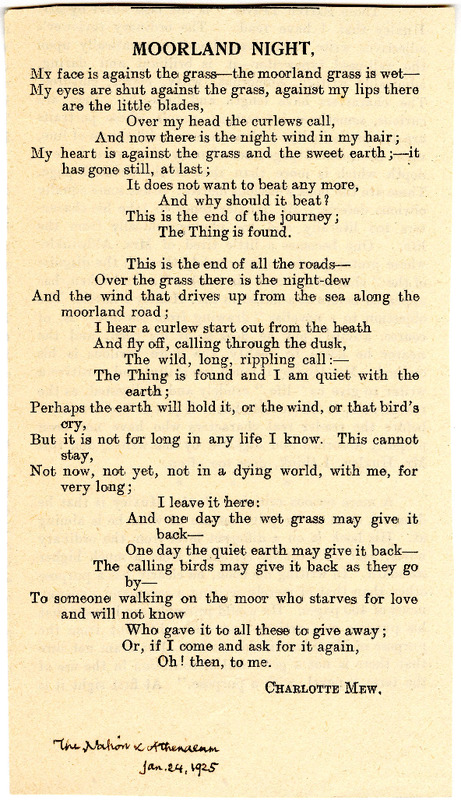
Part of Moorland Night in The Nation and Athanaeum, January 24, 1925
- Text
-
MOORLAND NIGHT,
My face is against the grass--themoorland grass is wetMy eyes are shut against the grass, against my lips there
are the little blades,
Over my head the curlews call,
And now there is the night wind in my hair;
My heart is against the grass and the sweet earth ;--i t
has gone still, at last;
It does not want to beat any more,
And why should it beat ?
This is the end of the journey;
The Thing is found.
This is the end of all the roads-Over the grass there is the night-dew
And the wind that drives up from the sea along the
moorland road ;
I hear a curlew start out from the heath
And fly off, calling through the dusk,
The wild, long, rippling call :The Thing is found and I am quiet with the
earth;
Perhaps the earth will hold it, or the wind, or that bird's
cry,
But it is not for long, in any life I know. This cannot
stay,
Not now, not yet, not in a dying world, with me, for
very long;
I leave it there:
And one day the wet grass may give it
back-One day the quiet earth may give it backThe calling birds may give it back as they go
by-To someone walking on the moor who starves for love
and will not know
Who gave it to all these to give away;
Or, if I come and ask for it again,
Oh! then, to me.
CHARLOTTE MEW.
" Those Barren Leaves is the best novel by Mr.
Huxley that I have read
The ordinary reviewer's
adjectives write themselves almost automatically upon
the well-used typewriter--it is brilliant and daring,
admirably written, humorous, witty, clever, cultured.
The characters have length and breadth; they are
curious, sometimes interesting, people whose portraits
are drawn distinctly, with assurance and firmness of line ,
upon the printed page; occasionally they even ha,ve a
depth which is more than that of the printed page.
These are the book's obvious merits; it has some equally
obvious defects. Mr. Huxley tends to take his characters too lit,erally and too photographically from the
life.
One becomes a little tired of Mrs. Aldwinkle,
whose prototype shows too crudely through the disguise
of the " characte,r ," and who, unless I am mistaken, has
appeared before as a model in Mr. Huxley's novels. The
objection to a novelist " drawing from the life " is, of
course, absurd; but he does so at his peril, and the
nearer he keeps to reality, the more perilous is his
method. Mr. Huxley is much too skilful and sensitive a
writer to give us "life " crudely and undigested, as the
realist does, in his novels; but it is just as bad art to set
before the reader real characters who have not been
properly absorbed and digested by the writer, and this
Mr. Huxley, I think, does too often .
*
*
*
A more serious criticism of Mr. Huxley is that he
does not seem to be quite certain of what he is aiming
at. His book is on a different level from the ordinary
novel, and he must be criticized from a much higher
standard. In writing his book, he clearly has a purpose
other than that of merely writing a seven-and-sixpenny
novel of 400 pages. He would probably say himself that
his purpose was artistic and quite different from the
purpose of Mr. Shaw in his novels. But I am not sure
that there is not a good deal of confusion in the use of
the term " novel with a purpose." At first sight it is
Reproductions from the Charlotte Mew Digital Collection are provided courtesy of the
University at Buffalo Libraries.
Preferred Citation:
[Title], Digital Collections - University at Buffalo Libraries, accessed [date accessed], [URL].