
http://digital.lib.buffalo.edu/upimage/RG9-5-1366_1_1_009.pdf
Media
Part of Talented Tenth Theory: The Controversy of the Black Elite, meeting topic, September 13, 2006
- Text
-
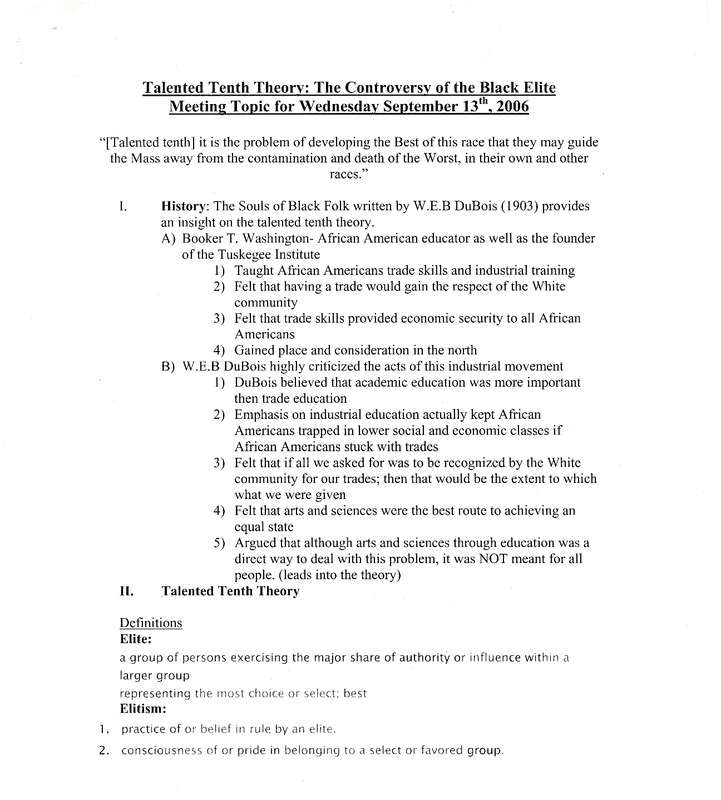
Talented Tenth Theory: The Controversy of the Black Elite
Meeting Topic for Wednesday September 13th, 2006
"[Talented tenth] it is the problem of developing the Best of this race that they may guide
the Mass away from the contamination and death of the Worst, in their own and other
races."
I.
II.
History: The Souls of Black Folk written by W.E.B DuBois (1903) provides
an insight on the talented tenth theory.
A) Booker T. Washington- African American educator as well as the founder
of the Tuskegee Institute
1) Taught African Americans trade skills and industrial training
2) Felt that having a trade would gain the respect of the White
community
3) Felt that trade skills provided economic security to all African
Americans
4) Gained place and consideration in the north
B) W.E.B DuBois highly criticized the acts of this industrial movement
1) DuBois believed that academic education was more important
then trade education
2) Emphasis on industrial education actually kept African
Americans trapped in lower social and economic classes if
African Americans stuck with trades
3) Felt that if all we asked for was to be recognized by the White
community for our trades; then that would be the extent to which
what we were given
4) Felt that arts and sciences were the best route to achieving an
equal state
5) Argued that although arts and sciences through education was a
direct way to deal with this problem, it was NOT meant for all
people. (leads into the theory)
Talented Tenth Theory
Definitions
Elite:
a group of perso ns exercisin g th e majo r share of authority or influ ence w it hin a
larger g ro up
repres en ti ng the most choice or se lect ; bes t
Elitism:
l.
practice of or be li ef in rul e by an eli te .
2.
consciou sness of or pri de in be lo ngi ng to a select or favored grou p.
A) The theory of the talented tenth provided by W.E.B Dubois is an essay which
describes the necessity of the top 10% of the African American people to take
responsibility and lead the rest of the 90%.
B) The core of his theory is the idea that educated African Americans are obliged
to sacrifice their "personal interest and endeavors in favor of community
leadership activities designed to improve the social, economic, and political
condition of the race" (DuBois, 1948)
C) Controversies
a. The talented tenth theory separates African Americans
1. Did DuBois really believe that only those with means could
become members of this elitist group?
11. Was he only cultivating an entourage of elitist who would
exploit the rest of the people or seek individual gain at the
expense of the masses?
m. Program contemplated the uplift of a few rather then the
development of many
1v. Criticism by other leaders (Booker T.) showed that they
disapproved of this concept because it looked as if he separated
the race and only those that were financially capable of
attaining a higher education were basically responsible for
leading the rest of the people and did not effectively involve or
portray anyone's interest
b. DuBois' defense
1. Rejecting the criticisms as not being "fair" to his original
meamng
11. Years after proposing this concept he acknowledged that he did
not fully articulate the responsibilities or obligations of the
Talented tenth that could prevent the misconception of his
theory
111. Theory based on the educated who would future educate many
generations
1v. Leadership of African Americans was much more needed in
intellect rather then physical muscle
c. Questions
1. Is DuBois' Talented Tenth engaging in leadership
activities as was the original idea?
2. Have the Talented Tenth forsaken their responsibility
to their communities in response to personal
gratification and accomplishments?
3. Is the theory of the Talented Tenth still needed today?
4. Should we be defined by our educational attainment,
our occupation, and income?
5. DuBois stated that to belong to this Talented Tenth you
must get an education through higher education; such as
college. Do you agree with this?
6. Are these Blacks lifting as they climb?
7. Are members of the Black Middle Class engaging in
the leadership activities of their respective
communities?
8. Is there a distinction between the Talented Tenth and
the Black Middle Class?
Study which shows the talented tenth are actually engaged and working in their
communities, yet the Black Middle Class look to attain personal gratification and success
through materials and class issues.
"Here is a race transplanted through the criminal foolishness of your fathers.
Whether you like it or not the millions are here, and here they will remain. If you do
not lift them up, they will pull you down. Education and work are the levers to uplift
a people. Work alone will no do it unless inspired by the right ideals and guided by
intelligence. Education must no simply teach work - it must teach Life. The
Talented Tenth of the Negro race must be made leaders of thought and missionaries
of culture among their people. No others can do this work and Negro colleges must
train men for it. The Negro race, like all other races, is going to be saved by its
exceptional men." (William Edward Burghardt Du Bois)