
http://digital.lib.buffalo.edu/upimage/RG9-5-1366_1_2_003.pdf
Media
Part of The Black Grapevine, October 4, 2006
- Text
-
• Africon-Americon Spending Hobits
Volume l , Issue 3
• Block Woll Street
October 4, 2006
• ARocist Medio
• This Week In Block History
African-American Spending Habits
By Ekua Mends-Aidoo
In a recent article it
explained
that
African
Americans suffer "not from the
lack of money, but the inability
to manage it." This quote can be
directly attributed to the fact that
based on worker income alone
African Americans produced
$586 billion in 2004. This figure
was faintly smaller than the
overall GDP of Brazil in 2006
and also 80% of Russia's GDP in
2005,
even
though
their
populations are 4 to 5 times the
size of the population of African
Americans. In comparison it has
been said that the income rates
of African Americans in 2004
would have been ranked as the
"15 th largest GDP internationally
out of 177 ranked," even though
the unemployment rate is 10.3
percent.
These figures come as no
surprise as one takes a look at
consumer spending habits of
African
Americans.
Basic
necess111es such as shelter, food,
and clothing were ranked high
amongst the list, yet African
Americans spent exceptionally
more on clothing than all other
ethnic groups. Among our
favorite purchases are cars. When
observing
the
rates
of
transportation and vehicles, again
African
Americans
spent
exceedingly more than other
ethnic groups did, spending
approximately
$45
billion.
Unfortunately, the only area in
which
African
Americans'
spending has been declining is on
books and other educational
materials. A total purchase of
books has declined since 2001
going from a net purchase of
$356 million to $303 million.
The priority of African
American spending is obvious;
educational resources ranks low
while other material possessions
are at the top of the list. If
African Americans realized our
dominant spending power and
capability, we could influence the
future
generations
and
communities
to
be
more
successful as a whole. If we
reduced the over consumption
of depreciable materials and
invested more in education, it
would benefit our growth and
maximize our potential as a
whole.
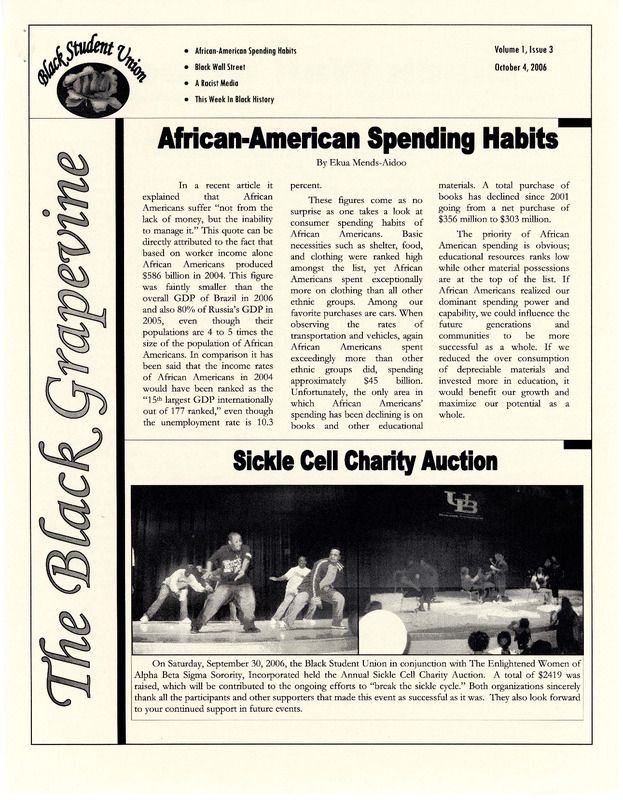
Sickle Cell Charity Auction
On Saturday, September 30, 2006, the Black Student Union in conjunction with The Enlightened Women of
Alpha Beta Sigma Sorority, Incorporated held the Annual Sickle Cell Charity Auction. A total of $2419 was
raised, which will be contributed to the ongoing efforts to "break the sickle cycle." Both organizations sincerely
thank all the participants and other supporters that made this event as successful as it was. They also look forward
to your continued support in future events.
TH E BLACK GRAPEVINE
Page 2
Black Wall Street
A Summary of Dr. Leroy Vaughn's "Black (Negro Wall Street)" from the book Black People and their Place in World History
By Darnell Cummings
The "Black (Negro) Wall
Street" was the name given to
Greenwood Avenue of North Tulsa,
Oklahoma during the early 1900's.
Because of strict segregation, Blacks
were only allowed to shop, spend,
and live in a 35 square block area
called the Greenwood district. The
"circulation of Black dollars" only in
the Black community produced a
tremendously prosperous Black
business district that was admired
and envied by the whole country.
Oklahoma's first African-American
settlers were Indian slaves of the so
called "Five Civilized Tribes":
Chickasaws, Choctaws, Cherokees,
Creeks, and Seminoles. These tribes
to
leave
the
were
forced
Southeastern United States and
resettle in Oklahoma in mid-winter
over the infamous "Trail of Tears."
After the Civil War, U.S.-Indian
treaties provided for slave liberation
and land allotments ranging from
40-100 acres, which helps explain
why over 6000 African-Americans
lived in the Oklahoma territory by
1870. Oklahoma boasted of more
All-Black towns and communities
than any other state in the land, and
these communities opened their
arms to freed slaves from all across
the country. Remarkably, at one
time, there were over 30 African
American newspapers in Oklahoma.
Oil was soon discovered and Tulsa
rapidly grew into a thriving,
bustling, enormously wealthy town
of 73,000 by 1920 with bank
deposits totaling over $65 million.
However, Tulsa was a "tale of two
cities isolated and insular", one
Black and one White. Tulsa was so
racist and segregated that it was the
only city in America that boasted of
segregated telephone booths.
Since African Americans
could neither live among Whites as
neither equals nor patronize White
businesses in Tulsa, Blacks had to develop
a completely separate business district and
soon
became
community,
which
prosperous and legendary. Black dollars
invested in the Black community also
produced self-pride, self-sufficiency, and
self-determination. The business district,
of
beginning
at
the
intersection
Greenwood Avenue and Archer Street,
became so successful and vibrant that
Booker T. Washington during his visit
bestowed the moniker: "Negro Wall
Street."
By 1921, Tulsa's African
American population of 11,000 had its own
bus line, two high schools, one hospital,
two newspapers, two theaters, three drug
stores, four hotels, a public library, and
thirteen churches. In addition, there were
over 150 two and three story brick
commercial buildings that housed clothing
and grocery stores, cafes, rooming houses,
nightclubs, and a large number of
professional offices including doctors,
lawyers, and dentists. Tulsa's progressive
African American community boasted
some of the city's most elegant brick
homes, well furnished with china, fine
linens, beautiful furniture, and grand
pianos.
A 19 year old Black male
accidentally stumbled on a jerky elevator
and bumped the 17-year-old White
The
elevator operator who screamed.
frightened young fellow was seen running
from the elevator by a group of Whites and
by late afternoon the "Tulsa Tribune"
reported that the girl had been raped.
Despite the girl's denial of any
wrongdoing, the boy was arrested and a
large mob of 2000 White men came to the
jail to lynch the prisoner. About 75 armed
African Americans came to the jail to offer
assistance to the sheriff to protect the
prisoner. The sheriff not only refused the
assistance but also deputized the White
mob to disarm the Blacks.
With a
defenseless Black community before them,
the White mob advanced to the
Greenwood district where they first looted
and then burned all Black businesses,
homes, and churches. Any Black resisters
were shot and thrown into the fires.
When the National Guard arrived, they
assisted the others by arresting all Black
men, women, and children, and herding
them into detention centers at the
Baseball Park and Convention Hall. As
many as 4,000 Blacks were held under
armed guard in detention. On May 31,
1921, the successful Black Greenwood
district was completely destroyed by one
of the worse race riots in U.S. history. Dr.
Arthur C. Jackson, a nationally renowned
surgeon known as "the most able Negro
surgeon in America", was shot at the
Convention Hall and allowed to bleed to
death. By the next morning the entire
Greenwood district was reduced to ashes
and not one White was even accused of
any wrongdoing, much less arrested. The
race riot of Tulsa, Oklahoma was not an
isolated event in American history.
During the "Red Summer" of
1919, over 25 race riots were recorded
(white
mobs
attacking
black
neighborhoods). After the Tulsa riot, the
White inhabitants tried to buy the Black
property and force Black people out of
town.
No Tulsa bank or lending
institution would make loans in the riot
marred Greenwood district, and the city
refused all outside assistance. However,
racial pride and self-determination would
not permit the Greenwood owners to sell,
and they doggedly spend the entire winter
in tents donated by the American Red
Cross. Rebuilding was a testament to the
courage and stamina of Tulsa's pioneers
in their struggle for freedom. Most of the
buildings along the first block of
Greenwood Avenue were rebuilt within
one year. In 1926, W. E. B. DuBois
visited Tulsa and wrote: "Black Tulsa is a
happy city. It has new clothes. It is young
and gay and strong. Five little years ago,
fire and blood and robbery leveled it to
the ground. Scars are there, but the city is
impudent and noisy. It believes in itself.
Thank God for the grit of Black Tulsa."
The Black Student Union
presents its
•
Annual Skating Jam
October 2 7th, 2006
@New
Skateland
Black Student
8PM-11 PM Union
More
Information Coming Soon
State University of New York at
Buffalo
The Black Student Union
307 Student Union
Amherst, NY 14260
Phone: 716-645-3029
Fax: 716-645-2112
E-mail: BSU1967@gmail.com