
http://digital.lib.buffalo.edu/upimage/RG9-9-00-3_40_57_1991-gulf.pdf
Media
Part of BSU defines African-American role in war, February 22, 1991
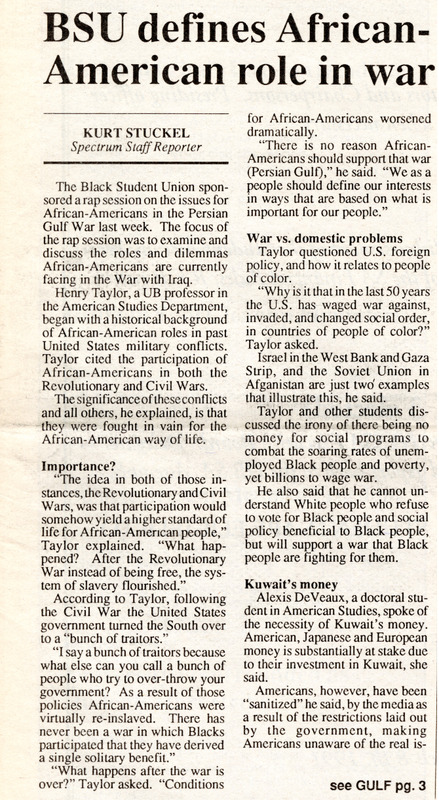
- Text
-
BSU defines African
American role in war
KURT STUCKEL
Spectrum Staff Reporter
The Black Student Union spon
sored a rap session on the issues for
African-Americans in the Persian
Gulf War last week. The focus of
the rap session was to examine and
discuss the roles and dilemmas
African-Americans are currently
facing in the War with Iraq.
Henry Taylor, a UB professor in
the American Studies Department,
began with a historical background
of African-American roles in past
United States military conflicts .
Taylor ci ted the participation of
African-Americans in both the
Revolutionary and Civil Wars.
The significance ofthese conflicts
and all others, he explained, is that
they were fought in vain for the
African-American way of life.
Importance?
"The idea in both of those in
stances, the Revolutionary and Civil
Wars, was that participation would
somehow yield a higher standard of
life for African-Amencan people,"
Taylor expla ined. "What hap
pened? After the Revolutionary
War instead of being free, the sys
tem of slavery flouri shed."
According to Taylor, following
the Civil War the United States
government turned the South over
to a "bunch of traitors."
" I say a bunch of traitorsbecause
what el e can you call a bunch of
people who try to over-throw your
government? As a result of those
policies African-Americans were
virtually re-inslaved. There has
never been a war in which Blacks
participated that they have derived
a single solitary benefit."
"What happens after the war is
over?" Taylor asked. "Conditions
for African-Americans worsened
dramatically.
"There is no reason African
Americans should support that war
(Persian Gul f)," he said. " We as a
people should define our interests
in ways that are based on what is
important for our people. "
War vs. domestic problems
Taylor questioned U.S. foreign
policy, and how it relates to people
of color.
"Why is it that in the last 50 years
the U.S . has waged war against,
invaded, and changed soc ial order,
in countries of people of color?"
Taylor asked.
Israel in the West Bank and Gaza
Strip, and the Soviet Union in
Afgani stan are just two examples
that illustrate this, he said.
Taylor and other students dis
cussed the irony of there being no
money for social program s to
combat the soaring rates of unem
ployed Black people and poverty,
yet billions to wage war.
He also said that he cannot un
derstand White people who refuse
to vote for Black people and social
policy beneficial to Black people,
but will support a war that Black
people are fighting for them.
Kuwait's money
Alexis DeVeaux, a doctoral stu
dent in American Studies, spoke of
the necessity of Kuwait's money.
American , Japanese and European
money is substantially at stake due
to their investment in Kuwait, she
said.
Americans, however, have been
"sanitized" he said, by the media as
a resul t of the restrictions laid out
by the governmen t , making
Americans unaware of the real is-
see GULF pg. 3
Gulf: military finances education
from page 1
sues involved.
Taylor said African-American
interests are not of concern to the
corporate structure, who are the
real beneficiaries of this conflict.
DeV eaux also said poor African
Americans and Hispanics often use
the option of military service to
earn money for a college education.
This linkage of education to the
military is something w ell-off
White middle class students can
avoid, but poor minorities cannot.
The issue of Pres ident George
Bush's " New World Order" was
also rai sed.
" What is the 'New World Or
der '?" DeVeaux said. " It is an old
concept, Hitler al so used it. The
' New World Order' is the ideo logy
of the strong getting stronger and
the weak getting weaker, not a
theory ofparticipatory democracy."
She said that there is a need to
"read between the lines" of what
the governm en t and the media is
telling us, and to sec the true
meaning of what we hear, sec and
read, Deveaux explained.
A s
U D I
A
Riyadh
Tropic of Cancer
-------------------
A
0
R
A B
I
A
Mecca
Friday February 22 , 1991 • The Spectrum
3