
http://digital.lib.buffalo.edu/upimage/RG9-9-00-3_65_31_2015.pdf
Media
Part of Pressure mounts for UB to take stance on 'White Only' art project, November 11, 2015
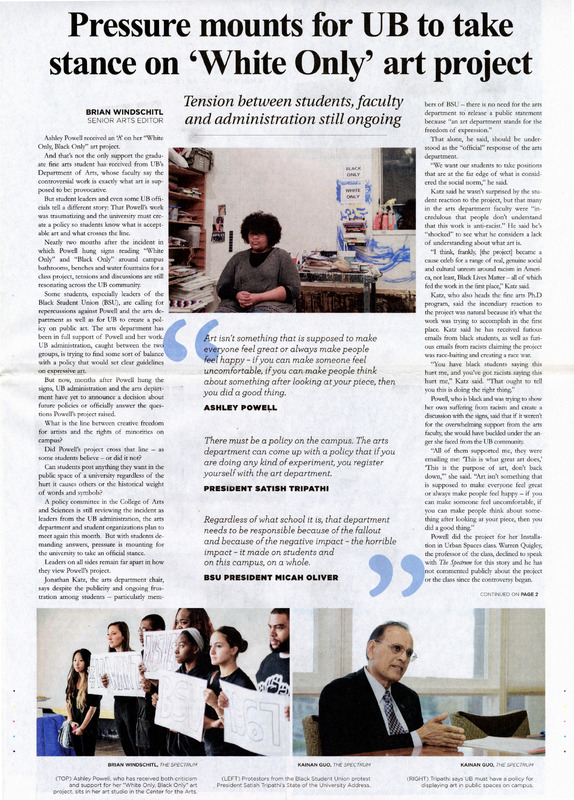
- Text
-
Pressure mounts for UB to take
stance on 'White Only' art project
BRIAN WINDSCHITL
SENIOR ARTS EDITOR
Tension between students, fac ulty
and administration still ongoing
Ashley Powell received an 'A' on her ''White
Only, Black O nly" art project.
And that's not the only support the gradu
ate fine arts student has received fro m UB's
D epartment of Arts, whose faculty say the
controversial work is exactly what art is sup
posed to be: provocative.
But student leaders and even some UB offi
cials tell a different story: That Powell's work
was traumatizing and the university must cre
ate a policy so students know what is accept
able art and what crosses the line.
early two months after the incident in
which Powell hung signs reading ''White
Only" and "Black O nly" around campus
bathrooms, benches and water fountains for a
class project, tensions and discussions are still
resonating across the UB community.
Some students, especially leaders of the
Black Student Union (BSU), are calling for
repercussions against Powell and the arts de
partment as well as for UB to create a pol
icy on public art. The arts department has
been in full support of Powell and her work.
UB administration, caught between the two
groups, is trying to find some sort of balance
with a policy that would set clear guidelines
on expressive art.
But now, months after Powell hung the
signs, UB administration and the arts depart
ment have yet to announce a decision abo ut
future policies or officially answer the ques
tions Powell's project raised.
What is the line between creative freedom
for artists and the rights of minorities on
campus?
Did Powell's project cross that line - as
some students believe - or did it not?
Can students post anything they want in the
public space of a university regardless of the
hurt it causes others or the historical weight
of words and symbols?
A policy committee in the College of Arts
and Sciences is still reviewing the incident as
leaders from the UB administration, the arts
department and student organizations plan to
meet again this month. But with students de
manding answers, pressure is mounting for
the university to take an official stance.
Leaders on all sides remain far apart in how
they view Powell's project.
Jonathan Katz, the arts department chair,
says despite the publicity and ongoing frus
tration among students - particularly mem-
Art isn't something that is supposed to make
every one feel great or always make people
feel happy - if you can make someone feel
uncomfortable, if you can make people think
about something after looking at your piece, then
you did a good thing.
ASHLEY POWELL
There must be a policy on the campus. The arts
department can come up with a policy that ifyou
are doing any kind of experiment, you register
yourself with the art dep artment.
PRESID ENT SATISH TRIPATHI
Regardless of what school it is, that department
needs to be responsible because of the fallout
and because of the negative impact - the horrible
impact - it made on students and
on this campus, on a whole.
BSU PRESIDENT MICAH OLIVER
bers of BSU - there is no need for the arts
department to release a public statement
because "an art department stands for the
freedom of expression."
That alone, he said, should be under
stood as the "official" response of the arts
department.
''We want our students to take positions
that are at the far edge of what is consid
ered the social norm," he said.
Katz said he wasn't surprised by the stu
dent reaction to the project, but that many
in the arts department faculty were "in
credulous that people don't understand
that this work is anti-racist." He said he's
"shocked" to see what he considers a lack
of understanding about what art is.
''I think, frankly, [the project] became a
cause celeb for a range of real, genuine social
and cultural unrests around racism in Ameri
ca, not least, Black LivesMatter -- all of which
fed the work in the first place,"Katz said.
Katz, who also heads the fine arts Ph.D
program, said the incendiary reaction to
the project was natural because it's what the
work was trying to accomplish in the first
place. Katz said he has received furious
emails from black students, as well as furi
ous emails from racists claiming the project
was race-baiting and creating a race war.
''You have black students saying this
hurt me, and you've got racists saying this
hurt me," Katz said. "That ought to tell
you this is doing the right thing."
Powell, who is black and was trying to show
her own suffering from racism and create a
discussion with the signs, said that if it weren't
for the overwhelming support from the arts
faculty, she would have buckled under the an
ger she faced from the UB community.
''All of them supported me, they were
emailing me: 'This is what great art does,'
'This is the purpose of art, don't back
down,'" she said. ''Art isn't something that
is supposed to make everyone feel great
or always make people feel happy - if you
can make someone feel uncomfortable, if
you can make people think about some
thing after looking at your piece, then you
did a good thing."
Powell did the project for her Installa
tion in Urban Spaces class. Warren Quigley,
the professor of the class, declined to speak
with The Spectrum for this story and he has
not commented publicly about the project
or the class since the controversy began.
CONTINUED ON PAGE 2
•
•
•
BRIAN WINDSCHIT L, THE SPECTRUM
KA INAN GUO, THE SPECTRUM
KAIN AN GU O, THE SPECTRUM
(TOP) Ashley Powell, who has received both criticism
and support for her "White Only, Black Only" art
project. sits in her art studio in the Center for the Arts.
( LEFT) Protestors from the Black Student Union protest
President Satish Tripathi's State of the University Address.
(RI GHT) Tripathi says UB must have a policy for
displaying art in public spaces on campus .
Pressure mounts for UB to take
stance on 'White Only' art project
You have black students saying this hurt me, and
ou've got racists saying this hurt me. That ought to
tell you this is doing the right thing.
JONATHAN KATZ,
CHAIR OF THE ARTS DEPARTMENT
KAINAN GUO, THE SPECTRUM
BSU President Micah Oliver, who demands UB take a stance on the project, speaks at an
open forum about the issue in September.
CONTINUED FROM PAGE 1
Katz said he reached out to Powell im
mediately when students voiced strong feel
ings about the project and has met with
her several times since. Even faculty mem
bers from other departments have support
ed Powell. Ana Grujic, an instructor in the
composition program run through the Eng
lish department, helped Powell write her of
ficial project statement.
President Satish Tripathi, in a sit down in
terview with The Spectrum last week, said UB
needs a policy concerning works of art in
public places - and that art projects need to
be labeled as such.
"Arts are going to be controversial," he
said. "But when it's put on the wall, one
should say that this is art. So there must be a
policy on the campus. The arts department
can come up with a policy that if you are
doing any kind of experiment, you register
yourself with the art department."
Tripathi has faced continued pressure
from BSU for UB to create a policy. BSU
protested Tripathi's annual address last
month, demanding an swers about the proj
ect. The student organization has also held
meetings with university leaders. BSU has
asked the university to create a clear policy
for future art projects, as well as reprimand
Powell and the arts department.
Tripathi said UB cannot punish Powell
because she did not break any rule in the
Student Code of Conduct.
BSU President Micah Oliver said that the
university and the arts department should
show more responsibility for their students.
''As an individual, I think the art depart
ment should be held accountable because
the implications of the project were under
the art department's watch," he said. "Re
gardless of what school it is, that depart
ment needs to be responsible because of
the fallout and because of the negative impact - the horrible impact - it made on stu
dents and on this campus, on a whole."
Oliver, who is also the chief justice of the
Student-Wide Judiciary, said the most dis
appointing thing about the university response to the ''White Only, Black Only"
project was that "the institution that I love
has done something to me in a very nega
tive way."
"The art department is a part of UB and I love UB. The most disappointing part
of the university not responding is that I
thought better of the university itself," Oliver said.
Oliver said the responsibility ultimate
ly comes down to the arts department that
oversees students' works of art, like Pow
ell's.
"This happened under a university-sanc
tioned curriculum," Oliver said. ''And for
that reason, the department that houses,
produces and ensures that the curriculum is
taught and experienced by students must be
responsible, ultimately."
Powell, caught in a place of student-driv
en anger and faculty support, is just trying
to maintain her own vision.
As an artist, Powell said having a set goal
- upending racism in society - is the most
inspirational and important part of keeping
her sane and keeping her driven.
Powell said the 'A' on her ''White Only,
Black Only" project didn't really matter to
her. For her, the main indicator of success
isn't the amount of negative feedback she
is receiving, rather the discussion about race
she has created and the support from the
arts faculty she has received.
According to Katz, a meeting between
Katz, Tripathi and Oliver to create an offi
cial statement and perhaps a new policy on
public art is set for sometime in mid-November.
emall: arts@ubspectrum.com