
http://digital.lib.buffalo.edu/upimage/VF_I18G_002.pdf
Media
Part of BSU discusses lack of African-American faculty in African-American Studies, October 19, 2017
- Text
-
BSU discusses lack of
African American faculty in
African-American Studies
, ..
.
Students discuss importance·
ofhaving a diverse faculty .
SPECTRUM
10/19/17
MADDY FOWLER
NEWS EDITOR
Students discussed the importance of hav
ing black professors, especially for African
American studies courses at UB's Black Stu
dent Union general body meeting Wednesday
in SU 210.
Roughly 50 students filled the seats and
some students sat on the floor.
BSU Vice President Tavaine Whyte facil
itated the discussion. Whyte, a senior Af
rican-American Studies major, started the
conversation by asking students if they had
ever had a black professor. Less than half of
the students in the room raised their hands.
Last semester, The Spectrum wrote a story,
"UB's black faculty: dwindling and isolated,"
which discussed the lack of black faculty at
UB. Ninety-eight out of 2,513 faculties
or 3.8 percent- at UB were black as of fall
2015, according to UB Spokesperson John
Della Contrada. Only 41 were tenure track,
which brings the total down to 1.6 percent.
And of the 17 faculty in the African-Amer
ican Studies program, only three are black.
"UB prides itself on being a diverse, in
ternational campus, but when we look at
our [faculty], they're not diverse and interna
tional," said SA President Leslie Veloz. "So
the question is, what initiatives is the univer
sity putting into place to ensure that the di
versity we're seeing in [faculty] is reflective
of the diversity in the student body?"
.
·
. . .· . '
.
Malcom Gray, BSU president and a senior
political science major, feels he gets a more
"raw'' experience learning from a black professor.
''They understand the issues, they're not
just reading from a textbook or research
studies; they're teaching you from what they
experienced and they're trying to show,"Gray
said. "Not hiring more African-American
professors to teach in the African-American
Studies department is really a disgrace."
Gray also expressed concern that while
UB has a diversity' learning requirement,
students aren't necessarily being educated
about diversity and race in Buffalo.
"As students, do we really know how peo
ple in Buffalo really live?" Gray questioned.
"Can we speak on the social and econom
ic divide that exists between East Buffalo
and West Buffalo? No we can't, because UB
doesn't do a good job of showing us why
we come to school and that we have to help
fix our own communities."
Whyte pointed out that UB's newest
freshman class has one of the largest per
centages of African-American students in
UB's history, yet most of their instructors
will not look like them.
Rosaura Romero, a junior psychology and
health and human services major, related
her own experience of how powerful it can
be to have a fellow person of color as a pro
fessor. She said she is often the only person
of color in a classroom, which can be an
isolating experience. She felt disconnected
from faculty until she had a professor who
was a person of color.
"The first office hours I ever went to
were for a professor who was of color be
cause I felt like I could actually relate to him
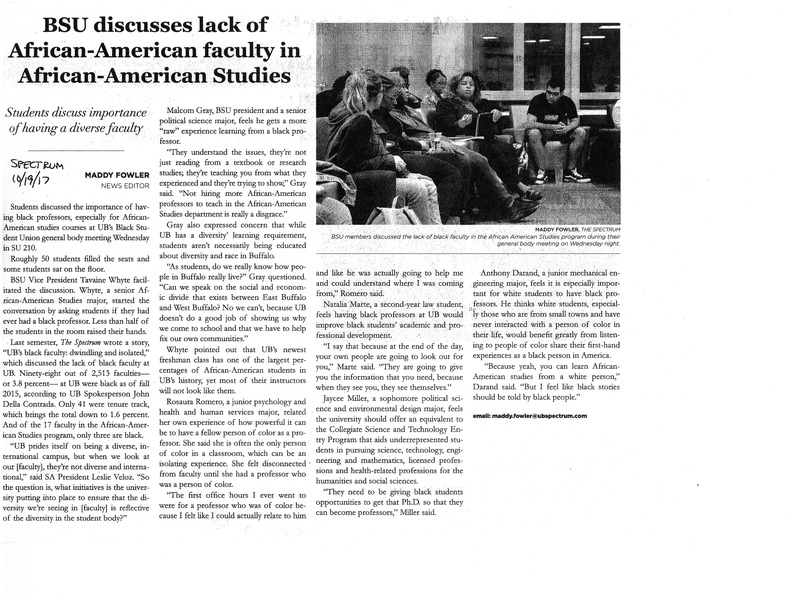
MADDY FOWLER
THE SPECTRUM
BSUmembers discussed the lack of blackfaculty in the African.American Studies program during their
general body meeting on Wednesday night.
and like he was actually .going to help me
and couldunderstand where I was coming
fromt Romero said.
Natalia Marte, a second-year law student, :
feels having black professors at UB would
improveblack students' academic I and professional development.
'
"I say that because at the end of the day,
your owri people are going to look out for
you," Marte said. "They are going to give
you the information that you heed, because
when they see you, they see themselves."
Jaycee Miller, a sophomore political science and environmental design major, feels
the university should offer an equivalent to
·1
.
•
the Collegiate Science and Technology Entry Program that aids underrepresented students in pursuing science, technology, engineering and mathematics, licensed .professions and health-related professions for the
humanities and social sciences.
"They need to be giving black students
opportunities to get that Ph.D. so that they
can become professors," Miller said.
Anthony Darand, a junior mechanical engineering major, feels it is especially important for white students to have black proHe thinks
white ·students,
especialfessors.
,
·,
.
ly those who are from small towns arid have
never interacted with a ·person· of color in
their
would benefit greatly from listening to people of color share their first-hand
experiences as a black person in America.
"Because yeah, you can learn African
American studies from a white person,"
Darand said. "But I feel like black stories
should be told by black people."
life,
email: maddy.fowler@ubspectrum.com