
http://digital.lib.buffalo.edu/upimage/VF_I18G_035.pdf
Media
Part of Students Demand Change, September 25, 2015
- Text
-
STUDENTS
DEMAND
CHANG
SA and BSU hold open fo rum to
discuss recent controversial art
SPECTRU
. M••
9/25/15 pro1ect
GABRIELA JULIA
SENIOR NEWS
EDITOR
The controversial ''White
Only" and "Black Only" · art
project displayed on campus
last week caused an emotional and at times
intense open forum discussion for stu
dents, faculty and UB officials Wednesday
night.
The Student Association and the Black
Student Union (BSU) organized the forum.
The forum aimed to give students an op
portunity to voice opinions on the ''White
Only" and "Black Only" signs UB gradu
ate fine arts student Ashley Powell posted
around campus last week as part of a class
art project.
More than 300 people attended, indud-.
ing a panel of UB faculty and officials. The
forum's main focus was allowing students
to speak. Students applauded and snapped
when one of them made a point they all
agreed with and one student began to cry
while speaking to the audience.
Before the forum began, BSU made it
clear that the discussion was not intended
to focus on the signs or Powell, but about
those affected_. and to make sure it never
happened again. The forum used the signs
as the first of many discussions about po
tential change on campus.
Students, faculty and officials discussed a
wide range of topics, but the main points
were:
• The historical context of the signs
• Students' personal ex.periences with .
racism on campus
• Issues with how UB and University
Police handled the situation
• What UB can do to have more racial
and social inclusion on campus
• The legality of Powell's project
• President Satish Tripathi's absence
from the forum and student disappoint
ment that he had at that time yet to release
a statement about the controversy
Kenny Berrouet, a junior business major,
said some students of color currently don't
want to apply to UB because of the situa-
tion. He said the only way to change that is
to make sure the university does not let the
problem slowly dissolve without a solution.
"We are a campus under fire and a busi
ness," he said. "We don't want the reputa
tion of the university on the line."
Student reactions to the
signs
Discomfort, anger, fear and disgust were
just a few of the emotions students mentioned when asked how they felt when they
first saw the signs.
Jason Young, a history professor, gave
the historical context of the signs by dis
playing images of ''White" and "Colored"
water fountains from the mid-19th century.
He also said why he believes students had
the reaction they did toward them.
"The angst that emerged from these
signs came from students wondering where
they are allowed versus where they are wel
comed," Young said.
When Deidree Golbourne, BSU vice
president and junior African American
studies major, asked who felt unwelcomed
when they saw the signs, almost every hand
in the audience went up.
One student said because he grew up in
a mainly white community in Westchester,
New York, he has trained himself to tolerate favor, biases and prejudice.
Another student said when he first saw
the signs, he was defensive and had to con
trol himself because he knew that if he
proceeded in a violent manner, it could .
have resulted in a bigger problem.
Susan Green, clinical associate professor
and co-director of the Institute on Trauma and Trauma-Informed Care, said being
defensive is an appropriate reaction to this
traumatic experience.
Green said one theory for this trauma
is called Post Traumatic Slave Syndrome,
which is based on history and experience
of past generations. African Americans to-
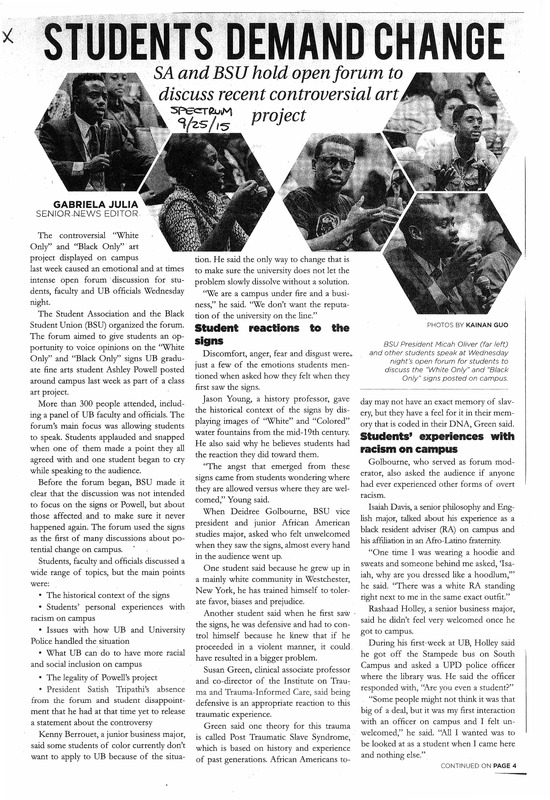
PHOTOS BY KAINAN GUO
BSU President Micah Oliver (far left)
and other students speak at Wednesday
night's open forum for students to
discuss the "White Only" and "Black
Only" signs posted on camp us.
day may not have an exact memory of slav
ery, but they have a feel for it in their mem
ory that is coded in their DNA, Green said.
Students' experiences with
racism on campus
Golbourne, who served as forum mod
erator, also asked the audience if anyone
had ever experienced other forms of overt
racism.
Isaiah Davis, a senior philosophy and Eng
lish major, talked about his experience as a
black resident adviser (RA) on campus and
his affiliation in an Afro-Latino fraternity.
"One time I · was wearing a hoodie and
sweats and someone behind me asked, 'Isa
iah, why are you dressed like a hoodlum,"'
he said. 1'There was a white RA standing
right next to me in the same exact outfit."
Rashaad Holley, a senior business major,
said he didn't feel very welcomed once he
got to campus.
During his first week at UB, Holley said
he got off the Stampede bus on South
Campus and asked a UPD police officer
where the library was. He said the officer
responded with, ''Are you even a student?"
"Some people might not think it was that
big of a deal, but it was my first interaction
with an officer on campus and I felt un
welcomed," he said. ''All I wanted was to
be looked at as a student when I came here
and nothing else."
CONTINUED ON PAGE 4
STUDENTS DEMAND·CHANGE
CONTINUED FROM PAG E·l
Davis said a UPD officer told students
BSU President Micah Oliver, a senior so- , that calls about the signs kept officers from
cial sciences major, said he had a professor handling a situation on South Campus.
rap lyrics from a 1979 song "Rock n Roll
"He blamed the black community for not
N*gger."
addressing an assault on South Campus,"
"He tried to make it OK by putting it in D avis said. "It just shows those people are
some academic context but it just shows incompetent with their jobs."
how desensitized some professors are," OlBarbara Ricotta, associate vice president
iver said.
for Student Affairs, told students every call
Issues with University Po• that comes into the dispatch unit is recordlice's response
ed and UB is currently listening back to evOne of the biggest issues students said ery call and examining how dispatchers han
they had was UPD's response.
dled them. She also said every complaint
Christina Dunn, a junior communication against an officer is taken seriously and she
and sociology major, said her mother called advised students file a complaint if they are
UPD to get more information on the signs concerned with how a situation was handled.
since Dunn was off campus at the time. She Issues with UB's response
said UPD told her mother, "there are black
At least three students brought up Tripa
(only] signs too."
thi's absence and his lack of a statement on
"That shouldn't have been the response,"
the issue Wednesday night. One student
Dunn said. ''Why assume the caller was o f even said Tripathi was failing students.
any race?"
They all thanked the panelists for being
there, but commented that the university
president should be there.
"I love that you're all here, but you're not
him," one female student said to the panel.
Tripathi released a statement Thursday
about the project and explaining he was
traveling to Albany for a SUNY presidents
meeting Wednesday night.
Students also took issue that the universi
ty did not send out an ale.r t about the situa
tion, as the students felt their safety was in
danger when they first saw the signs. UB re-
KAINAN GUO, THE SPECTRUM
( LEFT) A student speaks at Wednesday's forum .
(TOP) History professor Jason Young speaks as a panelist Wednesday night.
leased · a statement about the signs later in
the evening once it had been revealed the
signs were a part of an art project.
Ricotta admitted that UB should have
sent out message to alert students more
quickly and the situation could have been
handled better.
One student was angered by the student
representation at the forum, as she commented that the entire university was invit
ed but the vast majority of student attend
ees were black.
Legality of art project
Students· said they will not be at ease until
UB's administration makes a decision on
the art project.
Jim Jarvis, associate counsel for gener
al accounts, said there is tension between
the right of freedom of expression and discrimination. The art project was not perva
' sive or severe enough to be unlawful dis
crimination, he said.
He did admit, however, that rules were
broken.
Jarvis said UB requires projects and items
placed in common areas are submitted for
approval of health, safety and welfare before
CO NTINUED ON PAGE 6
------- --------------
STUDENTS DEMAND CHANGE
CONTINUED FROM PAGE 4
stallment. Powell's signs were not. •
If the project had been approved, the
display would have been labeled as such so
people had a clear understanding of what.
it was.
When Golbourne asked the audience
who considered the signs art, no one raised
their·hand.
Franchesca Lara, a senior health and hu
man services major, said she didn't look at
it as art because of Powell's intent.
''All she did was print out a sign and post
it to get a reaction out of people - that was
a social experiment," Lara said.
One student said that rules are meaning
less without enforcement. Since the univer
sity has agreed that the student broke the
rules, there must be a consequence. The
audience applauded in agreement.
How to moveforward
Although • UB is one of the more di
verse universities in _the nation, many students said they feel a division among eth-
nic groups.
"It's like oil and water - we're a diverse
campus but people don't mix," said Rog
elio Garnes, a sophomore business ma
jor. "You can put in as many students as
you want, but not everyone understands
or cares to understand where each
other
I .
come from."
UB has taken some steps to change this.
Starting next fall, all incoming UB stu
dents are required to take a diversity and
learning course for the first time· ever, said
Teresa Miller, law school professot and
vice provost for Equity and Inclusion. It
will not only discuss racial oppression, but
how gender, sexuality and religion ·overlap
each other as well. The room applauded
the announcement.
So far, 44 courses have been approved
and more than 200 seats have been filled.
But students made it clear that this isn't
enough. Students _suggested faculty go
through diversity training as well.
One student commented on the lack of
minority professors at UB. According to
College Factual, 83 percent of UB faculty
is white and 5.9 percent is black.
Another student noted the absence of
many black UPD officers.
Ricotta said she and other faculty want
to create an advisory colored committee
for UPD starting in October. She wants
students to talk to officers about their past
experiences and how officers can do a bet
ter job at making students feel safe on
campus.
Berrouet has taken it upon himself and
his peers to reinstate a NAACP chapter at
UB. He said BSU can't be the only ones to
evoke necess·ary changes.
"If I were student of color applying for
college, I wouldn't come here," Berrouet
said. "I'll go to (SUNY] Buff[alo] State or
another SUNY school."
Oliver and SA President Minahil Khan
both gave closing statements that the con
versation about change must continue and
cannot end with Wednesday's ·forum.
email: news@ubspectrum.com
PHOTOS BY KAINAN GUO
(LEFT TO RIGHT) Kenny Berrouet, a junior buisness major, Vice Provost for Equity and Inclusion Teresa Miller;
Associate Counsel for General Accounts Jim Jarvis, Institute of Trauma Co-Director Susan Green, and
Associate Vice President of Student Affairs Barbara Ricotta all spoke at Wednesday's forum.
.