
http://digital.lib.buffalo.edu/upimage/VF_I18G_041.pdf
Media
Part of UB students discuss racial experiences and lack of diversity on campus, October 17, 2016
- Text
-
UB students discuss racial experiences
and lack ·o f diversity on campus
SPECTRU M
10/17/ 16
ASHLEY INKUMSAH
SENIOR NEWS EDITOR
Angelique Romulus is used to being the
only black person in her class.
Romulus, a junior psychology major, feels
UB's campus is lacking in diversity. UB fac
ulty and other stud'ents agree with Romulus,
saying UB's population does not accurate
ly reflect New York State racial demograph
ics. Some say the low number of black fac
ulty on campus is the issue. Others feel it is
because the Transnational Studies D epart- .
ment doesn't receive enough funding and
there tsn't an African American Studies D e
partment on its own.
There are currently 1,881 black students
at UB out of 28,444 total students, accord
ing to UB Spokesperson John Della Contra
da. In Fall 2015, UB had a total of 98 black
faculty . members. Forty-one were tenure
AS HLEY INKUMSAH, THE SPECTRUM
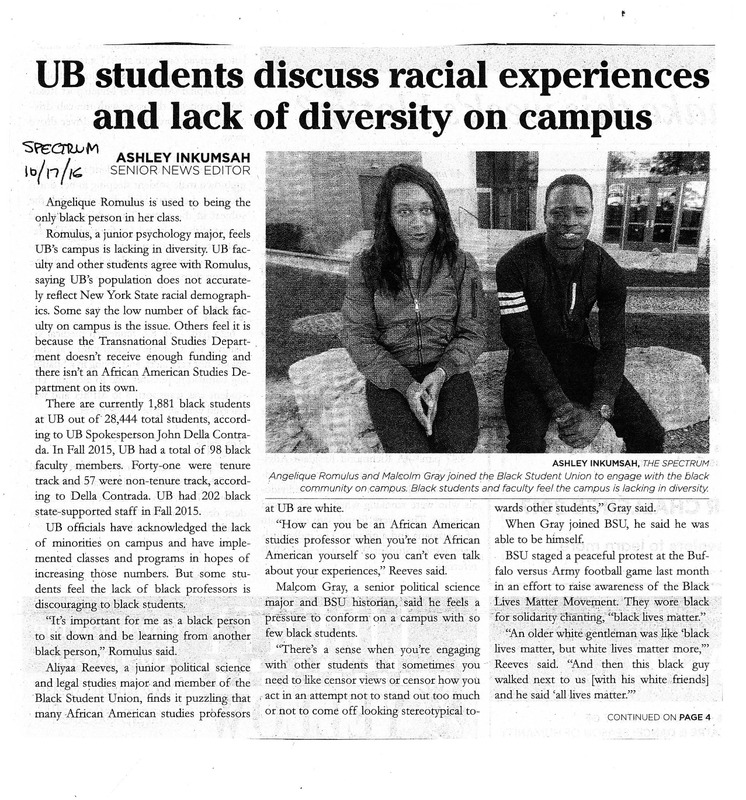
Angelique Romulus and Malcolm Gray joined the Black Student Union to engage with the black
track and 57 were non-tenure track, accordcommunity on campus. Black studen ts and faculty feel the campus is_lacking in diversity
ing to Della Contrada. UB had 202 black
state-supported staff in Fall 2015.
UB officials have acknowledged the lack
of minorities on campus and have implemented classes and programs in hopes of
increasing those numbers. But some students feel the lack of black professors is
discouraging to black students.
"It's importantfor me as a black person
to sit down and be 1earning from another
black. person," Romulus said. .
Aliyaa Reeves, a junior political science
and legal studies major and member of the
Black Student Union, finds it puzzling that
. many-African American studies professors
at UB are white.
wards other students," G ray said.
"How can you be an African American
When Gray joined BSU, he said he was
studies professor when you're riot African able to be himself.
American yourself so you can't even talk
BSU staged a peaceful protest at the Bufabout your experiences," Reeves said.
falo versus Army football game last month
Malcom Gray, a senior political science in an effort to raise awarene·ss of the Black
major and BSU historian, said he feels a Lives Matter Movement. They wore black
pressure to conform on a campus with so for solidarity chanting, "black lives matter."
"An older white gentleman
was like 'black
few black students.
"There's a sense when you're engaging lives matter, but white lives matter more,"'
with other students that sometimes you Reeves said. ''And then this black guy
need to like censor views or censor how you walked next to us [with his white .friends]
act in an
a ttempt not to stand out too much and he said 'all lives matter."'
or not to come off looking stereotypicaltoCONTINUED ON PAGE 4
UB students di.s cuss racial experiences and
lack of diversity on campus
CON TINUED FROM
PAGE 1
Gray described this experience as fright
ening and intense.
Carl Nightingale, chair of the Diversity
or Learning Committee and Transnation
al Studies and American studies professor,
thinks the Black Lives Matter movement has
become the spark in which race relations are
examined in the U.S.
Nightingale said black students have a lot
working against them.
"The fact that African Americans have
about one twentieth the wealth of white
people and no matter what educational lev
el, no matter what income level, you take a
poor white person, he's gonna have twen
ty times more wealth than a poor black per
son," Nightingale said.
Students with "black sounding names"
have harder a time finding jobs than stu
dents with "white sounding names," Night
ingale said.
"Personally over the summer, and especial
ly recently this semester with the killings of
the black men and women in society, it took
an emotional toll on me It hurts," Gray said.
"What if one day I walk in the street and I
get in a problem? I can't really trust cops to
protect me and I have to depend on myself
really. Even though I come in a peaceful mat
ter, I may still be deemed as a threat and it's
scary sometimes to think of that."
Gray said whenever he walks to campus
from his apartment in Hadley Village, he
looks around to make sure everything in his
surroundings is OK.
"It's no secret that black students and
white students get treated differently,"
he said. " I feel like with more enclosure
with my own people, I feel more safe and
watched over."
Reeves feels a lot of the white students on
campus segregate themselves from people
of color. For this reason, Reeves said most
of her friends are black.
Tavaine Whyte, a junior African Studies
major, said he tends to encounter more rac
ism outside of UB's campus.
"When I'm in Wegmans or Tops or some
thing like that, I get a lot of looks because I
wear all black, I'm very tall, dreadlocks, very
intimidating," Whyte said. "I get a lot of
people walking very quickly away from me
or trying to avoid me and it's kind of obvi
ous that it's based on how I look."
Many students and faculty feel the ab-
ASHLEY INKUMSAH.
THE SPECTRUM
Romulus (left) and Gray (right) both say the university can do more to enhance minority
students· experience at UB.
sence of an African American Studies de
partment promotes segregation on campus.
African American Studies is encompassed
under the Transnational Studies depart
ment, which includes Global Gender Stud
ies and other ethnic studies.
"There's always been this sense of resent
ment .towards the Black Studies department
from the country in the same ·sense that
there's ·been a resentment towards women's
studies or gender studies," Whyte said. "The
idea of learning about these groups and the
way the world interacted with them denotes
that there has been problems or inaccura
cies in the way that these groups have been
observed or interacted with this country."
Whyte said to bunch African American
studies into one field of transnational stud
ies, ultimately limits the amount of funding
UB needs to give to the entire department.
Lakisha Simmons, a Transnational Studies
professor, also said black studies programs
need more resources and funding.
She said UB has lost faculty of color over
the past few years and is continuing to lose
more. Simmons believes the program is cur
rently in a "dire situation."
"African and African American studies no
longer has a department and I think that's im
portant because it reflects values of the uni
versity," Simmon_s said. ''Where the funding
is going often reflects the university."
Whyte said UB should put more money
into understanding black history.
"I believe the university needs to hire di
verse faculty in all departments and units,"
Simmons said. "Cluster hires on a vari
ety of topics relating to diversity and inclu
sion would show that they university is truly
committed to serving the students and pro
viding more classes across cam.pus."
The university has taken a number of
steps to increase diversity.
Teresa Miller, vice provost for Equity and
Inclusion, said there are several programs
that are meant to "retain and enhance" the
experience of black ,students.
The Cora P. Maloney College includes the
Arthur 0. Eve Educational Opportunity Pro
gram (EOP}, Daniel Acker Scholars Program
and Student Support Services (SSS) Program
and other programs, which help . to recruit
underrepresented minority students.
The university introduced the Diversity
of Learning .general education requirement
last year in an effort to provide students
with cultural knowledge and awareness.
While Whyte believes the diversity of learn
ing general education requirement is a step in
the right direction, he wonders how effective it
will be for students in the long run.
''A diversity of learning requirement is im
portant but it's also kind of vague," he said.
''As much as it in theory does a lot to quell
relations or to teach at the end of the day
it's only one foot in the water. In the same
way that you probably don't remember a lot
from your Psych 101 course, you probably
won't remember a whole lot from your di
versity course," Whyte said.
Whyte said the new requirement is more
beneficial for UB's press and politics than it
---
is for engaging and teaching students.
Keith Griffler, chair of the Transnation
al Studies department, said the media has
played a big role in raising awareness for the
Black Lives Matter movement.
"The year I came in [to the University of
Cincinnati] in 1998, the student'worker in Af
rican American Studies was shot by the po
lice on campus. The police alleged that this
student had robbed an ATM but none of the
evidence presented by the police held up."
This was one of at least 15 killings of
blacks in Cincinnati in a five-year period, ac
cording to Griffler.
"Of course it's incontestable· that all lives
matter, but the point of Black Lives Matter is
that black lives have not mattered and seem
to continue not to matter to a nation that al
lows the police to shoot particularly black
males at such a disproportionate rate," said.
Griffler said UB's student body should re
flect the high school graduating class in the
State of New York.
''We are not close to being diverse enough,"
he said. "It's a state institution. We have the
mission of serving the people of the state.
When we have achieved that level of diver
sity, we'll be there or at least close to there."
The university is attempting to attract fac
ulty of color by requiring training to reduce
barriers around diversity and faculty searches,
according to Miller. The training is focused
on understanding implicit unconscious bias
and how it can affect faculty searches.
"One of the best practices is don't use
questions that ask people about their na
tional origin or race or ethnicity," Miller
said. ''Another best practice is you write job
descriptions broadly to make sure that you
attract the most qualified people that you
can in the applicant pool." •
The university is currently writing a "di
versity and inclusion strategic plan," Miller
said, which charts out a number of strategic
directions to "move the needle on diversity."
One of the initiatives of the -plan is to cre
ate a Center for Inclusive Excellence at UB.
She said the center will help the university
deal with issues of diversity and inclusion.
"Blackness is a universality that transcends
regional structures," Whyte said. ''Blackness
is not something you can take off or you can
wear out, no matter where you are in this
world, colorism will affect you."
email: ashley.inkumsah@ubspectrum.com
Twitter: @Ashleylnkumsah
- ··- - - - - -