
http://digital.lib.buffalo.edu/upimage/LIB-HSL008_v33n04-1999-Spring.pdf
Media
Part of Buffalo physician, Spring 1999
- Text
-
IJ
Surfactant Therapy Comes of Age
BUFFALO PHYSICIAN
Volume 33, Number 4
ASSOCIATE VICE
PRESIDENT FOR
UNIVERSITY S E R V I C E S
Dr. Carole Smith Petro
DIRECTOR O F
PUBLICATIONS
Kathryn A. Sawner
EDITOR
Stephanie A. Unger
ART DIRECTOR/DESIGNER
Alan J. Kegler
PRODUCTION MANAGER
Cindy Todd
STATE UNIVERSITY O F
NEW YORK AT BUFFALO
S C H O O L O F MEDICINE
AND BIOMEDICAL
SCIENCES
Dr. John Wright, Dean
EDITORIAL BOARD
Dr. Bertram Portin, Chair
Dr. Martin Brecher
Dr. Harold Brody
Dr. Linda J. Corder
Dr. Alan J. Drinnan
Dr. James Kanski
Dr. Barbara Majeroni
Dr. Elizabeth Olmsted
Dr. Stephen Spaulding
Dr. Bradley T. Truax
Christopher Adams
Dr. Franklin Zeplowitz
TEACHING HOSPITALS
Erie County Medical Center
Kaleida Health—
The Buffalo General Hospital
The Children'sHospital of Buffalo
Millard Fillmore Gates Hospital
Millard Fillmore Suburban
Hospital
Roswell Park Cancer Institute
Veterans Affairs Western New York
Healthcare System
Catholic Health System—
Mercy Health System
Sisters of Charity Hospital
Niagara Falls Memorial Medical
Center
Dear Alumni and Friends,
BY NOW YOU SHOULD HAVE RECOVERED from the pictorial extravaganza, featuring
your new dean, in the winter issue of Buffalo Physician. Now, as I travel around the
countryside meeting alumni, 1 will perhaps have become a more familiar face.
Having just returned from such a trip (Houston, Dallas and San Antonio) it
occurred to me that perhaps, as important as these excursions might be for
maintaining contact with the school, they also represent marvelous opportunities
for connecting alumni with others in the region. For example, in addition to
getting together with classmates, more recent UB graduates are able to meet
established alumni who just happen to live and work in the same area of the
country. In Houston, where Robert Hall, class of 1948, hosted a dinner and
reception, the graduation dates of alumnus representation spanned 56 years, including two graduates
enrolled in the early years of their respective residency training programs. These residents were able
to make contacts with established UB alumni—well placed and highly respected within the local
academic and medical community, as well as nationally. In turn, the more "chronologically challenged"
alums had opportunities to compare their experiences at UB with those of the more recent graduates.
At our Dallas meeting, hosted by Ken Altschuler (Class of 1952), the represented dates of
graduation spanned 46 years and provided similar networking opportunities, as did our subsequent
meeting in San Antonio, hosted by Bradley Aust (Class of 1949 ), where two alumni were able to join
the Dean's Advisory Council for a reception and dinner. Clearly, this kind of local networking is
something we should try to encourage and facilitate through these events. Indeed, as we plan to repeat
the Texas circuit of visits on a more regular basis, hopefully the word will get out about these affairs
yielding even greater turnouts—and consequently, enhanced networking opportunities.
Spurred on by the success of these recent meetings, we are planning additional outings to include
California and Florida. Please be receptive to any of the forthcoming invitations to participate in one
of these gatherings. I look forward to meeting with as many of you as possible.11 is particularlygratifying
to meet former students but it is also great fun to trade anecdotes with pre-1963 graduates. Although
my chair tenure in Buffalo began in 1974,1 was also at UB and actively teaching, between 1963 and 1967
(in fact, it isa little-known fact that I personally crafted many of the pathology exams during that time).
Accordingly, I feel I know at least some of the students from that era as well.
If we don't have an opportunity to meet on one of these future trips, I hope to see as many of you
as possible at the upcoming Spring Clinical Day, which is scheduled for the first weekend in May.
See you there!
John R. Wright, MD
Dean, School of Medicine and Biomedical Sciences
© The State University of New York
at Buffalo
Buffalo Physician is published
quarterly by the State University of
New York at Buffalo School of
Medicine and Biomedical Sciences
and the Office of Publications. It is
sent, free of charge, to alumni,
faculty, students, residents, and
friends. The staff reserves the right
to edit all copy and submissions
accepted for publication.
Letters to the editor,
address changes or other
correspondence should be
addressed to: The Editor,
Buffalo Physician, State
University of New York at
Buffalo, Office of Publications,
136 Crofts Hall, Buffalo, NY
Dear Fellow Alumni,
1 KNOW MANY ALUMNI HAVE NO IDEA how the Medical Alumni Association is
governed, so this letter is my attempt to change that. The Governing Board
oversees the various activities of the association. It consists of three officers,seven
to nine active members, the immediate past president, three emeritus members
and regional members representing alumni from outside Western New York. The
board has several committees that oversee finances, medical student affairs,
alumni awards and Spring Clinical Day/reunion activities. The purposes of the
Medical Alumni Association (as stated by our Bylaws) is to promote the general
welfare of the medical school, to advance the cause of medical education, to instill
a fraternal spirit in the student body and to sustain that spirit among its alumni.
The Governing Board meets ten times per year, in addition to the annual business meeting during
Spring Clinical Day. Dues-paying members are invited to attend meetings and are encouraged to notify
board members or the alumni office of their interest in becoming involved.
It has been my honor to serve as the president of the Medical Alumni Association this year. 1 would
like to acknowledge the support and help received from Mrs. Nancy Druar, the association's
administrative assistant. She has had a particularly arduous year with our offices being moved and
telephones being changed multiple times, as I am sure anyone who has tried to contact the office knows.
Despite these hardships, she has sustained all the good works of our organization with much grace. I
will pass the gavel to Richard Collins, '83, on May 1, 1999, at Spring Clinical Day. 1 hope to see many
of you there.
14260. We can also be reached
by phone at (716) 645-6969;
by fax at (716) 645-2313; or
Elizabeth L. Maher, MD
by e-mail at
President, Medical Alumni Association
bpnotes@pub.buffalo.edu
II f f » [
2
The Surfactant
Story
A SPECIAL REPORT ON
14
V O L U M E
3 3 ,
N U M B E R
4
S P R I N G
Our Duty Toward
Children and Family
MAXINE HAYES, CLASS
18
1 9 9 9
New Health Care
Business Center
ORGANIZATION
BUFFALO'S HISTORIC
OF 1 9 7 3 , ASSISTANT
DESIGNED TO SUPPORT
ROLE IN DEVELOPING
SECRETARY OF COMMUNITY
REGIONAL HEALTH-CARE
SURFACTANT THERAPY
AND FAMILY HEALTH FOR
IN BUFFALO, ONTARIO,
by S. A. Unger
WASHINGTON STATE
ROCHESTER
photos by Paul Francis
by Mary Van Vorst
by Ellen Goldbaum
CORRIDOR
Student Column
Medical School News
THE ROLE OF THE
NEW PLACES, NEW
PATIENT IN MEDICINE—
FACES—OVERVIEW OF
A FIRSTHAND ACCOUNT
CHANGES ON SOUTH
by James J. Mezhir
CAMPUS
by Lois Baker
Hospital News
CATHOLIC HOSPITAL
MERGER TAKES SHAPE
Development
Research News
JAMES PLATT WHITE
ADVANCES AT UB'S TOSHIBA
S ociety — M E D I C A L
STROKE RESEARCH CENTER
SCHOOL DONORS
RECOGNIZED
COVER PHOTO
BY
PAUL FRANCIS
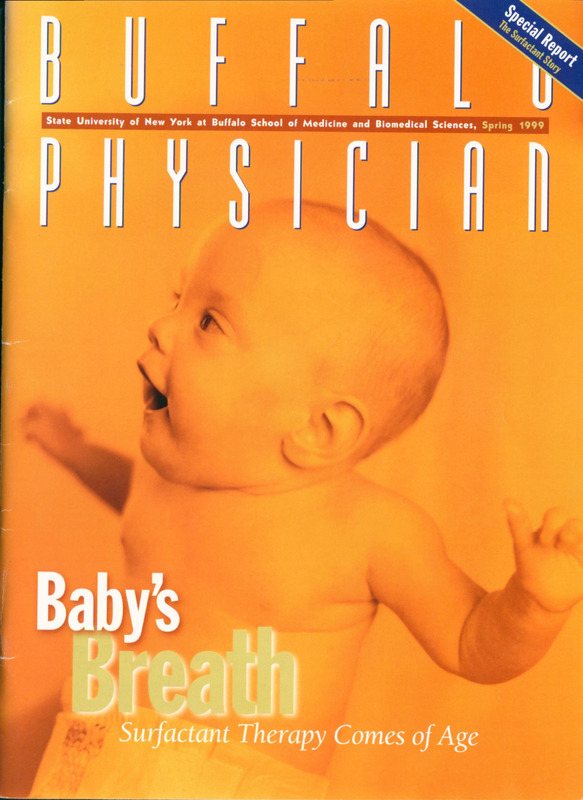
PICTURED ON THE COVER is nine-month-old Kristie Ponter,
who wos born at 23 weeks andweighed 1.4pounds. She
developed respiratory distress syndrome and
was given surfactant shortly after her birth,
according to her parents, Joelle and Rick
Ponter of Gasport, New York, At her last
checkup, Kristie weighed over 10 pounds.
Classnotes
DEBORAH A. WHITE,
CLASS OF 1 9 B 7 ,
MOURNED
Special Report
Buffalo's historic role in surfactant therapy, and the man who led the way
t hurt me to see that when infants were born too early and had difficulty breathing, really nothing could be
done about it. They were just left to die."
In one breath, these are the words spoken by Goran Enhorning, obstetrician, as he talks about his motive
for beginning his tortuous, but historic, quest to develop exogenous pulmonary surfactant 35 years ago. His
hopes then, as they are today, weresimple and straightforward:to alleviate thesuffering and prevent thedeath
of premature babies afflicted with respiratory distress syndrome (RDS), a condition that, previous to "the
surfactant era," killed 70 percent of its victims.
In his next breath, Goran Enhorning, Swedish research physiologist and inventor, moves away from the realm of the heart
and into the mind, where, with softly accented words, he struggles to translate into layman's language the scientific insights
he has experienced throughout his controversial career, a career he is still fully engaged in at age 75.
Leaning forward in his chair in his office at the Children's Hospital of Buffalo, he explains that surfactant is a naturally
occurring substance in the lungs that helps make breathing possible by decreasing surface tension at the airway-fluid interface
in the alveoli. "Surface tension was described by LaPlace's Law—you know, P equals two times T over R, with P representing
the pressure that must be generated to overcome surface tension, T, and R representing the radius of the alveolus ..."
o
B
u
f
f
a
l
o
P
h
y
s
i
c
i
a
n
S
p
r
i
n
g
1
9
9
9
UB professor of gynecology and
obstetrics, is credited with playing a
pivotal role in convincing the
international medical community that
surfactant-replacement therapy is a
valid treatment for premature infants
suffering from respiratory distress
syndrome (ROS). He is pictured here with
Alex Collura, who received surfactant
therapy for RDS at Children's Hospital of
Buffalo. Alex, who weighed 1 pound, 14
ounces at birth, is the son of Susan and
Joseph Collura of Hamburg, New York.
n talking with Enhorning, it becomes clear how his affinity for both basic science and medicine enabled
him to make crucial contributions that kept the field of surfactant research alive in years past, when
leading experts worldwide dismissed its viability. It also becomes clear that his work contributed to making
Buffalo, New York, a hub for surfactant research—a place where world-class scientists converged in free
wheeling collaboration to help make real the dream Enhorning first envisioned many decades ago.
These scientists include Enhorning's long-time colleague and sometime rival Edmund "Ted"
Egan II, MD, professor of pediatrics and physiology at the University at Buffalo School of Medicine and
Biomedical Sciences. In the early 1980s, Egan and his collaborators—building on Enhorning's seminal
work—spurred on a highly contentious international race to develop the first exogenous surfactant
product. Today, despite the behind-the-scenes jostling that continues among these competitors, there are
several surfactant products on the market and, as a result, the mortality rate for infants born with RDS
has dropped to 5 percent.
This dramatic, innovative work has not ended in the
clinic, however. As the 1990s draw to a close, Buffalo is
equally noted for the contributions its scientists are
making to basic research in the area of surfactant therapy—
contributions that are leading the field into the 21st
century, where it promises to impact a wide range of
respiratory disorders affecting adults, as well as neonates.
Bruce Holm, PhD, associate dean for research and
graduate studies at UB's School of Medicine and Bio
medical Sciences, is one of the preeminent scientists
recruited to UB in the late 1980s by Enhorning and
Egan. Like many others worldwide, he readily acknowl
edges the pioneering contributions made by Enhorning,
whose fortitude against all odds is now as well honored
as his science. "If it weren't for Goran Enhorning, we
wouldn't have the low neonatal mortality rates we have
today," states Holm, "and we wouldn't have been able to
develop our understanding of the science behind pul
monary surfactant to the extent we have. And, clearly,
there's a good deal for the Buffalo medical community
to be proud of regarding its contributions to surfactant
therapy and research.
"But the surfactant story isn't over yet," he adds.
"Even though it has already resulted in what would have
to be considered one of the most dramatic breakthroughs
in the past 50 years in terms of what neonatologists have
in their repertoire for treating prematurely born infants,
everyone involved believes there's much more to come."
first espoused the theory that in order for the lung to
function, it needed an agent that would coat the inside
of the airway, particularly the tiny air sacs called alveoli
(of which an adult human lung has about three million).
He surmised that this coating would prevent the alveoli
from collapsing during expiration, when they become
very small. Working from an understanding of the Law
of LaPlace, he deduced correctly that this agent causes
surface tension in the lung to change its value and that
the agent is composed of a phospholipid or protein.
• e became so frustrated trying to get his
work published, he gave up," explains
E Enhorning. Medical historians often cite
|| von Neergaard's finding as a classic exampleofa "prematurediscovery," asnothing was done with his promising line of research until
the early 1950s, when Richard Pattle in England and
John Clements in the U.S. independently rediscovered
the concept of an alveolar surface-active material that
came to be known as "surfactant."
"John Clements was and probably still is the biggest
name in surfactant research," explains Egan. Working
at the University of California at San Francisco, Clements,
in the 1950s, was shoring up his reputation as a giant in
his field by focusing on the problem of surface tension
in the lung and the role surfactant plays in alveolar
stability. His research in those early years was primarily
basic, which put his career in perfect synch with the
pioneering phase the science of lung physiology was
undergoing at that time.
"You have to understand that during that era—
between 1940 and 1965—scientists were just beginning
to gain a sophisticated understanding of how the lungs
work and how we control breathing by mixing gas and
air," says Egan. "And in the 1950s, these studies were
being led by two or three great centers in the United
u\
Discovering How the Lungs Work—or Don't
To get a sense of the fortitude Enhorning, Egan and
others needed to bring exogenous surfactant to where it
is today—and to appreciate the promise it holds for
tomorrow—it's necessary to go back to 1929, when the
"surfactant story" begins.
That year, a pulmonologist named Kurt von
Neergaard, who was living in Switzerland at the time,
o
B
u
f
f
a
l
o
P
h
y
s
i
c
i
a
n
S
p
r
i
n
g
1
9
9
9
The Surfactant Story
"If it weren't for Goran Enhorning, we wouldn't have the low neonatal mortality rates we have
today, and we wouldn't have been able to develop our understanding of the science behind
pulmonary surfactant to the extent we have."
— BRUCE HOLM
States, one of which was at the University at Buffalo,
where key contributions were being made by Hermann
Rahn, Leon Farhi and many others in our Physiology
Department."
A spin-off of the basic research going on at UB and
elsewhere during this time was that scientists began to
develop a more sophisticated understanding of lung
diseases and their etiology, according to Egan.
With the stage thus set, a giant leap in surfactant
research took place in the late 1950s, when a pediatri
cian named Mary Ellen Avery was invited to complete a
fellowship in the laboratory of Jere Mead, a Harvard
University physiologist. "Avery and Mead were think
ing about the premature babies who had a progressively
more difficult time breathing and then died. Their lungs
were totally collapsed and looked like livers, and they
had the idea that maybe these babies were missing this
lung surfactant," explains Egan.
Following through on this idea, Avery and Mead
completed a complex project in which they studied the
lung material of infants who died of RDS (then called
hyaline membrane disease), compared with the lung
material found in babies with normal respiratory sys
tems who died of other causes. In a now-famous paper
published in 1959, the researchers "showed that surface
tension was higher in infants dying from RDS than it was
if you got the lung material from infants dying from
other causes," says Enhorning.
Based on their findings, Avery and Mead put forth the
idea that babies who have RDS are surfactant deficient, in
the same way somebody with diabetes is insulin deficient.
"This idea really sparked enormous interest,"
Enhorning comments.
"This was very esoteric science," Egan emphasizes. "It
wasn't anything the great majority of physicians around
the country had any training in; they didn't understand it.
There simply wasn't a good paradigm for it."
Soon after publication of the Avery and Mead paper,
the scramble was on to concoct an exogenous surfactant
material and get it into the lungs of babies born with RDS.
Around the world, research groups moved into action,
hoping to be the first to produce a lifesaving substance
that would put a stop to a disease that killed approxi
mately 10,000 babies each year in the U.S. alone.
At about this same time, in 1961, Goran Enhorning
had just completed a PhD in physiology at Karolinska
Institute's Medical School in Stockholm, Sweden, where
B
u
f
f
a
l
o
P
h
y
s
i
c
i
a
n
S
p
r
Bruce Holm, PhD, associate dean for research and graduate studies at
UB's School of Medicine and Biomedical Sciences, came from the University of
Rochester in 1988. That year, he teamed up with Sadis Matalon, then a UB
physiologist, to show for the first time that high concentrations of oxygen can
damage the cells in the lungs that produce surfactant. Today, the innovative
studies conducted by Holm and his UB collaborators continue to help define the
forward edge of surfactant research worldwide.
in 1952 he had earned his medical degree. Upon gradu
ation he was awarded a Fulbright scholarship to study
at the University of Utah, where he began research into
surfactant. Normally, Fulbright scholars are limited to
a one-year stay, but an exception was made for
Enhorning and his visit was extended for another year.
During this second year, Forest Adams, a well-known
surfactant researcher from the University of California
at Los Angeles (UCLA), came to the University of Utah
to lecture, at which time he was introduced to
Enhorning. As a result of their meeting, Adams
i
n
g
1
9
9
9
o
arranged for yet another year extension for Enhorning
and made a place for him in his lab at UCLA.
In Adams's lab, Enhorning continued work he had
begun in Utah on an ingenious apparatus he called a
bubble surfactometer, which he readily admits took him
more than 15 years to fully develop. In the decades that
followed, however, the bubble surfactometer would
greatly enhance scientists' ability to run physical tests on
surfactant preparations in order to assess their surface
tension-lowering properties prior to in vivo studies.
Adams's lab also provided the setting for Enhorning
to work alongside another young scholar, Tetsuro
Fujiwara of Japan, who, like Enhorning, would go on to
devote his career to the elusive goal of developing a
surfactant-replacement product.
One of the requirements of Fulbright scholars is that
they return to their country of origin for a minimum of
seven years upon completion of their studies abroad. As
a result, in 1964 Enhorning left Los Angeles to return to
Sweden, but that was not the last he and Fujiwara would
see of one another.
D
The Rush to Find a Cure
uring the years that Enhorning and Fujiwara
were studying in the U.S., the race had intensi
fied amongscientists who hoped to be the first to
determine the active components of lung surfac
tant and to discover a replacement substance.
Foremost among the scientists exploring this prob
lem was Clements in San Francisco, who, in collabora
tion with M. H. Klaus, was studying the biochemistry of
surfactant. Using the limited testing technology they
had available to them at the time, they concluded that
the surface tension-lowering component of the material
resided in its phospholipid, most specifically a biologi
cally rare molecule called dipalmitoylphosphatidylcholine, or DPPC.
Convinced that DPPC was the active surface tensionlowering substance in surfactant, the San Francisco
group then decided to take a step that remains contro
versial to this day.
"They took this DPPC material, which they had only
tested in physical systems, not biologic systems," says
Egan. "It looked like surfactant. Best of all, it was easy
to make, easy to work with, and they were really
convinced they had the 'guts' of it, so their next thought
was, 'Let's test it in babies.'" Additional motivation to
push ahead with testing had come in 1964, when a
Canadian group, which had rapidly followed up on
Clements's findings, published a paper reporting that
they had found some improvement in babies with RDS
who had been treated with a DPPC mist.
In 1965, therefore, with their new DPPC solution in
hand, the Clements team boarded a plane for Singapore,
where they had access to a large population of babies
and could complete their studies quickly.
"They took aerosolized forms of DPPC and fogged it
into the babies," recounts Holm. "And remember, these
are the days before mechanical ventilation. The babies
were in these plastic hoods, and they just put this mist
of DPPC in the hood and that was the concept of
ventilation. Looking back on it, most of the DPPC
probably stuck on their hair and face. I'm sure almost
none of it got in their lungs. If it had, it probably would
have had some positive benefit. But they hadn't done
any animal studies so, among other things, they didn't
know how to deliver it correctly."
Upon returning, the group published a landmark
60-page paper in Pediatrics in 1967, concluding that
exogenous surfactant was not efficacious for the treat
ment of infants with RDS.
"So here you have the biggest names in surfactant
research saying thatsurfactant therapy doesn't work," says
Egan. "And not only that, but concluding that surfactant
deficiency was a result of RDS rather than the cause of it."
Once the paper was published, interest in surfactantreplacement research for RDS, in large measure, came to
a sudden halt. "Clements's conviction alone and his stature
in the academic community were such that the
publication of this paper turned the entire field of surfac
tant research in the wrong direction for more than 10
years," Egan explains. Pausing, he adds,
. . with the
exception of one kind of idiosyncratic, brilliant
intellectual who lived in Sweden and was an obstetrician
by training."
"This Has Been Tried Before and Does Not Work"
Back in Sweden, with his bubble surfactometer in tow,
Goran Enhorning was running some tests of his own.
"DPPC wasinexpensive, it was sterile, it didn't have any
antigenic proteins, so it was appealing. If you could use
DPPC, it would have been wonderful. But you couldn't.
It was hopeless. I found that out with the bubble
surfactometer," he recalls.
At this point, Enhorning turned to a pathologist
named Bengt Robertson for help, and together the
scientists experimented with various surfactant prepa
rations, which they began early testing of on rabbit
neonates. "What they found," Egan explains, "is that
the rabbits lived longer and breathed better. But
because the medical establishment was by now con
vinced that surfactant deficiency was not the cause of
RDS, they had trouble getting their work published.
"I think people in the field ignored Goran's early
work because he was producing evidence that was
contrary to conventional wisdom, because he was up in
The Surfactant Story
In the 1950s, these studies
great centers in the United
States, one of which was at
the University at Buffalo, where
key contributions were being
made by Hermann Rahn, Leon
Farhi and many others in our
Physiology Department.
Edmund "Ted" Egan II, MD, UB professor of pediatrics and physiology and founder, president and CEO
of ONY, Inc., holding a vial of the company's exogenous surfactant product, Infasurf. In the early 1980s—building
on Goran Enhorning's seminal contributions—Egan worked with Robert Notter at the University of Rochester to
develop the drug. Their efforts fueled a race among scientists around the world working toward this same goal.
Sweden and because he had very distinguished people
openly pooh-poohing his work."
After years of having his work essentially blackballed
by the scientific community, Enhorning finally met with
temporary success in 1972. "The editor of Pediatrics who
accepted the paper Robertson and 1 coauthored was an
exception," recalls Enhorning, "and he invited me to
follow up with an editorial on our work." Despite publi
cation of this paper, however, Enhorning and Robertson
again found their work ignored; between 1972 and 1976,
few journals accepted their papers. "Papers we submitted
were rejected with one line: This has been tried before
and does not work,'" recalls Enhorning.
published a paper describing, in depth, his bubble
surfactometer, which has since become a staple tool
used by scientists studying surfactant.
Based on the work Enhorning and Robertson were
doing in the 1970s, researchers began revisiting the idea
of creating a synthetic surfactant material. Some were
once again testing the DPPC substance that Clements
had unsuccessfully experimented with in the mid-1960s.
For example, in 1976 Fujiwara was back at UCLA and
was working with Adams in an attempt to duplicate the
Enhorning and Robertson studies by depositing DPPC in
the upper airways of sheep. Frustrated with their results,
they concluded that surfactant therapy didn't work.
"During a trip to Los Angeles that year, Robertson visited
Adams's lab and was told about the frustrating results of the
experiments. He told them that what they needed to use was
natural surfactant from adult animals, not a synthetic mate
rial like DPPC. So they changed their techniques and then
could confirm our studies," explains Enhorning.
Shortly thereafter, Robertson returned to Sweden
permanently and Enhorning began collaborating with
Fred Possmayer, a biochemist who worked in London,
Ontario, at the University of Western Ontario. Their
A
year before publication of the paper in Pediat
rics, Enhorning had moved to Canada to take a
position at the University of Toronto. There, he
continued collaborating with Robertson, who
still lived in Sweden but made extended visits to
Canada. "In 1973 and 1974,1did a study with Robertson
I consider very important," says Enhorning. "We depos
ited surfactant in the pharynx of premature rabbit neo
nates, who inhaled it with their first breath, and X rays
showed how it opened up their lungs. We published this
goal was to develop a surfactant material that would be
safe to test in babies. "One of the big problems we had
was that the raw material—the natural surfactant—was
very difficult to get," Enhorning recounts.
To overcome this problem, Enhorning paid a visit to a
local slaughterhouse in Toronto. "I got really lucky
because one of the investigators working in research at the
slaughterhouse had just hada baby who developed RDS,so
study in 1975, and it was at that point that we started
thinking about seriously testing it in babies." Toward
this goal—and with publishing no longer an insur
mountable hurdle—Enhorning and Robertson submit
ted a steady stream of papers on animal studies they
conducted throughout the latter half of the f970s.
It was during this time, in 1977, that Enhorning first
B
u
f
f
a
l
o
P
h
y
s
i
c
i
a
n
S
p
r
l
n
g
1
9
9
9
o
There's no doubt that
Enhorning and Possmayer
were much farther down the
with our synthetic product.
was primarily interested in a
synthetic product.
Biochemist Fred Possmayer, PhD, of the University of Western Ontario in London, Ontario,
collaborated with Goran Enhorning in the late 1970s to prepare a sterile and active exogenous surfactant
product using material obtained from the lungs of large calves. It was this product that Ted Egan and Robert
Notter used as a basis for developing Infasurf for treatment of neonates with respiratory distress syndrome.
he arranged for me to get lung lavage from large calves."
The surfactant material that Possmayer made using
raw material obtained at the slaughterhouse was ex
tremely active in terms of its surface tension-lowering
properties; however, when they attempted to sterilize it
with gamma rays or by autoclaving, this crucial activity
was lost. "We felt this was due to its high protein
content," says Enhorning, who by this time understood,
as did all researchers in the field, that surfactant was a
complex mixture composed of 90 percent lipids and 10
percent proteins. "In an attempt to rid the material of
these proteins, we extracted the surfactant lipids and
resuspended them in saline solution, and the material
we obtained could then be autoclaved and sterilized
without it losing its surface activity," he explains.
However, unbeknownst to Enhorning and Possmayer
at the time, a few tiny apoproteins slipped through and
made it into their experimental material. It wasn't until
the mid-1980s that scientists made the critical discovery
that these apoproteins of pulmonary surfactant, which
have since been named SP-B and SP-C, are essential for an
immediate expression of surface activity.
"Possmayer and I extracted the phospholipids from the
material. By doing that, we thought we would get rid of the
proteins, which we felt might be dangerous and which
interfered with our attempts to sterilize the material," says
Enhorning. "We thought we had removed all the proteins
but, serendipitously, we hadn't. Later we found out that
about 2 percent of the extract was made up of proteins that
had slipped by when we analyzed its properties."
Once Enhorning and Possmayer discovered how to
produce their sterile, active substance, they wrote about
it extensively in journal publications.
o
f
f
Coming Around to Goran Enhorning's Idea
"By the late 1970s, everyone had come around to Goran
Enhorning's idea of 10 years earlier: that it probably is
surfactant deficiency that causes RDS," Egan explains.
"The obvious next step, then, was determining what kind
of surfactant-replacement therapy you're going to give.
Basically, you have two options—synthetic and natural."
E
gan, himself, entered the field of surfactant
research at about this time. In 1977 he moved to
Buffalo, where he had accepted a joint appoint
ment as chief of neonatology at Children's Hospi
tal of Buffalo and professor of pediatrics and
physiology at the University at Buffalo's School of Medi
cine and Biomedical Sciences.
"Ted Egan was a physiologist who had some world
renown for his work in lung-water clearance," explains
Holm, referring to the process in which, at birth, a baby
absorbs the liquid that fills its lungs and establishes
breathing. "And as a neonatologist and chief of neona
tology at Children's, he obviously was interested in
developments with surfactant therapy."
Once in Buffalo, Egan set up his lab, where he
conducted ongoing studies on sheep related to his
research. Soon he met Robert Notter, a scientist who
earlier in his career had given up a faculty position in
chemical engineering at Pennsylvania State University
in order to go to medical school, which he felt would
better prepare him to pursue a consuming interest he
had in lung surfactant. After he completed medical
school at the University of Rochester, he stayed on as a
faculty member, dedicating himself to his research.
The Surfactant Story
what we had used was whole lung surfactant as we had
planned," Egan says. "But when it worked so well, I said,
'This whole surfactant is great!'" It was at this point that
Notter informed Egan that what they were testing was
an extract he had prepared based on the published
works of Enhorning and Possmayer, an extract that he
had slightly modified to his own specifications.
"There's no doubt that Enhorning and Possmayer
were much farther down the road with their natural
extract in 1981 than we were with our synthetic prod
uct. Until we ran this test, Bob was primarily interested
in a synthetic product. But once this new extract looked
so good and once I found out that there was almost no
protein in it, I thought, 'We're home,"' Egan recalls.
It was from this point onward that Egan and Notter
abandoned their quest for a synthetic surfactant and
focused their efforts on refining a natural extract.
y 1980, Bob Notter had a synthetic
mixture of surfactant that we both
thought would work, and we
decided that the best way to find
out was to test it in my sheep,"
recalls Egan.
Egan and Notter were encour
aged by a paper that had just been
published in Cambridge, England,
which reported that surfactant had
been tested on babies with very
good results. Based on the Cam
bridge study and others, they were acutely aware that
groups around the world were hard at work in the
ongoing race to develop their own surfactant products.
They knew, for example, that Fujiwara had returned to
Japan and was working there; that Clements was working
in San Francisco; that Robertson had returned to Sweden,
where he was continuing his research; that a group in San
Diego was approaching the problem by extracting surfac
tant from amniotic fluids; and that Enhorning and
Possmayer continued their work in Toronto.
A
Which Way to Go?
ll the scientists working on surfactant worldwide
had come to this difficult junction in their re
search. Obviously a synthetic product was attrac
tive: It would be easier to mass-produce, would be
available in limitless quantities, could be more
easily controlled for quality and could be patentedand sold
as a brand-name product, something that was sure to
attract the needed support of pharmaceutical companies.
Natural products, on the other hand, while holding
exceptional promise, posed very formidable challenges.
It was with great anticipation, therefore, that Egan and
Notter began their experiments in 1981. Notter had exten
sively tested his surfactant preparation in physical systems
and had found it very promising. "We took this synthetic
product and put it in preemie lambs that were surfactant
deficient, and the results were disastrous," Egan recalls.
Frustrated with their lack of progress, Egan andNotter
decided they needed to pull back and reassess their
methodology because, as Notter pointed out, everything
was looking good on his physical systems, so perhaps
they needed to look at whether Egan's "experimental
setup" was flawed. "In other words, he was saying to me,
If we have good stuff, would we even recognize it? " Egan
says. Thinking there was only one sure way to determine
this, the scientists decided they would put their synthetic
mixture aside and instead test a dose of whole surfactant
taken directly from the lungs of an animal.
"We were simply looking for a positive control,"
Egan says. However, what occurred that day in March of
1981, when they tested the new surfactant mixture, was
something Egan says he will never forget.
"It was stunning. It was probably as exciting a lab event
as I've ever participated in. Surfactant-deficient sheep are
pretty doleful animals, let me tell you. But when we gave
them the surfactant Bob provided, they were acting like
mature fetal sheep getting ready to be born. It was fantastic."
But the biggest surprise was yet to come. "I thought
"In 1980 we knew that natural surfactant was about 10
percent proteins and that one of these proteins was very
large. Like the proteins in your blood, it clots, coagulates
and you can't sterilize it; it has all kinds of problems," Egan
explains. "So we were faced with two issues: if we were
going to develop a natural replacement product, it had to
be one that wouldn't hurt the patient, yet was hardy."
In 1983, despite these complications, the BuffaloRochester team of Egan and Notter and the Toronto
team of Enhorning and Possmayer had each begun
small, prospective placebo-controlled trials of natural
surfactant extract to prevent RDS in preemies—at last
marking the start of full-fledged efforts on the part of
the two groups to test the drug in babies.
Two years later, both the Buffalo-Rochester group—
now joined by clinicians Melinda Kwong and Donald
Shapiro—and the Toronto group had completed larger
randomized clinical trials, which they each reported on
in the August 1985 issue of Pediatrics. Using what were
similar extracts, they demonstrated that calf-lung
"We were simply looking for a positive control," Egan says. However, what occurred that day in March of
1981, when they tested the new surfactant mixture, was something Egan says he will never forget.
u
f
f
a
l
o
P
h
y
s
i
c
i
a
n
S
p
r
i
n
g
1
9
9
9
o
surfactant extract did prevent lung disease in premature
babies and could significantly reduce the severity of
respiratory disease.
"After seeing the results of these clinical studies, all
of which were so compelling for this particular material,
Ted took it on as a crusade to go out and see that it
became widely available," recounts Holm. "Early on, he
had offered the calf-lung surfactant, pretty much free, to
pharmaceutical companies, but they had already com
deficiency; therefore, the accepted belief was, 'It can't be
part of the issue."'
B
y the late 1980s Holm, who had admired
Enhorning for many years, began to collaborate
with the senior scientist and others on studies
demonstrating a mechanism by which plasma
proteins were shown to inhibit surfactant func
tion. These findings, published in 1988 in the Journal of
Applied Physiology, helped introduce the concept that
surfactant-replacement therapy could be of benefit to a
much wider range of lung conditions than just RDS.
"While we were off doing clinical studies, Holm was
working with researchers throughout this area—in Buf
falo, Rochester, Toronto and London, Ontario—to find
out that you can inhibit lung surfactant, which was a brand
new concept," explains Egan. "They were showing that
surfactant plays a role in lung diseases, not just when it is
missing, but when it becomes deactivated by things seep
ing into the lungs that don't belong there and which start
tearing up the surfactant, making it terribly difficult for
people to breathe. We began to see it as being similar to
autoimmune diseases, where the body turns on itself."
In 1988 Holm also teamed up with Sadis Matalon,
mitted to marketing products developed by other groups.
Also, another reason why they weren't interested in the
material was that it had been reported on in professional
journals to such an extent it was considered to be in the
'public domain,' so it couldn't be patented.
"So this really was the genesis of the idea 'Let's go out
and make and market our own product.'" In hindsight,
Holm adds, "Remember, these were academic physicians
with no background in commercializing a drug, and so
they were too naive to know that they couldn't go through
the FDA process without any financial backing."
What they did have, according to Holm, was "the
best of intentions and a belief that what they were doing
was for the greater good."
Determined to provide a parent company for his
orphan drug—which has since been dubbed "Infasurf"—
Egan founded ONY, Inc. (Ontario New York), in 1985
and set up offices in the Baird Research Center located
near the University at Buffalo campus.
who was then a physiologist at the University at Buffalo,
and others to publish a study that showed for the
first time that high concentrations of oxygen can
cause changes in Type II pneumocytes, the cells that
produce surfactant.
A Boost from Basic Research
"Obviously, this was really very important because
we use oxygen as an essential therapy for treating lung
diseases," explains Egan, who notes that, today, the
40-year-old Holm is recognized as "one of the world's
leading experts on oxygen toxicity."
"Not only did Holm and Matalon document that
oxygen can damage cells in the lungs that make surfac
tant, but they also showed that if you give an animal
surfactant, it will speed its recovery, diminish the injury
or even prevent it," he adds.
While studying oxygen toxicities, Holm also refined
a technique for isolating the Type II pneumocytes. This
was a very important development, as well, according to
Enhorning, because "more and more, physiologists are
studying disease at the cellular and molecular level."
While surfactant was entering its clinical-trial phase,
other equally momentous developments were again tak
ing place on the basic-science side of surfactant research.
Much of it centered onBruce Holm, who in 1981 came
to work in Notter's lab at the University of Rochester
while pursing a doctorate in toxicology. Over the next
seven years, Holm gained considerable recognition for a
series of contributions he made to the field of surfactant.
In the mid-1980s, it was Holm and Jeffrey Whitsett, a
researcher at the University of Cincinnati, who conducted
a study that finally identified apoproteins as the mystery
component in surfactant that enables it to be efficiently
adsorbed by the lungs. In their paper, which was published
in Pediatric Research in 1986, they were the first to show
the functionality of the apoproteins SP-B and SP-C.
From the start, Holm was primarily interested in
studying adult respiratory distress syndrome (ARDS)
Critical Mass Converges in Buffalo
As the years passed, it became increasingly clear that,
philosophically, the Buffalo-Rochester group had much
in common with the Toronto group and that, together,
they stood apart from other groups worldwide. Most
important, they shared the philosophy that both lipids
and proteins must be included in surfactant prepara
tions if they were to produce optimal results. Further-
and its potential connection to surfactant. "No one had
ever really wanted to study surfactant in adults," he
explains. "Initial attempts to do so went nowhere
because the dogma at the time was that surfactant
deficiency was related to a quantitative deficiency—as
in the case of premature babies—but not to a qualitative
0
B
u
f
f
a
l
o
P
h
y
s
i
c
i
a
n
S
p
r
i
n
g
1
9
9
9
The Surfactant Story
"It's this cell-biology aspect
that will take us to the next
level. The philosophy shouldn't
just be 'Okay, we can keep them
alive.' That, of course, is very
important for the physician,
but, for a scientist, you always
want to go one step farther;
you want to see if you can
prevent this from happening
Robert Notter, MD, gave up a faculty position in chemical engineering at Pennsylvania State
University to earn a medical degree, which he felt would better prepare him to pursue a consuming
interest he had in lung surfactant. In the 1980s, as a faculty member at the University of Rochester,
he collaborated with Ted Egan at the University at Buffalo to develop the surfactant drug Infasurf.
more, they felt strongly that both SP-B and SP-C must be
present because their research had shown that the two
apoproteins work synergistically.
In contrast, in the late-1980s Clements's group in
San Francisco, which had by then partnered with
Burroughs Wellcome, wasdeveloping a synthetic prepa
ration called Exosurf that was composed primarily of
DPPC and contained no protein. In turn, Fujiwara's
group in Japan, which had partnered with Abbott Labs,
was testing a patented product called Survanta, manu
factured from a mince of whole cow lung, supplemented
with synthetic phospholipids and neutral lipids, but
containing only trace amounts of the SP-B apoprotein.
G
iven the long years of collaboration between
the Buffalo-Rochester-Toronto researchers, it
came as no surprise when Egan successfully
recruited Enhorning to Buffalo in 1986, fol
lowed in 1988 by Holm, who came from the
University of Rochester to complete a postdoctoral
fellowship at UB, during which time he worked with
Enhorning and others to continue his novel work on
surfactant inhibition.
There's So Much at Stake
Once the randomized clinical trials were completed on
Infasurf in 1985, Egan initiated the process whereby he
hoped to win Food and Drug Administration (FDA)
approval for the drug. Immediately, he was told by the
FDA that in order for Infasurf to be considered for
approval, controlled studies of it had to be completed.
in the first place."
— BRUCE HOLM
"This meant some of the babies would getsurfactant and
some of the babies would get nothing," recalls Egan. "So
I said, 'I can't do that.'" Egan's appeals to the FDA to
make an exception to their rule did not meet with
success. As a result, he decided to delay controlled
clinical trials until other surfactant drugs came on the
market, at which time he could compare one surfactant
to another.
In 1990, his wait ended when Exosurf was approved by
the FDA and debuted as the first surfactant drug available
in the U.S., followed closely by Survanta in 1991.
In the intervening years, while waiting for Exosurf to
come on the market, Egan made Infasurf available to all
babies in Buffalo who needed it, something he was able
to do while Infasurf was classified as an "investigational
new drug." This strategy was given a boost in 1989,
when the FDA gave Egan's company, ONY, Inc., per
mission to charge for Infasurf so that costs for its
development could begin to be recouped. However, the
FDA gave the company permission to do this with the
stipulation that it upgrade its manufacturing facilities to
meet the requirements for a commercial venture. The
only way to get the needed equipment in a timely
manner was for the owners of the company to guarantee
a loan, which Egan did personally after buying out the
other owners.
"I was placed in a position where I felt we had developed
something that was really a super therapy but which,
because it wasn't a mainstream commercial venture, was
about to be abandoned," Egan says. "I thought about my
own motivation up to this point—why I went into this in
the first place—and I felt it really didn't do any good to
develop an optimal product and then watch it die."
In 1989, therefore, Egan gave up his position as chief
of neonatology at Children's Hospital of Buffalo and
went to a part-time status at the hospital in order to fully
devote his energies to ONY, Inc.
present, while Infasurf contains it in quantities normally
found in healthy mammals."
To demonstrate what he calls "a night-and-day
difference" between protein-based surfactant drugs and
those containing no proteins, Holm points out that as
soon as Survanta became available, "Exosurf rapidly lost
its majority share of the market, which tells you what the
clinicians using the two drugs are finding. We feel that
Infasurfs inclusion of both apoproteins makes it a
drug with notable differences when compared with
W
hen Exosurf came on the market in 1991,
Infasurf finally entered the clinical-trial phase
for FDA approval, as studies were conducted
in which the two drugs were compared. To
facilitate this process, ONY, Inc. formed an
Survanta and one that defines the 'next generation' in
surfactant drugs."
alliance with Forrest Labs, which has its headquarters in
New York City. With Forrest Labs providing the person
nel and financial resources needed for this costly process,
FDA trials of Infasurf were completed between 1991 and
1994, with all data submitted to the agency by 1995.
In 1995, when it looked like Infasurf would finally
make it out the other end of the FDA pipeline, Egan's
plans hit yet another snag and were ground to a halt.
When the FDA approved Survanta in 1991, it designated
it an "orphan drug" because it was determined to be the
first pharmaceutical of its kind. "Being designated an
'orphan drug' by the FDA puts you in a category that gives
you some tax breaks and provides you market exclusivity
against similar or same drugs for seven years. It's like
having a patent for that period of time. What happened in
1995 was the FDA decided that, under the orphan-drug
rules, Infasurf was the same drug as Survanta. That
doesn't mean that we are the same drug, like a generic
drug, but just that we are a 'similar' drug," Egan explains.
The effect of this ruling, therefore, was that Infasurf had
to stay off the market until 1998, since Survanta had made
its debut in 1991. Despite repeated requests for the FDA to
change its ruling, the decision held fast. Today, Egan
simply says, "What it came down to with the FDA is that
both drugs came from cows."
On July 1, 1998, the exclusivity clause for Survanta
expired, and Infasurf finally became an FDA-approved
drug. What would have otherwise been a banner day in
the history of Infasurf, however, was clouded by yet
another obstacle. In 1994, Abbott Laboratories claimed
Infasurf infringed on Survanta's patent, and hearings on
the ensuing case began in June 1998.
Despite the ongoing legal battles (see article, page 13)
Egan is convinced that as Infasurf becomes widely avail
able to physicians working on the front line in neonatal
intensive care units, it will win a significant share of the
market through its own merit. "Physicians are looking for
the best product," he says, "and any margin of improve
ment will be huge because there's so much at stake."
The Stage Has Been Set
Throughout the 1990s, scientists in the informal
Buffalo-Rochester-Toronto research network have con
tinued to pursue independent interests, as well as to
collaborate with each other on groundbreaking studies
that have helped define the leading edge of surfactant
research worldwide. "We're looking at cell-directed
therapies now," Holm says. "We know that surfactant
can take care of many of the symptoms of lung disease
and that it has reduced infant mortality related to RDS
to 5 percent, down from a high of 70 percent in the
1960s. So now what we want to do is take a step back and
ask ourselves, Can we stimulate the cells so you
can never get the symptoms in the first place?
That involves looking at what the mechanisms
are for cellular function, and what we've dis
covered is that you can do
pharmacological
manipulations, n"
Holm is emphatic about the difference between Infasurf
and the Survanta and Exosurf products. "In our opinion,
and in the opinion of many scientists, the most effective
surfactant drugs are those that contain the lipids as well as
the two apoproteins B and C. Our studies have shown that
these two proteins work synergistically and that, of the
two, B is the most important. Exosurf contains no proteins,
and in the Survanta
preparation only
minute amounts of
the B protein are
particularly with I*
oxidant stress, and
*» > i
T •'
L
©
B
u
f
f
a
l
o
P
h
y
s
i
c
i
a
n
S
p
r
i
n
g
1
9
9
9
The Surfactant Story
you can prevent this damage from occurring in vitro
and in vivo."
Citing a series of diverse investigations that build on
surfactant research, Holm talks about studies ongoing
at UB whereby researchers are hoping to find improved
ways of treating ARDS, pulmonary dysplasia and hypo
plastic lung from congenital diaphragmatic hernia.
Referring to the latter condition, he says, "For example,
we have shown that the blood-flow problem that exists
there and the stiffness of the lung can be corrected by
giving exogenous surfactant. But the lungs are still
small, so we've been doing things directly to the Type II
cells in this and other injuries. By tweaking those cells
and putting mechanical stressors and growth factors in,
lo and behold, we're finding we can grow the lung back
to normal size in two weeks in vivo.
"So, we're branching out, and it's interesting because
it's all growing out of surfactant," he adds. "It's this cellbiology aspect that will take us to the next level. The
philosophy shouldn't just be, 'Okay, we can keep them
alive.' That, of course, is very important for the physi
cians, but, for a scientist, you always want to go one level
farther; you want to see if you can prevent all of this from
ever happening in the first place."
Enhorning couldn't agree more and has headed off
on his own to again champion a controversial theory in
which he contends that surfactant dysfunction
The Pro
rogress
IjT
e courts and new clinical trials
W
hen the Food and Drug Administration (FDA)
approved Infasurf in July 1998, ONY, Inc.,
and Forrest Labs implemented a licensing
agreement which stipulated that ONY, Inc.,
would manufacture Infasurf and Forrest Labs would mar
ket it under its label. Despite this progress, ONY, Inc., still
faced a legal challenge from Abbott Laboratories, which in
1994 claimed Infasurf infringed on the patents of its
surfactant drug, Survanta. A trial was held in the summer
of 1998 in the District Court in Buffalo. "To be honest,
Abbott is a 13-billion-dollar-a-year company and their
attitude toward a multimillion dollar lawsuit is very differ
ent from that of a 20-employee embryonic company," says
Edmund "Ted" Egan, MD, ONY's founder, president and
chief executive officer, who isalso a professor of pediatrics
and physiology at the University at Buffalo School of
B u f f
contributes to symptoms of asthma. To assist in the
elucidation of his new theory, he has again invented an
apparatus, which he calls a capillary surfactometer. "I
feel the capillary surfactometer is the most important
work I have done; I think it has the most promise," he
states matter-of-factly.
Egan is following Enhorning's new studies with
great interest and says, "Goran has this fascinating, very
innovative theory about asthma and, again, he's going
against the tide, he's way out in left field. He's challeng
ing conventional wisdom and almost nobody thinks
he's right because he's saying that the reason why
asthmatics have a tough time getting air is not because
there is a spasm of the muscles of the airway and not
because the airway is clogged with inflammation, but
because they have surfactant dysfunction. And you
better watch him, because he may be right again." "
Fortunately, history may not repeat itself for Goran
Enhorning. "Some people are looking at what Goran is
saying and have approached us about doing some studies
in asthma and respiratorysyncytial virus," Holm reports.
"But, really, the big battle has been won, and that
battle was getting enough evidence out there to finally
convince the international medical community that
surfactant-replacement therapy is a valid treatment for
premature infants. That set the stage; now the science
will continue to develop." +
Medicine and Biomedical Sciences. In September 1998,
the jury in the case ruled in favor of Abbott Laboratories,
but a final judgment has not been entered and appeals are
expected to extend the legal dispute well into 2000.
Commercial sales of Infasurf await resolution of the law
suit, according to Egan.
Meanwhile, Infasurf continues to make impressive in
roads in the scientific arena. In January 1999, Critical Care
Medicine (Vol. 27, No. 1) published a study led by Douglas
F. Willson, MD, of Children's Medical Center of
Charlottesville, Virginia, in which it was shown that pediat
ric patients who received the drug for a spectrum of
respiratory disorders demonstrated rapid improvement in
oxygenation and, on average, were extubated 32 percent
sooner and spent 30 percent less time in the pediatric
intensive care unit than control patients. "The success of
surfactant replacement therapy in newborn infants with
respiratory problems is well established now, so scientists
are looking at its efficacy for children beyond the neonatal
period," says Egan, who was a coauthor of the study.
"While these findings are very encouraging, a larger,
blinded, controlled trial is necessary, and this is something
that's being planned before recommendations can be
made for use of surfactant in pediatric patients with
respiratory failure," he adds.
0
WHEN PEDIATRICIAN MAXINE HAYES entered medical school at
the University at Buffalo in 1969, she was planning on a career in oncologic
research. However, after her first year at UB, she decided she could make
a greater contribution as a clinician, so for the first time she began to
ponder her career options as a physician. "I wasn't going to pursue
pediatrics because that was the unspoken gestalt of that time: Women were
supposed to become pediatricians," she recalls. During her clinical rota
tions, she discovered she had promise as a surgeon, but, still, something
wasn't quite right. This "something" suddenly began to clarify when she
completed her final clinical rotation, which was in pediatrics. Hayes says
she found that the people who were drawn to pediatrics were different from
those in other medical disciplines. "They were highly sensitive to social
issues. They weren't necessarily interested in making a lot of money, and
they were very public-health oriented," she explains, adding with a
chuckle, "They were a lot like me."
"EVERY CHILD HAS A RIGHT TO A GOOD
AND AFTER THAT A CORE OF GOOD PREVENTIVE HEALTH SERVICES.
LI I
HESE INTUITIVE PROMPTINGS eventually compelled Hayes to redefine her
career goals, and in the two and a half decades since graduating from UB, she has
gone on to become not only one of the more prominent pediatricians in the United States,
but also a public health advocate widely recognized for her dedication to policies that
promote maternal and child health. Today, Hayes is the assistant secretary of community
and family health for Washington State's Department of Health, where she oversees a staff
>f more than 200 and manages an annual budget of over $300 million (70 percent of the
Department of Health's budget).
Maxine Hayes's push to succeed can
be traced back to her childhood in Jack
son, Mississippi. Raised in thesegregated
South of the 1950s and '60s—where she
says there was literally a railroad track
separating blacks from whites—she grew
up poor, but admits she never knew it.
"My family taught me there was nothing
1 couldn't do," she says.
In addition to poverty and racism,
Hayes remembers battling the specter of
sexism in high school, as well, and
reflects, "I guess I was always trying to
prove girls could do things boys could
do, and do them better. It tickled me to
death when I was valedictorian of my
senior class and a boy came in second."
It was during her high school years
that Hayes was singled out by an African
American women'sservice club, LINKS,
Inc., which every year took under its
wing one promising African American
girl or boy from each of the three public
high schools in Jackson. The women in
this club introduced their young charges
to art, music and literature. Also, to
compensate for segregationist practices
that banned blacks from fine restau
rants, the women hosted elaborate
social dinners in their homes, taking the
opportunity to teach etiquette to Hayes
and the others. Among the women in
the club was a graduate of Spelman
College in Atlanta who, over time,
became Hayes's mentor. Convinced
Hayes would flourish in the all-girls'
setting at Spelman, the woman encour
aged her to apply. When the college
responded with an offer for a scholar
ship, Hayes was on her way to Atlanta.
©
While at Spelman, where she ma because she wanted to dedicate her
jored in biology, Hayes won a Charles career to finding a cure for cancer and
Merrill scholarship to study abroad in UB's affiliation with Roswell Park Can
Vienna for a year, an opportunity whose cer Institute strongly appealed to her.
timing would lead to events that would
"I felt there was a reason why all of
alter her life's path in ways she never that happened, and that attending medi
could have imagined at the time. By cal school was going to provide me with
choosing to go abroad
an opportunity to
and opting to study
do something for
outside her major,
my community
Hayes delayed her
and the greater
graduation by a year.
good. As the say
And that year—
ing goes: 'To
1968—was a momen
whom much is
tous one marked by
given, much is also
the assassinations of
required,"' Hayes
both Robert Kennedy
says. "I had class
and Martin Luther
mates in my biol
King, acts of violence
ogy classes at
that resulted in politi
Spelman
who
cal upheaval and calls
would have given
for change. One fallout from Hayes says she has long had
anything to go to medical
that tumultuous year was an appreciation for the social
school. But they graduated
that the country began to context of medicine. "We
on time and were not given
examine its college and post
that opportunity. That all
physicians need to have a role
graduate entrance policies
turned around in one year,
in impacting policies," she
for minorities. As a result,
and I have always felt it was
contends. "We need to ensure
for a reason."
the extra year Hayes added
that the technical knowledge
to her undergraduate stud
After her first year in medi
ies put her in the right place brought to healing is such that cal school, Hayes spent a
at the right time when medi it gets to the root causes of why summer working as a medi
cal schools began working people are sick in the first
cal extern at a family health
place,
things
such
as
poverty
to attract minority students.
clinic in Mississippi. It was
When she had entered and social disparities."
there that she realized her
Spelman, Hayes's goal had
family had shielded her from
been to eventually earn a PhD in biology the stark realities in her home state, as
or cytology; however, in 1969, when that summer she not only wrote pre
recruiters-from UB's medical school of scriptions for medicine, she wrote pre
fered her a scholarship, she accepted it, scriptions for food. "I began to see all the
turning down a scholarship to Harvard social ills and to realize that having the
f
f
wasted
S o MUCH OF WHAT WE SPEND IS
technical knowledge of medicine was
not going to be sufficient," she recalls.
Following graduation from UB in
1973, Hayes pursued her postgraduate
training in pediatrics at Vanderbilt Uni
versity Hospital in Nashville and at
Children's Hospital Medical Center in
Boston, finishing in 1976. In 1977, she
went on to earn a master's degree in
public health at Harvard University.
She then returned to Mississippi, where
she established a primary care family
health clinic on the outskirts of Jack
son, becoming the first and only pedia
trician in Rankin County and serving a
population of some 60,000.
Word of Hayes's success in her Mis
sissippi clinic began to circulate among
public health professionals and, in 1985,
"out of the clear blue," she says, she
received an offer from Children's Hospi
tal and Medical Center in Seattle to serve
as medicaldirector for the Odessa Brown
Children's Clinic, which delivers
primary care to a predominantly lowincome population in central Seattle.
Hayes accepted the offer and moved
West, leaving her home state but not
its problems, which she soon discov
ered to be much the same in Washing
ton State, except that instead of poor
rural families, there were poor innercity families.
Hayes says her move to Seattle was
nothing short of culture shock. Though
soft-spoken, she acknowledges, "I'm
very intense, very competitive—a TypeA personality.
"When I arrived in Seattle, the first
thing everybody noticed was my inten
sity, and people in the Northwest are
definitely not intense. I was amazed
you could be so productive and casual
at the same time." Over time, as people
got to know her, she says, "They told
me, 'Loosen up,' so, now, Birkenstocks
are definitely part of my wardrobe, and
I carry a backpack at all times, even on
the rare occasion when I'm wearing a
business suit. I've been won over!"
During her three years as medical
B
u
f
f
a
l
o
P
h
y
s
i
c
i
ON TRYING TO CURE THINGS THAT COULD HAVE BEEN PREVENTED."
director at the Odessa Brown Children's
Clinic, Hayes worked to expand its mis
sion. In addition to seeing patients her
self, she set up educational programs for
unemployed single mothers, established
a sickle-cell screening program and ad
vocated for policies that ensured better
access to health care for foster children.
Hayes's dedication and organizational
talents caught the attention of Jule
Sugarman, one of the founders of
Headstart and then-secretary for the
Department of Social and Health Ser
vices for Washington State. Sugarman
had a vision for children's health in
Washington and needed a pediatrician
who had credibility in the private com
munity to go to work in the public
sector. In 1988, hesuccessfully recruited
Hayes to come to work with him for the
express purpose of getting a bill passed
in the legislature that would launch a
maternity care access program called
First Steps. "I'm not asking for your life,
only two years," she recalls him saying
in response to her hesitation to leave a
job she loved. Sugarman, who had al
ready gotten Children's Hospital to agree
to "loan" Hayes to the state for that
period of time, told her: "Go and get this
bill implemented, and then you can go
back." What really hooked Hayes, she
says, was when he asked her, "How long
do you want to take care of kids one by
one and deny the opportunity to take
care of every single one of them?"
B
ecause her original appoint
ment was to be temporary,
Hayes decided to stay in her
home in Bellevue, a suburb east
of Seattle, and make the daily threehour round-trip commute by vanpool
to the state capital of Olympia. That was
10 years ago, and she's still at it. Hayes,
a single mother of two boys, ages 12 and
16, starts each day at 5:30 a.m.
Carpooling by van allows her time to
work en route and frees her to spend
time with her sons after her busy days,
which usually include a visit to the gym,
a
n
S
p
r
i
n
g
1
9
9
9
where she says she follows "a very disci
plined exercise program."
Hayes's initial appointment in 1988
was as director of the Division of ParentChild Health Services, and one of her
first accomplishments was to help win
passage of the First Steps legislation as
Sugarman had hoped she would. In1990,
she was promoted to assistant secretary
of Parent-Child Health Services, and
three years later she moved into her
current position as assistant secretary of
community and family health.
Hayes believes her most important
contribution to public health is her abil
ity to solve problems. "I see opportuni
ties where others see challenges," she
says. Last year she created a new office
in her division, called the Office of Com
munity Wellness and Prevention. By
targeting the pediatric population, in
particular, this office strives "to approach
chronic disease by looking at common
risk factors, such as tobacco, physical
inactivity and nutrition, especially as it
relates to obesity," Hayes explains. An
other innovative idea she implemented
was to position the state's Women, In
fants and Children (WIC) program as a
counterpart to existing chronic disease
prevention programs. "When you look
at chronic diseases, you realize you can
begin to intervene against many risk
factors for these diseases in childhood
by focusing on good nutrition," Hayes
notes. "Our health department is the
only one in the country where you'll
find this 'upstream' approach to chronic
disease prevention."
Hayes says she has long had an ap
preciation for the social context of medi
cine. "We physicians need to have a role
in impacting policies," she contends.
"We need to ensure that the technical
knowledge brought to healing is such
that it gets to the root causes of why
people are sick in the first place, things
such as poverty and social disparities."
She is particularly adamant on the
CONTINUED ON
PAGE 26
o
MEDICAL
New Health Care Business Center Opened
— CAPITALIZING ON MARKETABLE PRODUCTS
AND PROCESSES THAT DEVELOP FROM RESEARCH
I
M A G I N E B U F F A L O , Rochester and
Ontario as an internationally recog
nized corridor for innovation in
health care, with the University at
Buffalo a critical component. That's
the vision that led to the formation
of the new Health Care Business Center
(HCBC), a joint venture between UB
and the Health Care Industries
Association that will allow the region's
health-care industry to capitalize on
marketable products and processes that
develop from research projects at UB,
Roswell Park Cancer Institute, Kaleida
Health and the Catholic Hospitals.
According to the Health Care Indus
tries Association, a nonprofit organiza
tion designed to support and promote
the regional health-care industry, this
corridor, dubbed the "Lake Affect
Region," represents the fourth-largest
medical development market in North
America, with more than 100 research
institutions, 265 medical manufactur
ers and 95 hospitals.
Strategically located in Cary Hall in
the School of Medicine and Biomedical
Sciences on UB's South Campus, the
HCBC serves as a focal point for foster
ing new opportunities
between local companies and
UB researchers—whether
G O L D
they are in medicine, dental
medicine, pharmacy, engi
neering, management or arts and
sciences. "Locating the Health Care Busi
ness Center at the hub of medical
research at UB is key," says Luke Rich,
vice president for regional development
for the Empire State Development Corp.
In the past six years, 35 percent of the
inventions registered with the UB Office
of Technology Transfer have been in the
©
TORONTO
W JPBP
o rsi ~r
.•if ii
ROCHESTER
R i o
BUFFALO
RXL
Y